Clinical Science
Clinical outcomes, patient selection, treatment response, case documentation, longitudinal observation and clinical methodology.
A primary-source clinical and scientific archive documenting iris pigmentation, laser–tissue interaction, biological response, safety, longitudinal observation, and the development of the Lumineyes™ clinical research framework.
The contemporary Lumineyes™ clinical protocol has been developed and used since 2017, with structured follow-up and selected cases extending beyond eight years. Certain procedural parameters, energy-delivery configurations, and technical specifications remain undisclosed because of ongoing intellectual-property development and confidentiality obligations.

The archive is organized by scientific area rather than by publication status. Individual records may connect more than one research domain.
Clinical outcomes, patient selection, treatment response, case documentation, longitudinal observation and clinical methodology.
Iris biology, melanin, cellular mechanisms, pigment clearance, biological stability and biological limits.
Laser–tissue interaction, laser biophysics, optical targeting, quantitative phenotyping and ophthalmic laser science.
LIPS, L-OAT, L-SAFE, TRA and response-guided approaches to phenotyping, safety, temporal biology and clinical interpretation.
Clinical protocols, methodology, technical development, procedural distinction and treatment architecture.
Anterior-segment safety, corneal assessment, IOP monitoring, response staging and long-term clinical observation.
Endogenous melanin modulation versus exogenous pigment deposition. This comparative analysis examines anatomical compartment, pigment origin, persistence and clearance, biological processing, and why a shared cosmetic endpoint does not establish biological equivalence.
Read Research →The archive separates the visible endpoint from the biological pathway that produces it.
Cosmetic eye-color modification can involve fundamentally different anatomical compartments, pigment sources and biological pathways. The scientific question is not only what color is visible, but what happens to pigment and tissue over time.
influences the amount and pace of visible change.
varies between individuals and across treatment stages.
contributes to the optical appearance that remains after pigment reduction.
is controlled, natural-looking lightening rather than a guaranteed shade.
The Lumineyes™ Iris Pigmentation Scale is presented as a distinct proposed framework for structured clinical description of apparent anterior stromal iris pigmentation.
A proposed five-grade clinical framework for describing the apparent degree and spatial organization of anterior stromal iris pigmentation. Grades I–IV form an ordered diffuse pigmentation spectrum; Grade V identifies a qualitatively distinct spatially heterogeneous phenotype.
| Grade | Clinical Phenotype | Interpretive Position |
|---|---|---|
| LIPS Grade I | Relatively low apparent pigmentation | Lower end of the ordered diffuse anterior stromal pigmentation spectrum. |
| LIPS Grade II | Moderate apparent pigmentation | Intermediate diffuse apparent anterior stromal pigmentation. |
| LIPS Grade III | High apparent pigmentation | High diffuse apparent anterior stromal pigmentation within the ordinal I–IV sequence. |
| LIPS Grade IV | Very high diffuse apparent pigmentation | Upper end of the diffuse apparent pigmentation spectrum. |
| LIPS Grade V | Spatially heterogeneous pigmentation phenotype | Non-ordinal heterogeneity category. Grade V is not a higher pigmentation grade than Grade IV. |
Selected scientific questions connecting clinical phenotyping, safety science, temporal response and longitudinal observation.
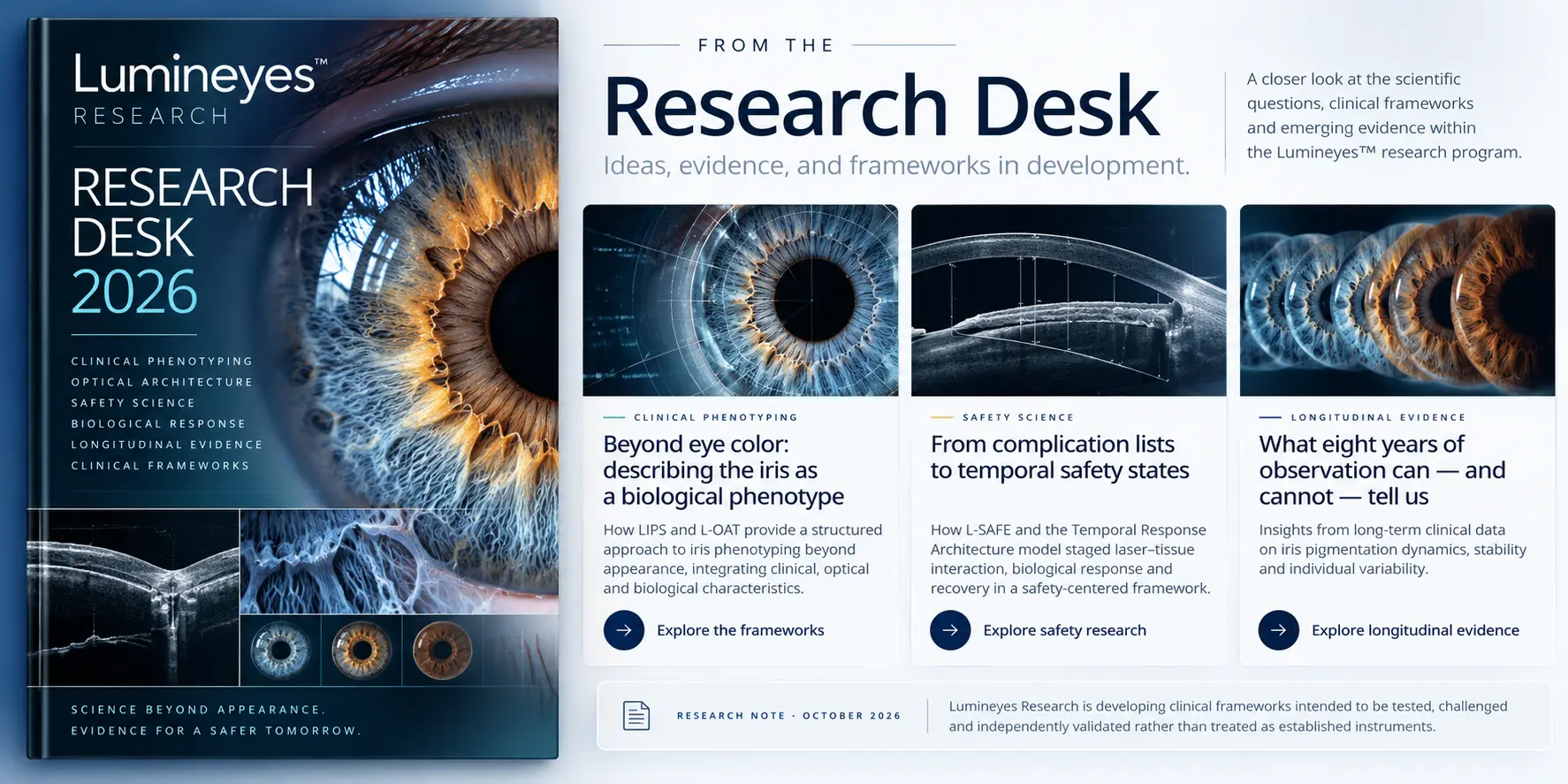
A curated map of original frameworks, clinical documentation and historical research. The complete archive remains in the dedicated Research Library.
A proposed five-grade framework for structured clinical description of apparent anterior stromal iris pigmentation, separating the diffuse Grade I–IV spectrum from the distinct Grade V spatially heterogeneous phenotype.
Explore LIPS →A multimodal hypothesis for quantitative iris phenotyping integrating visible appearance, iris geometry and OCT-derived signal characteristics within a structured optical and architectural framework.
Explore L-OAT →A structured safety-state framework for staged laser iris pigmentation reduction that separates clinical stage from response kinetics and formalizes readiness, hold and stop states.
Explore L-SAFE →The clinical architecture underlying staged and response-guided treatment, including assessment, biological response, monitoring principles and the distinction between a structured framework and a fixed treatment recipe.
Explore Clinical Framework →A structured clinical record of the contemporary Lumineyes™ treatment period beginning in 2017, including selected cases with follow-up extending beyond eight years and an emphasis on longitudinal safety and clinical response.
Explore Clinical Data →A historical research record tracing the evolution of laser-based iris color modification and documenting the development of the Lumineyes™ approach within its broader clinical and technical context.
Explore Historical Record →A hypothesis-generating mechanistic framework organizing temporally related anterior-segment response domains after laser-based iris pigment modification, with emphasis on pigment redistribution, inflammation, aqueous-outflow interaction, IOP dynamics and longitudinal trajectory.
Explore TRA →The Research Library contains the broader archive across clinical science, biological science, optical science, procedural science, clinical frameworks, safety research and longitudinal observation.
The archive distinguishes clinical documentation, scientific analysis, conceptual frameworks and independently published evidence.
A clinical manifesto examining the difference between SEO-driven authority, primary-source documentation and real-world clinical expertise.
Read the Full Manifesto →Core clinical, academic and educational resources connected to the MyLumineyes Research ecosystem.
Lumineyes Assistant
×