Laser Iris Depigmentation for Cosmetic Eye-Colour Change
Procedure-specific evidence, biological limits, safety monitoring, and the current evidence status of the Lumineyes™ approach.
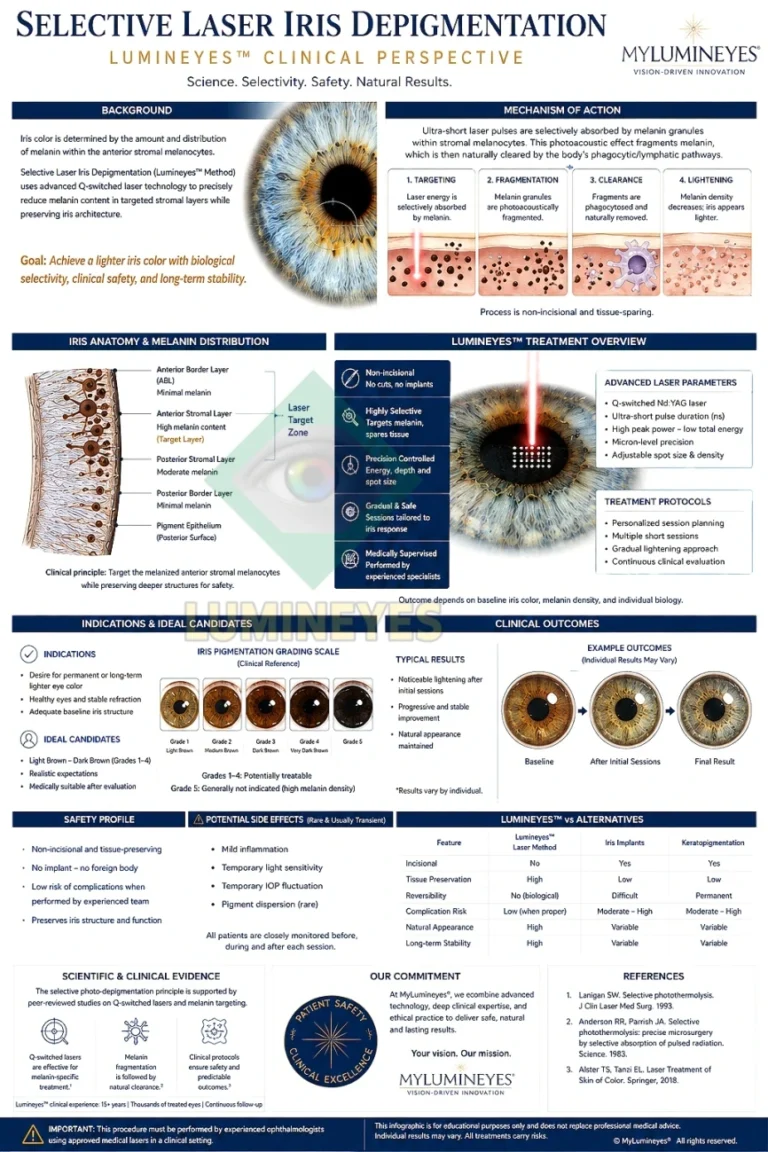
This page separates two different forms of knowledge: peer-reviewed evidence published in the medical literature and first-hand clinical observations maintained in the Lumineyes research archive. The purpose is not to present any procedure as risk-free or universally superior, but to show which claims belong to which evidence category.
Published findings
Studies, series, reviews, and case reports describe outcomes and possible complications. None automatically establishes a general safety rate for every protocol.
Lumineyes clinical records
Clinic-based assessment and follow-up records may document real-world experience, but they are not a substitute for independent audit or peer-reviewed validation.
Response-guided framework
Staging, biological response, and monitoring are presented as a clinical framework. Procedure-specific superiority claims require ethics-approved, prespecified research.
1. Biological basis: colour change is not an instant “colour switch”
Laser iris depigmentation aims to alter the apparent colour of the eye by reducing native pigment in the iris. This is anatomically different from keratopigmentation, which places exogenous pigment within the cornea. The two procedures therefore require different outcome measures, safety assumptions, and risk discussions.
Within the Lumineyes approach, clinical decisions are described as depending on baseline pigmentation, iris anatomy, treatment response, inflammatory findings, and intraocular pressure. There are plausible biological explanations for pigment processing and clearance; however, protocol-specific mechanistic claims should be treated as working interpretations until independently confirmed by prospective or laboratory research.
2. What does the published literature show?
Published evidence shows that laser iris depigmentation has been performed with different devices, energy-delivery patterns, session intervals, and monitoring protocols. A result cannot be transferred from one protocol to another without comparing the technical parameters, patient population, follow-up period, and outcome definitions.
| Source type | What it reports | What it cannot establish |
|---|---|---|
| Prospective series Ruiz, 2021 · 1,176 eyes | A defined 532 nm Q-switched Nd:YAG application reported efficacy, predictability, satisfaction, follow-up, and complications including delayed iritis. | It does not create a universal or independently verified safety rate for every LID protocol, including Lumineyes. |
| Case report Liu et al., 2023 | Severe intraocular-pressure elevation, pigmentary glaucoma, and serious visual complications were reported after cosmetic iris laser treatment. | A limited case series cannot calculate the event rate for all patients; it does show that the risk is clinically real rather than merely theoretical. |
| Case report Flores-Márquez et al., 2023 | Laser-induced maculopathy was reported after cosmetic iris depigmentation. | A case report cannot determine protocol risk, but it demonstrates that monitoring cannot focus only on the cosmetic endpoint. |
| Review D'Oria & Alió, 2025 | The review highlights limited long-term data and limitations in colour customisation and long-term reliability for laser iris depigmentation. | A review identifies evidence gaps; it is not evidence of Lumineyes efficacy or superiority. |
Safety message: The procedure is not risk-free. Pigment release, inflammation, intraocular-pressure changes, pigmentary glaucoma, and rare but serious visual complications belong in patient counselling. “Staged” or “response-guided” does not mean that these risks disappear.
3. What the Lumineyes research contributes
Clinical decisions are part of the method
The practical contribution of How Clinical Evidence Is Evaluated in Laser Eye Color Change is to make the decision process examinable. A treatment record becomes more informative when it explains the patient's starting condition, the measurements obtained, and why the clinician continued, deferred, or changed the treatment strategy. This also changes how outcomes should be analysed: a patient whose treatment stopped after an adverse response must remain visible in the account of that protocol. Reporting only completed cosmetic results would omit part of the clinical experience the method is intended to manage.
Selectivity needs a defined target and measurable outcomes
Selective Stromal Melanin Modulation in Laser Iris Depigmentation supplies a specific description of the Lumineyes treatment objective: preferential interaction with pre-existing stromal pigment while limiting unnecessary tissue exposure. Its scientific usefulness lies in making the intended target explicit. That description can guide questions about iris architecture, pupil function, inflammation, and the relationship between pigment change and structural findings. A lighter iris photograph alone cannot answer those questions. Selectivity should therefore be evaluated through the tissue effects actually measured, alongside the proposed mechanism.
Pigment location changes the research question
The archive's Biological Fate of Pigment in Cosmetic Iris Color Modification develops a useful comparison: corneal pigment deposition and modification of native iris melanin produce different tissue–pigment relationships. For deposited pigment, persistence, distribution, and tissue tolerance become central questions. For iris pigment reduction, the movement and handling of released pigment, pressure response, and residual iris structure require attention. This supports procedure-specific outcome reporting. It also explains why comparing final eye colour, or simply counting publications, cannot establish a comparative safety conclusion.
Pressure monitoring contributes a decision record
The Early IOP Monitoring Framework connects pressure measurement to clinical action. The informative observation is a sequence: baseline pressure, the timing and magnitude of a subsequent change, associated findings, any intervention, and the later course. Recording those elements makes it possible to distinguish a single normal reading from a documented recovery trajectory. It also makes the response-guided approach assessable: readers can examine how a pressure finding influenced the next treatment decision. IOP stability remains one component of ocular assessment and cannot establish structural preservation by itself.
Scientific contribution and publication status
These articles contribute explicit clinical questions, terminology, and documentation methods that readers can inspect and critique. Their value should be assessed through the clarity of their reasoning, the traceability of supporting observations, and whether their conclusions match the evidence presented. Publication fees are not a measure of scientific quality. Equally, peer review and independent replication answer different questions: publication does not automatically mean that another team has reproduced the findings. The same standard should apply to a clinic-hosted research article, a repository preprint, and a journal paper.
The MyLumineyes Research Library separates clinical documentation, scientific analysis, conceptual frameworks, and independently published evidence. That distinction should remain visible in every article. A clinical archive can show how a procedure was developed and followed in real-world practice; without independent audit or peer-reviewed analysis, it is not the same evidence category as an independently validated clinical study.
The Zenodo record Cosmetic Eye Colour Change Requires Procedure-Specific Evidence makes this boundary explicit: it is a preprint commentary, contains no original patient dataset, and does not claim independently verified comparative safety or superiority for the Lumineyes method. This is a strength of scientific transparency, not a weakness.
The accurate present-tense statement is therefore: Lumineyes is a first-hand, response-guided and staged LID framework under clinical development; independent claims of superior safety or efficacy have not yet been established.
The figure of 3,500 cases should not be presented as a safety outcome or proven success rate until ethics approval, prespecified endpoints, data cleaning, and independent statistical analysis are complete. In this article, it is positioned as a future validation target.
4. Planned evaluation of the reported 3,500-case clinical experience
The clinician reports an intended evaluation of approximately 3,500 cases following ethics approval. The final study must define whether this count represents patients, eyes, or treatment episodes, and establish which records meet its eligibility and follow-up requirements. No results from that planned analysis are reported here. Ethics approval permits research within its approved scope; the findings will depend on the collected data, analysis, and reporting.
5. Clinical safety framework
Patient selection cannot be based only on pigment density or the anticipated cosmetic result. A comprehensive ophthalmic assessment should consider the anterior segment, intraocular pressure, angle anatomy, iris characteristics, inflammatory history, and any other clinically relevant findings. Suitability must be determined by a qualified ophthalmologist for each individual patient.
- Pre- and post-treatment intraocular-pressure monitoring
- Assessment of inflammation and pigment release
- Monitoring of iris and anterior-segment integrity
- A clear escalation plan for pain, blurred vision, photophobia, or visual change
- Biological recovery and reassessment between sessions
- Complete recording of outcomes, follow-up, and adverse events
Evidence check for readers: When you see a clinical claim, identify whether it is an independently published result, a clinic’s own observation, or an unvalidated working hypothesis. If the source does not state the patient count, eye count, follow-up period, outcome definition, and limitations, the claim should not be presented with more certainty than the evidence supports.
Author and medical review
Dr. Mustafa Mete — ophthalmologist and developer of the Lumineyes clinical framework. Lumineyes-specific clinical descriptions on this page are presented as first-hand clinical documentation, not as independent peer-reviewed validation. This article is educational and does not provide individual diagnosis or treatment advice.
References and research archive
- Ruiz, P. G. (2021). Photoablative cosmetic iridoplasty: effective, safe, and predictable—eye color change in 1176 eyes. International Ophthalmology.
- D'Oria, F. et al. (2022). Cosmetic Change of the Apparent Color of the Eye: A Review on Surgical Alternatives, Outcomes and Complications. Ophthalmology and Therapy.
- Liu, J. et al. (2023). Bilateral severe iatrogenic pigmentary glaucoma following laser treatment for cosmetic iris color change. American Journal of Ophthalmology Case Reports.
- Flores-Márquez, A. et al. (2023). Laser-induced maculopathy after iris depigmentation cosmetic treatment. Canadian Journal of Ophthalmology.
- D'Oria, F. & Alió, J. L. (2025). Surgical Techniques for Cosmetic Eye Color Change: A Narrative Review. Ophthalmology and Therapy.
- Mete, M. (2026). Cosmetic Eye Colour Change Requires Procedure-Specific Evidence: A Commentary on Laser Iris Depigmentation and Keratopigmentation. Zenodo preprint, Version 1.0.
- MyLumineyes Research Library — clinical archive, research records, and evidence-status disclosures.
- MyLumineyes Research Archive. How Clinical Evidence Is Evaluated in Laser Eye Color Change. Clinical methodology.
- MyLumineyes Research Archive. Selective Stromal Melanin Modulation in Laser Iris Depigmentation. Proposed biological and procedural framework.
- MyLumineyes Research Archive. Biological Fate of Pigment in Cosmetic Iris Color Modification. Comparative biological analysis.
- MyLumineyes Research Archive. Early IOP Monitoring Protocol & Post-Laser Ocular Pressure Stability. Clinical monitoring framework.
Evidence note: These sources are not interchangeable. Case reports provide risk signals; single-centre series describe specific applications; reviews synthesise available evidence; and the clinical archive represents first-hand observation. Long-term safety and comparative superiority require ethics-approved, prespecified, independently analysed research.