Permanent Eye Color Change: What Does “Permanent” Really Mean?
Can eye color be changed permanently? Several ophthalmic techniques can create a lasting change in the appearance of the eye, but they do not define or establish permanence in the exact same way.
What Does “Permanent” Really Mean in Eye Color Change?
In this context, “permanent” should not simply mean that an eye looks different months later. A meaningful clinical discussion separates cosmetic permanence from biological stability and clinical stability.
Cosmetic Permanence
The visible appearance remains changed for a prolonged period. This may occur because pigment or an artificial material has been introduced or because an existing ocular structure has been altered.
Biological Stability
The underlying biological change remains stable over time without requiring continuous intervention. For laser iris depigmentation, this concept is particularly important when discussing long-term pigment reduction.
Clinical Stability
The visible result is considered together with ocular findings, follow-up observations and the absence of progressive problems. Appearance alone is not the complete clinical assessment.
How Permanence Differs Across Eye Color Change Methods
Permanence profiles differ fundamentally depending on the anatomical target and mechanism involved. For a complete procedural comparison of technical steps, pros, and cons, visit our dedicated Eye Color Change Method Comparison guide.
| Method | Anatomical Target | Permanence Profile & Long-Term Stability |
|---|---|---|
| Laser iris depigmentation | Existing iris stromal melanin. | Intended to produce a long-lasting reduction of superficial pigment. Long-term stability depends on cellular clearance, iris anatomy, and longitudinal follow-up. |
| Keratopigmentation | Corneal stroma (intracorneal pigment). | Creates a long-lasting visual effect in the cornea. Stability relates to pigment stability, light exposure, and potential need for corneal touch-ups over time. |
| Artificial iris implantation | Anterior chamber / intraocular placement. | Intended to be long-lasting unless surgically removed. Long-term stability involves monitoring for intraocular device-related complications or surgical removal. |
Can Eye Color Change Permanently Without a Cosmetic Procedure?
Natural eye color generally becomes stable after childhood. A new change in adult iris color can instead be associated with ocular disease, trauma, pigment disorders or medication effects and should not automatically be interpreted as a cosmetic phenomenon.
Is Laser Eye Color Change Permanent?
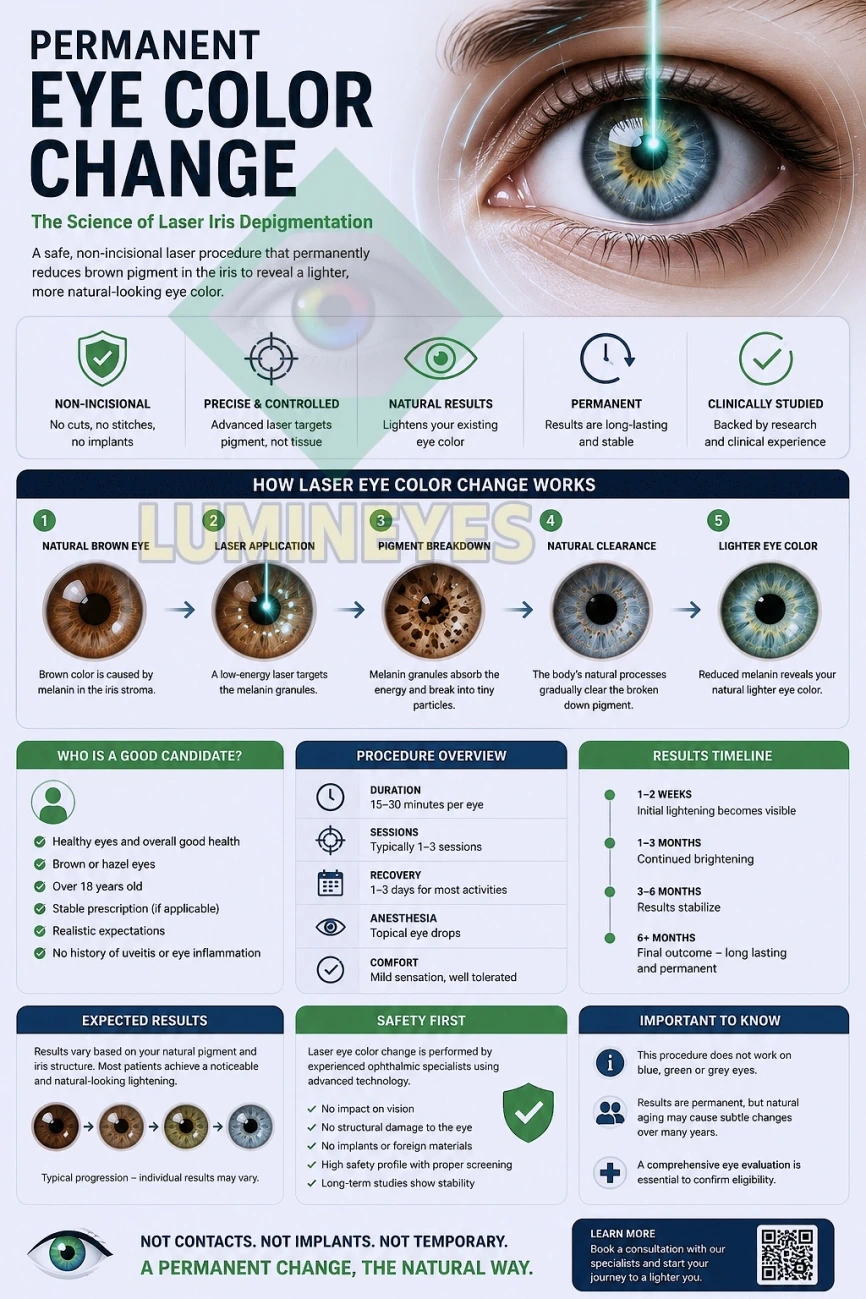
Laser iris depigmentation aims to create a long-lasting change by reducing stromal iris melanin rather than placing an artificial color material inside the eye.
The clinically useful question is therefore not simply “Is it permanent?” but: “Does the reduction in iris pigmentation remain stable over time, and how is that stability assessed?”
Long-term stability can be influenced by:
- baseline iris pigmentation;
- iris anatomy and stromal characteristics;
- individual biological response;
- the degree of pigment reduction achieved;
- the subsequent pigment-clearance process;
- long-term clinical follow-up.
To learn more about laser depigmentation techniques, visit our guide on Laser Iris Depigmentation .
For the deeper biological discussion, see: Biological Permanence & Long-Term Stability .
For the overall treatment framework, see the primary Laser Eye Color Change clinical guide .
How Does a Long-Term Result Develop?
A visible change immediately after treatment should not automatically be interpreted as the final or stable result. Pigment response and clearance occur over time, which is why staged assessment is important.
This is why “permanent” should be discussed as a long-term biological and clinical observation, rather than as a promise made on the day of treatment.
Residual Pigment, Incomplete Response or Repigmentation?
A darker appearance after an initial lightening response does not necessarily mean that the iris has regenerated all of its original pigmentation. Several different biological or optical explanations can produce a change in appearance.
Residual Pigment
Some baseline stromal pigmentation may remain after treatment, particularly when the starting pigmentation is greater.
Incomplete Response
Individual response can vary, and visible change may be less pronounced than initially expected.
True Repigmentation
A change over time must be interpreted clinically rather than assumed from photographs alone. Follow-up is important when assessing long-term pigment behavior.
This distinction is particularly important when reading online patient reviews or comparing before-and-after photographs.
Can Brown Eyes Become Permanently Blue, Green or Gray?
Laser iris depigmentation does not implant a blue, green or gray pigment into the iris. The visible result depends on the interaction between remaining iris pigmentation, stromal structure and light scattering.
Therefore, the same treatment approach should not be understood as producing an identical color in every patient.
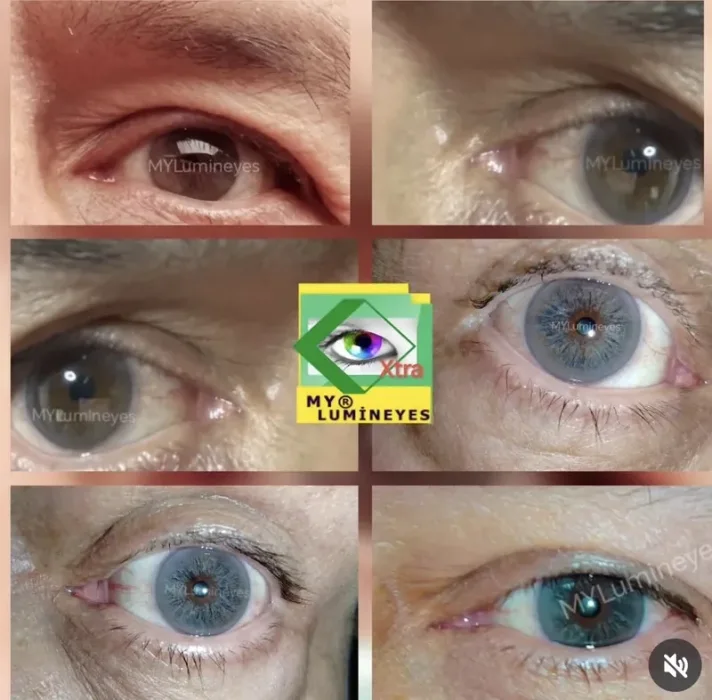
How Should Before & After Results Be Evaluated?
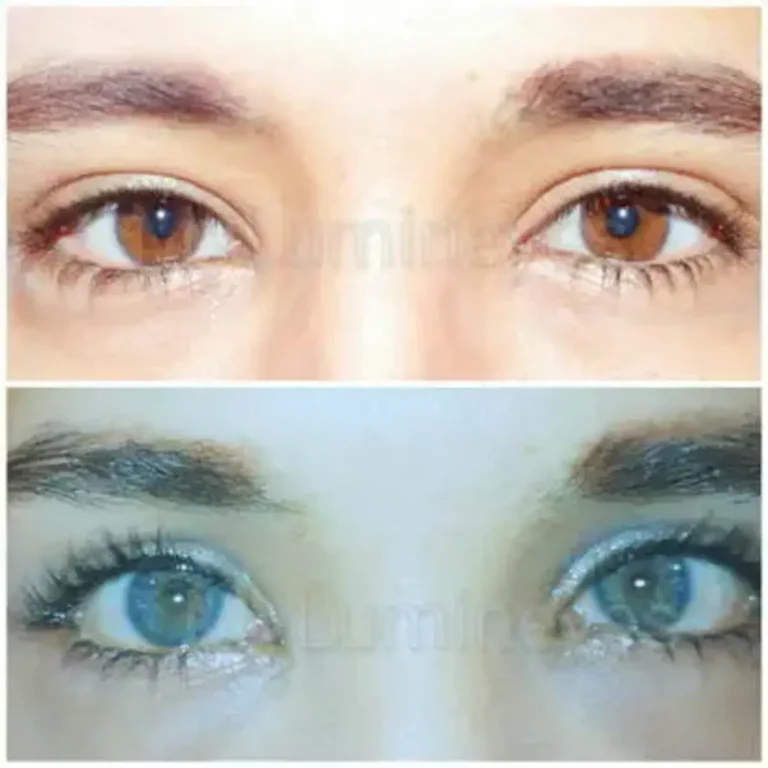
Before-and-after photography can be useful, but photographs should be interpreted carefully. Lighting, camera exposure, white balance, pupil size, viewing angle and image processing can all influence apparent iris color.
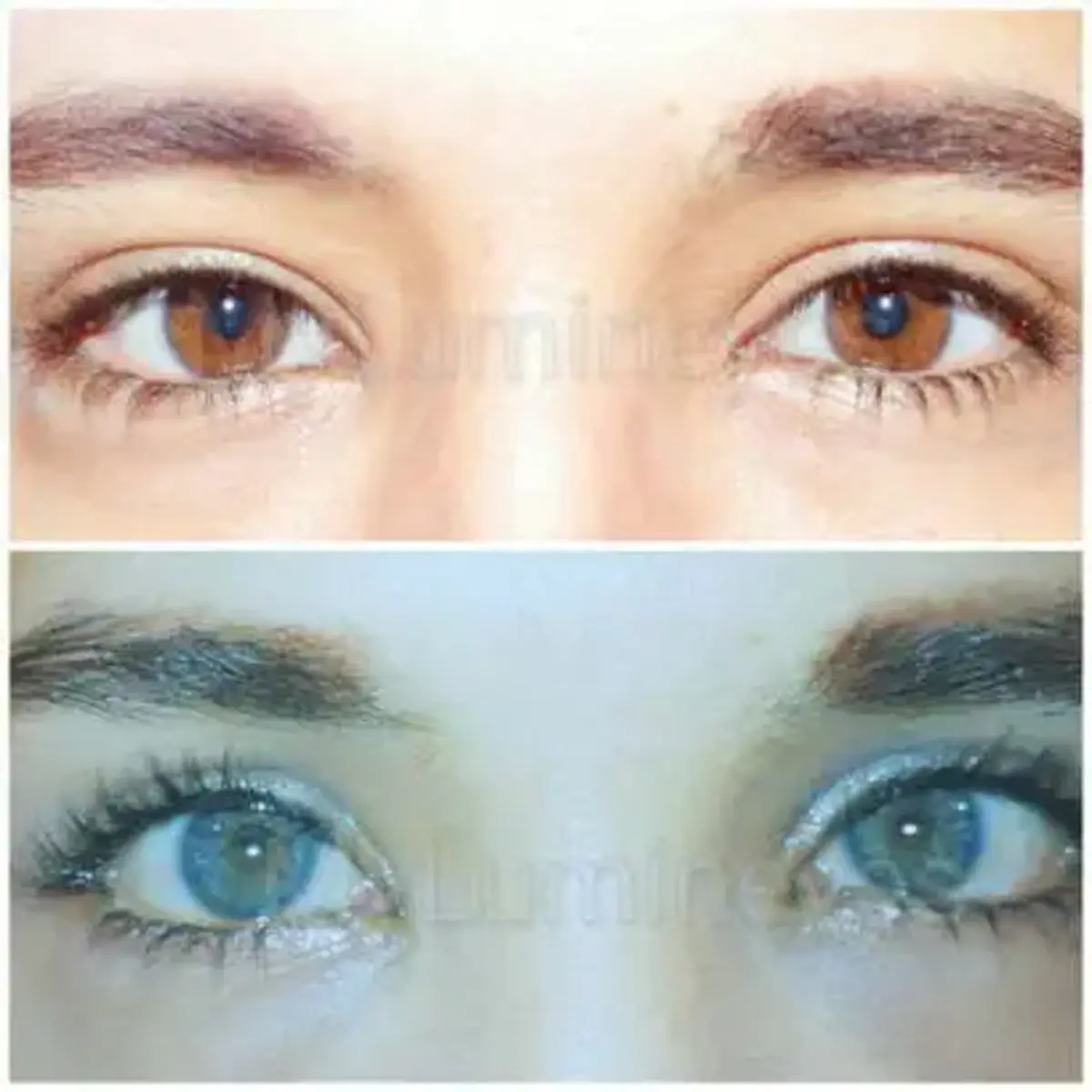
For documented treatment images and clinical examples, see the Laser Eye Color Change Before & After page.
How to Evaluate a “Permanent Eye Color Change” Claim
Patients researching permanent eye color change often encounter testimonials, before-and-after photographs and claims about long-term results. A useful review should provide more than a final photograph.
| What to check | Why it matters for long-term stability |
|---|---|
| Treatment method | Different procedures affect different tissues and cannot be compared simply because they all change eye appearance. |
| Baseline documentation | Original iris pigmentation and standardized photography make later comparisons more meaningful. |
| Follow-up duration | A photograph taken shortly after treatment cannot establish long-term stability by itself. |
| Clinical monitoring | Long-term assessment should consider ocular findings rather than cosmetic appearance alone. |
| Limitations disclosed | Transparent discussion should include variability, possible incomplete response and the inability to guarantee an exact final color. |
| Independent evidence | Published research and clearly identified clinical data help distinguish documented observations from promotional claims. |
Evaluating Clinical Experience for Long-Term Stability
When evaluating a procedure for long-term stability, physician qualification and structured follow-up pathways are critical factors.
| Factor | Relevance to Long-Term Stability |
|---|---|
| Procedure-Specific Experience | Experience in laser iris depigmentation helps establish appropriate patient selection, energy calibration, and staged clearance evaluation. |
| Baseline & Longitudinal Assessment | Objective pre-treatment diagnostics and standardized longitudinal follow-up allow accurate monitoring of pigment stability over time. |
| Defined Follow-Up Pathway | Long-term stability requires structured post-treatment evaluations rather than relying on a single immediate post-treatment outcome. |
| Transparency & Realistic Expectations | Ethical clinical practice emphasizes individual response variability, potential limitations, and the absence of absolute shade guarantees. |
Learn more about the clinical team: About MyLumineyes and Why Trust MyLumineyes? .
Permanent Does Not Mean Risk-Free
Permanence should never be considered independently from ocular safety. The appropriate procedure depends on the patient's anatomy, ocular health, medical history and treatment goals.
Clinical evaluation may include assessment of iris characteristics, intraocular pressure, anterior segment findings, ocular inflammation, optic nerve status and other relevant findings.
Read the dedicated Eye Color Change Safety guide for the detailed safety discussion.
Patient eligibility is discussed in: Eye Color Change Patient Eligibility .
Want to Understand the Actual Laser Procedure?
This page focuses on the meaning of permanence and long-term stability. For the procedure itself — including how laser eye color change works, patient assessment, treatment planning, monitoring and the clinical journey — continue to the primary clinical guide.
Scientific & Clinical Resources
Biological Permanence & Long-Term Stability
A deeper discussion of biological stability, pigment behavior, treatment response and the distinction between clinical observation and absolute permanence.
MyLumineyes Research Hub
Explore published and developing clinical research, ophthalmic assessments and scientific material related to iris pigmentation and laser eye color change.
Before & After Documentation
Review visual treatment documentation and consider photographic evidence together with treatment history and follow-up.
Why Trust MyLumineyes?
Learn how physician experience, clinical follow-up, patient selection and evidence transparency are presented by the clinic.
Frequently Asked Questions About Permanent Eye Color Change
Is permanent eye color change really possible?
Several ophthalmic techniques can create a lasting change in eye appearance, including laser iris depigmentation, keratopigmentation and artificial iris implantation. They use different mechanisms and have different clinical considerations.
What does “permanent” mean in eye color change?
In this context, permanence refers to a long-lasting cosmetic, structural or biological change rather than a temporary visual effect. For laser iris depigmentation, long-term pigment stability is an important part of the discussion.
Is laser eye color change permanent?
Laser iris depigmentation aims to produce long-term reduction of stromal iris pigmentation. The degree of long-term stability can vary between individuals, so an exact permanent result or exact final eye color should not be guaranteed.
Can brown eyes become permanently blue, green or gray?
Laser iris depigmentation does not add blue, green or gray pigment. The resulting appearance depends on remaining pigmentation, iris structure and individual biological response.
Can eye color change back after laser treatment?
A darker appearance after treatment should not automatically be interpreted as complete pigment regeneration. Residual pigment, incomplete response and other biological or optical factors must be distinguished through appropriate follow-up.
How long does it take for a permanent eye color change to stabilize?
The visible result develops over time rather than necessarily appearing as a final result immediately after treatment. Follow-up helps assess pigment response, clearance and longer-term stability.
Are surgical methods more permanent than laser?
Permanence cannot be compared independently from anatomy, mechanism and risk. Artificial iris implantation, keratopigmentation and laser iris depigmentation create their effects in different tissues and therefore require different clinical considerations.
Are color-changing eye drops permanent?
Some prostaglandin-analogue glaucoma medications can cause long-lasting iris pigmentation changes. This is a medication effect rather than an approved cosmetic method of changing eye color.
Is permanent eye color change safe?
Every procedure has potential risks. Safety depends on the procedure, the patient's ocular health, the treatment approach and appropriate clinical monitoring. A comprehensive ophthalmic evaluation is essential.
Can an exact final eye color be guaranteed?
No. Individual iris anatomy, baseline pigmentation and biological response influence the final appearance. A responsible clinical discussion should therefore avoid guarantees of a specific final color.
How should I evaluate a clinic regarding long-term stability?
Consider the physician's ophthalmic qualification, procedure-specific experience, patient-selection process, objective monitoring, long-term follow-up pathway, evidence transparency, and how limitations are communicated.