01
Individual Assessment
Each eye is evaluated individually rather than treated according to a universal preset or eye-color category.

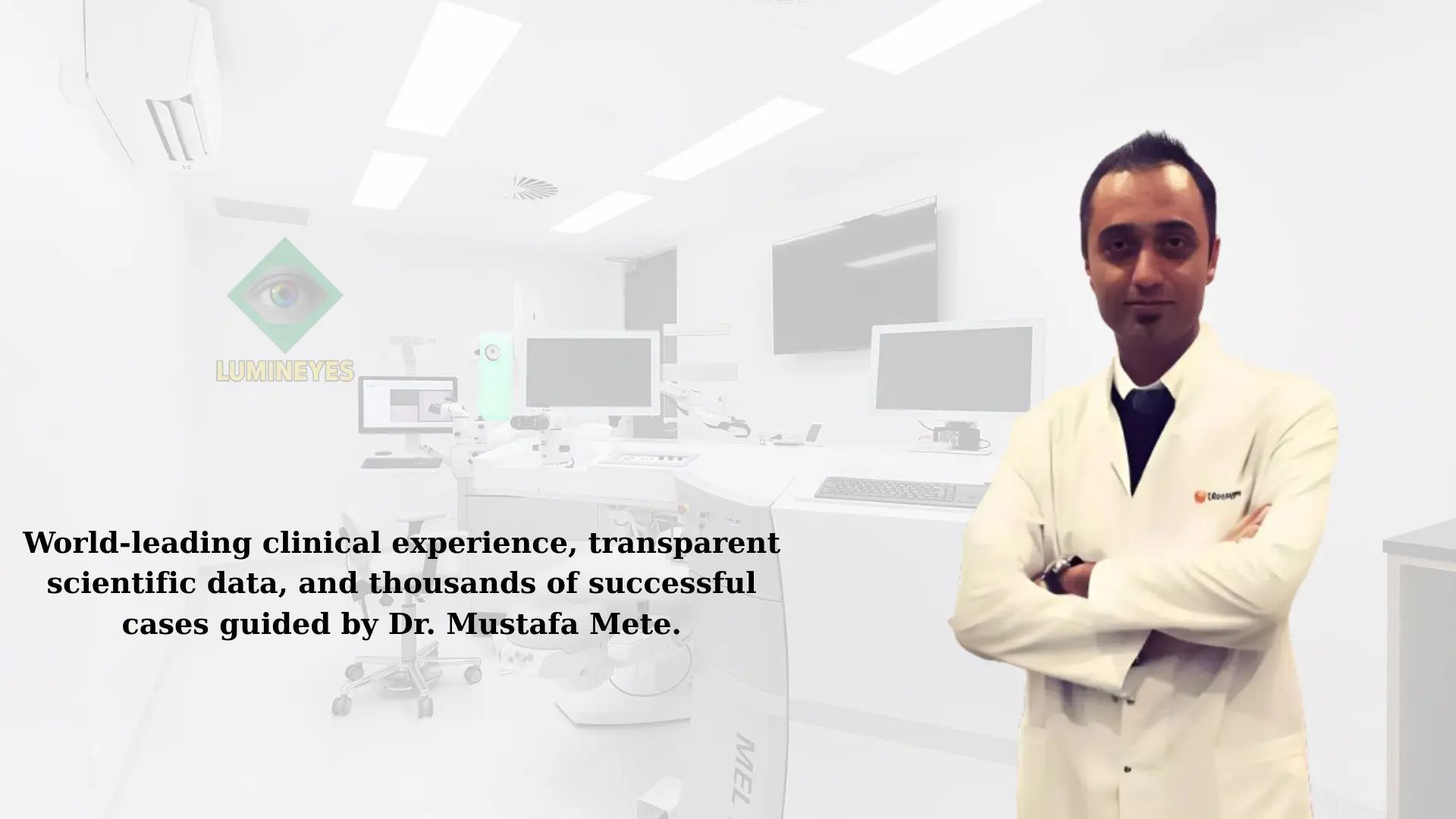
Trust in medical care should be based on clinical experience, transparent information, realistic expectations and responsible long-term ophthalmic follow-up — not on promises of a particular cosmetic result.
Clinical decisions remain under ophthalmic evaluation and supervision.
More than 25 years of clinical ophthalmology experience.
Clinical observations are presented together with their limitations.
Treatment planning reflects individual anatomy and biological response.

MyLumineyes® was founded around a straightforward clinical principle: patients should receive accurate information, realistic expectations, individualized assessment and treatment planning that places ocular health ahead of cosmetic expectations.
No two irides, medical histories or biological responses are identical. Suitability therefore cannot be determined from desired eye color alone. Clinical assessment considers ocular findings, iris characteristics, treatment expectations and factors relevant to responsible follow-up.
Explore the Lumineyes Method →Responsible eye-color treatment requires clear boundaries. A desired shade cannot override anatomy, ocular findings, biological variability or clinical judgment.
Each eye is evaluated individually rather than treated according to a universal preset or eye-color category.
Exact final color and a fixed treatment course cannot be promised from baseline eye color alone.
Treatment decisions are informed by ophthalmic findings and the observed response of the individual eye.
Treatment may be declined or modified when clinical findings or expectations are not compatible with responsible care.

Dr. Mustafa Mete is an ophthalmologist and clinical researcher whose work includes iris pigmentation, laser iris depigmentation, ophthalmic assessment, treatment monitoring and long-term follow-up.
His broader clinical background spans more than 25 years in ophthalmology, while his work with the Lumineyes® approach extends over more than 15 years.
View Physician Profile →Clinical experience, documented patient outcomes, long-term observation and published evidence are different forms of information. They should not be presented as if they were interchangeable. MyLumineyes® aims to distinguish clinical observation from broader scientific evidence and to communicate the limitations of each.
Treatment planning is informed by direct ophthalmic evaluation and accumulated clinical observation of iris response.
Long-term patient relationships allow outcomes and ocular findings to be observed beyond the immediate treatment period.
Clinical observations are not a substitute for independent, controlled evidence. Research limitations should remain visible when outcomes are discussed.
Ethical communication is especially important when a medical intervention is sought for cosmetic reasons. Patient expectations should never be presented as guaranteed biological outcomes.
Individual biological response and color perception vary.
Treatment course depends on clinical characteristics and response.
Unsuitable candidates may be declined on clinical grounds.
Risks, limitations and evidence boundaries should be discussed openly.
One of the most valuable aspects of long-term clinical practice is continued contact with patients after treatment. Follow-up allows clinical observations to extend beyond the immediate visual result and provides a broader view of the individual treatment course.
Medical content should make its clinical reviewer identifiable. Dr. Mustafa Mete's physician profile provides professional context, while his ORCID record provides an external research identity.
Learn about the clinical approach, treatment limitations, patient eligibility, potential risks and available evidence before considering laser eye color change.
Lumineyes Assistant
×