How Clinical Evidence Is Evaluated in Laser Eye Color Change
Clinical evidence is more than a number. Its meaning depends on how patients are selected, what is measured, how clinical decisions are made, how follow-up is conducted, and what the available observations can legitimately support.
Why Clinical Evidence Must Be Interpreted in Context
A large number of treated eyes or many years of clinical experience can provide valuable information, but neither should be interpreted in isolation.
The meaning of a clinical observation depends on the characteristics of the patients assessed, the baseline examination, the measurements performed, the clinical decisions made during treatment, the duration and completeness of follow-up, and the limitations of the underlying observations.
This is particularly relevant in laser eye color change because patients do not begin with identical iris pigmentation, ocular anatomy, medical history, expectations, or biological response.
Clinical evidence should therefore be interpreted alongside the broader MyLumineyes® / Lumineyes™ Clinical Research & Scientific Documentation .
Four Questions That Should Be Asked About Clinical Evidence
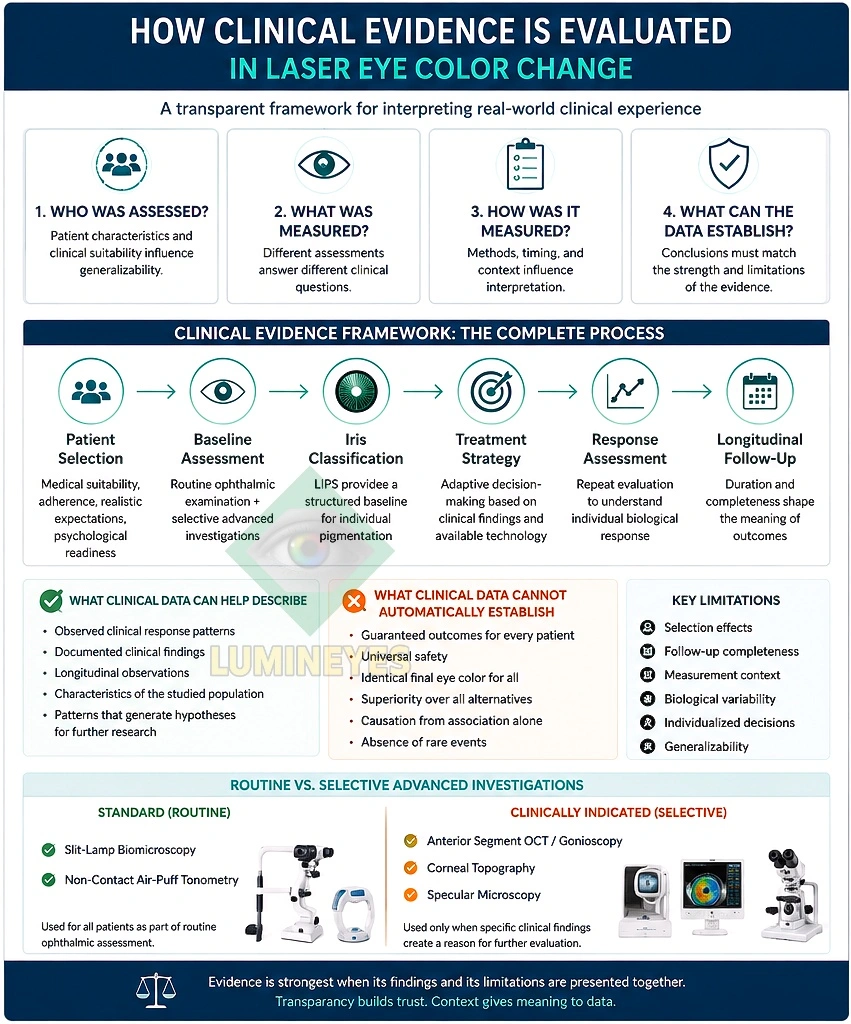
Before interpreting a clinical claim, four methodological questions help establish its context.
Who was assessed?
Patient characteristics, ocular findings, inclusion decisions, and clinical suitability influence how widely observations can be generalized.
What was measured?
Different clinical assessments answer different questions and should not be treated as interchangeable endpoints.
How was it measured?
Measurement method, timing, repeat assessment, and clinical context influence how an observation should be interpreted.
What can the data establish?
The strength of a conclusion should remain consistent with the type, completeness, duration, and limitations of the underlying evidence.
A Clinical Dataset Is Not the Same as a Clinical Trial
Real-world clinical experience can provide valuable longitudinal observations, particularly when patients are assessed repeatedly over time.
However, observational clinical data have inherent methodological limitations. Patients may not be randomized, treatment decisions may be individualized, and follow-up duration may differ between patients.
The appropriate interpretation is therefore not simply whether a dataset is large, but what type of evidence it represents, how the observations were generated, and which questions they can reasonably answer.
Clinical Assessment Before Treatment
Clinical evidence begins before treatment itself. Baseline assessment establishes the clinical context in which subsequent observations can be interpreted.
In the MyLumineyes® / Lumineyes™ framework, routine ophthalmic assessment is distinguished from additional investigations that are requested only when a specific clinical finding creates a reason for further evaluation.
The broader clinical context of laser iris depigmentation is discussed separately, including its technical mechanism, biological response, safety boundaries, and clinical limitations.
Routine Ophthalmic Evaluation
Slit-lamp biomicroscopy provides direct clinical assessment of the anterior segment, iris, ocular surface, and relevant baseline findings.
Automated non-contact air-puff tonometry is used for routine intraocular pressure assessment without requiring corneal contact.
Selective Advanced Investigation
Additional diagnostic investigations are not automatically required for every patient. They are requested when examination findings, ocular anatomy, or clinical history create a specific reason for further evaluation.
Routine Monitoring and Selective Advanced Investigations
A meaningful clinical methodology distinguishes what is assessed routinely from what is investigated selectively. An advanced diagnostic test should be used to answer a clinical question rather than simply to make a protocol appear more extensive.
| Clinical Assessment | Clinical Role | Status |
|---|---|---|
| Slit-Lamp Biomicroscopy | Baseline and follow-up examination of the anterior segment, iris, ocular surface, and clinically relevant findings. | Standard |
| Non-Contact Air-Puff Tonometry | Routine intraocular pressure assessment as part of the ophthalmic examination and clinical monitoring process. | Standard |
| Anterior Segment OCT / Gonioscopy | May be requested when a narrow anterior chamber angle or another clinically relevant anterior-segment finding requires additional anatomical evaluation. | Selective |
| Corneal Topography | May be requested when high or irregular astigmatism or other examination findings raise concern about corneal irregularity, including the need to investigate possible keratoconus. | Selective |
| Specular Microscopy | An advanced assessment of corneal endothelial cell characteristics when a specific clinical concern makes endothelial evaluation appropriate. It is not presented as a routine test required for every patient. | Selective / Advanced |
When closer pressure observation is clinically indicated, the dedicated Early IOP Monitoring Framework provides a separate discussion of early IOP assessment and interpretation.
Advanced ophthalmic investigations should be interpreted according to the clinical question they are intended to answer. A selective test is not evidence of inadequate routine assessment, and a routine test does not replace targeted investigation when a specific concern is present.
Patient Selection Is Part of the Evidence Methodology
Patient selection is not merely an administrative step before treatment. It directly influences the population from which clinical observations are generated.
In a medically supervised elective procedure, suitability includes more than the absence of an obvious contraindication. Clinical decision-making also considers whether the patient can follow treatment and follow-up requirements, understands biological variability, and has realistic expectations.
Ocular Suitability
Relevant ocular disease, instability, or an unresolved clinical finding may require treatment, additional assessment, postponement, or exclusion from elective treatment.
Treatment Adherence
Patients must be capable of following prescribed medication, aftercare, monitoring, and follow-up instructions.
Realistic Expectations
Biological response varies between individuals. A responsible clinical framework cannot promise an identical endpoint or a fixed final shade for every patient.
Psychological & Decision-Making Suitability
Patients whose expectations, motivations, or decision-making circumstances raise clinically significant concerns may not be appropriate candidates for an elective procedure.
For the dedicated discussion of candidacy and suitability, see Eye Color Change Patient Eligibility .
The biological handling of fragmented pigment is examined in greater detail in Pigment Clearance Kinetics After Laser Iris Depigmentation .
Iris Classification as a Clinical Baseline Variable
Patients do not begin with identical iris pigmentation. Differences in baseline pigmentation can influence clinical planning and the way later observations are interpreted.
For this reason, the Lumineyes® Iris Pigmentation Scale (LIPS) is used within the broader MyLumineyes® / Lumineyes™ clinical framework as a structured way of describing baseline iris pigmentation characteristics.
The broader clinical rationale for iris anatomy and pigment distribution is discussed in the Clinical Perspective on Laser Iris Depigmentation .
LIPS: Classification Before Interpretation
The purpose of iris classification is not to reduce a patient to a single grade. It provides a clinical framework for describing baseline pigmentation and placing subsequent observations into individual biological context.
Classification therefore supports clinical decision-making; it does not replace ophthalmic examination, individualized assessment, or clinical judgment.
Clinical Know-How Is More Than a Device or a Fixed Protocol
One of the most important distinctions in interpreting long-term clinical experience is the difference between a named procedure and the clinical decision-making that surrounds it.
A laser system, energy parameter, or treatment sequence does not by itself describe the complete clinical methodology. The relevant clinical process includes patient selection, baseline examination, iris classification, interpretation of individual findings, treatment planning, response assessment, and decisions about subsequent management.
Assessment → Strategy → Response → Reassessment
Within the MyLumineyes® / Lumineyes™ clinical framework, treatment strategy is informed by the individual patient rather than being defined exclusively by one permanently fixed device or one predetermined sequence.
Depending on the clinical period, technology available, individual findings, and observed response, the selected laser system or treatment strategy may change, be combined with another appropriate approach, or transition to another system when clinically indicated.
The broader technical evolution of the Lumineyes approach is discussed in Lumineyes 2026: Iris Stroma & Technical Evolution .
This adaptive element is part of clinical know-how: knowing when a predefined approach remains appropriate, when reassessment is necessary, and when the clinical strategy should change.
What Clinical Decision-Making Adds to the Protocol
| Clinical Layer | Question | Decision Context |
|---|---|---|
| Patient selection | Is this person an appropriate candidate? | Ocular status, adherence, expectations, motivation, and clinical suitability. |
| Baseline assessment | What is the patient's starting ocular condition? | Routine ophthalmic examination plus targeted investigations when clinically indicated. |
| Iris classification | What is the relevant baseline pigmentation phenotype? | LIPS and individual clinical assessment. |
| Strategy selection | What approach is appropriate for this clinical situation? | Clinical experience, available technology, individual findings, and treatment objectives. |
| Response assessment | How is the patient responding? | Repeat clinical assessment and individualized monitoring. |
| Reassessment | Should the current strategy continue or change? | Ongoing clinical findings and biological response rather than a rigid predetermined sequence alone. |
The biological principles underlying selective treatment of iris pigmentation are discussed further in Cellular Selectivity in Laser Iris Depigmentation .
Longitudinal Follow-Up Changes the Meaning of Clinical Data
The duration and completeness of follow-up are central to the interpretation of clinical observations.
An observation made shortly after treatment describes the early clinical period. It cannot by itself establish what will happen years later. Conversely, repeated observation over a longer period can provide additional information about persistence and stability.
The available longitudinal clinical dataset is presented separately in MyLumineyes® Clinical Data: 8-Year Results , where the observational nature of the dataset and its reported outcomes can be examined in greater detail.
Missing Data and Loss to Follow-Up
Real-world clinical populations do not always provide complete longitudinal data for every patient. This can be particularly relevant when patients travel internationally or continue follow-up in another healthcare system.
A patient for whom a later observation is unavailable should not automatically be classified as having a favorable or unfavorable outcome. The observation remains unavailable unless an appropriate methodology allows a valid interpretation.
The methodological question is therefore not simply how many patients were originally treated, but how many patients have usable observations at each relevant follow-up period and whether incomplete follow-up could influence interpretation.
Clinical Findings, Events, and Complications
Clinical terminology matters when interpreting safety-related observations. A transient finding, a clinically significant event, and a persistent complication should not automatically be treated as equivalent.
Similarly, observing an event does not by itself establish causation. Clinical interpretation requires consideration of baseline status, timing, persistence, alternative explanations, and the available clinical evidence supporting a relationship with the intervention.
The underlying biological principles of pigment response and depigmentation are examined further in Advanced Principles of Iris Depigmentation .
Observed Finding
A clinical change or measurement identified during examination or follow-up.
Clinical Event
A finding that becomes clinically relevant and requires appropriate documentation, observation, or management.
Persistence
Whether a finding resolves, remains present, or changes during subsequent assessment.
Treatment Relationship
Whether the available clinical information supports a relationship between the finding and the intervention.
Real-World Clinical Data Have Inherent Limitations
Real-world clinical data are valuable because they reflect actual clinical practice. At the same time, they are affected by limitations that should remain visible when findings are interpreted.
What Clinical Data Can — and Cannot — Establish
Scientific transparency requires a clear boundary between an observed clinical pattern and a conclusion that goes beyond the available evidence.
Clinical Data Can Help Describe
- Observed clinical response patterns
- Documented clinical findings
- Longitudinal observations
- Characteristics of the observed patient population
- Patterns that may justify further clinical or scientific investigation
Clinical Data Cannot Automatically Establish
- Guaranteed outcomes for every patient
- Universal safety
- An identical final eye color for every individual
- Superiority over every alternative procedure
- Causation from association alone
- Absence of rare events simply because none were observed
What Remains Uncertain and Requires Further Research
Scientific transparency also requires acknowledging questions that cannot yet be answered with sufficient confidence from a particular clinical dataset or observational framework.
Further research may provide additional information through longer independent follow-up, larger and more diverse patient populations, standardized outcome definitions, prospective study designs, and independent evaluation of clinically relevant findings.
Evidence Is Strongest When Its Limitations Are Visible
Clinical experience becomes more informative when its methodology is transparent.
Understanding patient selection, clinical assessment, iris classification, treatment decision-making, outcome measurement, follow-up, missing data, and evidence limitations allows clinical observations to be interpreted with appropriate scientific context.
For MyLumineyes® / Lumineyes™, the purpose of this framework is therefore not simply to report what has been observed, but to explain how those observations are evaluated, what they can support, and where uncertainty remains.
Explore the MyLumineyes® / Lumineyes™ Research Framework
This methodology page provides the evidence-interpretation layer for the broader Research Hub. Other pages address specific clinical, biological, safety, and procedural questions without duplicating the methodology discussed here.
For questions about the clinical methodology, patient suitability, and individual assessment, the relevant clinical pages should be read together rather than interpreted as substitutes for an ophthalmic examination.
From Clinical Experience to Responsible Evidence
The value of long-term clinical experience is not simply the number of patients treated. It also lies in the ability to recognize clinical patterns, identify relevant variables, measure what can be measured, recognize uncertainty, adapt clinical decision-making, and respect biological limits.
A responsible evidence framework therefore asks not only how much clinical data exist, but also what those data represent, how they were obtained, what they can support, and where further research remains necessary.
Evidence is strongest when its findings and its limitations are presented together.