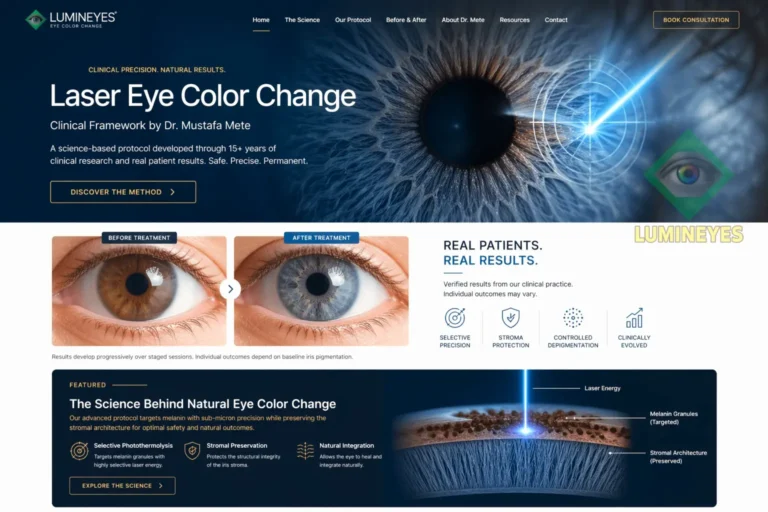
Lumineyes 8G Xtra: Clinical Evolution of Iris Pigment Modulation
Stromal integrity, treatment response, and the clinical decisions that connect laser application with longitudinal ophthalmic care.
Updated · Clinical and technical commentary
Abstract
Lumineyes 8G Xtra is the name used within the Lumineyes clinical programme for its evolving approach to laser iris pigment modification. This clinical commentary examines the relationship between the intended pigment target, tissue response, treatment staging, and outcome assessment. It connects the technical discussion to the programme’s published research methodology and monitoring frameworks. Its central proposition is that evaluating a technology requires documenting what was delivered, how the eye responded, and how that response influenced subsequent care.
What clinical evolution means for 8G Xtra
Within the Lumineyes programme, 8G Xtra brings the discussion of technology back to the eye being treated: its starting anatomy, pigment distribution, and response over time. Clinical development involves the way these findings inform treatment delivery and the decisions made between stages. The useful question is how each element of care contributes to a coherent, individually assessed treatment course.
Clinical experience contributes the ability to recognise variation, reconsider a plan, and document why a decision changed. The Lumineyes article How Clinical Evidence Is Evaluated in Laser Eye Color Change explains this relationship between examination, treatment strategy, response, and reassessment. An informative technical account should preserve that decision history alongside the cosmetic result.
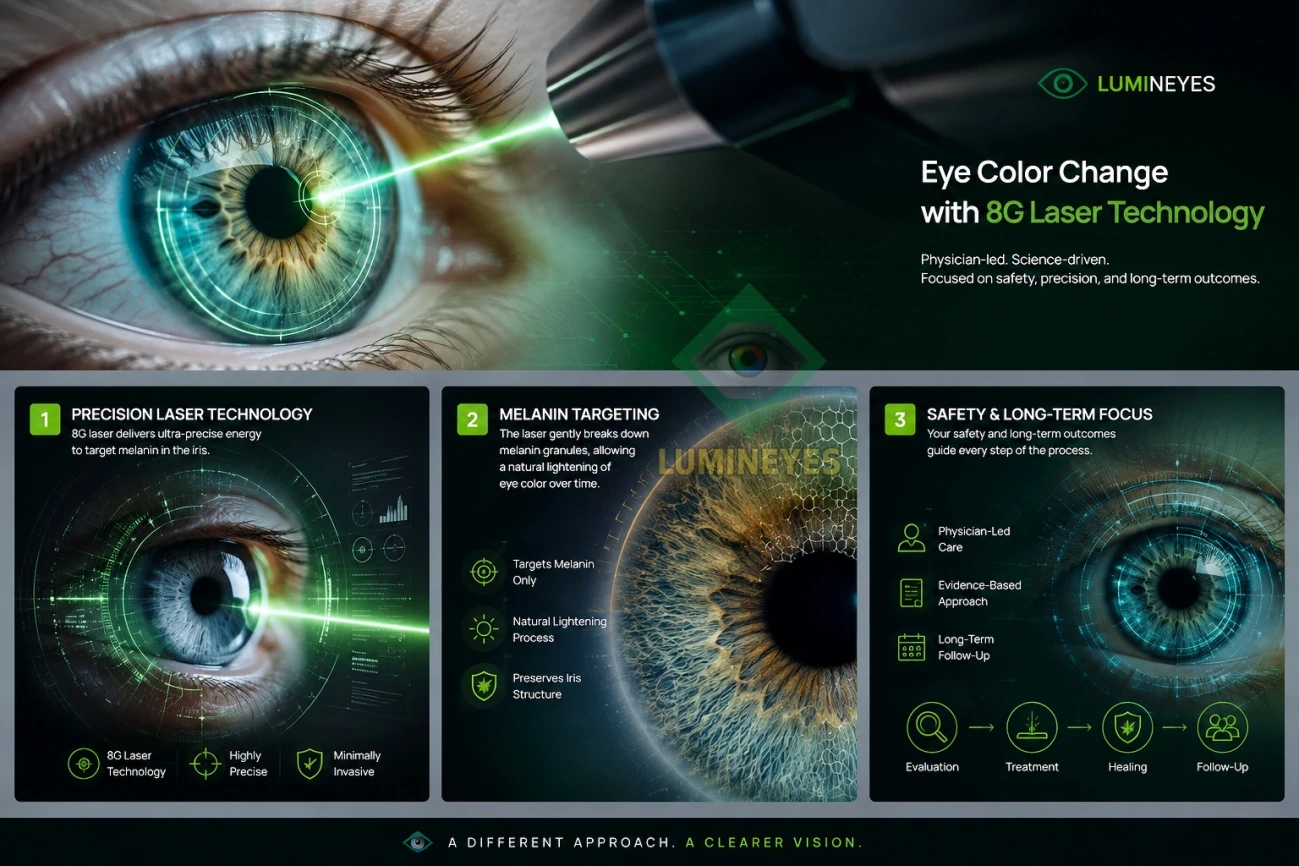
Stromal melanin modulation: defining the treatment objective
The Lumineyes research article Selective Stromal Melanin Modulation in Laser Iris Depigmentation describes the intended preferential interaction with pre-existing stromal pigment while limiting unnecessary exposure of surrounding structures. This gives the approach a defined biological objective and provides questions against which its effects can be assessed.
In this context, selectivity describes a treatment objective: achieving the intended pigment response while limiting effects on surrounding tissue. Its clinical assessment includes the appearance of the iris, pupil behaviour, inflammation, and visual function. These observations bring the discussion beyond colour alone and connect the proposed mechanism with findings that can be recorded over time.
- 01 · AssessDocument baseline ocular findings and treatment suitability.
- 02 · ApplyRecord the treatment version and exposure delivered.
- 03 · ReassessObserve pressure, inflammation, symptoms, and tissue findings.
- 04 · DecideDocument why treatment continues, changes, pauses, or ends.
Pigment response continues after laser application
The biological question extends beyond the initial interaction with melanin. The archive’s Biological Fate of Pigment in Cosmetic Iris Color Modification examines pigment origin, location, persistence, and processing. Modification of native iris pigment raises different follow-up questions from depositing pigment within the cornea, even when the intended visible endpoint is similar.
This biological perspective gives the interval between treatments a clinical purpose. The clinician can observe the course of pigment-related findings and inflammation, assess pressure, and reconsider the next step. Cellular uptake and clearance remain relevant to the proposed mechanism, while the patient’s measured response guides care. The speed of visible lightening does not directly measure cellular clearance.
IOP monitoring as part of treatment decisions
The Early IOP Monitoring Framework gives pressure measurement a practical role in determining subsequent management. Baseline pressure, measurement timing, the magnitude and persistence of a change, associated findings, and any intervention belong together in the record. Serial assessment is more informative than a statement that pressure was “normal” at one visit.
A pressure result is interpreted alongside the examination and the patient’s symptoms. A reassuring reading contributes useful information; an unexpected change may prompt further assessment, management, or postponement of another stage. This is the practical meaning of response-guided care: follow-up findings can change the treatment plan. Normal IOP remains one part of a broader ocular assessment.
How published findings inform the technical discussion
A 2021 prospective series involving 1,176 eyes reported favourable cosmetic outcomes with a specified laser approach and also reported complications, including delayed iritis. These observations concern the intervention and population described in that study; they are not outcome data for Lumineyes 8G Xtra.
Conversely, Liu and colleagues’ 2023 case report describes severe pigmentary glaucoma and macular involvement after cosmetic iris laser treatment. Such reports inform counselling and monitoring, while providing no denominator from which to calculate a protocol-wide event rate. Meaningful comparison with 8G Xtra requires information about treatment parameters, patient selection, and follow-up. These reports remain relevant safety signals when considering iris laser procedures.
Documenting improvement across technology versions
Technical evolution is easiest to understand when each patient’s record identifies the treatment version used and the decisions made during care. Earlier clinical experience can inform a newer approach; version-specific records show which outcomes belong to which intervention. The framework below connects the technical history with the clinical questions it is intended to answer.
| Record | Question it helps answer |
|---|---|
| Technology version, treatment dates, and exposure parameters | Which intervention did each patient actually receive? |
| Baseline findings and selection criteria | Are the groups clinically comparable? |
| Changes in strategy and their clinical reasons | How did observed response influence care? |
| Visual, structural, pressure, and symptom outcomes | Which dimensions of the result were measured? |
| Follow-up duration, missing visits, and adverse events | How complete is the account of later outcomes? |
Where intellectual-property considerations restrict public disclosure, those limits should be identified. External appraisal still requires sufficient methodological information to understand the intervention and its outcomes. A proposed mechanism and a clinical result answer related but distinct questions.
What personalised planning means for the patient
Personalisation begins with a clinical baseline: the iris being examined, the ocular findings that matter for that patient, and the expectations being discussed. The Lumineyes methodology distinguishes routine examination from additional investigations prompted by a particular finding. This gives each assessment a purpose and avoids treating a list of tests as a substitute for clinical judgement.
It also changes how progress is discussed. The next appointment may be a reassessment rather than another treatment stage. A decision to wait, investigate a finding, or end the course is part of individual care. For the patient, a useful explanation connects the intended cosmetic change with the observations that determine what happens next.
Long-term stability and the living iris
Colour stability, stromal integrity, and visual function should be reported as separate outcomes. Years of clinical practice describe experience; years of follow-up describe an individual observation period. A longitudinal study additionally needs a defined cohort, assessment methods, follow-up completeness, and results.
For a future stability analysis, consistent photographic conditions and dated examinations would help distinguish an apparent colour difference from a persistent clinical change. Any numerical estimate of pigment recurrence needs a defined event, a denominator, and an observation period. Claims about the biological cause of a later change require their own supporting evidence.
The broader Lumineyes Clinical Perspective places these questions within staged treatment and patient assessment. Together, the research articles provide a connected account of the intended target, clinical decisions, and questions for further investigation.
References
- MyLumineyes Research. How Clinical Evidence Is Evaluated in Laser Eye Color Change.
- MyLumineyes Research. Selective Stromal Melanin Modulation in Laser Iris Depigmentation.
- MyLumineyes Research. Biological Fate of Pigment in Cosmetic Iris Color Modification.
- MyLumineyes Research. Early IOP Monitoring Framework.
- Grimaldos Ruiz P. Photoablative cosmetic iridoplasty: effective, safe, and predictable—eye color change in 1176 eyes. International Ophthalmology. 2021. DOI: 10.1007/s10792-021-01693-5.
- Liu J et al. Bilateral severe iatrogenic pigmentary glaucoma following laser treatment for cosmetic iris color change. American Journal of Ophthalmology Case Reports. 2023. DOI: 10.1016/j.ajoc.2023.101927.
- MyLumineyes Research. Laser Iris Depigmentation — Clinical Perspective.
- Mete M. Cosmetic Eye Colour Change Requires Procedure-Specific Evidence: A Commentary on Laser Iris Depigmentation and Keratopigmentation. Zenodo. 2026. Version 1.0. DOI: 10.5281/zenodo.23014030.