Clinical Reference Guide · Five Options · Mechanisms · Reversibility
Eye Color Change Method Comparison: Five Options and Their Differences
Eye color can be changed in appearance without changing the iris itself, or it can be altered through procedures involving the cornea, the anterior chamber, or iris pigment. This guide compares five approaches by what they actually change, whether the effect can be removed, and which clinical considerations remain relevant.
Publisher disclosure: MyLumineyes develops a non-incisional laser iris depigmentation methodology. Descriptions of that method are distinguished from general information about other approaches; no comparison here establishes universal safety or superiority.
What are the five main eye color change options?
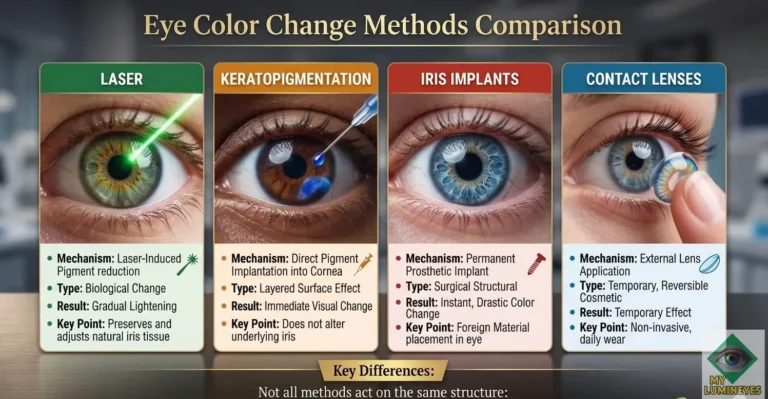
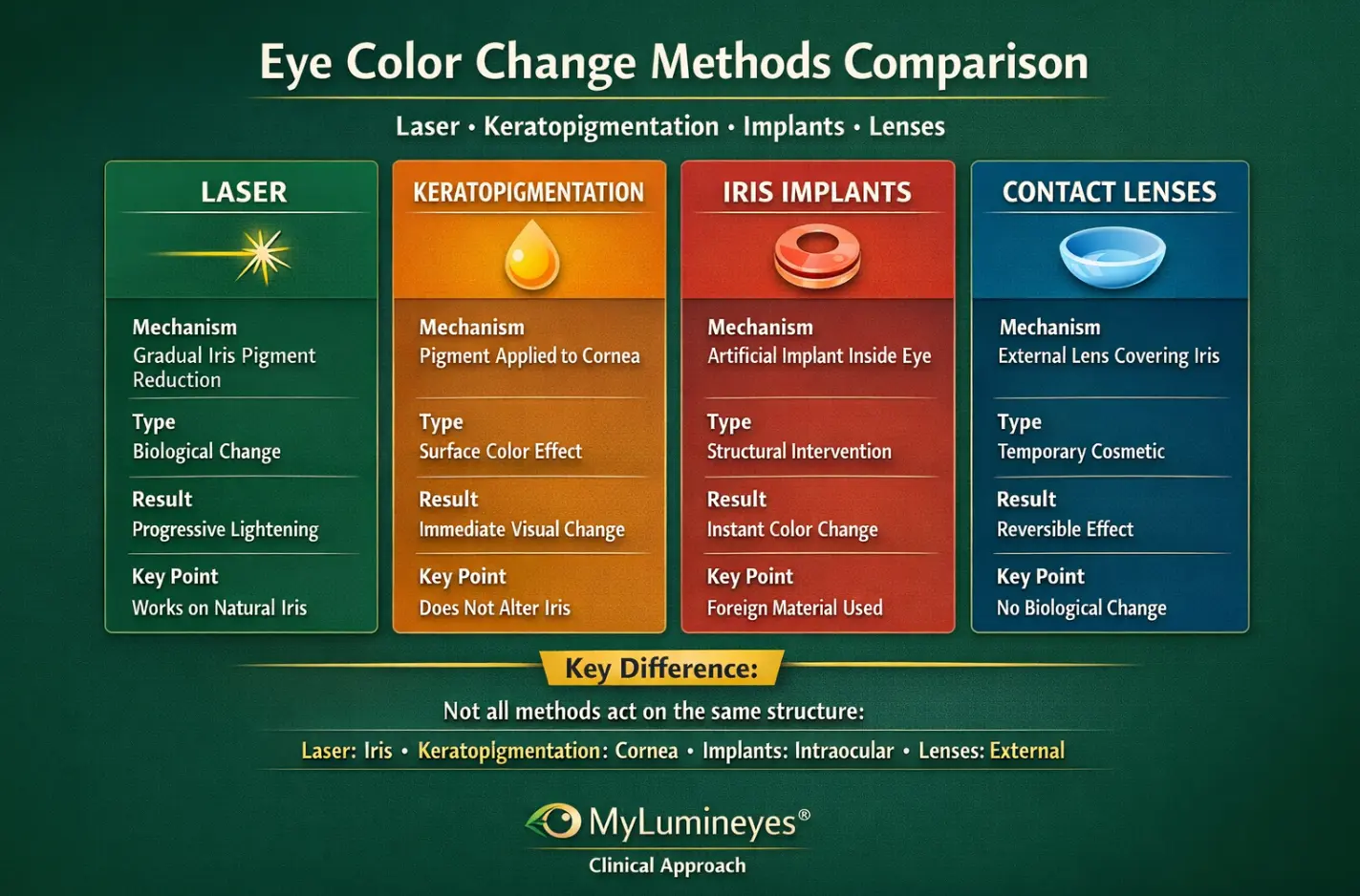
Colored contact lenses temporarily mask the iris; digital simulation changes only an image; keratopigmentation adds pigment within the cornea; cosmetic iris implants place a colored device inside the eye; and laser iris depigmentation reduces visible iris pigment. These options differ in anatomical target, permanence, controllability, reversibility, and medical follow-up. For an in-depth assessment of the three procedural approaches, see the Eye Color Change Surgery clinical guide.
1. Five Approaches, Five Different Mechanisms
“Changing eye color” describes an appearance, not a single medical intervention. The first distinction is between a temporary external effect, a digital preview, and an alteration intended to last. Among lasting procedures, the treated anatomy is also different: cornea, anterior chamber, or anterior iris pigment.
Colored contact lenses
A removable optical cover alters the visible color while worn; the natural iris remains unchanged.
Simulation
Software changes a photograph or on-screen preview without physically affecting the eye.
Keratopigmentation
Artificial pigment is introduced into corneal tissue to modify the visible appearance.
Cosmetic iris implants
A colored prosthetic device masks the native iris from within the anterior chamber.
Laser depigmentation
Protocol-specific laser exposure aims to reduce visible anterior iris pigment without adding artificial color.
2. Eye Color Change Method Comparison Table
The table separates target tissue from duration of effect. It also distinguishes whether a chosen artificial color is introduced or the final appearance depends on the patient's existing iris.
| Method | What changes? | Color control | Duration / removal | Key consideration |
|---|---|---|---|---|
| Colored contact lenses | Visual appearance through an external lens; iris remains unchanged. | Commercially available lens colors and patterns. | Temporary; effect stops when the lens is removed. | Professional fitting, handling, hygiene and corneal health. |
| Digital simulation | Photograph or display only; no biological change. | On-screen shade is freely selectable. | Digital preview only; nothing to reverse in the eye. | Display color cannot predict a clinical result. |
| Keratopigmentation | Corneal stroma contains added pigment. | Pigment shade can be selected, not guaranteed to appear identical after healing. | Intended to last; revision or removal may be incomplete. | Corneal optics, tissue response and procedure-specific follow-up. |
| Cosmetic iris implants | An intraocular colored device covers the native iris. | Device color is selected. | May persist while implanted; explantation is another intraocular operation. | Anterior-chamber anatomy and potential structural complications. |
| Laser iris depigmentation | Visible pigment in the anterior iris is reduced. | No artificial shade is added; phenotype and response determine appearance. | Intended to produce lasting pigment reduction; not readily reversible. | Protocol-specific selection, pressure and anterior-segment monitoring. |
This is an anatomical and practical comparison, not a ranking of treatment safety. A removable method can still cause injury when used improperly, and a non-incisional procedure can still have clinically important effects.
3. How Each Option Works in Practice
Colored Contact Lenses: Temporary Appearance
Opaque or tinted lenses can cover the visible iris pattern without attempting to change the iris pigment. Their main advantage for someone exploring appearance is the ability to stop wearing them. Nevertheless, these are medical devices, not ordinary fashion accessories: inappropriate fitting or inadequate hygiene can lead to abrasions, keratitis and other corneal complications. Our colored contact lens guide addresses their practical use.
Decision point: A temporary option is not the same as a zero-risk option.
Digital Eye Color Simulation: Visualization Only
A simulator can help communicate aesthetic preferences, but its output depends on image lighting, camera processing, display settings and digital editing. It cannot reproduce postoperative tissue behavior or forecast the precise result of a pigment-based intervention. Try our eye color simulator as a visualization tool, not a medical prediction.
Decision point: A selectable screen color is not a selectable biological outcome.
Keratopigmentation: Pigment Within the Cornea
Cosmetic keratopigmentation creates a visual color effect through the clear tissue in front of the iris. Pigment may be placed within a stromal channel or pocket, depending on the technique. The patient's native iris pigment is not removed. Because the cornea is integral to optical quality, pigment position, corneal integrity and postoperative visual symptoms must be assessed within the actual surgical technique. Our keratopigmentation guide examines this anatomy in depth.
Decision point: A corneal color effect does not constitute an iris color change at the tissue level.
Cosmetic Iris Implants: An Intraocular Prosthesis
Cosmetic implants place a colored device inside the anterior chamber, over the natural iris. The immediate cosmetic effect arises from masking rather than biologically altering pigment. This differs substantially from medically indicated artificial-iris reconstruction for patients with iris defects. Explantation may be possible, but established corneal or pressure-related damage may not be reversible. See the detailed cosmetic iris implant complications guide.
Decision point: Device removal and reversal of tissue damage are two different questions.
Laser Iris Depigmentation: Response-Dependent Pigment Reduction
Laser-based approaches target melanin-bearing structures of the anterior iris rather than placing corneal dye or an implant. Outcome depends on the initial iris phenotype, distribution of pigment and the biological response to exposure. Techniques are heterogeneous; one protocol's safety or effectiveness cannot automatically be attributed to another. The laser eye color change guide explains how MyLumineyes frames staged, response-guided treatment and its monitoring requirements.
Decision point: Reduced iris pigment does not permit choosing a guaranteed shade.
4. Four Questions That Make the Comparison Useful
What anatomical structure changes?
Determine whether the effect is external, purely digital, corneal, intraocular-device-based or iris-pigment-based. Similar photographs can conceal very different mechanisms.
Can the effect actually be reversed?
Removing a lens is fundamentally different from revising corneal pigment, explanting a device or attempting to restore reduced iris pigment.
Can a specific color be promised?
A selected pigment or prosthetic shade is not identical to a guaranteed appearance, and iris pigment reduction does not introduce a selected artificial color.
What follow-up is appropriate?
Care varies from correct lens fitting and hygiene to corneal imaging, pressure assessment, anterior-chamber evaluation or other protocol-specific monitoring.
Clinical interpretation: A useful comparison begins with the mechanism and the patient's ocular findings—not the attractiveness of a simulated image. For procedure-specific red flags and medical evaluation, consult the dedicated eye color change safety guide.
5. Safety Information and Limits of Comparative Evidence
Different approaches have different bodies of published evidence. A referral series describing complications, a favorable single-center clinical series and a technology-specific review cannot be pooled into a reliable head-to-head safety ranking. Patient selection, exact technique, operator experience and duration of follow-up all affect interpretation.
American Academy of Ophthalmology warning: In its 2024 public communication, the AAO warned about potential vision-related harm from cosmetic eye-color procedures, including cosmetic iris implantation and keratopigmentation. The notice should not be interpreted as a direct evaluation, approval or safety endorsement of any specific laser iris depigmentation protocol. Read the official AAO notice.
Aesthetic satisfaction is not a substitute for objective ocular findings. Decisions involving clinical procedures should rely on an individualized ophthalmic assessment, and any new severe pain, sudden visual change or pronounced redness after a procedure warrants urgent ophthalmic examination.
Eye Color Change Methods: Frequently Asked Questions
Which eye color change methods are temporary?
Colored contact lenses have a removable appearance effect, while digital simulation changes only a photograph or screen image. Neither is intended to modify natural iris pigment.
Which procedures change the actual iris pigment?
Laser iris depigmentation is directed toward visible iris pigment. Keratopigmentation places pigment in the cornea, and cosmetic iris implants cover the natural iris with a device; these approaches do not remove native iris pigment.
Can I choose an exact blue, green or hazel eye color?
Cosmetic lenses and digital previews offer selectable appearances. Corneal pigments and implant devices have selectable colors, but final appearance can vary. Laser iris depigmentation does not add a chosen color, so an exact final shade cannot be guaranteed.
Does removable mean medically risk-free?
No. Poorly fitted or inadequately maintained colored contact lenses can injure the cornea and cause infection. Similarly, surgical removal of an implant does not guarantee reversal of prior ocular damage.
Is one permanent eye color change method proven safest?
Current evidence is not sufficiently comparable across procedures and protocols to justify a universal ranking. The relevant questions concern the individual eye, the specific intervention, the documented outcomes and the follow-up plan.
Does an eye color simulator predict the result of laser treatment?
No. It can illustrate aesthetic possibilities but cannot model an individual's pigment distribution, biological treatment response or exact postoperative appearance.
A clinical decision requires more than a color preference
For inquiries specifically concerning MyLumineyes laser iris depigmentation, the structured medical evaluation process can review ocular suitability, expectations and follow-up needs. Submitting an inquiry does not guarantee eligibility, an appointment or a particular result.
Request an ophthalmic evaluation