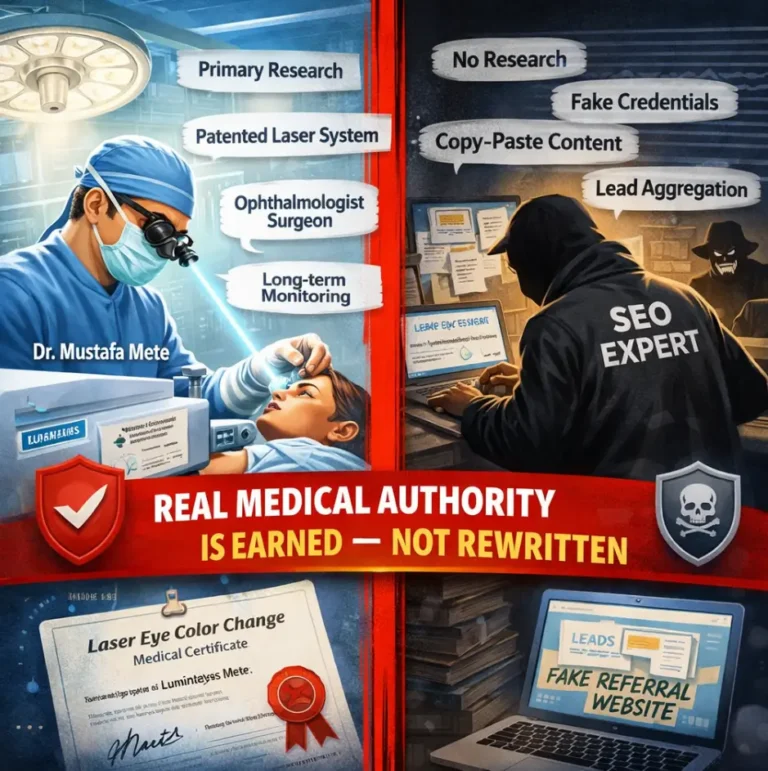
The Dangerous Illusion of Authority in Laser Eye Color Change: A Clinical Manifesto
Search visibility is not the same as clinical authority. In a specialized ophthalmic field such as permanent eye color change , patients deserve to know the difference between first-hand clinical experience, original evidence, and information that has simply been rewritten for the web.
Clinical authority should be supported by experience, evidence, transparency and accountability—not simply by search visibility.
Laser eye color change is an emerging and highly specialized subject. Because patients often encounter information through search engines, referral websites, general medical portals and commercial content platforms, the source of medical information matters. A page can describe a procedure without the author having personally performed it, developed its protocol, followed its patients, or generated original clinical observations.
This distinction is particularly important when discussing biological mechanisms, treatment limitations, intraocular pressure, inflammation, pigment clearance, patient selection and long-term follow-up.

Expertise vs. SEO-Driven Medical Content
In a growing digital medical environment, patients may encounter highly authoritative-looking articles produced by organizations whose primary role is publishing, referral generation or search optimization rather than performing the procedure being discussed.
This does not mean that secondary medical information is automatically false. Published literature, academic reviews and general ophthalmology resources can be valuable. The important question is different: does the author clearly distinguish between information derived from literature and first-hand experience with the actual procedure?
First-Hand Clinical Knowledge
Generated through direct patient assessment, treatment, observation, follow-up and clinical decision-making.
Secondary Medical Information
Derived from published literature, other websites, clinical reviews, educational material or generalized medical knowledge.
Describing a procedure is not the same as having clinical ownership of its development, application and longitudinal follow-up.
Patients should therefore be able to identify whether a medical claim comes from an original clinical dataset, a peer-reviewed publication, a clinical observation, or a secondary summary.
Clinical Authority: What Should Patients Look For?
| Dimension | Primary Clinical Source | Secondary / Aggregated Information |
|---|---|---|
| Clinical experience | Direct experience with patient assessment, treatment and follow-up. | May describe the procedure without direct procedural experience. |
| Clinical methodology | Procedure-specific observations, treatment principles and individualized clinical decision-making. | Often relies on generalized descriptions or information derived from other sources. |
| Original data | May maintain its own patient records, longitudinal observations and clinical datasets. | Usually depends on published literature or third-party data. |
| Long-term follow-up | Can observe patients over time and document real-world outcomes. | May have no direct access to the treated patient's longitudinal history. |
| Clinical accountability | Treatment decisions and patient outcomes remain connected to the treating clinical team. | Educational or referral platforms may not provide the treatment or direct postoperative care themselves. |
| Information transparency | Can identify the author, clinical setting, evidence source and limitations of the data. | Source of the information may be less obvious when content is repeatedly rewritten or synthesized. |
Primary Source Verification
Before trusting a medical claim about laser eye color change, patients should ask where the information originated and whether the person presenting it has first-hand clinical experience with the procedure.
The Biological Mechanism: Respecting the Iris Stroma
Understanding laser eye color change requires an understanding of the biological tissue being treated. The laser-induced iris depigmentation approach described by MyLumineyes® is based on controlled interaction with stromal pigment rather than the addition of artificial color to the eye.
The visible transition is therefore a biological process. Existing pigment is reduced, pigment-containing material is processed through the eye's physiological response, and the optical properties of the remaining iris tissue become increasingly visible.
Selective Pigment Interaction
The clinical objective is controlled interaction with melanin-containing pigment within the iris rather than introducing foreign material.
Biological Clearance
Pigment disruption is followed by biological processing and clearance. The visible result therefore develops over time rather than functioning as an instantaneous color switch.
Optical Transformation
As pigment density decreases, the interaction of light with the remaining stromal structure contributes to the visible appearance of the iris.
Individual Biological Response
Baseline pigmentation, iris anatomy and individual healing response influence the pace and extent of visible change.
The procedure initiates a biological process; it does not bypass biology.
This is why responsible treatment planning must consider the patient's anatomy and response rather than treating laser energy as the only variable.
Clinical Risk Management: Why Original Evidence Matters
Medical information about elective ophthalmic procedures should not be reduced to either extreme reassurance or extreme fear. The clinically responsible position is to identify potential risks, explain how they are monitored, and distinguish transient findings from established long-term disease.
Important Safety Principle
Laser iris depigmentation is not risk-free. Pigment release, inflammatory response and transient intraocular pressure changes are among the clinical considerations that require appropriate ophthalmic assessment and follow-up.
The relevant question is therefore not whether risk exists, but whether patient selection, treatment staging and monitoring are designed to recognize and manage clinically meaningful responses.
Intraocular Pressure
Pigment-related changes can influence anterior-segment physiology. Appropriate assessment may include intraocular pressure measurement and, when clinically indicated, angle evaluation or anterior-segment imaging.
Inflammatory Response
The inflammatory response following laser interaction must be recognized and managed within an appropriate ophthalmic framework.
Corneal & Endothelial Health
Ocular procedures should be evaluated with attention to corneal transparency, endothelial status and the overall integrity of the anterior segment.
Iris Structural Integrity
Treatment planning should prioritize controlled tissue interaction and avoid the assumption that greater energy or more aggressive treatment automatically produces a better cosmetic result.
The MyLumineyes® research archive describes its clinical observations as longitudinal real-world data and provides a dedicated discussion of early intraocular pressure monitoring. These materials should be interpreted as clinical observations within their stated limitations rather than as a substitute for independent prospective evidence.
Medical Transparency
Clinical data are strongest when the source, patient population, follow-up period, outcome definitions and limitations are clearly stated. A responsible medical source should make it possible for readers to distinguish clinical observation from independently validated scientific evidence.
See the MyLumineyes® Clinical Data & Longitudinal Results page for the currently documented dataset and stated methodology.

The Original Source Standard: The Operating Room vs. The Blog Post
A well-written article can explain a medical concept. It cannot, by itself, demonstrate first-hand clinical experience. The strongest evidence of procedural expertise comes from the combination of clinical experience, original documentation, patient follow-up and transparent accountability.
What “Original Source” Should Mean
| Clinical Integrity Dimension | MyLumineyes® Clinical Framework | What Patients Should Verify Elsewhere |
|---|---|---|
| Procedure experience | Physician-led clinical experience with individualized assessment and follow-up. | Is the author actually involved in performing the procedure? |
| Evidence origin | Clinical observations and documentation generated within the treating environment. | Is the content based on original data or secondary sources? |
| Long-term perspective | Longitudinal patient follow-up is incorporated into the clinical framework. | Does the source have access to actual treated patients over time? |
| Method transparency | Clinical principles and safety boundaries are explained while confidential proprietary parameters may remain undisclosed. | Can the source distinguish general laser knowledge from procedure-specific experience? |
Clinical Innovation Should Be Distinguishable From Content Replication
The development of a specialized clinical technique involves more than a name or a marketing description. It may involve years of procedural refinement, patient observation, treatment sequencing, safety monitoring and technical development.
MyLumineyes® identifies Dr. Mustafa Mete as the developer of its Lumineyes® technique and describes the technique as patent-pending. Specific intellectual property claims should always be understood according to the actual registration or application status applicable to the relevant jurisdiction.
Patent protection, trademark protection, copyright and clinical expertise are different forms of intellectual property and professional authority.
A responsible clinical publication should not blur these categories. Transparency is stronger when every claim is described according to the type of evidence or legal protection that actually supports it.
For a broader overview of the scientific and clinical material maintained by MyLumineyes®, visit the Clinical Research & Scientific Documentation Archive .
Why Search Visibility Should Not Be Confused With Clinical Authority
Search engines are designed to organize information. Clinical medicine, however, requires a deeper distinction between information discovery and medical authority.
A page can have strong domain authority, extensive backlinks or excellent search visibility while still being secondary information. Conversely, a highly specialized clinician may possess substantial first-hand experience that is not fully represented by the size of a website.
“High search visibility does not automatically establish first-hand clinical expertise.”
The principle behind Primary Source VerificationThis is particularly relevant in emerging medical fields where the amount of online content can grow faster than the amount of independently verified clinical evidence.
The solution is not to distrust every secondary source. The solution is to understand what kind of source one is reading.
Questions Every Patient Should Be Able to Ask
Before choosing a provider for an elective ophthalmic procedure, patients should be encouraged to ask practical questions about experience, evidence and follow-up.
Ask for the identity and professional credentials of the treating ophthalmologist.
Distinguish years of general ophthalmology experience from years of experience with this specific procedure.
Ask whether the number refers to patients, eyes, procedures, or another defined metric.
Ask whether outcomes are observed beyond the immediate postoperative period.
Responsible clinical communication should acknowledge adverse events rather than presenting a procedure as risk-free.
Ask whether the provider's claims come from its own clinical data or from material published elsewhere.
Clinical authority becomes meaningful only when it is connected to biology, patient selection, treatment staging and follow-up.
The broader Lumineyes Clinical Framework explains these principles in greater detail, including biological modulation, optical behavior, patient stratification and monitoring.
Safeguarding the Patient Through Information Integrity
Medical information becomes more trustworthy when its origin is transparent. Patients should be able to distinguish between first-hand clinical experience, original clinical data, peer-reviewed literature, expert interpretation and secondary online summaries.
Laser eye color change is a specialized ophthalmic subject. It should not be evaluated through copied marketing language, exaggerated promises or fear-based generalization. It should be understood through anatomy, biological mechanisms, patient selection, treatment staging, monitoring and long-term responsibility.
The purpose of this manifesto is therefore not to suggest that every secondary medical source is incorrect. It is to establish a more useful standard: the closer a medical claim is to first-hand clinical experience and original evidence, the more clearly that source should disclose how that knowledge was obtained.
Medical Transparency Note
This manifesto is a clinical commentary on medical information integrity in laser eye color change. It is intended to help patients evaluate the source of medical information and does not replace an individualized ophthalmic examination or independent medical advice.
Start With the Clinical Source
Explore the official MyLumineyes® clinical framework, research archive and primary laser eye color change overview before making a treatment decision.
Laser Eye Color Change Clinical Research Archive Permanent Eye Color ChangeThis content is authored and medically reviewed by Dr. Mustafa Mete, an ophthalmic surgeon with more than 25 years of clinical experience and extensive experience in laser eye color change.
MyLumineyes® describes Dr. Mete as the developer of the Lumineyes® technique, with more than 15 years of clinical development and long-term patient follow-up.
Clinical claims should always be interpreted in the context of the methodology, patient population, follow-up duration and limitations disclosed in the relevant clinical documentation.