
Research Archive — MyLumineyes
Cosmetic modification of apparent eye color can be achieved through fundamentally different biological and anatomical strategies. Despite producing a similar visible endpoint, these procedures should not be considered biologically equivalent.
Current approaches include cosmetic keratopigmentation (KTP), laser-based iris depigmentation procedures, and, historically, cosmetic iris implantation. These interventions differ in the anatomical compartment treated, the origin of the pigment responsible for the final appearance, the persistence or clearance of that pigment, and the mechanisms through which treatment-related biological responses may occur. Contemporary reviews identify cosmetic keratopigmentation as the most extensively studied surgical approach, while the evidence base for laser iris depigmentation remains substantially more limited. PubMed
This distinction becomes particularly important when evaluating laser-based iris color modification. The term laser iris depigmentation (LID) encompasses heterogeneous procedures and should not be treated as synonymous with the Lumineyes clinical framework. Complications reported in the LID literature therefore cannot automatically be attributed to Lumineyes without establishing procedural, dosimetric, anatomical, and biological comparability.
The Lumineyes approach was clinically developed around modification of pre-existing iris pigmentation rather than implantation of an artificial iris, corneal deposition of exogenous pigment, or intentional replacement of iris tissue. Its conceptual framework is based on Selective Stromal Melanin Modulation, Controlled Treatment-Related Pigment Response, and Response-Guided Staged Treatment.
The purpose of this Research Archive is not to establish that one cosmetic procedure is universally safer than another. Rather, it is to examine whether procedures producing a similar cosmetic endpoint should be evaluated according to the same biological model.
A shared cosmetic endpoint does not establish biological equivalence.
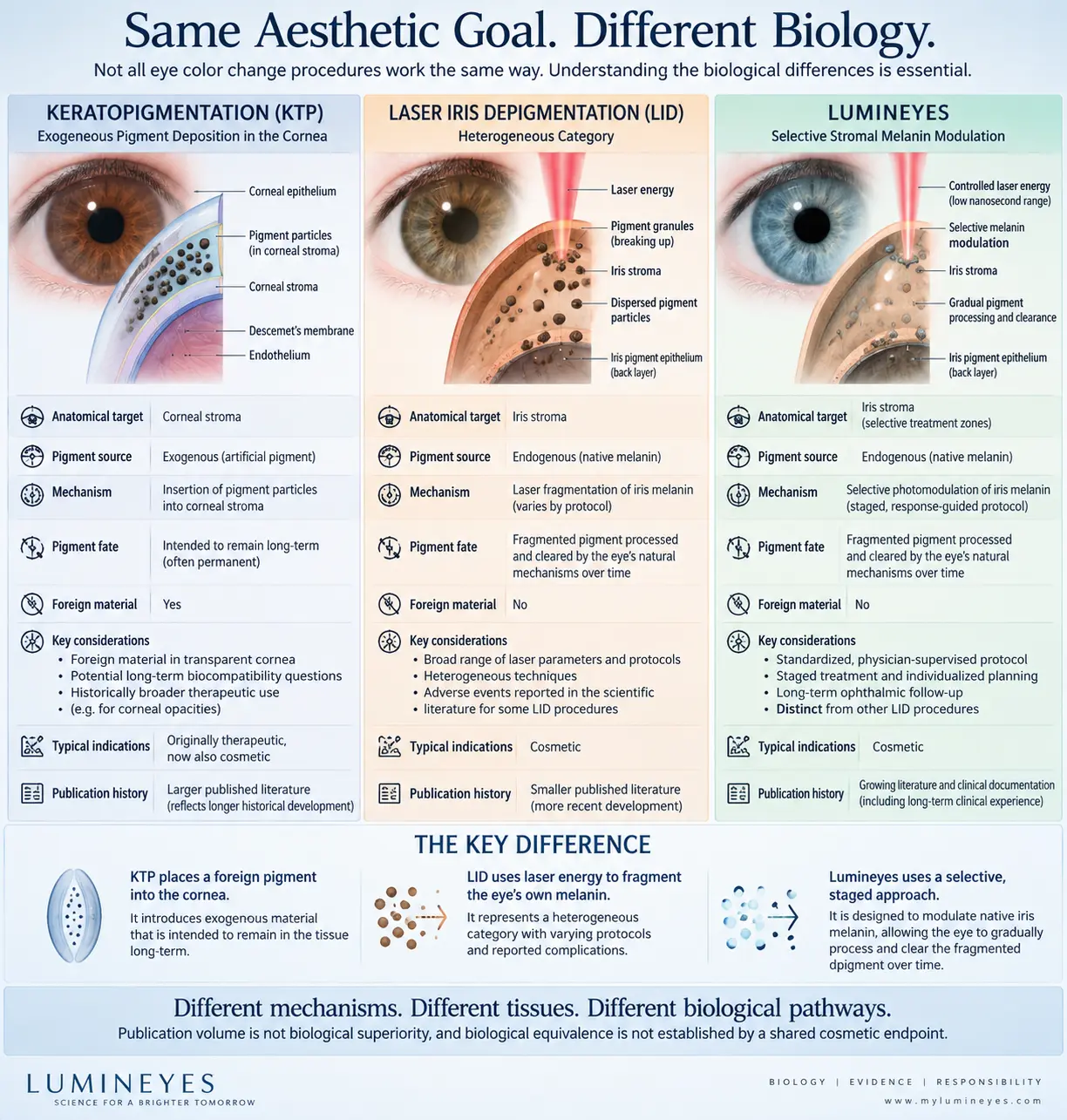
The cosmetic objective of changing apparent eye color is deceptively simple.
A patient may begin with a dark brown iris and subsequently present with a lighter brown, hazel, green, or blue appearance. From a purely visual perspective, the result may appear comparable regardless of the technique used.
Biologically, however, the pathway producing that appearance may be fundamentally different.
A procedure may:
Grouping these procedures together simply because they produce a similar visible color risks overlooking the biological events occurring between treatment and the final cosmetic appearance.
This distinction is particularly relevant because the existing literature itself treats the major cosmetic eye-color procedures as separate techniques with different mechanisms and risk profiles. Contemporary reviews identify cosmetic iris implants, laser iris depigmentation, and cosmetic keratopigmentation as distinct approaches rather than variations of a single biological procedure. PubMed Central (PMC)
The appropriate question, therefore, is not simply:
“Which procedure changes eye color?”
but rather:
“What happens to the tissue and pigment after the procedure has changed eye color?” “Consequently, when evaluating any prospective eye color change surgery, it is critical to differentiate between invasive intraocular procedures and non-invasive stromal melanin modulation.”
Cosmetic keratopigmentation changes the apparent color of the eye by introducing pigment into the corneal stroma.
In contemporary femtosecond-assisted KTP, a stromal pocket or tunnel is created and pigment is subsequently introduced into the corneal tissue. The final optical appearance therefore depends, at least in part, on the presence and optical properties of pigment that was not originally present in that anatomical compartment. PubMed Central (PMC)
This is fundamentally different from reducing the amount of pigment naturally present within the iris.
The relevant biological questions for KTP consequently include:
The KTP literature documents both favorable clinical outcomes and procedure-specific complications, including photophobia, pigment-related phenomena, neovascularization, ectasia in selected circumstances, and other complications depending on technique, pigment generation, depth, and indication. PubMed Central (PMC)
Importantly, this does not imply that all KTP pigments behave identically or that all KTP procedures have the same risk profile.
Cosmetic iris implantation represents a different biological strategy again.
Here, the cosmetic appearance is produced through placement of an artificial structure within the anterior segment rather than modification of native iris pigmentation.
The literature has documented severe complications associated with cosmetic iris implants, including uveitis, elevated intraocular pressure/glaucoma, corneal endothelial damage, cataract, and severe visual loss. PubMed
This history is relevant not because iris implants are equivalent to KTP or laser procedures, but precisely because it demonstrates why material location and anatomical interaction matter.
An implant can mechanically interact with:
That biological situation is fundamentally different from modifying endogenous iris melanin.
This distinction is essential.
Laser iris depigmentation (LID) is a broad procedural category, not a single standardized biological protocol.
Published reports and reviews describe laser-based iris color modification using different devices, parameters, treatment patterns, patient populations, and clinical protocols. The literature remains relatively limited compared with KTP, and several reviews explicitly emphasize the scarcity of long-term outcome data. PubMed
Accordingly:
A complication reported following one laser iris depigmentation procedure cannot automatically be assigned to every other laser-based iris pigmentation procedure.
This is particularly important when the following variables differ:
A meaningful safety comparison therefore requires procedural comparability, not simply the presence of the word “laser.”
The LID literature has reported complications including pigment dispersion, secondary pigmentary glaucoma, iris perforation and a reported case of laser-associated maculopathy. These reports are clinically important and should not be ignored. PubMed Central (PMC)
However, the correct scientific interpretation is:
These are complications reported in the literature of laser iris depigmentation procedures. They are not, by that fact alone, established complications of the Lumineyes protocol.
The distinction is especially important when an individual case contains additional potential explanations for an observed event.
For example, if a patient has a pre-existing infectious, inflammatory, retinal, or other ocular condition and subsequently develops a retinal or macular abnormality after a procedure, temporal association alone does not establish that the laser procedure caused the event.
The appropriate hierarchy is:
temporal association → clinical suspicion → mechanistic plausibility → exclusion of competing causes → reproducibility/epidemiologic evidence → causal inference.
This standard must apply equally to favorable and unfavorable claims.
The clinical origin of the Lumineyes approach was not the desire to place an artificial color into the eye.
It arose from the clinical problem of heterochromia and the observation that asymmetry of native iris pigmentation could potentially be modified without replacing the iris or introducing a permanent artificial pigment into the cornea.
The subsequent clinical development of the approach led to a broader biological question:
Can native stromal melanin be selectively modified while preserving the anatomical and biological integrity of the iris?
This question is fundamentally different from asking how to make the cornea or anterior segment appear a different color.
Over time, clinical observation led to recognition that treatment response itself could not simply be regarded as an immediate cosmetic endpoint. The biological response following treatment became part of the treatment process.
This led to the development of the Lumineyes framework of:
Selective Stromal Melanin Modulation → Controlled Treatment-Related Pigment Response → Response-Guided Staged Treatment.
Within the Lumineyes framework, Selective Stromal Melanin Modulation describes the intended preferential interaction with accessible stromal melanin while minimizing unnecessary exposure of surrounding ocular structures.
The term is a Lumineyes conceptual/procedural designation, not an established histopathological classification.
It should therefore not be interpreted as evidence of complete cellular selectivity.
The intended biological target is pre-existing stromal melanin rather than deliberate ablation or removal of iris tissue itself.
This distinction matters.
The objective is not:
remove iris tissue to change its appearance.
It is:
modulate the optical contribution of pre-existing stromal melanin while preserving the anatomical framework of the iris.
That distinction also creates a different biological question from KTP.
KTP asks how an introduced pigment behaves after placement within the corneal stroma.
Lumineyes asks how endogenous iris pigment behaves after controlled treatment-related modification.
Modification of endogenous pigment necessarily raises a second question:
What happens to pigment after it has been altered?
This is not a trivial secondary event.
Liberated or fragmented pigment may enter biological pathways involving cellular uptake, transport, processing, and clearance. Macrophage-mediated handling of pigment is biologically plausible and has been observed in experimental contexts involving iris pigmentation. However, macrophage activity should not be interpreted as an automatic safety mechanism.
The relevant variables include:
Therefore, the biological response to treatment is not simply a complication occurring after the procedure.
It is part of the biological process produced by the procedure.
A sequence of multiple treatment sessions does not automatically constitute a response-guided treatment strategy.
In the Lumineyes framework, Response-Guided Staged Treatment means that subsequent treatment decisions are informed by the observed biological and clinical response to the preceding intervention.
Conceptually:
Treatment → response → reassessment → interpretation → treatment decision
rather than:
Treatment → predetermined number of sessions → endpoint
This distinction becomes particularly relevant when endogenous pigment is being modified.
If treatment changes the amount and distribution of pigment available for biological processing, then the response between sessions may provide clinically relevant information before additional pigment is modified.
Accordingly, staging can be understood not merely as a scheduling strategy but as a method of controlling cumulative biological exposure.
The cornea and iris are not interchangeable biological compartments.
A pigment deposited within the corneal stroma is biologically different from endogenous melanin naturally located within the iris.
Likewise, an artificial iris implant is not biologically equivalent to either.
Therefore, comparisons based solely on the statement:
“All three procedures change eye color”
are biologically inadequate.
The relevant comparison should instead examine:
These questions provide a more meaningful framework for evaluating cosmetic ocular procedures.
One of the most important distinctions between pigment-modifying strategies is what is intended to happen to the pigment after treatment.
In exogenous pigment deposition, persistence within the target tissue is generally part of the intended cosmetic mechanism.
In endogenous pigment modulation, the desired visible change may instead arise from reducing the optical contribution of pigment that was already present.
This does not mean that endogenous pigment modification automatically guarantees complete clearance.
It does not.
Residual pigment may remain. Pigment may be redistributed. Clearance may vary between individuals. Biological processing may be incomplete.
These uncertainties are precisely why long-term observation is important.
The scientifically relevant question is therefore not simply:
“Did the eye become lighter?”
but:
“What happened to the pigment and the ocular environment over time?”
Patients do not necessarily begin with identical iris pigmentation.
Differences in:
may influence both the immediate appearance and the subsequent response to treatment. This provides the conceptual basis for the Lumineyes clinical classification framework known as LIPS. LIPS should be understood as a clinical framework developed within the Lumineyes methodology rather than as an independently validated biological classification unless and until independent validation establishes that status. Its purpose is to support individualized treatment planning rather than assuming that a single treatment strategy is appropriate for every pigmented iris.
The volume of published literature surrounding a cosmetic ocular procedure should not be interpreted as a direct measure of its biological superiority or inherent safety.
Keratopigmentation has a substantially longer historical development than modern cosmetic laser iris depigmentation. Its origins extend through older therapeutic and reconstructive applications of corneal tattooing and subsequent technical development of cosmetic keratopigmentation. A longer clinical history, broader historical application, and greater cumulative clinical use can consequently generate a larger body of published literature.
This distinction is important when comparing contemporary procedures.
A greater number of publications may indicate:
a longer period of clinical development;
a broader historical range of indications;
greater clinical adoption;
greater clinical adoption and broader historical use;
or simply a larger accumulated opportunity for publication.
It does not, by itself, establish:
biological superiority;
lower intrinsic biological burden;
superior tissue compatibility;
lower long-term risk;
or equivalence between fundamentally different treatment mechanisms.
Accordingly:
Publication volume is not biological equivalence, and biological equivalence is not established by a shared cosmetic endpoint.
This principle is particularly relevant when comparing keratopigmentation with endogenous iris pigment modulation.
Keratopigmentation introduces exogenous pigment into the corneal stroma. Lumineyes, by contrast, is designed around the controlled modification of pre-existing iris stromal melanin without intentional addition of an artificial pigment or placement of an intraocular implant. These are different anatomical targets and different biological strategies.
The appropriate scientific comparison therefore cannot be based simply on the number of publications supporting each procedure.
Instead, comparison should examine:
anatomical compartment → material origin → tissue interaction → pigment persistence or processing → biological clearance → inflammatory response → anatomical consequences → long-term clinical outcome.
A mature literature base is valuable. It does not, however, remove the need to examine the underlying biological mechanism.
The distinction between historical maturity and biological mechanism is particularly important in aesthetic ophthalmology.
A procedure may have accumulated decades of literature because it evolved from an established therapeutic technique. Another procedure may have a smaller literature because its clinical development occurred more recently or because its evidence has remained within longitudinal clinical practice rather than formal publication.
These two situations should not be confused.
The scientifically relevant question is not:
Which procedure has more papers?
It is:
What biological intervention is being performed, where is it being performed, what material is introduced or removed, and what is the subsequent biological fate of that material?
This framework allows procedures with very different histories to be evaluated according to the same biological principles without assuming that publication volume represents biological quality.
The term laser iris depigmentation describes a heterogeneous category rather than a single standardized treatment protocol.
The Lumineyes clinical framework specifically distinguishes its staged, response-guided protocol from other laser-based iris depigmentation procedures. The authors’ terminology of Selective Stromal Melanin Modulation is proposed as a conceptual and procedural description of the Lumineyes approach and is not presented as an established histopathological classification or as proof of complete cellular selectivity.
This distinction is essential when interpreting published complications.
A complication reported following another laser iris depigmentation procedure should not automatically be attributed to Lumineyes merely because both procedures use laser energy.
Meaningful comparison requires consideration of:
wavelength;
pulse characteristics;
energy and fluence;
spot size;
treatment geometry;
anatomical target;
treatment depth;
number and spacing of treatment sessions;
patient selection;
staging strategy;
postoperative monitoring;
and criteria used to determine whether additional treatment is performed.
The Lumineyes clinical framework explicitly describes staged treatment, individualized treatment planning, ongoing clinical assessment, and long-term ophthalmic follow-up.
Therefore, LID should not be used as a surrogate label for Lumineyes, and adverse-event data from heterogeneous laser procedures should not be generalized across protocols without establishing biological and procedural comparability.
The present Research Archive is intended to function as a connected scientific framework rather than as a collection of isolated claims. The following pages provide additional documentation of the clinical and biological concepts discussed here:
Laser Eye Color Change — Clinical Procedure: physician-supervised, non-incisional treatment, individualized planning, staged sessions, and long-term follow-up.
Selective Stromal Melanin Modulation: proposed biological and procedural concept underlying the Lumineyes framework.
Laser Iris Depigmentation — Clinical Perspective: protocol-specific distinction between Lumineyes and the broader heterogeneous category of LID.
Clinical Data & Safety: retrospective longitudinal clinical observations and their evidentiary limitations.
Clinical Evidence Methodology: framework for patient selection, baseline assessment, longitudinal follow-up and interpretation of clinical evidence.
Early IOP Monitoring: clinical monitoring framework for treatment-related IOP changes.
Biophysics of Selective Iris Depigmentation: laser–tissue interaction and physical principles.
Ophthalmic Lasers: broader review of laser mechanisms and ocular tissue interaction.
Biological Permanence: long-term stability, pigment reduction and biological clearance.
Advanced Scientific Analysis: structured analysis of melanin interaction, clearance and treatment logic.
These documents should be regarded as complementary components of the Lumineyes Research Archive and should not be interpreted as independent peer-reviewed validation of the Lumineyes protocol.
The comparison between KTP and Lumineyes should therefore not be reduced to:
“Which one is safer?”
A scientifically more useful comparison asks:
| Biological dimension | KTP | Lumineyes |
|---|---|---|
| Primary anatomical compartment | Corneal stroma | Iris stroma |
| Source of cosmetic pigment | Exogenous | Endogenous |
| Intended mechanism | Pigment deposition | Melanin modulation |
| Artificial pigment introduced | Yes | No intended pigment addition |
| Tissue incision/penetration | Technique-dependent | Non-incisional treatment framework |
| Pigment persistence | Part of cosmetic mechanism | Reduction/processing of native pigment |
| Biological response after treatment | Tissue response to deposited pigment | Response to pigment modification/liberation |
| Staging | Technique-dependent | Response-guided by design |
| Individualized treatment framework | Yes, depending on protocol | Central to methodology |
| Long-term evidence | More extensive published evidence | Requires continued systematic documentation |
The table should not be interpreted as a safety ranking.
It describes different biological strategies.
That distinction is the central premise of this Research Archive.
The available literature supports an important observation:
Cosmetic eye-color procedures are not biologically interchangeable.
KTP currently has a larger published evidence base than LID, reflecting in part its longer historical development and broader clinical literature. This greater publication volume should not, however, be interpreted as evidence of biological superiority, lower intrinsic biological burden, or equivalence between the two approaches.
Neither fact, by itself, establishes the biological superiority of one particular Lumineyes protocol.
Instead, it establishes the need to compare mechanisms rather than labels.
The relevant scientific question is:
Does modifying endogenous iris melanin within its native anatomical compartment constitute a biologically different intervention from depositing exogenous pigment into the corneal stroma?
The answer to the mechanistic component is yes.
The two procedures involve different tissues, different pigment origins, different anatomical compartments and different intended biological fates of pigment.
Whether those mechanistic differences translate into superior long-term clinical safety requires appropriately designed comparative and longitudinal evidence.
A cosmetic endpoint is an optical observation.
It is not a biological mechanism.
Two procedures may produce a similar visible eye color while creating fundamentally different relationships between pigment, tissue, cellular processing, anatomical structures and time.
Cosmetic keratopigmentation introduces pigment into the corneal stroma. Cosmetic iris implantation introduces an artificial structure into the anterior segment. Laser iris depigmentation procedures modify iris pigmentation through laser interaction with the iris. Lumineyes represents a distinct clinical framework centered on endogenous stromal melanin modulation and response-guided staged treatment.
These approaches should therefore not be treated as biologically interchangeable.
At the same time, scientific rigor requires that complications reported after one laser procedure not automatically be assigned to another merely because both involve a laser. LID is not synonymous with Lumineyes.
The appropriate standard is procedural and biological comparability.
The central proposition of this Research Archive is therefore deliberately narrower than a claim of universal safety:
A shared cosmetic endpoint does not establish biological equivalence.
Understanding the biological fate of pigment—and not merely the final color of the eye—should be central to the scientific evaluation of cosmetic iris color modification.
This document is a scientific research/clinical framework presented through the MyLumineyes Research Archive. It is not presented as a peer-reviewed publication or as a substitute for independently validated clinical evidence.
 Lumineyes Assistant
×
Lumineyes Assistant
×