LUMINEYES™ / EYE COLOR EDITION
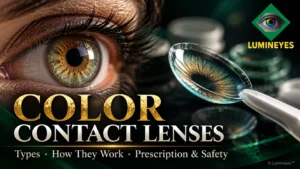
Colored Contact Lenses — Types, Appearance & Safety
Colored contact lenses temporarily change the appearance of your eyes without altering the iris itself. From subtle enhancement tints to opaque lenses for brown eyes, the best choice depends on coverage, realistic design, vision needs and professional fitting. This ophthalmologist-authored guide explains what matters before choosing a shade.
What are colored contact lenses?
Colored contacts are contact lenses with a translucent tint or an iris-like printed pattern. Most everyday cosmetic designs are soft lenses. The cosmetic effect and the optical prescription are separate features: a lens can change appearance with or without correcting vision.
Your natural eye color comes from the iris, the colored structure behind the clear cornea. Its appearance depends on pigment and how its tissues interact with light. Our eye color chart and genetics guide explains this natural variation.
How do colored contacts work?
A contact lens rests on the tear film over the cornea, in front of the iris. Translucent designs blend with the underlying color; opaque designs conceal more of it. Many cosmetic lenses have a clear central zone over the pupil, surrounded by the colored pattern.
The printed iris and the clear optical zone are not the same thing. The clear central opening has a fixed diameter, but your pupil becomes larger in dim light. If a colored pattern partly enters the visual axis, some wearers notice halos, reduced contrast or a shadowy edge. Lens decentration can add to that effect. A clinical study in 30 eyes found poorer optical quality with smaller clear zones in the particular decorative lens designs tested. [3]
A lens may therefore look excellent in a bright product photo yet feel visually different in a dim restaurant or after the pupil dilates. Check comfort, centration and actual vision in addition to the cosmetic appearance; do not rely on a marketing photograph alone.
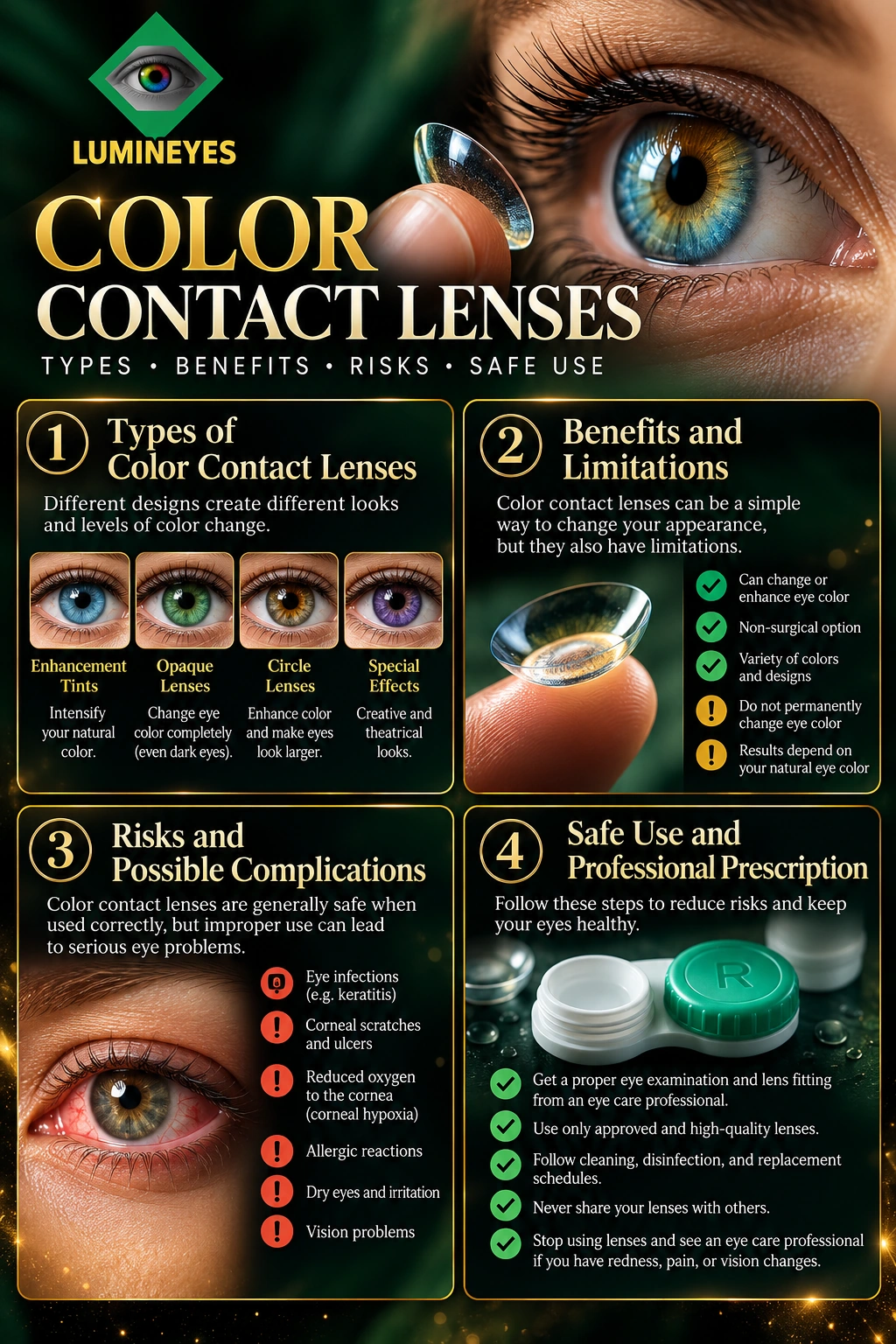
Types of colored contact lenses
The main distinction is how much of the natural iris remains visible. Tint labels describe appearance; they do not tell you whether a product fits your eyes or how long you may wear it.
On small screens, scroll the table sideways to read all columns.
| Design | What it does | What to expect |
|---|---|---|
| Visibility tint | A faint tint makes the lens easier to see when handling it. | Usually little or no visible eye-color change. |
| Enhancement tint | A translucent color blends with the natural iris. | Mainly enhances light eyes; limited change on dark brown eyes. |
| Opaque tint | A denser pattern covers more of the underlying color. | A more noticeable change, including on dark eyes; results vary. |
| Circle or limbal-ring design | A printed outer ring emphasizes the apparent iris border. | May make the iris appear larger or more defined; it does not enlarge the eye. |
| Theatrical or special-effect design | Unusual colors or patterns create a costume effect. | A deliberately dramatic appearance; professional fitting still matters. |
These categories overlap. For example, an opaque lens may also use a limbal ring or several printed tones. A color name such as “hazel” or “gray” is not a standardized promise of the result on your eye.
What should you compare besides the color?
Look at the design's opacity, how its pupil zone behaves in low light, whether the lens stays centered when you blink, and whether the material and replacement schedule suit your eyes. The most dramatic color in a product photograph may not be the best option for comfortable, clear everyday wear.
Choosing colored contacts for brown or light eyes
For dark brown eyes
Opaque colored contacts usually provide the clearest visible change on dark brown eyes. A sheer enhancement tint often leaves the brown background dominant. Coverage, the printed pattern and the size of the clear pupil opening affect how much natural color remains visible.
For blue, green, gray or light hazel eyes
An enhancement tint may deepen or shift the existing shade without masking it completely. An opaque design can create a stronger change. The same lens can look different on two people because the underlying iris and lighting differ.
Explore the natural shades before choosing a lens
Understanding real iris patterns helps you evaluate a printed design. These guides explore what makes each shade distinctive, while our aesthetics article looks at the role of personal preference rather than declaring one color universally best.
Mixed gold, brown and green.
Pigment and light interplay.
Light scattering and shades.
Color, contrast and perception.
What makes colored contacts look natural?
A natural-looking result depends on several details working together: a varied iris pattern rather than flat printed color, believable radial structures, a restrained limbal ring, a soft transition around the pupil and stable lens alignment. A very bold outer ring may emphasize contrast but can also reveal the lens. Greater opacity alone does not guarantee realism.
In a dark iris, a dense colored print can create a dramatic blue or green appearance, but a small uncovered area around the pupil may leave a contrasting brown ring. On a lighter iris, a translucent enhancement tint often blends more gently with the wearer's own pattern. Neither approach looks identical under daylight, camera flash and warm indoor light.
Begin with your existing shade in neutral light; see identify your eye color for mixed tones. When possible, assess a professionally fitted trial lens in more than one lighting environment. Online filters, influencer photos and identical shade names across brands cannot guarantee the same appearance on different eyes.
Explore your eye color digitally
Before selecting a decorative lens, explore how color and lighting affect the appearance of your iris. These two Lumineyes tools serve different purposes.
Both tools provide visual illustration, not contact-lens fitting, a clinical pigment measurement or a prediction of any procedure's outcome.
Do colored contacts require a prescription?
Yes, in the United States, including lenses with no corrective power. The FDA regulates decorative contacts as medical devices. An individual eye examination, appropriate fitting and a valid prescription are required under U.S. law. Rules in other countries can differ; professional fitting still matters for eye health. [1]
Prescription power is only part of the fit
A glasses prescription alone does not identify a suitable contact lens. An eye-care professional checks ocular-surface health, tear film, curvature, lens diameter, position, movement and visual performance. The brand and fitting parameters matter alongside corrective power. A lens that looks centered in a mirror but causes persistent foreign-body sensation or blur needs reassessment.
Plano means zero corrective power. It does not mean a lens is suitable for every eye. If you have astigmatism, dry-eye symptoms or another visual requirement, ask which colored designs are actually available and suitable; not every color comes in every prescription or material.
Before buying colored contacts online
Verify the exact brand, prescription, replacement schedule and seller. Avoid claims such as “one size fits all,” especially when no professional examination or fitting is required. Decorative lenses are not a separate, risk-free class of beauty accessory simply because they have no optical power.
Daily, reusable and monthly colored contacts
Wearing time and replacement schedule are different. Wearing time means how long the lens may stay on your eye in a day; replacement means when you must discard it. These are separate instructions and must not be confused.
- Daily disposable: use once and discard after removal; do not clean it for another day.
- Reusable: clean, disinfect and store it according to the specific lens and care-system instructions.
- Monthly replacement: replace on the prescribed schedule. The label does not permit sleeping in the lens or wearing it continuously for a month.
There is no wear-hour limit that applies to everyone. A “monthly” label describes the replacement interval, not permission to wear the lens for 30 days without removal. Ask about your daily wearing time, replacement date and care routine before starting. Even if you only wear lenses for a party, do not keep a reusable pair beyond its recommended replacement period or use expired care products.
Are colored contact lenses safe?
Properly fitted colored contacts can be worn by suitable users, but no contact lens is automatically risk-free. Lens material, fit, oxygen transmission, hygiene and wearing habits all matter. The American Academy of Ophthalmology particularly warns against decorative lenses obtained without a proper prescription. [2]
- Wash and dry your hands before handling lenses; never share them.
- Keep lenses away from water, including while showering or swimming.
- Use the recommended care system and fresh disinfecting solution for reusable lenses.
- Do not sleep in lenses unless your eye-care professional specifically prescribes that use.
For deeper discussion of keratitis, corneal injury and prevention, read colored lens risks. This page focuses on lens selection, fitting, appearance and the essential precautions.
Can contact lenses permanently change eye color?
No. Colored lenses change appearance only while they are worn. Removing the lens reveals the natural iris because its pigment has not been changed. Our explanation of melanin and eye color covers the underlying pigment.
Procedures intended to produce permanent eye color change are a separate medical topic with different evidence and risks. A temporary contact-lens effect does not predict a procedure's outcome or suitability.
Frequently asked questions about colored contacts
What is the difference between enhancement and opaque colored contacts?
Enhancement tints are translucent and mainly intensify a light natural iris. Opaque tints cover more of the underlying color and can create a stronger change, including on dark eyes.
Which colored contacts work best for dark brown eyes?
For a noticeable change, dark brown eyes usually need an opaque design. There is no single best lens for everyone: the result depends on coverage, pattern, pupil opening and professional fitting.
Can colored contacts look completely natural?
Some designs can look subtle, but no lens is guaranteed to look natural on every eye. Underlying iris color, print detail, lighting, pupil size and lens movement all affect the result.
What does a plano colored contact lens mean?
Plano means zero corrective power. The lens changes appearance without correcting a refractive error. It still needs appropriate fitting and care; normal vision does not make every lens suitable.
Do I need a prescription for colored contacts if my vision is normal?
Yes, in the United States. A valid prescription is required even for zero-power cosmetic contacts. Other countries have their own rules; professional fitting remains important wherever you obtain lenses.
Can I wear colored contacts if I already need vision correction?
Many designs are available with corrective power. Options depend on your contact-lens prescription, including any astigmatism, and the available fitting parameters. A glasses prescription alone does not specify a suitable contact lens.
How many hours can I wear colored contacts?
There is no universal safe number of hours. Follow the wearing time prescribed for your specific lenses and eyes. Remove them if discomfort or visual changes develop, even before that time is reached.
Why do colored contacts sometimes look different in photographs?
Flash, ambient lighting, camera white balance, filters and pupil size can change the apparent shade. Product images cannot guarantee the same result on your eyes.
Can colored contacts change my real eye color over time?
No. They do not permanently change iris pigment. Their cosmetic effect ends when the lens is removed. An unexpected persistent change in eye appearance should be assessed by an eye-care professional.
Are prescription colored contacts automatically safe?
No contact lens is risk-free. A prescription and proper fit are starting points; hygiene, replacement, wearing time and follow-up still matter. Do not keep wearing a lens that causes pain, redness or blurred vision.
Medical references
- FDA. Decorative lens prescription guidance.
- American Academy of Ophthalmology. Risks of colored contacts (2024).
- Jung JW et al. Pigment-free optical-zone study. Br J Ophthalmol. 2016;100:633–637. PMID: 26377415.