Hazel Eyes: Colors, Photos, Genetics & Rarity
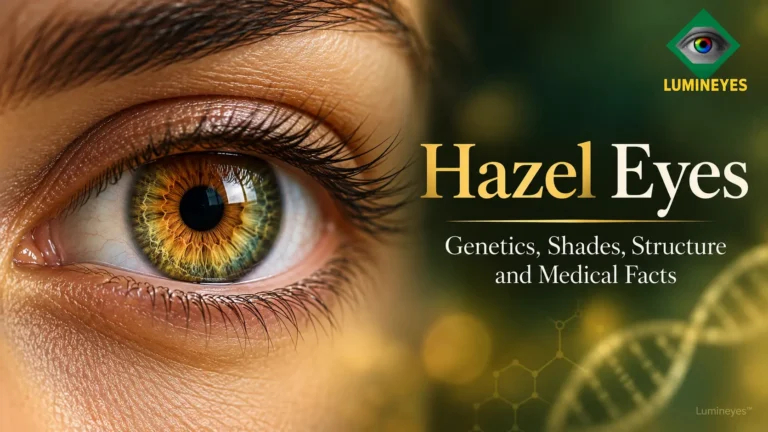
Hazel eyes blend brown, green, and golden tones in patterns that can look strikingly different from one person to another. Their appearance reflects the interaction of iris melanin, stromal structure, and lighting—not a pigment that changes from day to day.
- Hazel vs. green & amber
- Why colors appear to shift
- Genetics & rarity
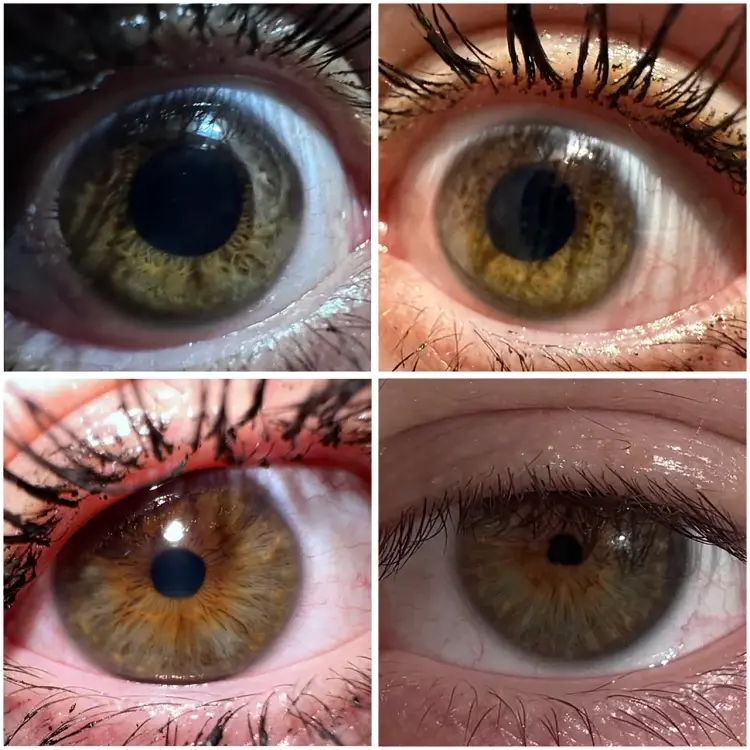
Hazel eyes are a mixed-appearing natural iris color, usually featuring brown or gold together with green or olive areas. Some have a golden center and greener outer zone; others appear mostly light brown with subtle green flecks. There is no single universal laboratory threshold separating hazel from green or amber.
What Do Hazel Eyes Look Like?
Unlike a uniformly brown or blue iris, a hazel iris may have several visible shades at once. Common appearances include a honey-brown center with green edges, an olive-green background with golden flecks, or a brown-green blend that changes in prominence under different illumination.
Some irides have a darker outer border, sometimes called the limbal ring. This can create contrast and make the lighter inner colors easier to see. The relative prominence of these colors varies among individuals; the appearance is not a fixed set of concentric circles.
If you are uncertain whether your eye is hazel or green, start by observing the overall iris under neutral daylight and then compare it with our What Is My Eye Color? guide. For the broader range of classifications, see the Eye Color Chart & Genetics resource.
Mixed hues
Brown, gold, olive, and green may appear in different combinations or zones.
Variable pattern
Flecks, radial streaks, a warmer pupil zone, or a contrasting outer iris may be present.
Optical variation
Daylight, camera white balance, and pupil size can change how prominent each tone looks.
Hazel vs. Green, Amber and Light Brown Eyes
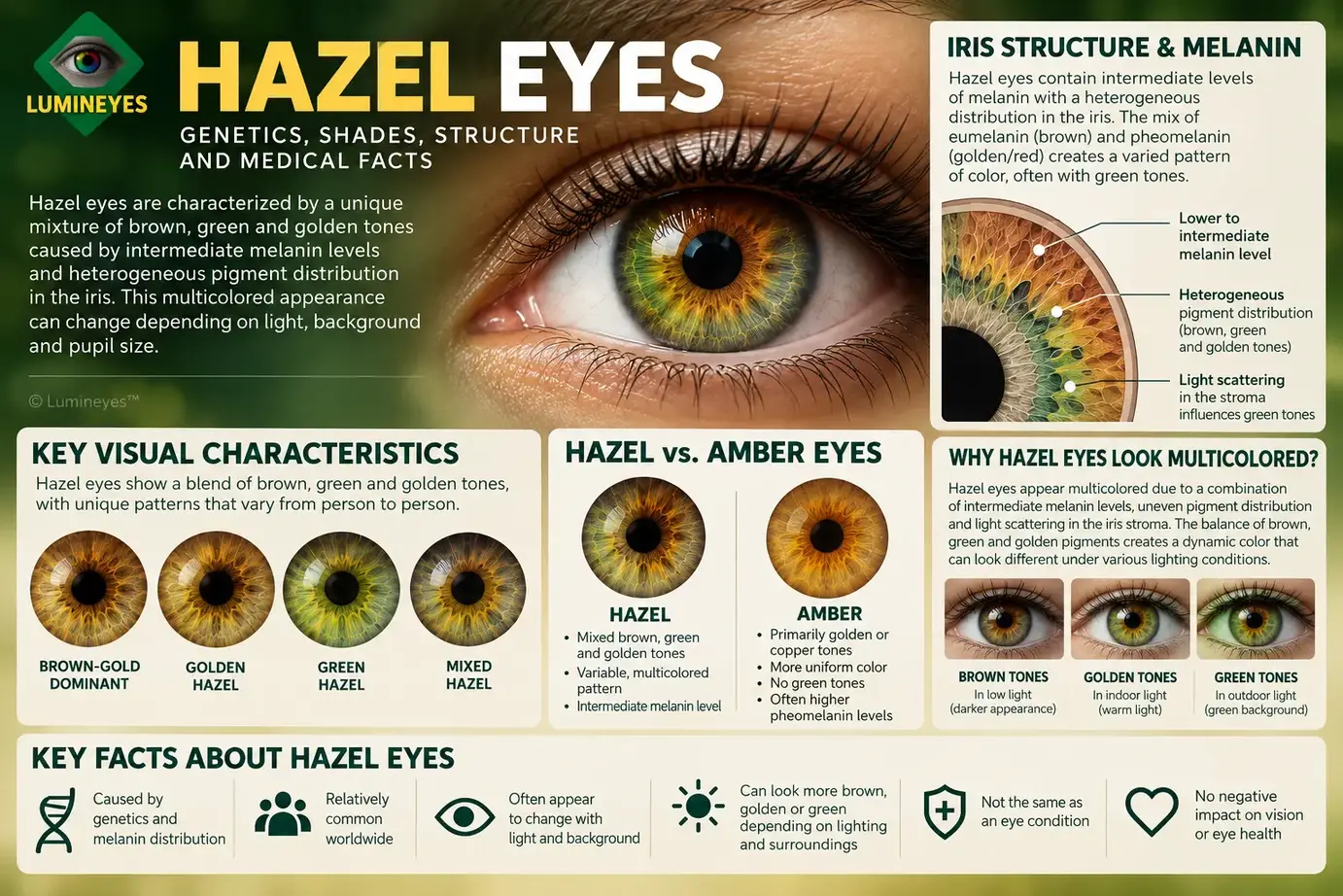
Many people search for hazel vs. green eyes because their iris looks olive outdoors but brown indoors. The most useful distinction is the overall distribution of visible shades, not one isolated fleck. These categories overlap, so photographs may not always establish a definitive label.
Hazel
Mixed green, brown, and gold; substantial variation across the iris.
Green
More consistently green or olive across the overall visible iris.
Amber
Generally more uniformly golden, yellow-brown, or copper.
Light brown
Predominantly brown, possibly with warm highlights and a lighter center.
Color circles are conceptual visual aids, not calibrated clinical iris photographs or diagnostic standards.
| Color label | Typical dominant impression | Pattern clue |
|---|---|---|
| Hazel | Green-brown or gold-brown mix | Multiple visible shades and transitional zones |
| Green | Green / olive | Green usually dominates the overall appearance |
| Amber | Yellow-gold / copper | More uniform warm color with little visible green |
| Light brown | Warm brown | Brown dominates, even with golden highlights |
For more detail, read how green eyes form or see blue eyes and their different shades. Blue eyes are included for comparison, but the biology and rarity of that color are covered in their own guides rather than repeated here.
Why Do Hazel Eyes Have Several Colors?
Normal eye color is shaped primarily by the amount and spatial distribution of melanin in the anterior iris and by how light interacts with its stromal architecture. In hazel eyes, intermediate and uneven-appearing pigmentation often produces a mixed result, with some regions looking warmer or darker than others.
Areas with greater visible pigmentation tend to absorb more light and look brown. In less pigmented regions, tissue structure and wavelength-dependent light scattering contribute more to greenish or grayish appearances. The particular combination of pigmentation, iris texture, and illumination makes every hazel iris visually different.
The iris is a living structure that also regulates pupil size; for a focused overview of its anatomy, visit What Is the Iris?. Blue, green, and hazel appearances should not be understood as three separate dyes deposited in the iris.
Important distinction: The visual label “hazel” describes iris appearance. It is not a measurement of melanin concentration, and it does not by itself predict the response to any eye color treatment.
How Rare Are Hazel Eyes?
Hazel eyes are uncommon globally compared with brown eyes. A published review gives an approximate worldwide estimate of 5% for hazel eye color, but this figure should be interpreted cautiously rather than as an exact population count. Definitions differ across studies, and many datasets combine green, hazel, or intermediate iris colors into a single category.
The prevalence also differs substantially by ancestry and geographic population. A percentage from a selected regional sample cannot automatically be applied to the entire world. Studies that measure iris color continuously rather than by broad labels demonstrate how much information is lost when variable pigmentation is forced into a single category.
To compare hazel with other uncommon appearances, visit Rarest Eye Colors. This page deliberately focuses on the appearance and biology of hazel eyes rather than ranking every natural iris shade.
Evidence context: “About 5% worldwide” is a commonly cited estimate, not a universally standardized epidemiological measurement. See the molecular review and quantitative pigmentation studies in the references below.
Hazel Eye Genetics: Is There a Hazel-Eye Gene?
Human iris color is a polygenic trait. Variants in the HERC2 and OCA2 region are important determinants, but additional loci and interactions influence both pigmentation and iris appearance. Hazel is not inherited through a single simple dominant-versus-recessive “hazel gene.”
Parents with the same broad eye-color label can have children whose eye colors differ, and a photograph alone cannot reliably predict inheritance. Large genome-wide studies have identified many regions associated with eye-color variation, reinforcing the complexity of the trait.
For an extensive genetics overview across all eye colors, see the Eye Color Chart & Genetics Guide. The purpose of this article is narrower: how a hazel phenotype looks and why it occurs.
Do Hazel Eyes Change Color in Sunlight or Over Time?
Hazel eyes may appear greener in daylight, warmer under yellow indoor lights, and darker when the pupil is dilated. Clothing, makeup, reflections, and camera processing can also change the perceived balance of green and brown. These changes usually reflect optics and contrast rather than rapid changes in melanin.
- Natural daylight: Often reveals a broader range of subtle olive and golden tones.
- Artificial lighting: Warm illumination can emphasize amber and brown areas.
- Pupil size: Changes how much of the surrounding iris is visible and can alter perceived contrast.
- Photography: Flash, distance, exposure, white balance, and filters can significantly distort color comparisons.
Some children experience gradual eye-color development as iris pigmentation matures. In adults, a new, persistent, or asymmetric change in iris appearance warrants ophthalmic evaluation, particularly if associated with pain, light sensitivity, reduced vision, or redness.
Hazel Eyes vs. Central Heterochromia
A central ring of one color around the pupil may be described as central heterochromia, while “hazel” generally refers to the overall mixed color impression. These terms sometimes overlap in casual use, but are not identical diagnoses. If you are comparing marked color differences between eyes or sectors of an iris, see our heterochromia overview.
Can Hazel Eyes Be Made Lighter?
Clothing and lighting may accentuate existing green or gold tones, but diet, household drops, and online “eye color changing” exercises do not reliably alter iris melanin. Properly prescribed colored contact lenses offer a temporary change in visible appearance, with their own hygiene and fitting requirements.
Can Lumineyes™ Lighten Hazel Eyes Toward Green, Blue or Gray?
In carefully selected, medically suitable adults, the Lumineyes™ staged laser iris depigmentation approach aims to reduce visible anterior iris stromal melanin. A hazel iris may become lighter and may appear greener; depending on the individual's pigmentation and structural optical characteristics, bluish or grayish appearances may also occur. These are possible appearances, not selectable or guaranteed final colors.
Baseline hazel coloration alone cannot predict the result. Responses vary with melanin distribution, iris structure, the degree of pigment reduction and individual healing. Treatment also carries potential risks, including inflammation and intraocular-pressure changes; long-term comparative evidence remains limited. Appropriate candidacy requires a detailed ophthalmic examination and monitoring, not a desired-color checklist.
For the clinical process, eligibility, risks and realistic outcomes, see our Laser Eye Color Change: Lumineyes™ Procedure & Safety Guide. You can also explore green, blue and gray shades using the Eye Color Simulator, but a digital preview does not predict an individual's treatment outcome.
Hazel Eyes: Frequently Asked Questions
Are hazel eyes rare?
Hazel eyes are uncommon worldwide. Around 5% is a widely cited estimate, but the actual rate varies with population and with how researchers define the hazel category.
Are hazel eyes green or brown?
Typically both tones contribute to their appearance. Some hazel irides look mostly green with golden or brown areas; others look mostly brown with olive-green zones.
What is the difference between hazel and amber eyes?
Hazel usually contains a more obvious mixture of green and brown or gold. Amber is generally described as a more uniform gold, yellow-brown, or copper appearance. The categories overlap in practice.
Why do my hazel eyes look greener in sunlight?
Daylight changes the balance of reflected light and contrast within the iris, so green or olive areas can become more noticeable. The pigment itself does not rapidly switch color.
Can two brown-eyed parents have a hazel-eyed child?
Yes. Eye color depends on many inherited variants, not a single dominant or recessive eye-color gene.
Do hazel eyes contain less melanin than brown eyes?
Hazel eyes often have intermediate anterior iris pigmentation relative to darker brown eyes, but there is substantial overlap, and a color name alone cannot quantify melanin.
Are hazel eyes the same as central heterochromia?
No. Hazel is a descriptive overall eye-color category; central heterochromia describes a distinct inner color ring. Some irides may be described using both terms.
Can Lumineyes™ turn hazel eyes green, blue or gray?
Staged laser iris depigmentation may lighten a hazel iris in medically suitable individuals. Some results may look greener, bluish or grayish, depending on individual iris biology. None of these shades can be selected or guaranteed, and ophthalmic safety assessment and monitoring are necessary.
Can the Eye Color Simulator predict my future iris color?
No. The MyLumineyes Eye Color Simulator is intended for digital visualization only. It cannot predict an individual response to laser treatment or guarantee a particular eye color.
Evidence & Further Reading
- Molecular and biochemical mechanisms of human iris color: a comprehensive review. PubMed 32488945. Discusses pigmentation biology and commonly cited eye-color estimates.
- Genome-wide association study in almost 195,000 individuals identifies 50 previously unidentified genetic loci for eye color. Science Advances, 2021.
- Genome-wide association studies of quantitatively measured skin, hair, and eye pigmentation in four European populations. PubMed 23118974. Demonstrates that measured pigmentation is a continuous trait.
- Genetics of human iris colour and patterns. PubMed 19619260. Reviews HERC2/OCA2 and the genetic complexity of iris traits.
- D’Oria F, et al. Cosmetic Change of the Apparent Color of the Eye: A Review on Surgical Alternatives, Outcomes and Complications. Ophthalmology and Therapy (2022). PubMed 35061240. Reviews limited evidence and clinical risks of laser iris depigmentation.