Rarest Eye Colors in the World
Green, gray, amber and hazel eyes are uncommon—but the science of rarity is more nuanced than a single percentage chart. Discover what makes these iris colors distinctive, why classification matters, and how heterochromia and violet-like appearances fit into the picture.
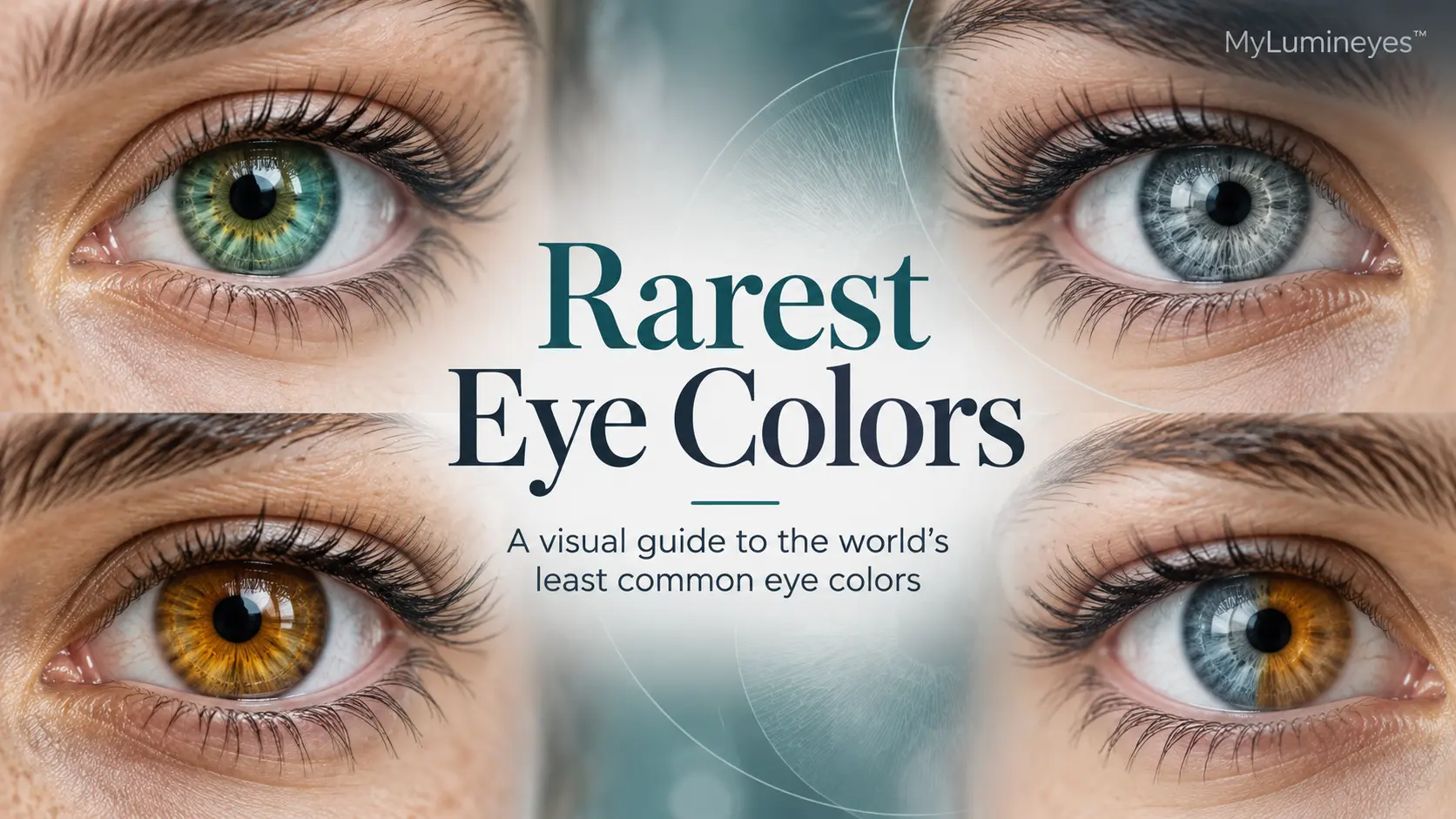
What is the rarest natural eye color?
Green is often cited as the rarest of the widely recognized natural eye-color categories, at approximately 2% of the global population. However, gray and amber are not consistently separated from neighboring color categories in population studies. As a result, it is not scientifically sound to claim that every named shade has an exact, universally accepted worldwide rank. [1] [2]
Eye color is a visible biological spectrum, not a collection of sharply separated pigments. A green iris can contain golden flecks; a gray iris may look blue under certain lighting; and amber may be confused with light brown or hazel. Population ancestry, illumination and the classification method all influence how often a color is reported.
A commonly quoted worldwide estimate for green as a distinct eye-color category.
A broad published estimate; some datasets combine hazel and green.
No single robust global percentage applies across all definitions and studies.
These figures are approximate summaries from the literature—not results of a single worldwide census. Heterochromia is a pigmentation pattern, while red or violet-like eyes generally describe an appearance rather than an ordinary eye-color category.
The rarest eye colors: a careful comparison
Rather than forcing different biological phenomena into a misleading ranking, this guide separates ordinary color categories from unusual iris patterns and disease-associated appearances.
Green eyes
Green-appearing eyes usually show relatively limited to intermediate anterior iris pigmentation combined with stromal light scattering. Their appearance may range from olive green to bright green with golden accents.
Explore green eyes →Gray eyes
Gray irises can appear silver, slate or blue-gray. Their optical character reflects relatively low anterior pigmentation and structural effects; studies do not always distinguish gray from blue.
Compare with blue eyes →Amber eyes
Amber describes a predominantly golden, honey or copper iris appearance. Because amber is often grouped with hazel or light brown, a precise worldwide prevalence should be treated cautiously.
Identify your iris shade →Hazel eyes
Hazel is a mixed appearance combining brown, green, olive or gold in varying proportions. Central brown rings and changing color impressions in different lighting are common descriptions.
Explore hazel eyes →The colored iris circles above are stylized visual markers, not diagnostic images or calibrated clinical color standards.
See how rare iris appearances differ
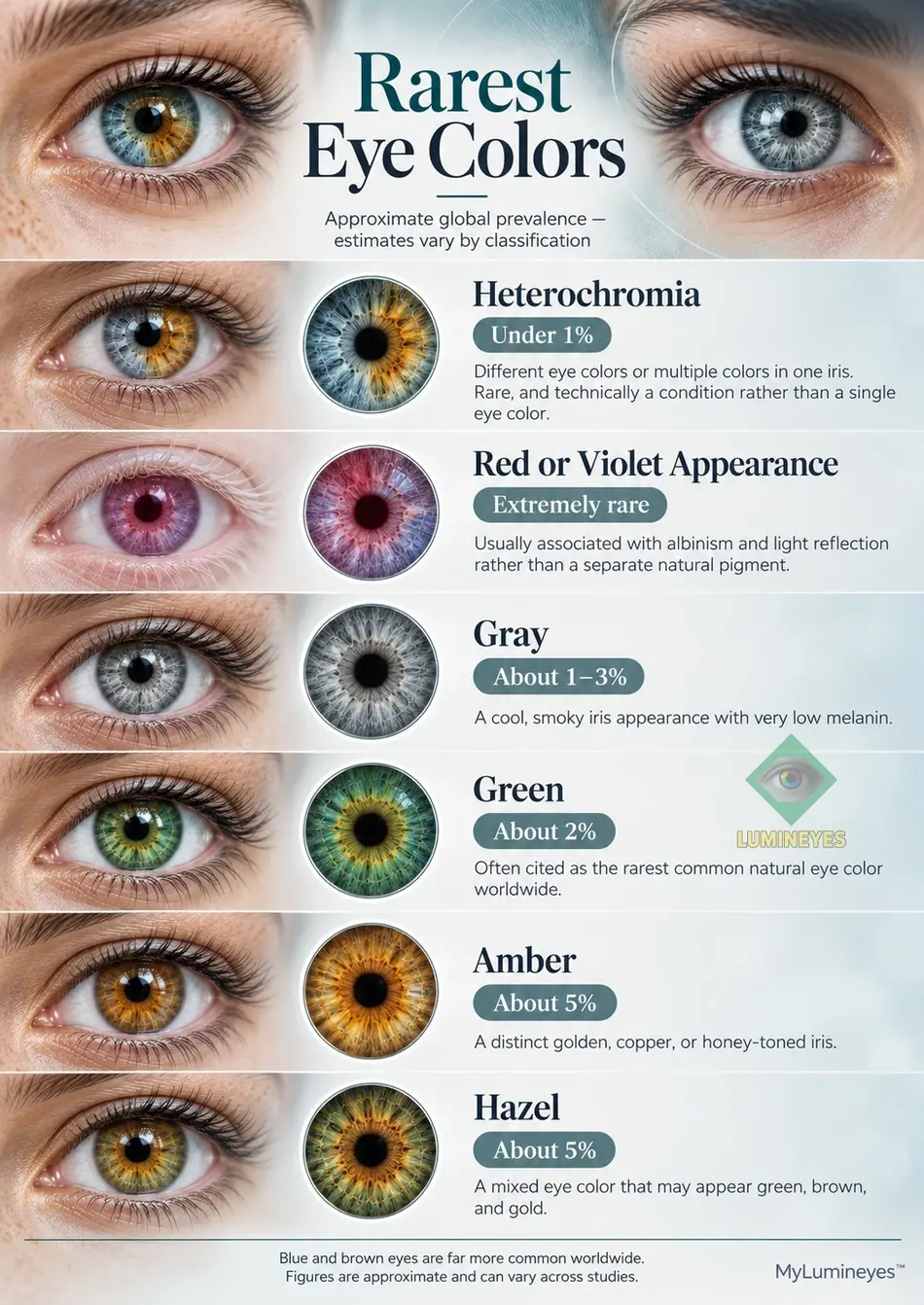
The infographic offers a side-by-side visual introduction to uncommon colors, heterochromia and very low-pigment appearances.
How to read its percentages: the green and hazel figures reflect commonly quoted broad estimates, while ranges sometimes assigned to gray, amber or heterochromia are less firmly established. They should not be interpreted as a definitive worldwide epidemiological ranking.
For a more complete breakdown of inheritance and pigment distribution, visit the Eye Color Chart & Genetics Guide.
| Appearance | Evidence-based interpretation | What to remember |
|---|---|---|
| Green | ~2% in a commonly cited review. | A rare mainstream iris-color classification. |
| Gray | Uncommon; no consistent global estimate. | Frequently grouped with blue or blue-gray. |
| Amber | Uncommon; no consistent global estimate. | May be classified as hazel or light brown. |
| Hazel | ~5% in a commonly cited review. | Definitions vary; often grouped with green. |
| Heterochromia | Uncommon, but robust overall prevalence is not established. | A distribution pattern, not a single color. |
| Red/violet-like | Very unusual optical appearance, not a standard pigment category. | May be associated with albinism and lighting. |
What makes these iris colors distinctive?
Melanin quantity is important, but visible eye color also depends on how pigment is distributed and how light interacts with the iris stroma.
Green eyes: rare, but not biologically uniform
Green eyes are widely described as one of the rarest major natural colors. Most show a combination of comparatively limited or intermediate anterior stromal pigmentation, tissue scattering and subtle yellow-brown or olive regions. The overall appearance can vary from muted olive to brighter green, and it may change under different light sources without any biological alteration in the iris.
There is no universally accepted single “green pigment” that explains every green iris. Detailed color categories reflect a continuum of pigment density, spatial patterns and optical conditions. The dedicated Green Eyes guide explores shades, genetics and distinguishing features in more depth.
Green versus hazel: green usually has a green-dominant overall impression, while hazel more visibly combines green/olive regions with brown or gold. Boundaries are subjective and lighting-dependent.
Gray eyes: why silver and blue-gray often overlap
Gray irises have a neutral, steel-like or smoky appearance. The visual impression is associated with relatively low anterior stromal melanin and the optical behavior of iris tissue. Gray can be mistaken for pale blue, particularly when photography, ambient reflections or color balance shifts the image toward a cooler shade.
Some published eye-color classifications do not include gray as a standalone category, making statements such as “exactly 1%” or “exactly 3% worldwide” difficult to establish. For the related structural explanation, see Blue Eyes: Genetics, Shades and Medical Facts.
Amber eyes: golden color without a fixed global percentage
Amber eyes are often described as predominantly golden-yellow, copper or honey-toned, sometimes with relatively even coloration across the visible iris. Their warm appearance distinguishes them from many green or gray irises. However, photographic descriptions alone may not reliably differentiate amber from light brown or warm hazel.
Claims that amber eyes always contain a specific concentration of pheomelanin, or that precisely 5% of people have amber eyes, go beyond what routine visual classification can establish. It is more accurate to discuss amber as an uncommon appearance whose reported prevalence depends strongly on definitions.
Hazel eyes: a mosaic of green, brown and gold
Hazel is not simply a lighter version of brown. It often features a combination of color zones: a brown or gold area around the pupil with green or olive in the mid-periphery, sometimes with a darker limbal ring. This variable distribution can create the impression that the iris shifts color with different clothing or lighting.
The widely quoted figure of about 5% should be understood as a broad estimate rather than an exact global measurement. Our Hazel Eyes guide focuses on mixed pigmentation patterns and their optical effects.
What about blue eyes?
Blue eyes are relatively uncommon globally, but generally more frequent than green in broad population summaries. Their blue color is primarily structural rather than the result of blue iris pigment. Read the dedicated Blue Eyes article for the full genetics and shades discussion.
What about brown eyes?
Brown is the most common iris-color category in global reviews. Higher anterior iris melanin generally produces darker appearances, although brown ranges from honey and light brown to very dark brown. To compare all major categories, see the Eye Color Chart.
Heterochromia, violet eyes and other unusual appearances
Not every striking iris appearance belongs in the same classification as green, gray or amber.
Heterochromia: different colors within or between eyes
Heterochromia describes a difference in iris coloration. In complete heterochromia, the two eyes have different predominant colors. In sectoral or partial heterochromia, one region of an iris differs from the rest. A differently colored central ring may be described as central heterochromia, although definitions vary.
Heterochromia can be congenital and harmless, but it may also arise in association with developmental conditions, injury, inflammation or other ocular disorders. There is no well-established single worldwide prevalence figure covering all its forms. [3] Read the dedicated Heterochromia guide for examples and clinical context.
Complete heterochromia
One iris is predominantly a different color from the other—for example, one blue and one brown. The difference is between eyes.
Sectoral and central patterns
One iris contains a distinct segment or central zone of different coloration. These patterns are not equivalent to a new worldwide color category.
Can eyes really be violet, purple or red?
Descriptions such as “violet eyes” and “red eyes” require careful interpretation. A genuinely purple iris pigment is not part of the usual human eye-color classification. Extremely low iris pigmentation, especially in some forms of albinism, can create unusual reddish, pinkish or violet-like appearances under particular illumination. Most people with albinism do not simply have uniformly red eyes; iris appearance varies by condition and residual pigment. [4]
A dramatic violet iris in a photograph may also reflect lighting, editing, contact lenses or white-balance effects. These possibilities should not be confused with evidence of a separate purple pigment.
Are truly black eyes a separate natural color?
Eyes that look black generally have very dark brown irises, particularly when the pupil is large or illumination is low. “Black” is not ordinarily treated as a separate pigmentation category in the medical literature.
The science behind rare eye colors
Melanin, stromal structure and light scattering
The iris is living tissue, not a flat colored surface. Its visible appearance results from pigment in the anterior iris, microscopic stromal architecture and the absorption and scattering of light. Brown eyes generally have more melanin in the visible anterior iris layers. Blue and some gray-appearing irises have substantially less, allowing structural light scattering to influence the perceived color. Green, hazel and amber lie within a broad range of intermediate or mixed appearances.
The amount and distribution of melanin are not the same thing. Two people may show a similar overall eye color while differing in their central rings, radial fibers, crypts, pigment spots and peripheral iris tones. This is one reason a photograph cannot reliably determine the precise biological characteristics of an iris. For anatomy, see What Is the Iris?
The OCA2–HERC2 region and polygenic inheritance
Human eye color is a polygenic trait. Variants affecting OCA2 and its regulatory relationship with HERC2 are especially important, but many additional genes influence pigment production, storage and iris appearance. A simple rule that “brown always dominates blue” cannot account for every family. Genetics shapes a continuum of pigmentation rather than a fixed set of discrete shades. [5]
For a comprehensive genetics-focused discussion, follow the Eye Color Chart & Genetics Guide. This rarity guide concentrates on how uncommon appearances should be described and compared.
Why rarity changes across populations
Global percentages can obscure major regional differences. Eye-color distributions vary across ancestry groups and geographical populations, while migration and shared ancestry influence observed frequencies. A shade that is unusual in one region may be relatively familiar in another. Importantly, “global prevalence” estimates do not all come from consistently sampled, representative international datasets.
Why a rare color can look different in every photograph
Daylight, shade, camera white balance, flash reflection, exposure, pupil diameter and surrounding contrast can all change the way iris color appears. Green may look gray; gray may appear blue; hazel can look warmer or browner indoors. To compare photographs responsibly, use similar illumination, camera distance, exposure and viewing conditions. Perceived color change in photographs is not proof that the iris pigment has biologically changed.
How can you tell similar rare eye colors apart?
| Comparison | Useful visual clue | Important limitation |
|---|---|---|
| Green vs. hazel | Green-dominant appearance versus mixed green, brown and gold zones. | No sharp clinical boundary; color labels overlap. |
| Gray vs. blue | Neutral slate or silver tone versus more evidently blue chromatic appearance. | White balance and lighting can alter the apparent category. |
| Amber vs. hazel | More uniform golden or copper look versus mixed areas of brown and green. | Some classification systems merge the categories. |
| Dark brown vs. black | Brown detail becomes visible with controlled, adequate lighting. | Large pupils and underexposure can make dark brown look black. |
The most practical first step is to identify your dominant iris color, then consider secondary rings and localized pigment differences. Our What Is My Eye Color? guide provides a more detailed visual identification approach.
Can an unusual eye color signal a health problem?
A lifelong, stable rare eye color is usually a normal variation. However, a new or progressive change in one eye deserves a different interpretation from a naturally unusual iris. An acquired change may sometimes relate to injury, inflammation, medication effects, changes in iris tissue or other ocular findings.
If color change is sudden or accompanied by pain, redness, light sensitivity, visual changes or a difference in pupil appearance, seek assessment from an ophthalmologist promptly. A photograph or online color classifier cannot establish whether the iris is healthy.
These medical considerations also explain why eye-color rarity is not a measure of visual acuity, ocular health or personal attractiveness. A green or gray iris is neither inherently healthier nor inherently superior to a brown iris.
Curious how different eye colors might look?
Eye color can be explored digitally for educational and aesthetic comparison. An image-based simulator can illustrate possible appearances, but it does not analyze all underlying biological features and cannot predict a medical outcome.
Explore eye-color variations with the simulator
Preview green, blue, gray, honey and other iris shades as a visual experiment. This is a digital illustration—not a promise of the final result of any treatment.
Open the Eye Color Simulator →What about clinical eye-color change?
Natural eye-color rarity and elective iris depigmentation are separate subjects. Laser iris depigmentation is an ophthalmic procedure with individual variability, medical eligibility considerations and potential risks; the exact shade cannot be selected or guaranteed. Readers looking for procedural information should consult the dedicated Laser Eye Color Change clinical guide and the more technical Laser Iris Depigmentation explanation, rather than treating this genetics and rarity article as a procedure guide.
Explore eye-color science by topic
Each guide develops a different subject in detail, without duplicating the focus of this rare-colors overview.
Frequently asked questions about rare eye colors
What is the rarest eye color in the world?
Green is commonly cited as the rarest of the widely recognized natural eye-color categories, at around 2% globally. Gray and amber may also be very uncommon, but differences in classification prevent a definitive universal ranking.
Are gray eyes rarer than green eyes?
They may be, depending on the population and how gray is defined. Because many studies combine gray with blue, there is no sufficiently consistent worldwide prevalence estimate to declare one always rarer than the other.
How rare are green eyes?
A commonly cited scientific review places green eyes at approximately 2% worldwide. This is a broad estimate, not an exact census figure, and frequencies vary among populations.
Are amber eyes rarer than hazel eyes?
Amber is generally described as uncommon, but no reliable global comparison is available because amber, hazel and light brown may overlap in different color-classification systems.
Are violet or purple eyes naturally possible?
A violet-like appearance can occur under particular optical conditions, especially with very low iris pigmentation, but violet is not generally recognized as a distinct iris pigment category. Lighting, images and contact lenses can also create purple-looking eyes.
Is heterochromia the rarest eye color?
Heterochromia is not one color: it is a difference in iris coloration within one eye or between both eyes. It is uncommon, but a robust single global prevalence for all types is not established.
What is the difference between green and hazel eyes?
Green eyes usually appear predominantly green. Hazel eyes typically show a mixture of brown, green, olive or gold, often in visible zones or rings. The boundary is subjective and can be affected by lighting.
Can two blue-eyed parents have a child with brown eyes?
Yes, although it is uncommon. Eye color depends on the combined effects of multiple genes, so the old single-gene dominant-versus-recessive rule does not predict every outcome.
Do rare eye colors change with age or lighting?
Eye color can develop during childhood, and some gradual changes may occur over time. Day-to-day shifts in photographs are usually optical effects of illumination, pupil size or camera settings rather than rapid pigment changes.
Can a simulator predict a specific laser eye-color result?
No. An eye color simulator provides a visual preview, not a medical forecast. Clinical suitability, risks and any treatment response require individualized ophthalmic evaluation; no exact final color is guaranteed.
Scientific references
Peer-reviewed and clinical educational sources underpin the biological explanations. Exact worldwide estimates for some uncommon categories are not firmly established.
- Dorgaleleh S, et al. Molecular and biochemical mechanisms of human iris color: A comprehensive review. Journal of Cellular Physiology. 2020. PubMed · PMID 32488945.
- Mackey DA. What colour are your eyes? Teaching the genetics of eye colour & colour vision. Eye (Lond). 2022;36:704–715. Full article · PMC8956647.
- Heterochromia. StatPearls. NCBI Bookshelf. Clinical reference.
- American Academy of Ophthalmology EyeWiki. Albinism. Ophthalmic reference.
- MedlinePlus Genetics (U.S. National Library of Medicine). Is eye color determined by genetics? Genetics resource.