
Blue Eyes: Genetics, Rarity, Shades and Medical Facts
Blue eyes are one of the most recognized and studied eye colors in the world. Their vivid appearance does not come from blue pigment but from the way light scatters inside a low-melanin iris. This page explains how blue eyes form, why they appear so bright, how common they are globally and what factors influence their shade.
For a complete overview of all natural iris colors, broader genetic patterns and comparisons, see our Eye Color Chart & Genetics Guide. This article focuses specifically on blue eyes.
What Makes Blue Eyes Look Blue?
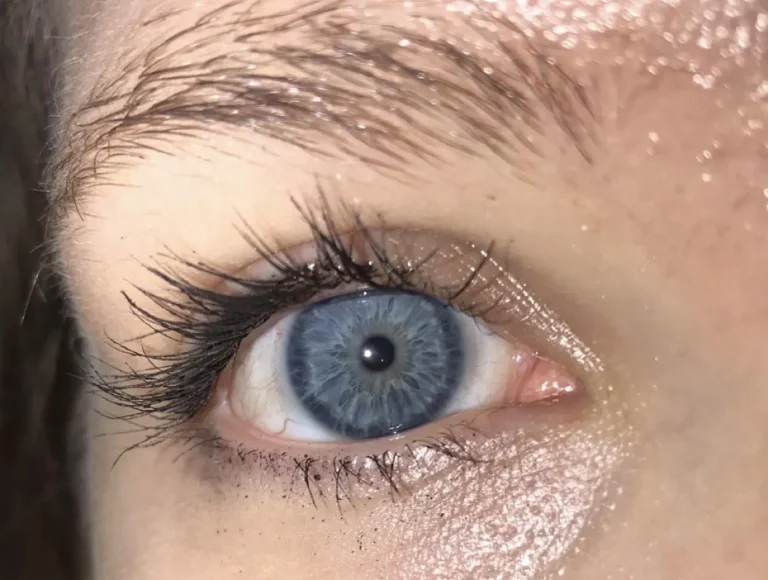
Blue eyes contain relatively little melanin in the front part of the iris stroma. There is no blue pigment. Instead, light interacting with the iris's fibrous structure produces wavelength-dependent scattering, often described as Rayleigh-like scattering. The biological iris is more complex than the atmosphere, however, so the mechanism should not be reduced to an identical copy of why the sky looks blue.
The posterior iris pigment epithelium is normally strongly pigmented even in blue eyes. The most visible differences between lighter and darker eyes depend largely on pigmentation and structure in the anterior iris. This anatomical distinction is explained further in our guide to melanin and eye color.
Melanin level
Lower superficial stromal melanin allows light scattering to play a greater role in visible color.
Stromal structure
Collagen arrangement and tissue thickness influence how the iris scatters and reflects light.
Limbal ring
A dark peripheral ring can increase perceived contrast without changing the central iris pigment.
How Common Are Blue Eyes?
Blue eyes are most common in parts of Northern and Eastern Europe, although they occur worldwide. The often-cited figure that about 8–10% of people have blue eyes is a rough global estimate, not the result of a single standardized worldwide census. Regional variation is considerable, and studies do not always classify blue-grey and mixed eyes in the same way.
Eye color does not reliably identify an individual's ethnicity, health status or personality. A visible iris shade is one inherited feature among many.
Different Shades of Blue Eyes
Blue eyes range from very pale, icy tones to deeper blue and blue-grey appearances. These descriptions are useful visually, but they are not sharply separated genetic or medical categories.
Ice-blue
Very pale blue with a silvery or greyish quality that can look almost white-blue in bright light.
Bright blue
Clearer blue reflections, often emphasized by diffuse daylight and a contrasting limbal ring.
Deep blue
A darker overall appearance influenced by pigment distribution, structure and illumination.
Blue-grey or blue-green
Mixed optical tones or warm pigment near the pupil can alter the perceived dominant shade.
Why Do Blue Eyes Sometimes Look Different?
Lighting, background color, pupil diameter and camera settings strongly influence blue-eye appearance. Neutral daylight often makes fine iris structures easier to distinguish. Warm indoor lights, dim surroundings, reflections, flash exposure and white balance may make the same iris appear darker, greyer or more saturated.
A photograph is not a direct measurement of melanin. Our article on why eye color seems to change explains the difference between apparent photographic variation and genuine iris pigmentation changes.
Do Blue Eyes Have Higher Light Sensitivity?
Some people with lightly pigmented eyes report more glare or sensitivity to strong light, but iris color alone does not predict photophobia. Corneal and tear-film conditions, pupil size, inflammation and other eye or neurological problems can also influence light sensitivity.
Regardless of iris color, well-fitting sunglasses with 99–100% UVA and UVB protection are sensible outdoors. The American Academy of Ophthalmology's sunlight and UV guidance explains why protection matters for everyone.
Are Blue Eyes Linked to Specific Health Risks?
Most people with blue eyes have normal ocular health and normal vision. Blue iris color is not a disease. Population studies have reported associations between lighter iris pigmentation and certain conditions, including uveal melanoma and some retinal outcomes, but these associations vary across studies and do not establish a prediction for any individual.
Age, family history, personal medical history, environmental exposure and other risk factors are also important. Blue eyes by themselves do not mean poor visual acuity or inevitable ocular disease.
Blue Eyes and Genetics
Eye color is polygenic: multiple genes influence the production, distribution and storage of iris melanin. The HERC2–OCA2 region is strongly associated with common blue-versus-brown differences. A well-studied regulatory variant within HERC2 affects expression of neighboring OCA2, but other genetic variants also contribute.
The familiar explanation that brown is dominant and blue is recessive is a teaching simplification, not a reliable prediction rule for every family. Two brown-eyed parents can have a blue-eyed child. Readers who want a wider examination of inheritance across all colors can consult our eye color genetics and chart overview.
Genetically inherited blue eyes must be distinguished from acquired changes in iris appearance caused by medication, disease or a medical procedure. A change in visible color does not rewrite a person's inherited eye-color genes.
Can Blue Eyes Change Over Time?
During infancy and childhood: a pale iris may gradually become darker as pigmentation develops. Not all babies are born with blue eyes, and the timetable varies from child to child.
In adults: established natural eye color is usually stable. A small difference between photographs is often optical, while a persistent one-sided change may require examination. Naturally different iris colors, known as heterochromia, should not be confused with newly acquired asymmetry.
Cosmetic or Medical Ways to Enhance Blue Eyes
Makeup, lighting and clothing contrast may emphasize an existing blue shade without modifying the iris. Professionally fitted color contact lenses can temporarily intensify or change the eye's appearance but do not alter natural iris pigmentation.
Procedures intended to modify eye appearance are different. Laser iris depigmentation aims to reduce visible iris melanin; keratopigmentation uses corneal pigment; and cosmetic iris implants place devices inside the eye. These are not interchangeable techniques, and each has distinct risks and evidence limitations. For procedural details, refer to the separate Laser Eye Color Change clinical guide. This Blue Eyes article is not a treatment page.
Clinical Example: Brown-to-Blue Iris Appearance
The following MyLumineyes patient collage illustrates a documented change in visible iris appearance after laser iris depigmentation. It is an acquired clinical result, not an example of how inherited blue eyes develop naturally. Photographs alone cannot establish treatment safety, quantify pigment reduction or predict another patient's outcome.

Any elective iris intervention requires individualized ophthalmic assessment and careful evaluation of safety, treatment parameters and follow-up. A visually striking photograph should not be mistaken for a general treatment guarantee.
Key Points About Blue Eyes
- Blue eyes contain relatively little anterior stromal melanin; they do not contain blue dye.
- Visible blue shades depend on optical scattering, tissue characteristics, pigment distribution and lighting.
- Blue eyes are globally uncommon, but quoted worldwide percentages are approximate.
- HERC2 and OCA2 are major genetic contributors, but eye-color inheritance involves many genes.
- Blue eyes are a normal trait. Sudden persistent or one-sided color changes deserve medical consideration.
Scientific References
- Sturm RA, Larsson M. Genetics of human iris colour and patterns. Pigment Cell & Melanoma Research. 2009;22:544–562. DOI: 10.1111/j.1755-148X.2009.00606.x.
- Eiberg H, et al. Blue eye color in humans may be caused by a founder mutation in a regulatory element within HERC2. Human Genetics. 2008;123:177–187. DOI: 10.1007/s00439-007-0460-x.
- American Academy of Ophthalmology. The Sun, UV Light and Your Eyes. Guidance on UV-related ocular protection.
Frequently Asked Questions About Blue Eyes
Why are blue eyes blue if there is no blue pigment?
Blue eyes contain relatively little melanin in the anterior iris stroma. Wavelength-dependent light scattering creates the blue appearance rather than any blue dye.
Are blue eyes rare worldwide?
Blue eyes are a global minority and are more common in some Northern and Eastern European populations. The widely quoted 8–10% figure is an approximate estimate, not a precise global census.
Can two brown-eyed parents have a blue-eyed child?
Yes. Eye color is polygenic, with important contributions from the HERC2–OCA2 region and other genes. Parents' eye colors alone cannot predict the exact color of their child's eyes.
Why do blue eyes look grey or green in photographs?
Lighting, reflections, camera white balance, pupil diameter and warm pigment near the pupil may change the apparent color without any actual change in iris melanin.
Are blue eyes more sensitive to sunlight?
Some people with lightly pigmented eyes report more glare, but iris color alone does not determine light sensitivity. UV-protective sunglasses are useful for everyone.
Can blue eyes become brown later in life?
Light eyes may darken in infancy and childhood as pigmentation develops. A new, significant or one-sided color change in an adult should be assessed by an ophthalmologist.
Are blue eyes after laser treatment the same as inherited blue eyes?
No. Inherited blue eyes arise through developmental pigmentation and genetic factors. A lighter blue appearance after laser iris depigmentation is an acquired optical result; it does not change inherited eye-color genes or guarantee a particular shade.
Medical information: This article is intended for educational purposes and is not a substitute for an individual ophthalmic examination, diagnosis or treatment advice. Any new or concerning ocular symptom should be reviewed by a qualified eye-care professional.