Dangers of Colored Contact Lenses: Risks, Infections and Safe Use
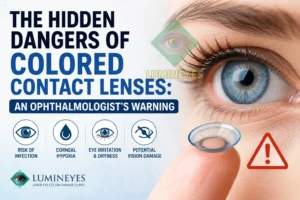
Colored contact lenses can change the appearance of the iris without surgery, but they remain contact lenses and should be treated as medical devices rather than ordinary cosmetic accessories. When a lens is properly prescribed, fitted and cared for, many people use it without serious problems. Risk increases when lenses are poorly fitted, worn for too long, exposed to water, shared, slept in or cleaned incorrectly.
Are Colored Contact Lenses Safe?
They can be worn safely by many people, but “cosmetic” should not be confused with “risk-free.” A colored lens rests directly on the corneal surface and interacts continuously with the tear film. Its material, geometry, movement, oxygen transmission and wearing schedule all matter.
The main issue is therefore not the presence of color alone. A lens with an unsuitable base curve or diameter may move excessively, fit too tightly or disturb the ocular surface. Poor hygiene, prolonged wear or contamination can further increase the chance of epithelial injury and infection.
A regulated, professionally fitted colored contact lens should not be treated as clinically equivalent to an unverified decorative lens purchased without an eye examination or appropriate fitting.
Prescription and Non-Prescription Colored Contacts Are Not the Same
In the United States, decorative contact lenses are regulated as medical devices. A person does not need refractive error for fitting to matter: a zero-power cosmetic lens can still be too tight, too loose or otherwise inappropriate for the ocular surface.
A contact-lens examination can assess corneal shape, tear-film quality, ocular-surface health and lens behavior on the eye rather than simply determining whether visual correction is needed.
| Factor | Lower-risk approach | Higher-risk situation |
|---|---|---|
| Fitting | Professional examination and lens fitting | One-size-fits-all lens without examination |
| Source | Regulated manufacturer and legitimate supplier | Unknown source, counterfeit or poorly labelled product |
| Wear | Prescribed wearing and replacement schedule | Overwear or continued use despite irritation |
| Hygiene | Clean hands, appropriate solution and case care | Water exposure, reused solution or shared lenses |
| Follow-up | Review when symptoms or fitting concerns arise | Persistent symptoms without professional assessment |
What Problems Can Colored Contact Lenses Cause?
Most complications are contact-lens complications rather than disorders caused uniquely by pigmentation. Their severity ranges from temporary irritation to sight-threatening corneal infection.
Corneal abrasion
Mechanical friction or an unsuitable fit may damage the corneal epithelium. Abrasion can produce pain, tearing, photophobia and foreign-body sensation. A disrupted epithelial barrier may also make infection easier to establish.
Microbial keratitis
Microbial keratitis is infection and inflammation of the cornea. Contact-lens wear is a recognized risk factor, particularly when hygiene is poor or lenses are worn in circumstances for which they were not intended. Severe disease may produce ulceration, scarring and permanent visual impairment.
Corneal ulceration and scarring
A corneal ulcer is more than routine contact-lens irritation. Central disease can affect the visual axis, and residual scarring may reduce vision even after infection has resolved.
Inflammatory and mechanical reactions
Lens deposits, lid interaction, sensitivity to care products and mechanical friction can contribute to itching, conjunctival inflammation, mucus production, papillary reactions or declining lens tolerance.
Dryness and epithelial disturbance
Dryness, fluctuating vision or discomfort may become more noticeable during prolonged wear. Persistent symptoms should not automatically be accepted as a normal consequence of cosmetic lens use.
Colored Contacts, Oxygen Transmission and Corneal Hypoxia
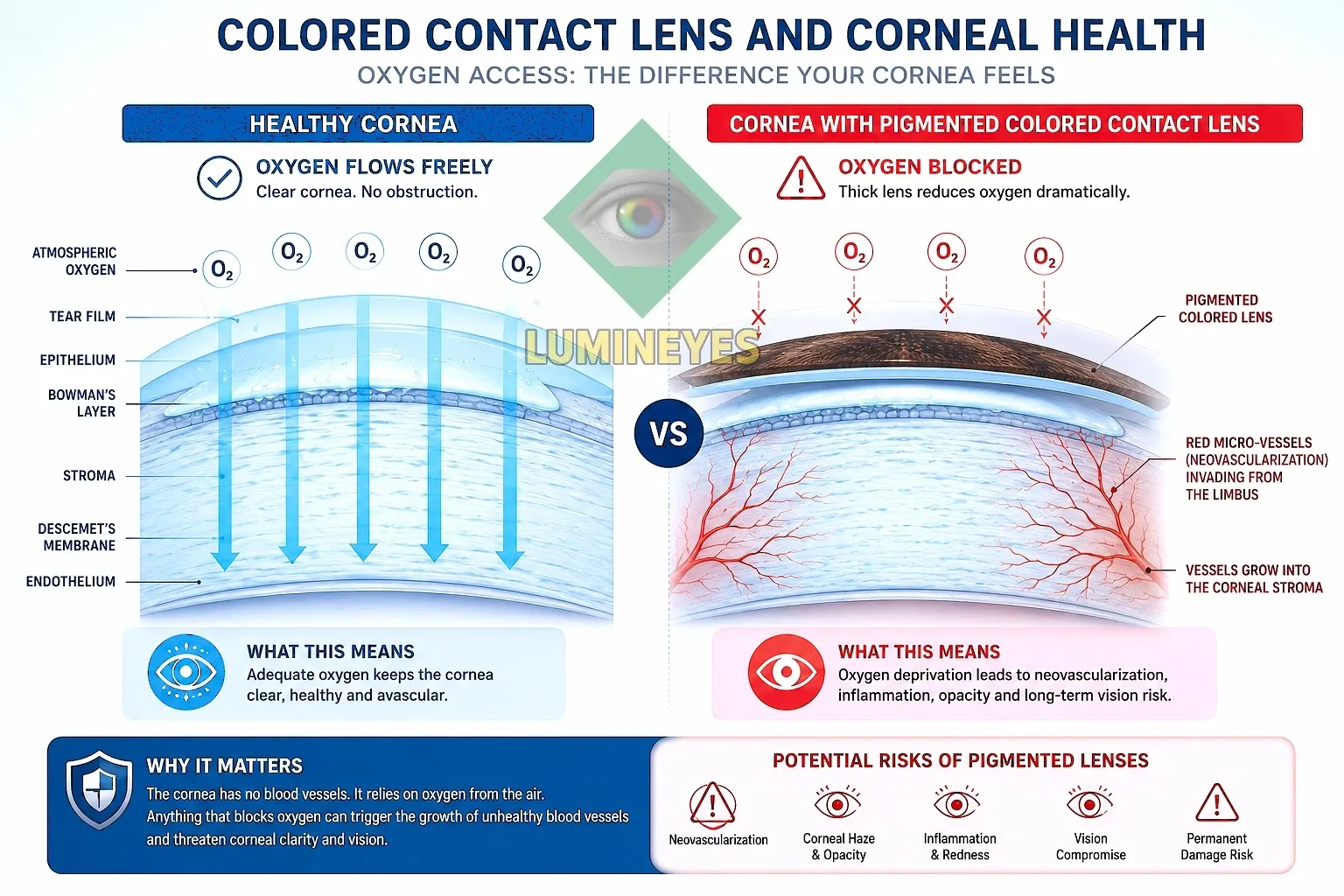
The cornea is avascular and receives much of its oxygen through the tear film. Any contact lens changes the interface between the atmosphere and the corneal surface. The degree of that effect depends on factors including lens material, thickness, fit and duration of wear.
It is therefore too simplistic to say that every colored lens “blocks oxygen.” Different products have different oxygen-transmission characteristics. Excessive or prolonged hypoxic stress, however, may be associated with epithelial disturbance, corneal edema and, in some cases, neovascularization.
Microbial Keratitis: The Complication We Take Most Seriously
From an ophthalmic perspective, infection is one of the most important reasons to take lens hygiene seriously. Microorganisms may reach a compromised corneal surface through contaminated lenses, cases, hands or water.
Risk may increase with poor hand hygiene, topping off old disinfecting solution, inadequate case care, sharing lenses, water exposure or wearing lenses longer than recommended.
Do not continue wearing a lens through significant pain or redness. Remove the lens and seek prompt professional assessment if symptoms include marked redness, photophobia, reduced vision, discharge or persistent pain.
Bacterial keratitis
Bacterial corneal infection can progress rapidly. Pseudomonas aeruginosa is one organism well recognized in contact-lens-associated keratitis, although many other pathogens may be responsible.
Acanthamoeba keratitis
Acanthamoeba keratitis is uncommon but can be difficult to treat and potentially sight-threatening. Contact between lenses and non-sterile water is an important avoidable risk.
Why Water and Contact Lenses Are a Bad Combination
Contact lenses should not be cleaned or stored in tap water. Showering, swimming or using a hot tub while wearing them can expose the lens and ocular surface to microorganisms that are not present in sterile lens-care solution.
Practical rule: keep cosmetic and corrective contact lenses away from water whenever possible. Follow the manufacturer's instructions and the advice of the eye-care professional responsible for the fitting.
Can You Sleep in Colored Contact Lenses?
Unless a specific lens has been prescribed for an approved extended-wear schedule, sleeping in it should be avoided. Closing the eyelids already changes oxygen conditions at the corneal surface, and overnight lens wear is associated with greater concern for contact-lens-related infection.
A lens that feels comfortable at bedtime is not necessarily appropriate for overnight wear. Comfort alone does not establish safety.
Warning Signs That Need Prompt Attention
Patients cannot always distinguish routine irritation from early keratitis. New symptoms deserve particular attention when they are unilateral, progressive or persist after lens removal.
Remove the contact lens if significant irritation or possible infection develops. Pain, photophobia, reduced vision or suspected corneal ulceration warrants prompt ophthalmic assessment.
How to Reduce the Risks of Colored Contact Lenses
- Have the eyes assessed before starting. Even zero-power lenses need appropriate fit.
- Use a legitimate product from a reliable source.
- Wash and dry your hands before handling lenses.
- Use appropriate disinfecting solution rather than tap water.
- Never share lenses.
- Avoid swimming, showering or hot-tub use while wearing them.
- Follow the intended replacement schedule.
- Do not sleep in them unless that use has specifically been prescribed.
- Stop wearing a lens that causes significant pain, redness or visual change.
When a device is being worn purely for appearance, there is little justification for tolerating persistent ocular symptoms. Cosmetic benefit should not override corneal health.
Can Colored Contacts Permanently Damage the Eye?
Permanent damage is not the expected outcome of properly fitted contact-lens use, but serious complications can leave lasting effects. A deep corneal infection may heal with scarring, and central scarring can reduce vision.
The appropriate message is therefore neither that colored contacts are harmless nor that every cosmetic lens is dangerous. Risk depends on the lens, the eye, the fit, the wearing pattern and the behavior of the wearer.
Can Colored Contact Lenses Cause Blindness?
Severe visual loss is uncommon, but serious contact-lens-related corneal infection can permanently affect vision. Both U.S. regulatory guidance and ophthalmic professional guidance emphasize that decorative lenses should be obtained and used with appropriate fitting, hygiene and medical oversight.
What If the Goal Is Permanent Eye Color Change?
Contact lenses are inherently temporary: they change appearance only while the lens remains on the eye. Someone researching permanent eye color change is therefore considering a fundamentally different subject involving long-term alteration of visible ocular pigmentation rather than temporary optical masking.
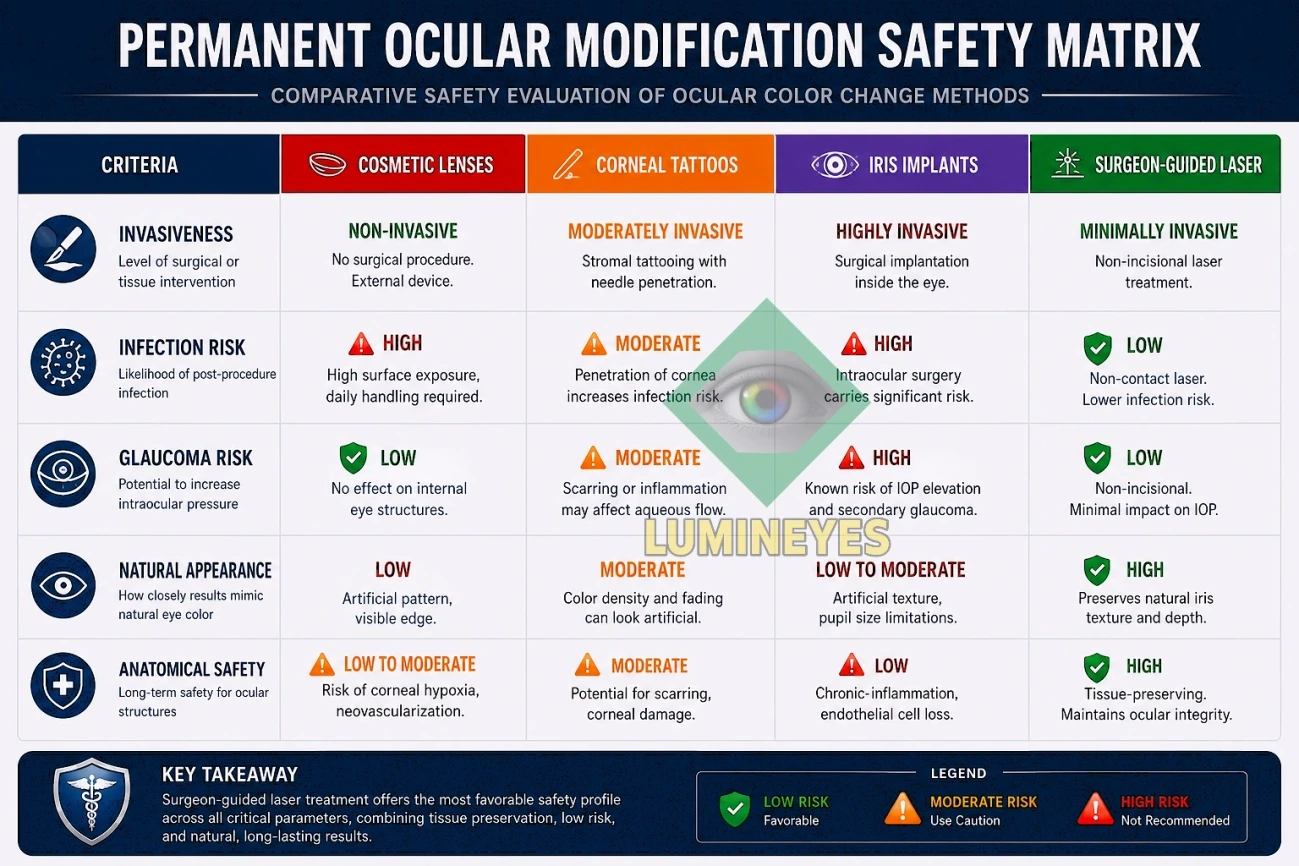
Cosmetic iris implants, corneal pigmentation and laser-based iris depigmentation act on different anatomical structures and should not be treated as equivalent procedures. Their biological behavior is also different. Our research analysis of pigment behavior in cosmetic iris color modification examines the distinction between altering endogenous iris pigment and adding exogenous pigment to ocular tissues.
The broader clinical principles, mechanism and patient-facing framework for non-incisional laser-based iris color modification are explained in our main laser eye color change guide.
Within the Lumineyes research framework, the treatment concept is described as selective stromal melanin modulation . This refers to modulation of pre-existing anterior stromal pigmentation rather than implantation or corneal pigment deposition.
Long-term stability is a separate biological question. The scientific reasoning and limitations behind this concept are discussed in our analysis of biological permanence after laser iris depigmentation .
Treatment response must also be interpreted over time. The L-SAFE anterior-segment safety staging framework describes a response-guided structure for deciding whether the current ocular response permits further exposure. It is a proposed framework rather than a universally validated clinical decision rule.
Longer-term observational findings are summarized in the MyLumineyes clinical data and longitudinal safety observations . Wider scientific material on iris pigmentation, laser–tissue interaction, response assessment and anterior-segment monitoring is organized in the MyLumineyes Research Archive .
Frequently Asked Questions
Are colored contacts bad for your eyes?
Not automatically. Properly fitted and appropriately cared-for colored contact lenses can be used by many people without serious complications. Poor fit, excessive wear, water exposure, inappropriate overnight wear and inadequate hygiene increase risk.
Do colored contacts require a prescription if my vision is normal?
In the United States, decorative contact lenses are regulated as medical devices even when they contain no corrective power. Appropriate fitting matters independently of visual correction.
Can colored contacts scratch the cornea?
Yes. An unsuitable or poorly fitting lens can contribute to epithelial injury or corneal abrasion.
Can colored contacts cause an eye infection?
Yes. Like other contact lenses, they can be associated with microbial keratitis, particularly when hygiene is poor or lenses are exposed to water, shared or worn outside their intended schedule.
Can I shower or swim with colored contacts?
It is safer to remove contact lenses before showering or swimming. Water can expose lenses and the ocular surface to potentially harmful microorganisms.
Can I sleep in colored contacts?
Not unless the specific lens and wearing schedule have been prescribed for extended wear. Overnight contact-lens wear carries additional infection risk.
Can colored contact lenses permanently change eye color?
No. Colored contact lenses alter the visible appearance of the iris only while they are being worn. They do not permanently alter iris pigmentation.
Medical References
- U.S. Food and Drug Administration. Colored and Decorative Contact Lenses: A Prescription Is a Must.
- American Academy of Ophthalmology. Guidance on risks associated with non-prescription decorative contact lenses.
This page provides general patient education and does not replace an ophthalmic examination, diagnosis or individualized medical advice. Risk depends on the condition of the eye, the lens being used, fitting, wear pattern and other individual factors.