Retinal Diseases & Advanced Laser Treatments
Expert care for Retinal Tears, Macular Degeneration (Yellow Spot), and Vitreoretinal Disorders by Dr. Mustafa Mete.
Understanding the Retina: The “Camera Film” of Your Eye
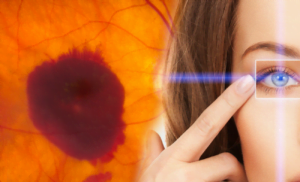
The retina is a ultra-thin (0.5 mm) light-sensitive layer at the back of the eyeball. Often compared to the film in a camera, it converts light into neural signals for the brain. The Macula (Yellow Spot) is the center of this layer, responsible for our sharp, detailed central vision.
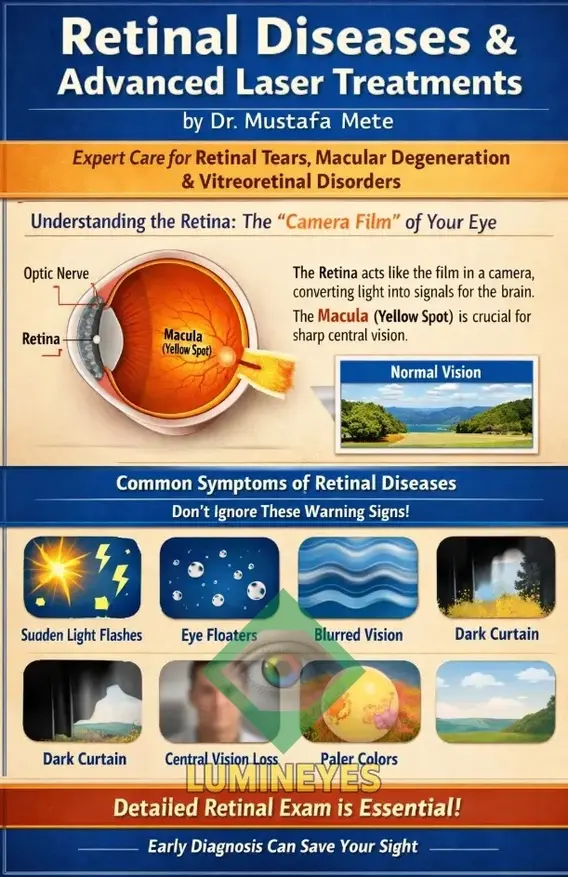
Common Symptoms of Retinal Diseases
If you experience any of the following, a detailed retinal examination is urgent:
- Sudden Light Flashes: Seeing “sparks” or lightning bolts.
- Eye Floaters: Spots, webs, or “flies” drifting in your vision.
- Blurred or Distorted Vision: Straight lines appearing wavy or crooked.
- Dark Curtains: A shadow or veil over your field of vision.
- Loss of Central Vision: Difficulty recognizing faces or reading.
- Paler Colors: Colors appearing less vivid than before.
Retinal Tear Laser Surgery (Photocoagulation)
A retinal tear is a serious condition where a hole forms in the retina’s periphery. If left untreated, it can lead to Retinal Detachment.
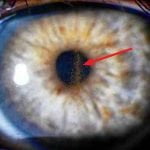
“Applying the same laser precision used in retinal tear laser surgery, Dr. Mustafa Mete also provides the world-renowned laser eye color change procedure using the MyLumineyes® technique.”
How it Works:
Dr. Mustafa Mete uses specialized thermal lasers to “weld” the edges of the tear, creating a protective seal. This painless outpatient procedure is the gold standard for preventing vision loss.
Anti-VEGF & Eye Injection Therapy
For conditions like Wet Macular Degeneration (AMD) or diabetic retinopathy, Anti-VEGF injections are a revolutionary treatment. These “eye needles” help to:
- Stop the growth of abnormal, leaking blood vessels.
- Reduce retinal swelling (edema).
- Stabilize and often improve visual acuity.
Photodynamic Therapy (PDT)
In specific cases of severe retinal disease, PDT is employed. A light-sensitive dye is injected and then activated by a specific laser wavelength for 83 seconds to target diseased vessels without damaging healthy tissue.
Vitreoretinal Surgeries: Vitrectomy
When lasers aren’t enough, surgical interventions like Vitrectomy are used. This procedure involves removing the vitreous gel from the eye to repair complex retinal detachments or hemorrhages using state-of-the-art microsurgical tools.