Better eye health begins with better evidence.
Which vitamins genuinely support vision? When are AREDS2 supplements useful, what can nutrition do for dry eyes, and which everyday habits matter most? A practical clinical guide to what the evidence supports—and what it does not.

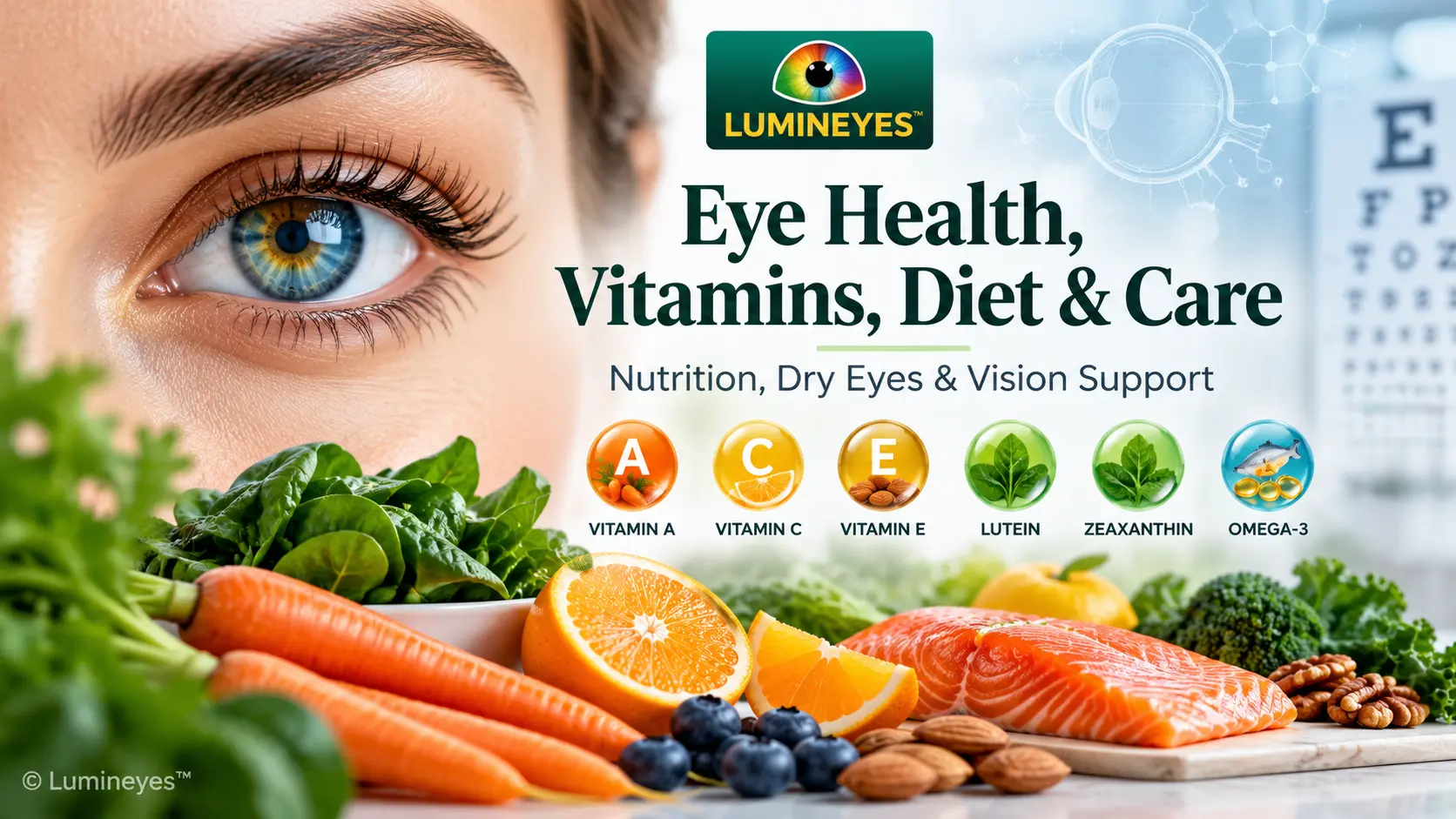
Nutrition helps maintain normal retinal function, the ocular surface and overall health, but no vitamin prevents every eye disease and more supplementation is not automatically better. Most people should begin with a varied diet. The clearest evidence for a specific eye supplement concerns AREDS2 in selected patients with age-related macular degeneration (AMD); routine supplementation for otherwise healthy eyes is a different question.
Vitamins and nutrients that matter for the eyes
The biological role of a nutrient is not the same as proof that taking extra supplements improves vision. These distinctions matter in clinical practice.
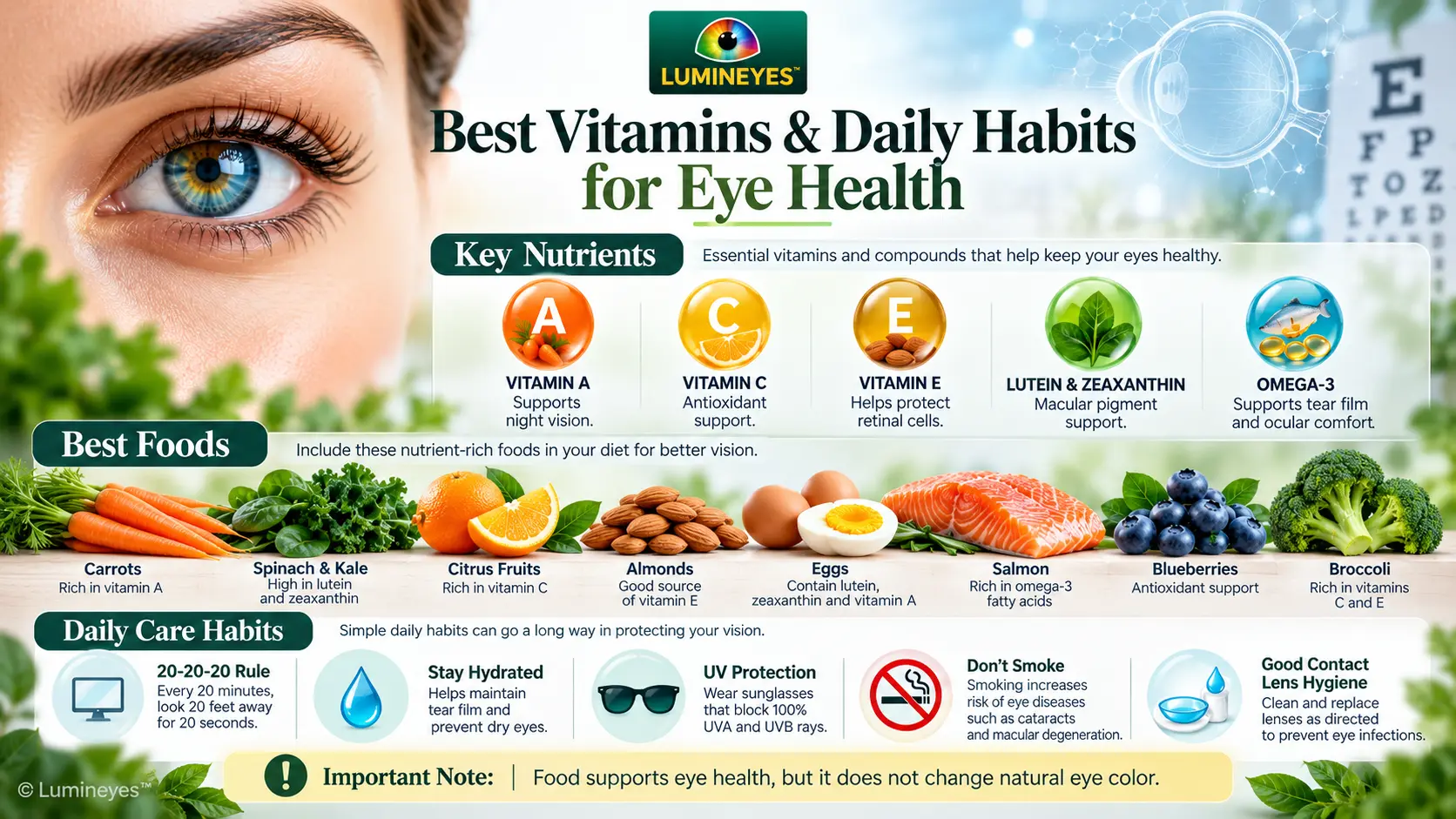
Vitamin A
Required for normal visual-pigment function and ocular-surface integrity. Deficiency can lead to night blindness, xerophthalmia and corneal damage.
Food sources: carrots, sweet potatoes, leafy greens, eggs and fortified foods. Excess preformed vitamin A can be harmful.Vitamin C
An antioxidant involved in collagen synthesis and normal tissue maintenance. A healthy dietary intake is valuable; high-dose supplements have not been established as a universal way to prevent cataracts.
Food sources: citrus fruits, kiwi, peppers and broccoli.Vitamin E
A fat-soluble antioxidant that helps protect cellular membranes from oxidative damage. It forms part of the AREDS2 combination, but vitamin E alone is not a proven treatment for AMD.
Food sources: almonds, sunflower seeds and avocado.Lutein & zeaxanthin
Macular carotenoids that contribute to macular pigment and optical filtering. They are included in AREDS2 for people in specific AMD risk categories.
Food sources: spinach, kale, egg yolks, corn and other green or yellow vegetables.Zinc & copper
Zinc contributes to normal cellular function and retinal metabolism. Zinc and copper are paired in AREDS2; high-dose zinc is not suitable for unsupervised long-term use.
Food sources: legumes, seeds, meat, seafood and eggs.Omega-3 fatty acids
DHA is a structural component of retinal tissue. Eating oily fish fits a balanced dietary pattern; evidence for omega-3 capsules specifically treating dry eye remains inconsistent.
Food sources: salmon, sardines and trout. Fish oil supplements are not universally necessary.AREDS2: useful for some AMD patients—not everyone
The Age-Related Eye Disease Studies identified a specific antioxidant/mineral combination that can reduce progression to advanced AMD in certain higher-risk groups, including many patients with intermediate AMD or advanced AMD in one eye. It does not prevent AMD in people without the disease, reverse established damage, or replace retinal monitoring.
What are the best foods for eye health?
A Mediterranean-style pattern rich in vegetables, fruit, legumes, whole grains, nuts and fish is more defensible than relying on one “miracle” food.
| Food | Relevant nutrients | Practical context |
|---|---|---|
| Dark leafy greens | Lutein, zeaxanthin, folate | Spinach, kale and chard support an overall nutrient-rich diet. |
| Carrots & sweet potatoes | Beta-carotene (provitamin A) | Useful for adequate vitamin A intake; extra carrots do not give normal eyes “super vision.” |
| Citrus, peppers & broccoli | Vitamin C and other micronutrients | Choose varied colors rather than chasing a single antioxidant. |
| Almonds & seeds | Vitamin E and unsaturated fats | Convenient nutrient-dense foods in reasonable portions. |
| Eggs | Lutein, zeaxanthin, vitamin A | Part of a varied diet if compatible with individual dietary needs. |
| Salmon & sardines | DHA and EPA omega-3 fatty acids | Prefer a balanced dietary pattern over assuming capsules will treat dry eyes. |
Can omega-3 supplements improve dry eyes?
Not reliably for every patient. Dry eye disease has different mechanisms, and nutrition alone rarely addresses all of them.
What the evidence suggests
Omega-3 fatty acids have biological roles in cell membranes and inflammatory signaling. Some studies have reported improvements in symptoms or tear-film measures, while larger randomized studies have found no clear advantage over placebo. The clinical literature is therefore mixed, not a basis for promising that fish oil cures dry eye.
In a review published in the European Journal of Ophthalmology, investigators discussed the complexity of dry-eye disease around cataract surgery, including variable evidence for management strategies and nutritional supplementation. [2]
What usually matters more
- Identify evaporative, aqueous-deficient or mixed dry eye.
- Assess eyelid and meibomian gland function.
- Consider preservative-free lubricants and indicated medical therapies.
- Address screen-related incomplete blinking, airflow and contact-lens intolerance.
- Seek an examination when symptoms persist or vision fluctuates.
See the dedicated dry eye syndrome: causes, diagnosis and treatment clinical article.
Daily habits that protect ocular health
A sustainable routine is usually more useful than an expensive supplement regimen.
Follow 20-20-20
About every 20 minutes, look 20 feet away for at least 20 seconds. Blink fully and adjust screen position and glare to improve comfort.
Wear proper sunglasses
Choose lenses labeled 100% UVA/UVB protection or UV400. Dark tint alone does not establish UV protection.
Avoid smoking
Smoking is a modifiable risk factor for AMD and cataracts. Quitting supports eye and systemic health.
Respect contact-lens hygiene
Do not expose lenses to tap water, showering or swimming. Follow wear and replacement instructions. Review our ophthalmologist's guide to colored contact-lens risks.
Support the ocular surface
Stay adequately hydrated, avoid direct airflow and take blinking breaks. Dry-eye treatment depends on mechanism, not water intake alone.
Do not ignore symptoms
New distortion, sudden vision loss, eye pain or marked light sensitivity warrants timely professional assessment. A healthy diet is not a substitute for evaluation.
What vitamins and food cannot do
Food cannot permanently change your natural iris color
Spinach, honey, lemon juice and vitamin supplements cannot selectively remove melanin from the healthy iris. Natural eye color reflects iris pigmentation, anatomy and light scattering, not a special diet. Explore the dedicated article Can foods change eye color? Myths and scientific facts, and the explainer on how color vision works.
Never place lemon juice, tea, honey, oils or unsterile preparations into your eyes. Such practices can irritate or injure the ocular surface and may introduce infection.
Medical eye-color procedures are a separate topic with procedure-specific risks and unresolved long-term evidence questions. They should not be presented as nutritional treatments. For context, see the laser eye color change clinical overview.
Eye health & nutrition FAQ
What is the best vitamin for eye health?
There is no single best vitamin for every person. Adequate vitamin A is important for normal vision, while a varied diet provides other nutrients. AREDS2 is specifically relevant to selected patients with age-related macular degeneration, not to everyone with healthy eyes.
Should everyone take AREDS2 supplements?
No. AREDS2 may reduce progression risk in certain AMD stages, such as intermediate AMD or advanced disease in one eye. It is not recommended as a routine preventive supplement for people without qualifying AMD findings; an ophthalmologist should determine suitability.
Do omega-3 supplements cure dry eye?
No. Trial results are mixed, and supplementation does not reliably treat every type of dry eye. Dry-eye management depends on tear-film and ocular-surface findings, eyelid function and the patient's clinical history.
Can carrots improve night vision?
Carrots supply beta-carotene, which can help maintain adequate vitamin A intake. Correcting vitamin A deficiency can improve deficiency-related night-vision problems; eating extra carrots does not enhance normal night vision beyond physiological limits.
Can diet change brown eyes to green or blue?
No. Food, vitamins and supplements do not selectively change the melanin distribution or anatomy of a healthy iris. Eye-color appearance can vary with lighting, but that is not a dietary pigment change.
Related clinical articles
Relevant posts from our ophthalmology library, selected for this topic rather than generic service-page links.
Selected scientific sources
- American Academy of Ophthalmology. Diet, Nutrition, and Eye Health Supplements. Guidance on dietary nutrients and the AREDS2 formulation. AAO clinical resource ↗
- Naderi K, Gormley J, O'Brart D. Cataract surgery and dry eye disease: A review. European Journal of Ophthalmology. 2020;30(5):840–855. doi:10.1177/1120672120929958. European Journal of Ophthalmology ↗
Ophthalmologist with over 25 years of clinical experience. This article distinguishes established nutritional physiology, trial-supported indications and areas where evidence remains uncertain.
Medical information is provided for education and does not replace an individualized ophthalmic examination. Sudden vision loss, new distortion, significant pain or marked redness should be assessed promptly. High-dose vitamins and mineral supplements can cause adverse effects or interact with medications.