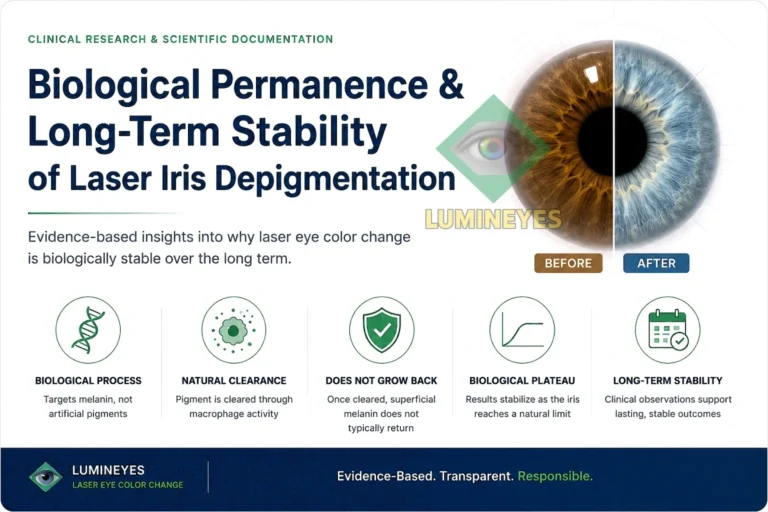
Biological Permanence & Long-Term Stability of Laser Iris Depigmentation
Laser iris depigmentation is based on the gradual reduction of pre-existing stromal melanin rather than the addition of artificial pigment. Unlike cosmetic masking approaches, the process is intended to reduce visible pigment density through controlled laser interaction followed by biological pigment processing and clearance.
The concept of long-term stability in laser eye color change is therefore related to the persistence of reduced stromal pigment density after the treatment-related biological response has stabilized. The final appearance may vary according to baseline iris anatomy, pigment distribution, treatment response, and individual biological characteristics.
The authors use the term “selective stromal melanin modulation” to describe the proposed treatment concept underlying the Lumineyes™ protocol. This terminology refers to the intended controlled interaction with pre-existing stromal melanin and should not be interpreted as proof that all pigment-containing cells or surrounding tissues are completely unaffected.
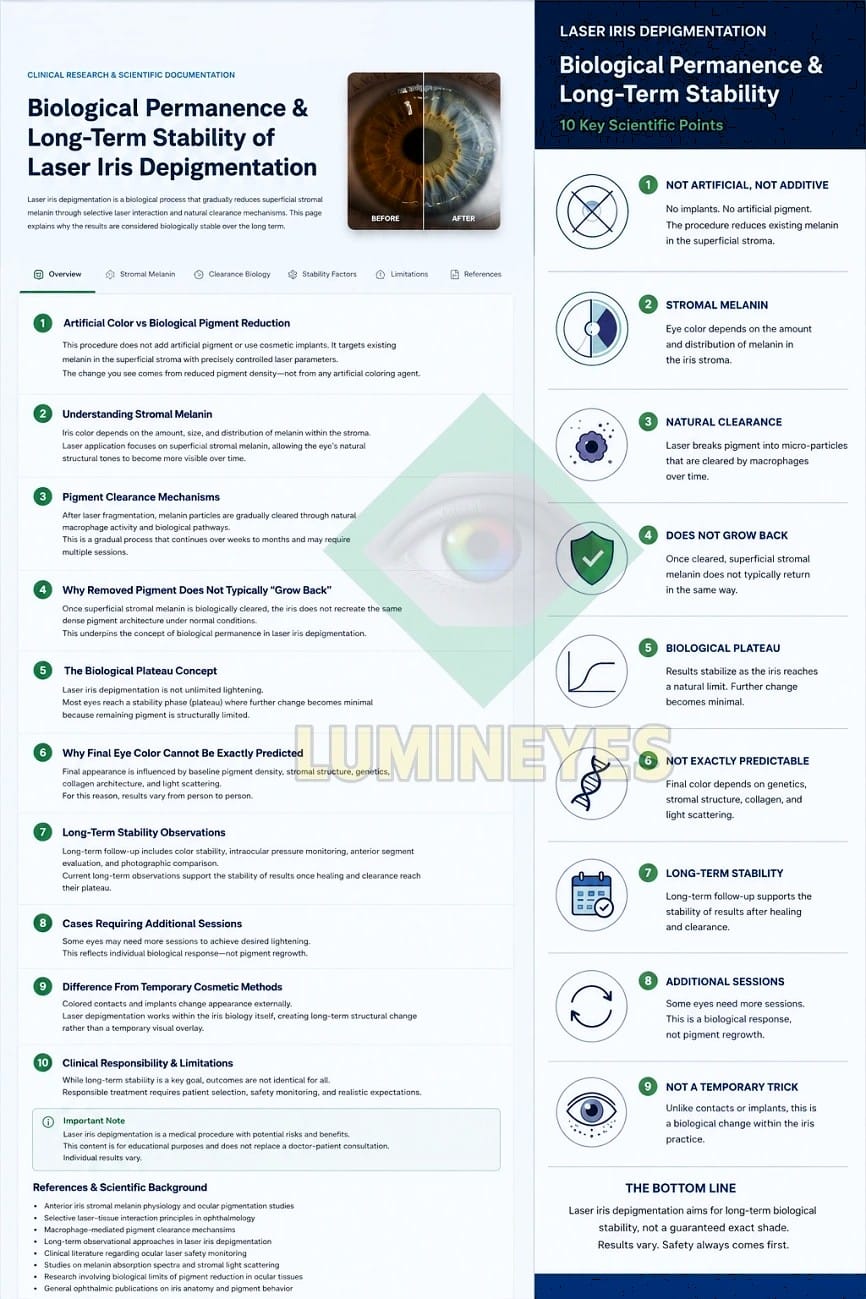
1. Artificial Color vs. Biological Pigment Reduction
Many cosmetic eye-color procedures rely on the placement of artificial material inside or over the eye. Laser iris depigmentation follows a fundamentally different anatomical concept: it does not require implantation of synthetic pigment or a permanent artificial coloring device.
Instead, the treatment is intended to reduce existing iris pigmentation through controlled laser interaction with melanin-containing structures. The visible color change develops progressively as pigment density changes and the resulting biological response evolves over time.
This distinction is important because biological pigment reduction is fundamentally different from temporary optical masking.
2. Understanding Stromal Melanin
Human iris appearance is strongly influenced by the distribution, density, and optical behavior of melanin within the iris stroma. Baseline pigmentation and stromal architecture differ substantially between individuals.
Within the Lumineyes framework, treatment is directed toward controlled modulation of pre-existing stromal melanin rather than introduction of an artificial color-producing material.
The final appearance may vary according to:
- baseline pigment density;
- depth and distribution of stromal pigmentation;
- iris stromal architecture;
- individual biological response;
- healing and pigment-clearance dynamics; and
- optical light-scattering characteristics of the remaining iris tissue.
3. Pigment Clearance Mechanisms
Following laser interaction, fragmented pigment material may undergo progressive biological processing and clearance. Macrophage-mediated phagocytic mechanisms may contribute to the removal of pigment-containing material during this response.
The visible change therefore does not necessarily occur as an immediate endpoint of laser exposure. Instead, the clinical appearance may continue to evolve during subsequent biological processing and between treatment stages.
This gradual response is one reason why a staged, response-guided approach may be preferable to an assumption that maximal pigment reduction should be pursued during a single treatment session.
4. Why Pigment Reduction May Remain Stable
An important distinction should be made between pigment removal and pigment regeneration.
Once a portion of superficial stromal pigment has been fragmented and biologically cleared, the iris does not necessarily recreate the identical previous distribution or density of visible pigment. However, this should not be interpreted as proof that pigment can never recur or that all patients will demonstrate identical long-term stability.
Long-term stability is better understood as the persistence of the achieved reduction in visible pigment density after the biological response reaches a relative stabilization phase.
The degree of stability may vary among individuals.
5. The Biological Plateau Concept
Laser iris depigmentation is not an unlimited lightening process.
As treatment progresses, the observable response may become slower or less pronounced as the remaining pigment distribution, tissue architecture, and biological response place limits on further visible change.
This may be described as a biological pigment plateau.
Recognition of such a plateau is clinically relevant because additional treatment should not be viewed as automatically producing proportionate additional color change. Treatment decisions should instead remain response-guided and dependent on the overall ocular findings.
6. Why Final Eye Color Cannot Be Precisely Predicted
Even when pigment reduction is clinically successful, the final visible iris color cannot be precisely predetermined.
Relevant factors include:
- baseline melanin density;
- stromal pigment distribution;
- iris collagen architecture;
- individual biological response;
- pigment-clearance kinetics;
- healing characteristics; and
- natural optical light scattering.
For this reason, laser eye color change should be understood as a biological transformation with an individual range of possible outcomes, rather than as a procedure capable of guaranteeing an exact predetermined color.
7. Long-Term Stability Assessment
Long-term assessment may include:
- persistence of visible color change;
- intraocular-pressure monitoring;
- anterior-segment examination;
- photographic comparison over time;
- assessment of treatment-related ocular findings; and
- longitudinal clinical follow-up.
The interpretation of long-term stability should therefore consider both pigment persistence and the broader ocular clinical context.
A stable visible color alone should not be interpreted as proof of overall ocular safety, just as a single postoperative examination cannot establish long-term biological stability.
8. Cases Requiring Additional Treatment
Individual responses to laser iris depigmentation may differ.
Eyes with greater baseline pigment density or a different stromal pigment distribution may require additional staged treatment before the desired degree of visible change is achieved.
A later treatment request does not necessarily indicate biological “pigment regrowth.” It may instead reflect:
- residual pigment;
- an incomplete initial response;
- individual variation in pigment clearance;
- a biological plateau;
- or a desire for further color modification.
The distinction between residual pigment and true repigmentation is therefore clinically important.
9. Biological Limits of Permanence
The term “permanent eye color change” should be interpreted cautiously.
In clinical communication, permanence may describe a long-lasting reduction in visible iris pigmentation rather than an absolute biological guarantee that pigment will never change again throughout life.
The iris remains living tissue and its biological behavior may vary over time. Consequently, the authors prefer the concept of long-term biological stability when discussing the persistence of pigment reduction.
This terminology is intended to reflect the observed clinical principle while acknowledging the inherent biological variability of living tissue.
10. Position Within the Lumineyes Clinical Framework
Within the Lumineyes™ framework, long-term stability is considered in conjunction with:
- staged treatment;
- response-guided decision-making;
- clinical reassessment;
- intraocular-pressure monitoring;
- anterior-segment evaluation; and
- individualized treatment limits.
The objective is not simply to achieve the greatest possible pigment reduction, but to determine the appropriate degree of pigment modulation for the individual eye while respecting biological and anatomical limits.
This principle is consistent with the broader concept of selective stromal melanin modulation proposed by the authors.
Conclusion
Long-term stability following laser iris depigmentation is best understood as a biological and clinical process rather than an absolute binary property.
Reduction of pre-existing stromal melanin may remain visually stable after the treatment-related clearance response reaches a relative plateau. However, the degree and duration of stability can vary according to baseline anatomy, pigment distribution, biological response, and individual ocular characteristics.
Within the Lumineyes™ framework, the authors therefore emphasize response-guided staged treatment, longitudinal observation, and respect for biological limits rather than a guaranteed predetermined endpoint.
Further independent longitudinal research is required to characterize the mechanisms, frequency, and long-term variability of pigment stability and any potential repigmentation phenomena.
References & Scientific Background
- Anterior iris stromal melanin physiology and ocular pigmentation studies
- Selective laser–tissue interaction principles in ophthalmology
- Macrophage-mediated pigment clearance mechanisms
- Long-term observational approaches in laser iris depigmentation
- Clinical literature regarding ocular laser safety monitoring
- Studies on melanin absorption spectra and stromal light scattering
- Research involving biological limits of pigment reduction in ocular tissues
- General ophthalmic publications on iris anatomy and pigment behavior