Lumineyes™ Iris Pigmentation Scale (LIPS)
A proposed clinical framework for describing the apparent degree and spatial organization of anterior stromal iris pigmentation without reducing the iris phenotype to a conventional color label alone.
LIPS is designed as an ordinal clinical descriptor of the apparent anterior stromal pigmentation phenotype. It is not a direct biochemical measurement of melanin, not an established treatment-response predictor, and not a replacement for conventional iris-color terminology.
Why separate iris color from pigmentation phenotype?
Familiar terms such as blue, green, hazel, amber, and brown are useful descriptions of visible iris appearance. They do not, however, fully describe how pigmentation appears to be distributed across the anterior iris stroma.
LIPS approaches the iris from a complementary clinical perspective. Instead of attempting to replace color terminology, it adds a structured descriptor for the apparent degree and spatial organization of anterior stromal pigmentation.
Apparent Degree
Clinical assessment of the relative degree of visible anterior stromal pigmentation within the diffuse LIPS spectrum.
Spatial Distribution
Evaluation of whether pigmentation is predominantly diffuse, sectoral, focal, asymmetric, or otherwise non-uniform.
Spatial Heterogeneity
Recognition of phenotypes that cannot be adequately represented by simply assigning a higher point on a linear pigmentation scale.
Two descriptions of the same iris — for different purposes
LIPS retains conventional iris color as useful clinical information, but treats it as conceptually distinct from the assessment of anterior stromal pigmentation.
Visible Iris Appearance
Conventional descriptors such as brown, hazel, green, amber, or other clinically appropriate terminology.
Structured Pigmentation Assessment
Apparent pigmentation degree, stromal visibility, distribution, and heterogeneity are considered separately.
LIPS Documentation
A LIPS grade is recorded alongside — rather than instead of — the conventional iris-color description.
The defining distinction: diffuse pigmentation versus spatial heterogeneity
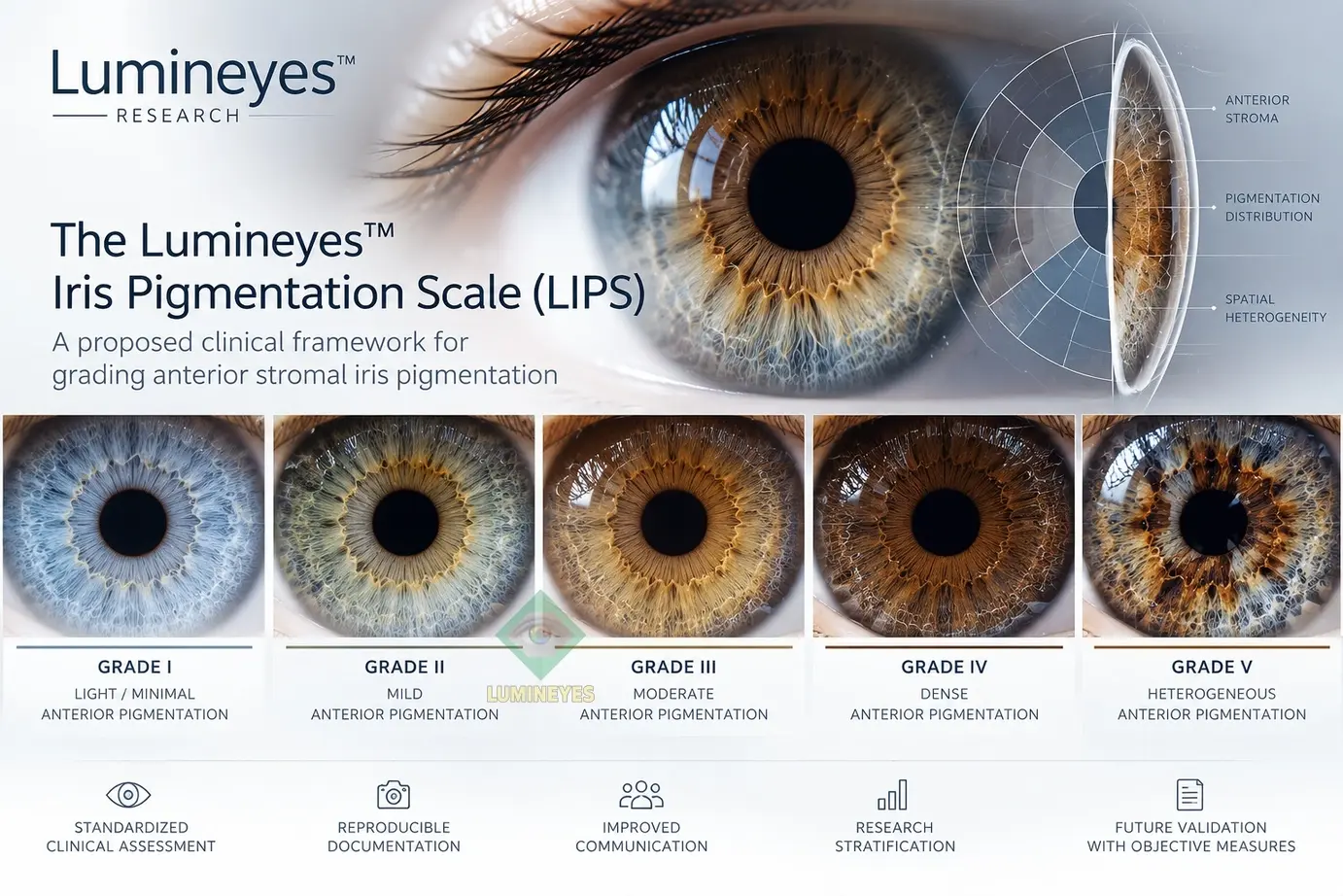
The LIPS architecture contains two related but conceptually different components. Grades I–IV form an ordered spectrum of increasingly apparent diffuse anterior stromal pigmentation. Grade V identifies a phenotype in which spatial heterogeneity becomes the dominant descriptive feature.
Ordered diffuse spectrum
Increasing apparent diffuse anterior stromal pigmentation →
Spatially heterogeneous phenotype
Grade V is reserved for substantial non-uniformity such as sectoral, focal, asymmetric, hyperpigmented, or heterochromic patterns.
Grade V is not a higher pigmentation level than Grade IV.Research-oriented interpretation of the five LIPS categories
The table below is a concise web reference to the conceptual architecture. It is not intended to substitute for standardized observer training or future validated reference material.
| Category | Dominant feature | Clinical interpretation | Distribution |
|---|---|---|---|
| LIPS I | Relatively low apparent pigmentation | Greater apparent stromal light transmission within the diffuse pigmentation spectrum. | Predominantly diffuse |
| LIPS II | Moderate apparent pigmentation | Intermediate apparent anterior stromal pigmentation with relatively uniform organization. | Predominantly diffuse |
| LIPS III | High apparent pigmentation | Greater visual predominance of pigmentation with reduced apparent stromal light transmission. | Predominantly diffuse |
| LIPS IV | Very high diffuse apparent pigmentation | Upper end of the proposed diffuse spectrum, with markedly reduced apparent stromal light transmission. | Diffuse / relatively uniform |
| LIPS V | Spatial heterogeneity | A qualitatively different pigmentation phenotype in which distributional complexity dominates the description. | Sectoral, focal, asymmetric, heterogeneous or heterochromic |
How the framework is intended to be recorded
LIPS is designed to preserve information rather than collapse multiple iris characteristics into a single color term. Each eye can therefore be characterized independently, with conventional color and distributional information retained as complementary descriptors.
Standardize Observation
Use reasonably consistent slit-lamp or photographic conditions, particularly when longitudinal comparisons are intended.
Assess the Pattern
Determine whether the dominant phenotype is diffuse or whether clinically meaningful spatial heterogeneity is present.
Record Complementary Descriptors
Document laterality, LIPS category, conventional iris color, and relevant distributional features rather than relying on the grade alone.
What LIPS is — and what it is not
LIPS is proposed as
LIPS is not currently
Why a clinical phenotype may still matter in an era of quantitative imaging
Quantitative imaging can describe continuous optical characteristics, while a clinical grading framework addresses a different problem: whether a recognizable phenotype can be described consistently at the point of examination.
The scientific value of LIPS will therefore depend not merely on the existence of its categories, but on whether independent studies show that trained observers can use them reproducibly and whether the resulting categories demonstrate meaningful relationships with objective optical or image-derived parameters.
Clinical Language
A structured vocabulary for describing anterior stromal pigmentation beyond a broad color label.
Research Stratification
A potential baseline phenotype for observational and interventional studies after appropriate validation.
Objective Correlation
A clinical framework that can be compared prospectively with photography, image analysis, spectrophotometry, and other objective measurements.
From proposed framework to testable clinical instrument
LIPS is intentionally presented before formal validation as a hypothesis-driven clinical architecture. The next scientific task is therefore empirical testing rather than assuming validity.
Related but distinct research frameworks
LIPS addresses clinical pigmentation phenotype. Other Lumineyes™ research frameworks examine different dimensions of anterior-segment characterization and should not be treated as interchangeable systems.
Original framework and research record
The Lumineyes™ Iris Pigmentation Scale (LIPS) was conceived and developed by ophthalmologist Mustafa Mete, M.D. as a proposed framework for structured clinical characterization of anterior stromal iris pigmentation.
The framework is intended for scientific evaluation, refinement, and future validation. Scientific use should acknowledge the original LIPS framework and, once available, cite the corresponding peer-reviewed publication.
Current Research Record
How to reference LIPS at the present stage
The LIPS manuscript is currently under editorial evaluation. A definitive journal citation and DOI will be added to this research record if and when a peer-reviewed version becomes available.
Until then, this page serves as a public research overview of the framework and should not be represented as a peer-reviewed publication.
This page is a research-framework overview intended for scientific and educational communication. LIPS remains a proposed and unvalidated clinical framework. The material presented here should not be interpreted as a validated diagnostic test, quantitative measurement of tissue melanin, predictor of treatment outcome, or substitute for comprehensive ophthalmic examination.