Foods That Change Eye Color: Is It Really Possible?
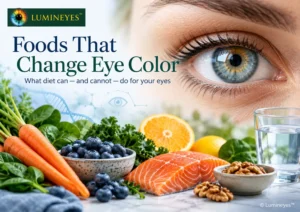
Can foods change eye color? The short answer is no: there is no credible clinical evidence that a food, juice, vitamin, supplement or special diet can permanently change the natural color of a healthy adult iris. Nutrition matters greatly for vision and ocular health, but it does not provide a proven way to turn brown eyes blue, make hazel eyes green or remove established iris melanin.
Eye color depends primarily on melanin, its distribution within the iris stroma, inherited biological factors and the way light interacts with iris tissue. A healthy diet can nourish the eye; it has not been shown to selectively lighten or darken the adult iris.
No food changes natural iris pigment in a predictable, permanent way. Carrots, spinach, honey, fish, citrus fruits, herbal drinks and supplements may be discussed online, but claims that they can change eye color are not supported by human clinical evidence. Changes seen in photos are usually changes of appearance, not pigment.
Why Foods Cannot Change Eye Color
The iris is not a colored film that can be bleached by a food ingredient. It is living tissue with an organized anterior border region, a vascular and fibrous stroma, pigment-containing cells and a posterior pigment epithelium. The visible difference between dark brown, hazel, green, gray and blue eyes reflects the interaction of pigment concentration, tissue structure and optical scattering.
In darker eyes, more anterior iris melanin absorbs incident light. In lighter eyes, reduced anterior melanin allows the optical properties of stromal tissue to play a greater role. A blue-looking iris does not contain a special blue food-derived dye. For an anatomical explanation, see what the iris is and how it functions, or explore the Eye Color Chart & Genetics Guide.
Dietary nutrients reach ocular tissues through normal circulation and contribute to essential biological functions. However, delivering nutrition to the eye is not equivalent to removing melanin stored in iris pigment cells. No controlled human trial has established that a particular diet reliably reduces or redistributes normal iris pigment in healthy adults. Statements such as “vitamin C dissolves brown iris pigment” or “a raw-food diet activates blue eyes” therefore have no demonstrated clinical foundation.
Eye color can change naturally during infancy and occasionally with disease, injury or medication. These are not examples of ordinary foods changing adult iris pigmentation.
Which Foods Are Claimed to Change Eye Color?
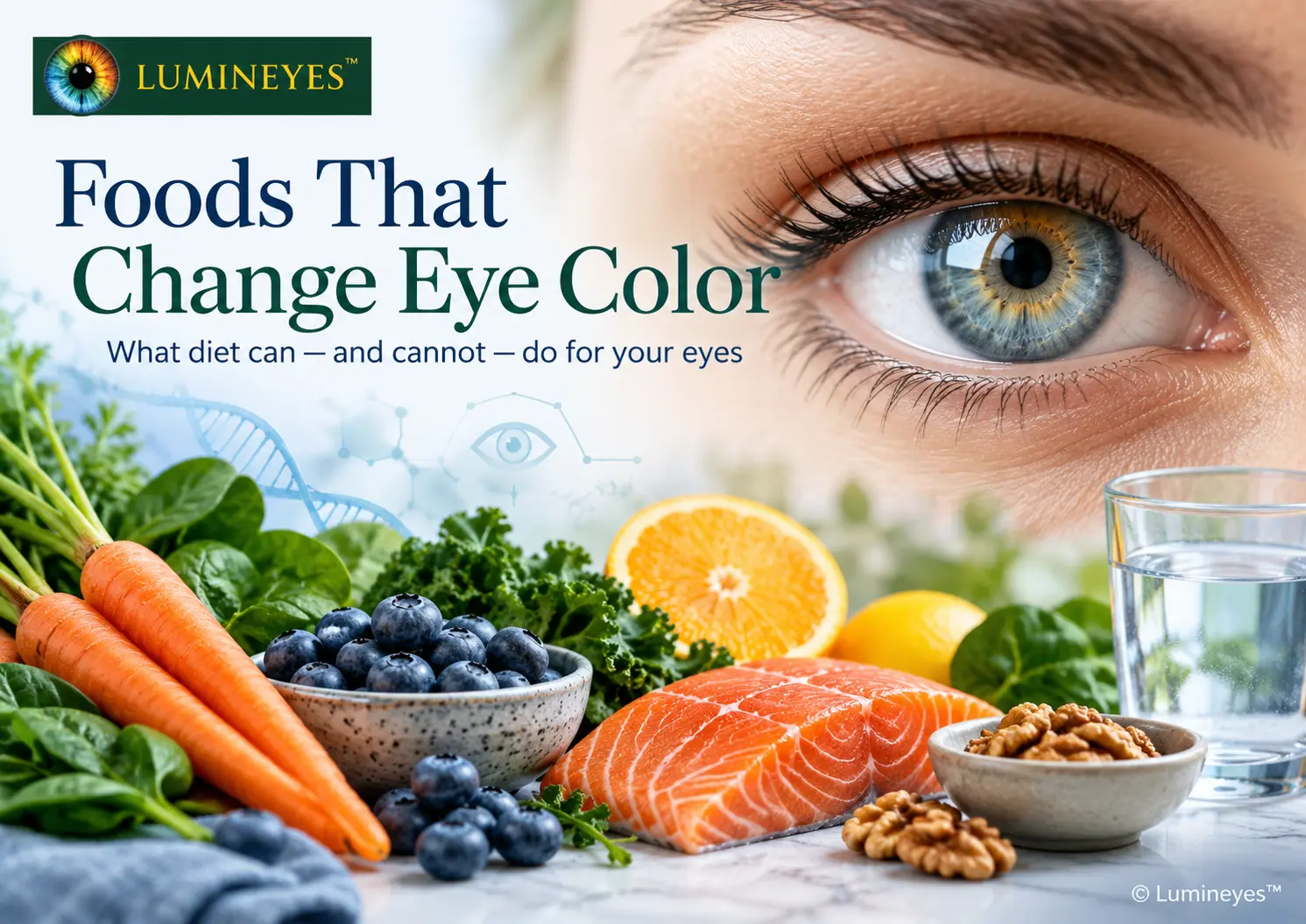
Online lists often recommend honey, carrots, spinach, fish, nuts, berries, olive oil or “detox” drinks. The problem is not that these foods are necessarily unhealthy. The problem is the leap from supporting normal eye physiology to changing iris pigmentation.
| Food or drink | What it may actually contribute | Change adult iris color? |
|---|---|---|
| Carrots and sweet potatoes | Beta-carotene, a precursor of vitamin A, supports normal visual function. | No clinical evidence |
| Spinach and kale | Lutein and zeaxanthin are relevant to macular pigment and retinal health. | No clinical evidence |
| Salmon and sardines | Omega-3 fatty acids contribute to overall nutrition and retinal function. | No clinical evidence |
| Oranges, berries and peppers | Vitamin C and other antioxidants support normal tissue health. | No clinical evidence |
| Nuts and seeds | Vitamin E and other nutrients are part of a balanced diet. | No clinical evidence |
| Honey, lemon water and herbal drinks | May be consumed as foods or beverages; no validated iris pigment effect. | No clinical evidence |
| Water | Supports hydration and general physiological function. | No clinical evidence |
Some pigments derived from food can affect the skin. For example, excessive carotenoid intake can produce a yellow-orange skin discoloration called carotenemia. That does not mean dietary carotenoids selectively turn brown iris tissue blue or green. Skin coloration and iris pigmentation are biologically different questions.
A useful distinction: “Good for the eyes” is not interchangeable with “changes eye color.” Clinical evidence must establish both the target tissue and the measured outcome before such a claim is justified.
Why Do Eyes Sometimes Look Lighter or Darker?
A person may sincerely believe that their eyes changed after adjusting their diet. The observation can be real while the proposed explanation is wrong: the photographic appearance of the iris can change without any measurable change in its melanin. This is especially noticeable in hazel, gray, green and blue-gray eyes with mixed pigment patterns.
Daylight, warm indoor lighting, reflected surfaces and camera software can shift apparent color.
The visible area and spatial arrangement of iris features change as the pupil contracts or dilates.
Surrounding colors can make existing blue, green, amber or gray elements more noticeable.
Redness, irritation or tear-film changes can alter the impression of eye clarity, without changing iris melanin.
Camera flash, close-up distance, image filters and exposure corrections are particularly important when comparing “before” and “after” photographs. Two pictures taken under different conditions cannot establish biological pigment loss. See our clinical explanation of why apparent eye color changes and the guide to identifying your true eye color.
Photographic check: Compare both eyes under similar indirect daylight, with the same camera, distance, exposure and no beautification filters. This can reduce apparent differences, but photos alone do not replace an ophthalmic examination when a persistent color change is suspected.
Best Foods for Eye Health — Not for Changing Iris Color
Diet does influence the biological environment in which the eye functions. The American Academy of Ophthalmology (AAO) discusses vitamin-rich foods, lutein, zeaxanthin and other nutrients within the context of visual health and age-related eye conditions—not as an iris-color treatment.
Vitamin A and beta-carotene
Carrots, sweet potatoes and several dark leafy vegetables supply provitamin A carotenoids. Vitamin A is required for normal photoreceptor function and ocular surface health. Correcting deficiency matters medically; taking extra vitamin A does not make the iris lighter. High-dose supplements are not automatically beneficial and may be harmful in some circumstances.
Lutein and zeaxanthin
Spinach, kale and other green vegetables contain these carotenoids, which are found in the retinal macula. The nutrients are discussed in the context of macular pigment and retinal health. The Eye Health, Vitamins, Diet and Care article explores nutritional care in more detail. Retinal pigment and visible iris pigmentation should not be confused.
Omega-3 fatty acids
Fatty fish such as salmon and sardines provide omega-3 fatty acids and can be part of a balanced Mediterranean-style dietary pattern. The AAO highlights the overall value of this pattern for eye health. Evidence about omega-3 supplements for specific conditions, such as dry eye, is more variable than popular summaries suggest, and none of it establishes a natural eye-color change.
Vitamin C, vitamin E and other dietary antioxidants
Citrus fruits, berries, peppers, nuts and seeds supply micronutrients involved in normal cell function and antioxidant defense. Their potential roles in maintaining ocular health should not be misrepresented as an ability to reach into the iris and dissolve melanin.
Hydration and everyday comfort
Appropriate hydration contributes to general health. Eye comfort and surface appearance may vary with environment, sleep, irritation and tear-film status, but drinking extra water does not change the inherited pigment distribution of the iris.
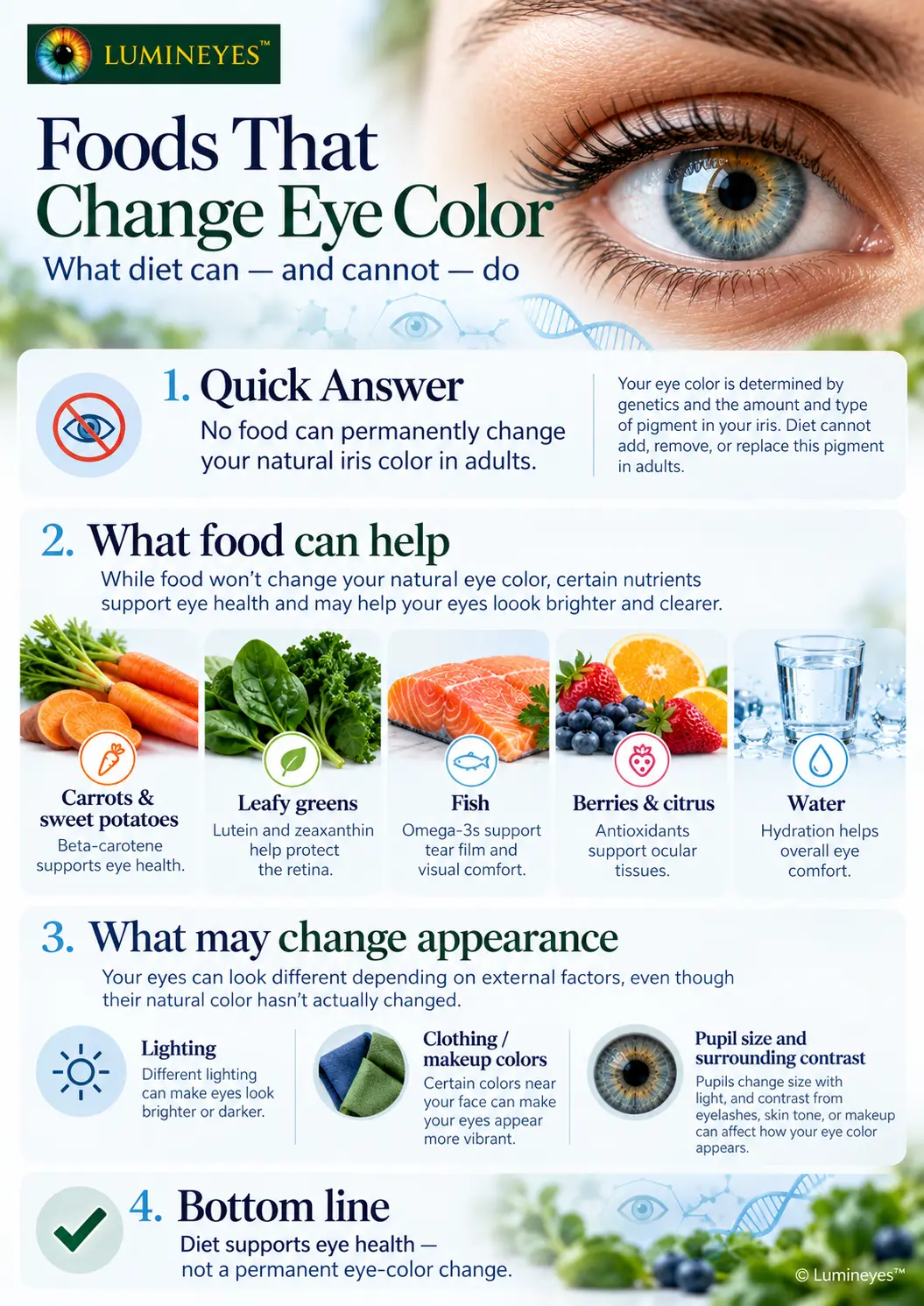
For patient-focused nutrition guidance, the AAO also publishes Fabulous Foods to Boost Eye Health. Its emphasis is on maintaining vision and overall ocular health, not cosmetic modification of the iris.
Can Supplements, Eye Drops or Natural Remedies Change Eye Color?
There is no well-established oral supplement, detox program, herbal mixture or dietary intervention that safely and predictably changes normal iris pigment in healthy adults. Marketing claims for “melanin-clearing” capsules or eye-color-changing diets should therefore be treated skeptically.
Never put honey, lemon juice, herbal extracts or homemade solutions directly into the eye. The ocular surface is sensitive to chemical irritation, contamination and infection. A substance being edible does not make it sterile or appropriate for ophthalmic use.
One important distinction is that certain prescription eye medications, particularly some prostaglandin-analogue glaucoma drops, can be associated with increased iris pigmentation. That is a documented medication-related effect—not a safe, controllable cosmetic strategy and not evidence that foods can alter eye color.
Some online products use phrases such as “natural iris detox” or “melanin flush.” These phrases do not describe a validated physiological pathway for selective stromal depigmentation. Ask what was measured: standardized iris photographs, objective colorimetry, slit-lamp findings and documented follow-up—or only testimonials?
What Can Actually Change Eye Color?
It is important to separate normal optical variation, acquired medical changes and elective cosmetic intervention. Natural eye-color development in infants is not equivalent to adult dietary lightening. Acquired iris changes can occur with ocular inflammation, injury, certain medications or other eye conditions, and deserve appropriate assessment.
If one iris develops a new patch of color, one eye gradually darkens or lightens, or a color change appears alongside pain, redness, blurred vision or unequal pupil size, an ophthalmologist should examine the eye. A sudden or symptomatic change should not be dismissed as a dietary effect.
Elective eye-color procedures are a separate subject
Procedures proposed for cosmetic eye-color alteration include approaches acting on the iris and approaches that change the appearance of the cornea. They have different anatomical targets, mechanisms and risks. They are not nutritionally induced changes. For a detailed clinical overview of laser-based reduction of anterior iris melanin, read the main Laser Eye Color Change – Clinical Guide.
Cosmetic iris procedures also require careful risk assessment. A case report published in the European Journal of Ophthalmology described refractory pigmentary glaucoma after a cosmetic laser iris treatment. A case report does not establish the complication rate of every laser method, but it demonstrates why the procedure, treatment protocol and long-term ocular monitoring matter. This literature should not be confused with the evidence on foods and nutrition.
If your interest is mainly in appearance rather than an intervention, you can explore shades using the Eye Color Simulator. It is a visual preview, not a biological pigment test or prediction of any medical result. Clothing and cosmetic color contrast are covered separately in our makeup guide for brown, hazel, green and blue eyes.
How to Recognize Misleading Eye-Color Before-and-After Claims
Reliable evidence for a claim of pigment change requires more than two different-looking photographs. The stronger questions are whether the same iris regions were evaluated, whether lighting and exposure were standardized, whether objective measurements were reported and whether the result persisted on follow-up.
- Look for consistent conditions. A brightly illuminated close-up next to a dark, distant photograph can create a convincing but misleading comparison.
- Separate eye appearance from iris biology. Whiter-looking sclera, makeup contrast or a smaller pupil does not demonstrate melanin loss.
- Check the type of evidence. Personal anecdotes and edited social-media videos cannot replace controlled clinical observations.
- Be cautious with guarantees. Claims that a fixed food plan will transform brown eyes into green or blue eyes within days or weeks lack a credible clinical basis.
Frequently Asked Questions About Foods and Eye Color
Can eating certain foods turn brown eyes blue or green?
No. No diet has been clinically shown to remove enough normal anterior iris melanin to transform brown eyes into blue or green eyes in healthy adults.
Do carrots or sweet potatoes lighten eye color?
No. Their carotenoids contribute to vitamin A nutrition, which matters for normal visual function. That is not the same as altering iris pigmentation.
Can honey, lemon or herbal tea change eye color naturally?
No reliable clinical evidence supports these claims. Never place homemade food mixtures into the eye.
Can vitamins, collagen supplements or antioxidants reduce iris melanin?
There is no established supplement regimen that safely and predictably reduces the pigmentation of a healthy adult iris. Supplements should be used for a genuine nutritional or medical indication, not as unproven eye-color treatments.
Why do my eyes look greener or lighter after changing my diet?
Lighting, pupil diameter, camera processing and surrounding colors can change perceived shade. A true persistent alteration of the iris should be examined rather than attributed automatically to nutrition.
Can dehydration change eye color?
Hydration and ocular surface comfort can affect how the eyes look, but routine changes in water intake are not proven to change iris melanin. New changes in an eye's appearance warrant assessment when persistent or accompanied by symptoms.
Can babies' eye color change naturally?
Yes. Iris pigmentation can evolve during infancy and early childhood. That developmental process is distinct from claims that specific foods can change the established iris color of adults.
Can eye color genuinely change later in life?
Sometimes, for medical reasons such as inflammation, injury or certain prescription medicines. These changes are not evidence that an eye-color diet works, and a new unexplained change should be evaluated by an ophthalmologist.
The Bottom Line: Eat for Eye Health, Not Eye-Color Change
Foods that change eye color are an internet myth, not an established medical intervention. The nutritional value of vegetables, fruit, fish, nuts and a balanced diet should be taken seriously—but their benefits should be described accurately. They support the eye as a living organ; they do not selectively remove, replace or redistribute normal iris pigment in healthy adults.
If your eyes appear different in photographs, consider optics and lighting first. If you notice an unexplained, persistent or symptomatic change, seek ophthalmic evaluation. To understand the genetics behind brown, hazel, blue, gray and green irides, continue with the Eye Color Chart & Genetics Guide.
Clinical Sources & Further Evidence
- American Academy of Ophthalmology. Diet, Nutrition, and Eye Health Supplements. Updated April 2025. Guidance on nutrient-rich foods and visual health.
- American Academy of Ophthalmology. Fabulous Foods to Boost Eye Health. April 2026. Food-based nutrition and ocular health.