Heterochromia Treatment: The World's First Permanent Symmetry Correction

Heterochromia iridum—characterized by complete or sectoral disparity in anterior stromal melanin distribution—presents a complex physiological challenge in anterior segment care. Achieving true, long-term ocular symmetry requires a highly targeted biophysical approach rather than generalized laser energy delivery.

The proprietary Lumineyes laser eye color change procedure provides a non-invasive, physician-guided methodology engineered specifically to modulate asymmetrical melanosome density within the iris stroma. By utilizing wavelength-specific selective photo-ablation, localized hyper-pigmented sectors are precisely targeted to stimulate natural macrophage-mediated clearance without compromising intraocular pressure, corneal endothelial density, or surrounding tissue elasticity.


Clinical Genesis: The Origin of Non-Invasive Heterochromia Correction

The MyLumineyes® protocol was originally conceptualized to address one of ophthalmology's most complex anatomical challenges: asymmetrical iris pigmentation and sectoral heterochromia. Historically, patients with pronounced iris color disparity had no non-invasive options, as conventional laser parameters were incapable of handling localized pigment density variations safely.

Through targeted clinical research, Dr. Mustafa Mete developed a specialized micro-energy delivery system designed to clear high-density melanosome pockets in sectoral heterochromia without compromising surrounding corneal or intraocular structures.

LIPS Grade V: Sectoral Resistance & Custom Dosing

Within The Lumineyes® Iris Pigmentation Scale (LIPS), sectoral heterochromia is classified as Grade V. Isolated hyper-pigmented sectors exhibit dense collagen-melanin coupling, requiring sector-specific energy calibration and extended macrophage clearance cycles. To explore the full biophysical classification, visit the MyLumineyes® Clinical Research Archive.

A Global Milestone in Ophthalmic Aesthetics

This case represents a global milestone in ophthalmic aesthetics: The first successful permanent symmetry correction of complete sectoral heterochromia using the non-invasive MyLumineyes 8G Xtra protocol. Under the expertise of Op. Dr. Mustafa Mete, genetic color asymmetries are now manageable safely and permanently.

Why is this unreplicable by standard clinics?

Standard ophthalmic lasers apply uniform energy across the entire iris, which cannot correct regional, millimeter-specific color differences. The correction of sectoral heterochromia cannot be achieved by merely pressing a button on a machine. 

It relies entirely on Dr. Mete’s 25 years of clinical mastercraft and cognitive mapping. By visually analyzing the exact stromal density and depth, Dr. Mete manually calibrates and targets only the hyper-pigmented sectors, leaving the natural lighter areas completely untouched. This level of surgeon-guided micro-precision is an acquired medical art, making true sectoral heterochromia correction exclusive to our clinic.
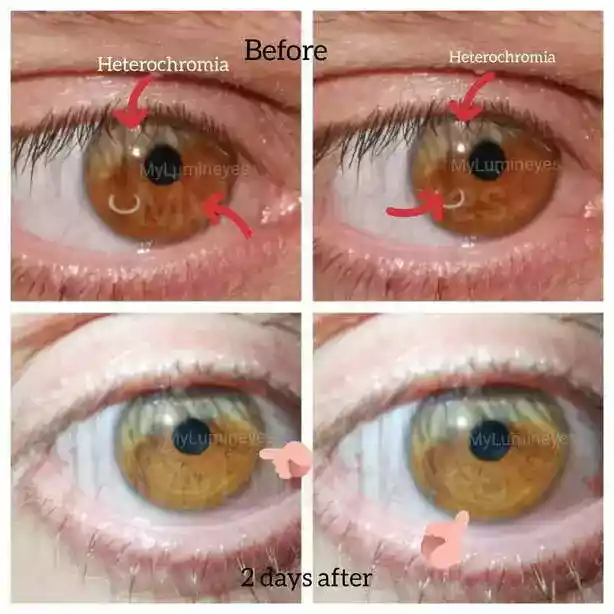
Before and after clinical progression of sectoral heterochromia correction using selective laser depigmentation by Dr. Mustafa Mete.
Clinical progression of a sectoral heterochromia patient showing targeted pigment clearance 2 days after surgeon-guided laser treatment by Dr. Mete.

Types of Heterochromia

“In The Lumineyes™ Iris Pigmentation Scale (LIPS), sectoral heterochromia is classified as Grade V due to dense collagen-melanin coupling, requiring sector-specific micro-energy calibration.”

To determine the right approach for eye color change by laser it is essential to identify the specific form of iris variation:

  1. Complete Heterochromia: Each eye has a distinctly different color (e.g., one blue and one brown eye).

  2. Sectoral (Partial) Heterochromia: A segment or “wedge” of one iris differs in color from the rest of the same eye.

  3. Central Heterochromia: The inner ring around the pupil shows a different color compared to the outer iris, creating a “halo” effect.

The Science: How Laser Correction Achieves Symmetry

Unlike invasive artificial iris implants or risky corneal tattooing (keratopigmentation), the Mylumineyes protocol targets the root cause: stromal melanin.

  • Selective Photothermolysis: We utilize specialized wavelengths to fragment excess melanin granules in the darker iris without affecting the surrounding tissue.

  • Natural Clearance: These microscopic particles are naturally cleared through the eye’s trabecular meshwork by the body’s immune cells.

  • Safety Thresholds: By using low-fluence energy, we preserve the eye’s structural integrity and maintain natural iris elasticity.
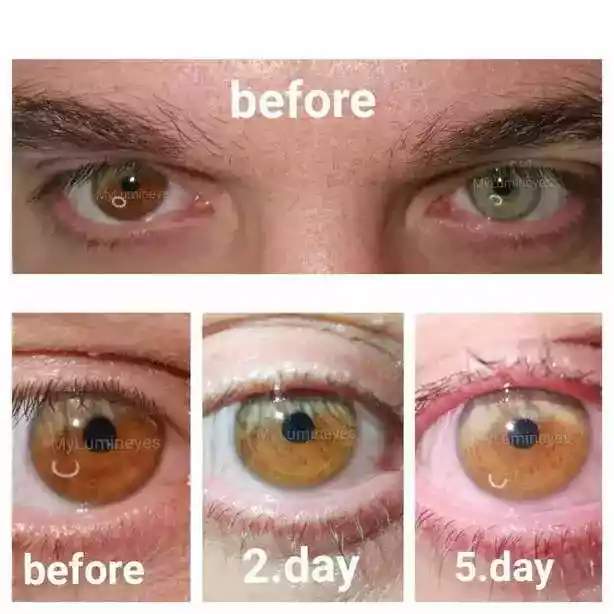
Heterochromia laser symmetry correction before and after results by Mylumineyes 8G Xtra.
Day-by-day clinical progression of sectoral heterochromia correction, demonstrating rapid and safe natural melanin clearance.

Clinical Case Report: Genetic Heterochromia Correction

As a pioneer in this field, Dr. Mete has documented the transition of patients from asymmetric iris patterns to harmonious, natural results. This is a response-guided medical progression that ensures long-term safety.

  • Patient Profile: Congenital Sectoral Heterochromia (Asymmetric stromal melanin distribution within a single iris).

  • NON-Surgical Protocol: MyLumineyes® 8G Xtra (Surgeon-guided selective depigmentation).

  • Mechanism of Action: Utilizing advanced selective photothermolysis, the laser energy was manually calibrated by the surgeon and applied exclusively to the hyper-pigmented segment, bypassing the lighter stroma completely.

  • Clinical Outcome: Permanent ocular symmetry achieved within 3 months post-laser treatment. Visible no thermal damage to the surrounding tissue or trabecular meshwork. For a complete breakdown of our safety parameters and longitudinal studies, review our long-term safety data.
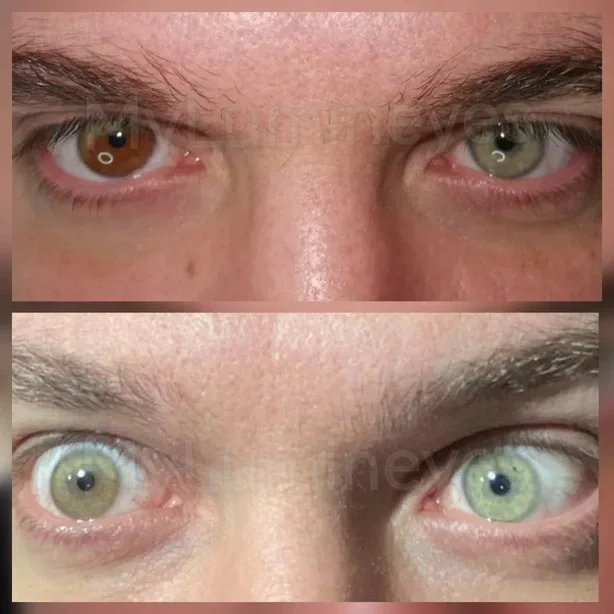
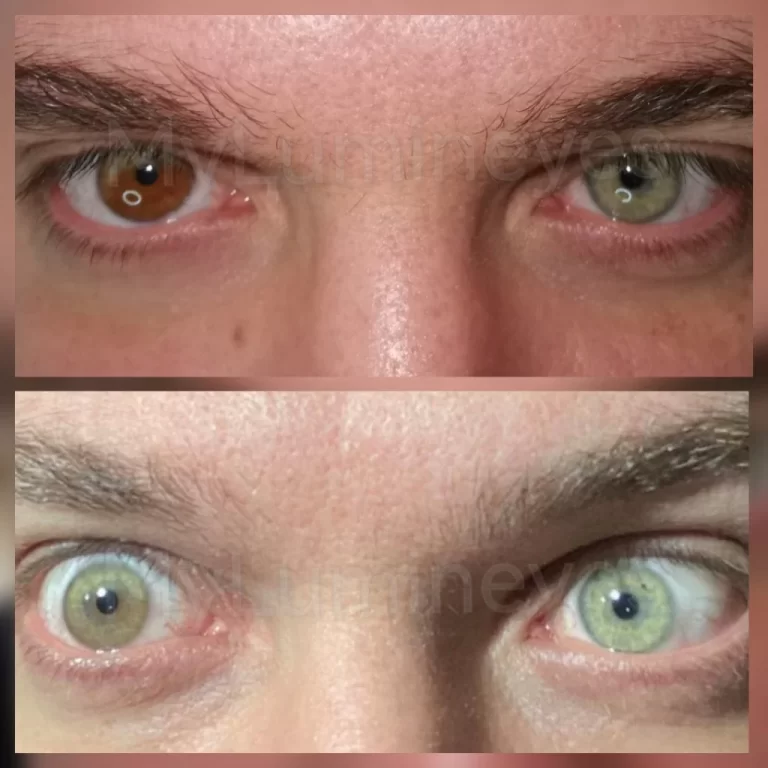
Complete Congenital Heterochromia Correction - 3 Months Post-Op
Perfect ocular symmetry achieved 3 months post-laser treatment for congenital complete heterochromia.


Is Heterochromia Treatment Permanent?

Yes. Because melanin in the iris stroma does not regenerate, once it is reduced through controlled laser iris depigmentation sessions, the change is permanent. This makes the 8G Xtra protocol the only medical solution for lifelong symmetry. Also Click here to view the [step-by-step Laser Eye Color Change] Procedure]
 

Clinical CriteriaMyLumineyes® 8G XtraIris ImplantsKeratopigmentation
Procedural NatureNon-Invasive
Physician-guided selective photo-ablation
Surgical Intraocular
Invasive anterior chamber insertion
Intrastromal Injection
Corneal tunnel creation & dye injection
Optical Appearance100% Natural Iris Texture
Preserves native stromal depth, limbal ring, and Rayleigh scattering.
Artificial / Plastic Reflection
Opaque synthetic membrane blocking natural iris architecture.
Opaque / Flat Masking
Unnatural "contact-lens" appearance lacking physiological depth.
Corneal & IOP SafetyHigh Safety Profile
Zero corneal contact; natural trabecular macrophage clearance.
Severe Complication Risk
High incidence of UGH syndrome, severe glaucoma, and decompensation.
Optical Blockage Risk
Permanent stromal opacity; impairs future intraocular surgical access.
Reversibility & Surgical AccessPermanent Natural Clearance
Full red reflex maintained for future cataract/retinal surgeries.
Requires Extraction
High-risk surgical removal often results in permanent tissue trauma.
Irreversible Opacity
Pigment extraction is clinically unfeasible without corneal transplant.
Medical Differential: When Does Heterochromia Require Immediate Ophthalmic Evaluation?

While congenital heterochromia is typically a benign genetic variation, acquired heterochromia (color changes developing later in life) can indicate underlying ocular or systemic pathology. An urgent diagnostic evaluation by an anterior segment specialist is mandatory if color asymmetry is accompanied by visual changes or develops abruptly:

Fuchs Heterochromic Iridocyclitis (FHI)

Chronic, low-grade intraocular inflammation leading to progressive iris stroma atrophy, heterochromia, secondary cataract, or glaucoma.

Horner’s Syndrome

Disruption of sympathetic innervation to the eye, inhibiting melanocyte maturation in congenital or early acquired cases, presenting with ptosis and miosis.

Iris Melanoma / Ciliary Body Nevi

Unilateral hyper-pigmented nodular growth or spreading melanocytic lesion within the stroma requiring high-resolution anterior segment OCT and oncological surveillance.

Pigment Dispersion & Trauma

Mechanical pigment liberation, iris sphincter tears, or post-inflammatory atrophy following ocular trauma or pharmacological iris alteration.

FAQ—Heterochromia

Yes. When melanin inside the iris is reduced gradually with laser, the change is long-lasting because melanin does not regenerate. However, the degree of lightening varies between individuals.

Temporary correction is possible with colored contact lenses.
In addition, certain patients with sectoral or complete heterochromia may be candidates for clinically supervised pigment-based procedures.
At MyLumineyes®, we have managed many heterochromia cases with high success by carefully evaluating each patient’s iris structure, melanin distribution, and medical suitability.
Every case is assessed individually to determine the safest and most appropriate approach.

Genetics, congenital pigment variation, trauma, inflammation, or certain medications may influence melanin distribution.

Before and after result of complete heterochromia treatment by Dr. Mustafa Mete, showing the permanent correction of asymmetrical eye colors using selective laser depigmentation.
Dr. Mustafa Mete - Inventor of MyLumineyes Laser Eye Color Change

Medical Review & Fact-Checking

All medical content is reviewed by Dr. Mustafa Mete, an ophthalmic surgeon with 25 years of clinical experience and 3,000+ laser eye color change cases.

Dr. Mete is the original developer of the patent-pending Lumineyes™ technique, with more than 15 years of clinical experience and over a decade of long-term patient follow-up.

✓ Original Developer
✓ 15+ Years of Clinical Experience
✓ Long-Term Follow-Up
Lumineyes Lumineyes Assistant ×
Structured clinical guidance • No automated free-text answers
Start Here
Ask a question or choose a topic above.
Explore laser iris depigmentation, clinical safety protocols, surgical differences, and long-term permanence.