Green Eyes: Genetics, Rarity, Shades and the Science of Iris Color
Why green eyes are so uncommon, what creates their distinctive color, how to distinguish green from hazel, and when an apparent color change deserves medical attention.
Green eyes are a rare natural iris color, generally associated with relatively low-to-intermediate anterior iris melanin and the optical scattering of light within the iris stroma. There is no distinct green pigment that colors the iris in the way green dye colors a surface. Instead, genetic variation shapes the amount and distribution of melanin, while microscopic tissue structure determines how incoming light is absorbed and returned to the observer.
This is why two people can both be described as having green eyes yet display very different olive, moss, gray-green or golden-green patterns. The same eye may also look distinctly greener in daylight than it does in a warm indoor photograph. To understand this variation, it helps to distinguish melanin biology, iris stromal anatomy and the physics of visual perception.
01 / Iris biologyWhat Actually Causes Green Eyes?
Visible iris color is generated through a complex interaction between pigmentation and optics. The anterior border layer and stroma contain melanocytes, melanin granules, collagen and other structures that influence how light behaves when it enters the iris. The heavily pigmented posterior iris epithelium is present in most normally pigmented eyes, including light-colored eyes.
Less visible anterior pigmentation than is typical of dark brown eyes allows a greater contribution from stromal optics. The actual distribution varies from eye to eye.
Collagen-rich iris tissue scatters incident light. Alongside wavelength-dependent absorption, this contributes to green, blue-gray and mixed appearances.
Gold near the pupil, darker outer rings and uneven pigment density influence the overall shade seen by an observer or camera.
A common explanation describes green eyes as blue light scattering combined with yellow-brown pigment. That can be a useful simplified visual model, but real iris optics are more complex than mixing two paint colors. Similarly, “lipochrome” should not be presented as an established, necessary green-eye pigment; melanin distribution and stromal optics provide the better-supported explanation. The American Academy of Ophthalmology's explanation of iris color describes why green and hazel irides can appear mixed without containing separate green or blue pigment.
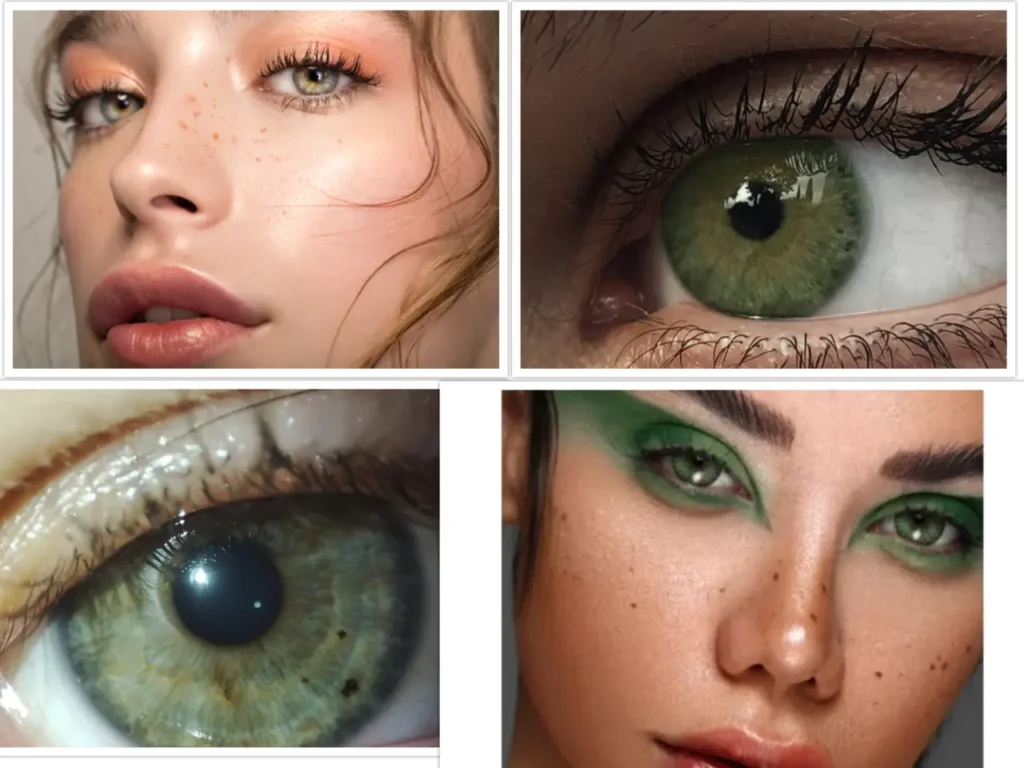
02 / Visible spectrumShades of Green Eyes: Olive, Emerald, Gray-Green and Golden-Green
“Green eyes” describes a family of appearances rather than a single standardized color. Some irides have a muted moss or olive base, while others look brighter or cooler. These visual descriptions are helpful in everyday language but do not represent separate genetic categories or measured clinical pigment grades.
These swatches are illustrative representations, not clinical predictions or treatment outcomes. The actual eye is often more intricate, with crypts, radial fibers, pigment spots, a limbal ring and distinct central zones. If you are uncertain whether your own eyes are green, hazel or gray, our What Is My Eye Color? guide explains how to assess the dominant color under neutral lighting.
03 / Population patternsHow Rare Are Green Eyes Worldwide?
Green eyes are among the least common major natural iris-color categories. The American Academy of Ophthalmology cites an often-repeated estimate of approximately 2% globally. This should be interpreted as a broad approximation rather than the result of a uniform, worldwide eye-color census.
Prevalence varies greatly between populations. Green eyes are more frequently reported in several European populations and are generally uncommon in much of the rest of the world. Importantly, categories overlap: one survey's “green” eye may be classified as “hazel” or “gray-green” in another, especially when photographs and lighting are not standardized.
Rarity is not a measure of eye health
Green eyes are unusual in population terms, but the color alone does not indicate that an iris is healthier, more functional or more attractive than another. To compare natural colors and the limitations of prevalence rankings, read our guide to the rarest eye colors.
04 / Visual differentiationGreen Eyes vs. Hazel, Blue and Gray Eyes
The distinction is usually easiest when the iris is viewed in diffuse daylight without makeup filters or flash. A single golden ring does not automatically make an eye hazel, and a cool gray cast does not necessarily make it gray.
| Eye color | Typical visual pattern | Common source of confusion |
|---|---|---|
| Green | Predominantly green or olive background; may have golden flecks or a darker limbal ring | Warm indoor light may exaggerate brown or amber areas |
| Hazel | Conspicuous mixture or transitions between green, brown and golden tones | Can look mostly green or mostly brown depending on illumination |
| Blue | Usually cooler blue background with relatively little visible anterior brown pigmentation | Warm or green surroundings can shift photographic appearance |
| Gray | More neutral, smoky or steel-colored dominant impression | May appear blue-green in certain lighting conditions |
The boundary between green and hazel is particularly subjective. A useful practical distinction is whether green remains the dominant background across several neutral-light observations or whether clearly mixed brown/green regions dominate. Our dedicated Hazel Eyes article explores mixed pigment patterns, while the Eye Color Chart & Genetics Guide examines the broader spectrum.
05 / HeredityAre Green Eyes Genetic? The Role of OCA2, HERC2 and Other Genes
Yes. Green eye color is strongly influenced by inherited genetic variants that regulate melanin production, melanosome function and pigment distribution. But there is no reliable single “green-eye gene.” Eye color is a polygenic and continuous trait, not a simple dominant–recessive switch.
The HERC2–OCA2 region on chromosome 15 has a major role in common eye-color variation. Regulatory variants near HERC2 can influence OCA2 expression, and other loci contribute additional effects. Consequently, two parents with similar eye colors can have children with a visibly different iris color. The NIH MedlinePlus Genetics overview provides a clear, evidence-based explanation of this inheritance pattern.
For the historical context of lighter iris colors and changing population frequencies, see Eye Color Evolution in Humans. Evolutionary explanations should be distinguished from genetic evidence that directly identifies pigment-regulating variants.
06 / Appearance and photographyWhy Do Green Eyes Look Blue, Gray or Brown in Different Lighting?
Green irides are especially responsive to photographic conditions because the visible color depends on both pigment absorption and the light that is scattered back. The underlying melanin does not have to change for a photograph to look dramatically different.
- Daylight versus warm indoor light: different spectral qualities can emphasize green, gold or brown components.
- Pupil size: dilation changes how much iris is visible and can alter the perceived proportions of central and peripheral colors.
- Camera processing: auto white balance, HDR, flash and saturation settings may shift a natural green iris toward blue or warm hazel.
- Surrounding contrast: hair, clothing, skin, eyelashes and makeup affect perception without changing pigment.
- Iris pattern: a central golden ring and a cool outer zone can respond differently to the same illumination.
How to photograph green eyes more consistently
Use indirect natural daylight, consistent camera distance and angle, no beauty filters and a neutral white-balance setting where available. Avoid comparing a close flash photograph with a distant indoor selfie. For a fuller explanation, see Why Does My Eye Color Change? and our practical guide to makeup contrast for green eyes.
The MyLumineyes Eye Color Simulator can illustrate different color appearances on a face. It is a visual preview, not a measurement of the true iris pigment or a prediction of medical treatment results.
07 / Ophthalmic perspectiveAre Green Eyes More Sensitive? When Is Eye Color Change a Medical Concern?
Eye color by itself is not a diagnosis of light sensitivity, retinal disease or visual performance. Pigmentation can influence aspects of ocular light handling, but discomfort in bright light has many possible causes, including dry eye, inflammation, corneal disorders and medication effects. A persistent symptom should be evaluated rather than attributed automatically to green eyes.
Most adults maintain a stable iris phenotype for many years. A different appearance in two photographs is usually not the same as an acquired anatomical color change. However, a new, persistent change in one eye, new patchy pigment loss, altered pupil shape, pain, redness or blurred vision deserves an ophthalmic examination. Disease, trauma and certain medications can change iris appearance or pigmentation. The AAO guide on changing eye color discusses these warning signs.
08 / Appearance and interventionsCan Green Eyes Be Made Lighter or Changed to Blue?
Green eyes may look lighter with changes in ambient light, makeup contrast or photographic exposure, but these do not reduce iris melanin. Food, supplements, oils, “eye-color drops” and other natural-lightening claims lack credible evidence that they safely produce a predictable, permanent change in adult iris pigmentation.
Properly fitted colored contact lenses can temporarily alter appearance without removing iris pigment, but they still require professional fitting and appropriate hygiene. Medical interventions for elective eye-color alteration are different: they may involve iris pigment interaction, corneal alteration or intraocular implants, and their risk profiles are not interchangeable.
For readers investigating actual stromal pigment modification, the Laser Eye Color Change medical guide describes the Lumineyes approach, candidate assessment, treatment staging, limitations and follow-up. No procedure should be assumed to guarantee a particular green, gray or blue shade. Possible complications need to be considered separately from a desired cosmetic outcome.
Clinical evidence and safety
Serious pigmentary-glaucoma complications following cosmetic laser iris treatment have been documented, including a report in the European Journal of Ophthalmology. A case report establishes that a complication can occur, not its incidence across every technique. The relevant clinical questions are protocol-specific safety data, patient selection, intraocular-pressure monitoring and long-term follow-up.
09 / Patient questionsFrequently Asked Questions About Green Eyes
How rare are green eyes?
They are among the rarest major eye-color categories. A widely cited global estimate is around 2%, but exact prevalence depends on geography, population sampling and whether gray-green and hazel eyes are grouped separately.
Is there a true green pigment inside green eyes?
There is no distinct green dye responsible for normal green irides. Their appearance reflects melanin distribution, tissue structure and light scattering; simplified references to yellow plus blue should not be taken as literal pigment mixing.
Are green eyes rarer than blue eyes?
In broad global estimates, yes. The comparison can vary by country and by how mixed eye colors are classified.
What is the difference between green and hazel eyes?
Green eyes generally have a predominantly green or olive background. Hazel eyes more often show clearly mixed brown, gold and green zones. There is no universally accepted visual boundary between the two.
Can two brown-eyed parents have a child with green eyes?
Yes. Iris color is influenced by many genes; parental eye colors alone do not determine a child's final phenotype.
Do green eyes change color with mood or weather?
Mood or environmental conditions may influence pupil size, illumination and the apparent contrast of the iris, but they do not ordinarily cause rapid, permanent changes in melanin.
Can green eyes become blue with age?
Major spontaneous changes in iris pigmentation are uncommon in adults. Some changes in apparent color are optical, but any new persistent color change—especially if one-sided—should be assessed by an ophthalmologist.
Can diet, honey or vitamins make eyes greener?
No food or supplement has been clinically established to change natural adult iris melanin into a green-eye phenotype. Healthy nutrition can support ocular function without changing inherent iris color.
Are green eyes automatically more sensitive to sunlight?
No single eye color is sufficient to predict an individual's light sensitivity. Persistent photophobia or discomfort requires evaluation for other ocular causes.
Can laser treatment guarantee green eyes?
No. Individual pigmentation and stromal structure vary, and treatment has medical risks. A precisely specified target shade cannot be guaranteed.
ConclusionThe Biology Behind a Distinctive Natural Eye Color
Green eyes are an uncommon expression of human iris pigmentation, shaped by multiple genetic factors and the way light interacts with the stroma. Their apparent variability is part of their optical character, not evidence that eye pigment changes from day to day. Understanding green irides therefore means looking beyond a simple color label to the distribution of melanin, the structure of the iris and the conditions under which it is observed.
For a broader scientific overview, browse the MyLumineyes Research Archive, which separates anatomical and biological analysis from the clinical evaluation of eye-color interventions.
Keep exploringRelated MyLumineyes Reading
Evidence & Further Reading
- American Academy of Ophthalmology. Eye Color: Unique as a Fingerprint. Updated 2026. Eye color variation and widely cited prevalence estimates.
- American Academy of Ophthalmology. Your Blue Eyes Aren't Really Blue. Iris stroma, pigmentation and scattered light.
- U.S. National Library of Medicine / MedlinePlus Genetics. Is Eye Color Determined by Genetics? HERC2, OCA2 and other genes.
- American Academy of Ophthalmology. Why Are My Eyes Changing Color? Ocular and optical causes of apparent or real change.
- Ong AY et al. Refractory iatrogenic pigmentary glaucoma secondary to cosmetic laser treatment: a case report. European Journal of Ophthalmology. doi:10.1177/11206721211050338.
Educational ophthalmic content. The visual color swatches are schematic. This article does not replace individualized examination or provide a prediction of cosmetic treatment results. © 2026 MyLumineyes™.