
MyLumineyes® Clinical Data: 15-Year Expertise & 8-Year Longitudinal Clinical Observations
Overview of Long-Term Clinical Observations, Biophysical Considerations, and Intraocular Pressure (IOP) Outcomes in Laser Iris Depigmentation
---
ABSTRACT
Background:
Laser-based iris depigmentation is an emerging approach to altering visible iris pigmentation. Long-term clinical observations may provide useful information regarding treatment outcomes, adverse events, follow-up patterns, and areas requiring prospective validation. The present report summarizes longitudinal clinical observations associated with the MyLumineyes® 8G protocol.
Objective:
To describe the long-term clinical observations, observed adverse events, intraocular pressure (IOP) patterns, and pigment-discharge outcomes associated with the MyLumineyes® 8G laser protocol for permanent iris color change, while clearly distinguishing observational findings from mechanistic interpretation and hypotheses requiring independent validation.
Methods:
This report summarizes a retrospective longitudinal clinical dataset comprising approximately 3,000 treated eyes in approximately 1,500 patients, with clinical application beginning in 2017 and follow-up observations extending in selected cases to 96 months. The dataset represents real-world clinical practice rather than a prospective randomized clinical trial. Reported outcomes are based on clinical observations accumulated during routine longitudinal follow-up.
Results:
Pigment discharge was documented as successful in approximately 97.4% of treated cases according to the clinic's clinical assessment framework. Within the available longitudinal observations, no cases of chronic or progressive IOP elevation or permanent vision loss were documented. Transient corneal edema was observed in approximately 3% of eyes, transient IOP elevation in approximately 1% of patients, and mild iridocyclitis in approximately 2% of cases. These events were described as resolving during clinical follow-up. The dataset includes observations extending to 96 months in selected cases.
Conclusion:
This retrospective clinical dataset provides longitudinal real-world observations from approximately 3,000 treated eyes over an observation period extending to 8 years in selected patients. The findings are relevant to clinical safety assessment and hypothesis generation but should not be interpreted as establishing zero population risk, universal treatment efficacy, or causal mechanisms. Prospective, independently validated studies with predefined endpoints are required to quantify complication rates, pigment-clearance kinetics, endothelial outcomes, IOP behavior, and long-term structural effects.
Scope of interpretation: The present report describes clinical observations from a single-practitioner/private-clinic setting. It is not presented as a randomized controlled trial, independently adjudicated registry, or externally validated multicenter study.
Development history: The conceptual and technical development of the MyLumineyes® approach by Dr. Mustafa Mete dates back to 2009. Structured clinical application and systematic longitudinal data collection described in this report began in 2017.
---
1. DATASET DESCRIPTION AND EVIDENCE STATUS
The clinical dataset summarized on this page represents longitudinal observations accumulated during real-world clinical practice with the MyLumineyes® protocol.
Dataset at a glance
| Parameter | Clinical dataset |
|---|---|
| Approximate number of treated eyes | 3,000+ |
| Approximate number of patients | 1,500 |
| Clinical application period | 2017–2026 |
| Maximum reported follow-up in selected cases | Up to 96 months |
| Study design | Retrospective longitudinal clinical observation |
| Clinical setting | Private clinical practice |
| External independent validation | Not yet performed |
| Randomization | None |
| Prospective protocol registration | Not applicable to the retrospective dataset |
The size and duration of a clinical dataset can provide useful real-world information; however, sample size alone does not establish causality or eliminate uncertainty. In particular, a single-practitioner dataset may be influenced by patient selection, referral patterns, treatment-selection criteria, follow-up adherence, documentation practices, and other forms of clinical practice bias.
For this reason, the outcomes below are described as observed clinical outcomes, rather than as definitive population-level risk estimates.
---
2. BIOPHYSICAL MECHANISM: HOW THE 8G PROTOCOL IS DESIGNED TO INTERACT WITH PIGMENT
Before interpreting clinical outcomes, it is useful to distinguish the intended physical mechanism of laser iris depigmentation from outcomes directly demonstrated by the clinical dataset.
The MyLumineyes® approach is based on the principle of selective photothermolysis/photoacoustic pigment disruption, using a frequency-doubled Q-switched Nd:YAG laser system configured for iris pigment modulation.
2.1 Wavelength and pigment interaction
The protocol is designed to preferentially interact with melanin-containing structures within the iris. The intended mechanism is based on the optical absorption characteristics of pigmented tissue and the delivery of short-duration laser energy.
The precise relationship between laser wavelength, pulse characteristics, tissue optical properties, pigment distribution, and treatment response is complex. Accordingly, the existence of selective pigment interaction should not by itself be interpreted as proof that surrounding tissue is completely unaffected.
2.2 Pigment disruption and cellular processing
Laser exposure may disrupt melanin-containing structures and release pigment material into the local tissue environment. Experimental and translational literature supports the biological plausibility of macrophage-mediated processing of pigment and cellular debris after tissue injury.
Within the present clinical dataset, however, macrophage recruitment and pigment processing were not prospectively quantified as independent biological endpoints. Therefore, the macrophage pathway should be regarded as a biologically plausible mechanism supported by broader literature, rather than as a directly measured mechanism in this dataset.
2.3 Pigment clearance
Pigment material released during treatment may subsequently undergo cellular processing and clearance through physiologic ocular pathways. The trabecular meshwork and aqueous outflow system are relevant to the handling of particulate material within the anterior segment.
However, the precise kinetics of pigment transport, cellular uptake, trabecular processing, and clearance after laser iris depigmentation remain incompletely characterized. The clinical observation of pigment discharge should therefore not be equated with direct measurement of the complete biological clearance pathway.
---
3. CLINICAL OUTCOMES SUMMARY (2017–2026)
This page presents a high-level summary of longitudinal clinical observations associated with the MyLumineyes® protocol.
At MyLumineyes® Clinic, the protocol has been applied to more than 3,000 eyes since 2017. The dataset represents real-world clinical practice and includes longitudinal follow-up in selected patients extending to 96 months.
The following table summarizes the principal observations reported in the current clinical dataset.
| Parameter | Clinical observation | Interpretation |
|---|---|---|
| Total eyes treated | 3,000+ | Approximately 1,500 patients; clinical application reported from 2017–2026 |
| Pigment discharge assessed as successful | 97.4% | Based on the clinic's clinical assessment framework; endpoint definition and independent adjudication require prospective standardization |
| Chronic/progressive IOP elevation documented | 0 cases observed | No chronic or progressive elevation was documented within the available follow-up; this does not establish a population risk of zero |
| Permanent vision loss documented | 0 cases observed | No cases were documented within the available follow-up; this does not establish a population risk of zero |
| Transient corneal edema | ~3% (90 eyes) | Described as resolving during the recovery period |
| Transient IOP elevation | ~1% (15 patients) | Managed medically and described as resolving during the first postoperative week |
| Mild iridocyclitis | ~2% (30 cases) | Managed with the clinic's anti-inflammatory protocol and described as resolving |
| Maximum longitudinal follow-up | Up to 96 months | Applies to selected patients/cases rather than necessarily to the entire cohort |
| Long-term endothelial observations | Reported as stable in available follow-up | Requires standardized prospective specular-microscopy methodology and independent validation |
Important interpretation of zero-event observations
A recorded rate of 0% in this clinical dataset means that no event was documented in the available observations. It should not be interpreted as proof that the true risk in a broader population is zero.
The distinction is particularly important for rare adverse events. A sufficiently large cohort can provide increasingly informative estimates, but the confidence interval around a zero-event observation remains greater than zero unless the statistical design and sample size support a sufficiently narrow estimate.
For this reason, the present report uses the terminology:
“No cases observed/documented within the available follow-up.”
rather than:
“The complication rate is zero.”
---
4. LONGITUDINAL SAFETY DATA: AN 8-YEAR PERSPECTIVE
The principal value of this dataset is its longitudinal nature. Selected patients have observations extending to approximately 96 months, allowing clinical outcomes to be considered beyond the immediate postoperative period.
Unlike a short-term case series, longitudinal observation can help identify delayed or progressive findings that might not be apparent during the early recovery phase.
At the same time, follow-up duration may differ among patients. Therefore, an observation extending to 96 months in selected cases should not be interpreted as equivalent to an 8-year follow-up for the entire 1,500-patient cohort.
4.1 Intraocular pressure
No chronic or progressive IOP elevation was documented in the available longitudinal clinical observations.
Transient IOP elevation was observed in approximately 1% of patients in the dataset and was described as occurring predominantly during the first postoperative week, with medical management and subsequent resolution.
These observations are clinically relevant because pigment dispersion and anterior-segment inflammation can potentially influence aqueous outflow. However, the present dataset does not establish a causal relationship between pigment load, inflammatory activity, trabecular function, and individual IOP trajectories.
Prospective studies should therefore include:
- standardized baseline IOP;
- predefined postoperative IOP time points;
- standardized tonometry methodology;
- documentation of antiglaucoma medication use;
- duration and magnitude of any IOP elevation;
- gonioscopic assessment where clinically appropriate;
- pigment grading within the anterior chamber/angle where feasible;
- and predefined criteria for clinically significant IOP events.
---
5. RETINAL AND OPTIC NERVE OBSERVATIONS
No permanent visual loss was documented within the available clinical follow-up.
The clinical dataset has also been described as showing preserved retinal and optic-nerve structural integrity in available long-term imaging.
Where imaging is used to support a structural-safety conclusion, the specific imaging modality, acquisition protocol, segmentation criteria, image-quality thresholds, and independent interpretation should be documented. A statement such as “100% structural integrity” should not be interpreted as proof that no microscopic or subclinical alteration occurred.
Accordingly, the scientifically appropriate interpretation is:
No clinically documented structural compromise was observed in the available long-term imaging assessments.
This wording reflects the distinction between the absence of a documented clinical finding and proof of absolute structural preservation.
---
6. CORNEAL ENDOTHELIAL OBSERVATIONS
The corneal endothelium is a clinically important safety endpoint in any procedure involving the anterior segment.
Available clinical observations associated with the MyLumineyes® protocol have been described as showing preserved corneal transparency and stable endothelial findings in the available follow-up.
Previous internal clinical observations have also included cases with extended follow-up. However, the present retrospective summary should not be interpreted as a definitive prospective endothelial safety study.
A rigorous future endothelial study should prospectively document:
- endothelial cell density (ECD);
- coefficient of variation;
- percentage of hexagonal cells;
- central corneal thickness where appropriate;
- image-quality criteria;
- baseline-to-follow-up change;
- and predefined clinically meaningful thresholds.
A paired longitudinal analysis would be particularly informative because each eye can serve as its own baseline reference.
Evidence status: The available clinical observations are supportive of continued investigation but do not independently establish long-term endothelial safety at the population level.
---
7. TRANSIENT ADVERSE EVENTS AND CLINICAL MANAGEMENT
Transparency regarding adverse events is essential when presenting real-world clinical data.
Within the approximately 3,000-eye dataset, the following transient events have been reported:
Transient IOP elevation
Approximately 1% (15 patients).
The available clinical summary describes these events as predominantly occurring during the first postoperative week, managed medically, and subsequently resolving.
Corneal edema / Descemet folds
Approximately 3% (90 eyes).
These events were described as temporary tissue responses that resolved during the recovery period.
Mild iridocyclitis
Approximately 2% (30 cases).
These cases were managed using the clinic's standardized anti-inflammatory protocol and were described as resolving during follow-up.
Pupillary membrane / asymmetry
<1% (very rare).
The clinical summary describes these findings as uncommon and clinically managed.
Posterior synechiae
No cases documented to date.
As with all zero-event observations, this should be interpreted as:
No cases documented in the available clinical dataset and follow-up.
It should not be interpreted as evidence that the event is biologically impossible or that the population risk is exactly zero.
---
8. PIGMENT DISCHARGE AND CLINICAL RESPONSE
The current clinical dataset reports successful pigment discharge in approximately 97.4% of cases, according to the clinic's clinical assessment framework.
This endpoint requires careful interpretation.
“Successful pigment discharge” should be distinguished from:
- immediate visible lightening;
- reduction in measurable pigment burden;
- complete clearance of pigment from the iris;
- resolution of pigment from the anterior chamber;
- absence of residual pigment in the trabecular meshwork;
- and final visible iris phenotype.
These are biologically and clinically distinct endpoints.
For future prospective work, pigment response should ideally be quantified using predefined imaging and/or colorimetric criteria rather than relying exclusively on clinical visual assessment.
---
9. TEMPORAL EVOLUTION OF VISIBLE IRIS COLOR
Visible iris color may continue to evolve after the initial treatment period.
The biological explanation for delayed changes may involve several interacting processes, including:
- progressive pigment processing and clearance;
- changes in local inflammatory activity;
- tissue recovery;
- alterations in stromal optical properties;
- extracellular-matrix remodeling;
- and changes in light scattering.
Some of these processes are established components of ocular biology, whereas their specific temporal coordination after laser iris depigmentation remains incompletely characterized.
Accordingly, delayed color evolution should be regarded as a clinically observed phenomenon that warrants prospective mechanistic investigation rather than as proof of a single established biological pathway.
This distinction forms the basis of a separate hypothesis-generating framework concerning the temporal immunobiology of iris pigment modulation.
---
10. PATIENT SELECTION AND CLINICAL RISK MANAGEMENT
Patient selection is a central component of procedural safety.
The current clinical framework includes exclusion or caution criteria intended to reduce risk in patients with conditions that may alter inflammatory response, wound healing, ocular pressure regulation, or general procedural safety.
Examples include, where clinically appropriate:
- pre-existing uveitis or significant ocular inflammation;
- uncontrolled systemic disease;
- relevant anterior-segment pathology;
- uncontrolled diabetes or clinically significant systemic disease affecting healing;
- conditions associated with increased ocular risk;
- and other patient-specific contraindications identified during ophthalmic evaluation.
The observed absence of permanent vision loss in the present dataset should not be attributed solely to patient selection without a formal comparative analysis. Patient selection may contribute to observed outcomes, but the magnitude of that contribution cannot be established from the current retrospective dataset alone.
---
11. WHAT THIS DATASET CAN AND CANNOT ESTABLISH
What the dataset can provide
The dataset can provide:
- a large real-world clinical experience from a single clinical practice;
- longitudinal observations extending to 96 months in selected cases;
- information regarding observed transient adverse events;
- information regarding documented IOP behavior;
- clinical observations regarding pigment discharge;
- a basis for generating prospective research questions;
- and a practical framework for identifying clinically relevant safety endpoints.
What the dataset cannot establish on its own
The dataset cannot independently establish:
- that the true complication rate in the general population is zero;
- that the protocol is universally safe;
- that the reported outcomes would be reproduced in other centers;
- that the observed outcomes are superior to those of other techniques without a comparative study;
- that a specific biological mechanism caused delayed color evolution;
- that macrophage activity follows a particular temporal pattern after treatment;
- or that stromal remodeling is responsible for delayed visible color change.
These limitations are not weaknesses to be hidden; they define the appropriate scientific interpretation of retrospective clinical evidence.
---
12. STATISTICAL AND METHODOLOGICAL CONSIDERATIONS
The present report is a clinical dataset summary rather than a fully specified statistical manuscript.
The reported frequencies are descriptive observations. Where denominators are available, percentages should be accompanied by exact counts.
For example:
- approximately 3% corneal edema corresponds to approximately 90 eyes among 3,000 eyes;
- approximately 1% transient IOP elevation corresponds to approximately 15 patients among 1,500 patients;
- approximately 2% mild iridocyclitis corresponds to approximately 30 cases.
Future formal analysis should include, where appropriate:
- exact denominators for every endpoint;
- patient-level versus eye-level analysis;
- bilateral-eye correlation;
- treatment-session number;
- baseline ocular characteristics;
- follow-up completeness;
- missing-data analysis;
- confidence intervals around event rates;
- time-to-event analysis for delayed complications;
- longitudinal IOP trajectories;
- paired endothelial measurements;
- and prespecified definitions of treatment success and adverse events.
Important methodological correction
The absence of a documented event should not be described as a “mathematical confirmation of 0% risk.”
Likewise, a clinical observation should not be described as statistically validated merely because it is numerically summarized.
The scientifically appropriate terminology is:
“No event was observed/documented within the available dataset and follow-up.”
Formal statistical inference requires a predefined analytical framework and appropriate uncertainty estimates.
---
13. RESEARCH PRIORITIES ARISING FROM THE DATASET
The current clinical experience supports several questions that can be addressed through prospective research.
13.1 Pigment-clearance kinetics
How does pigment burden change over time after treatment, and what are the biological rate-limiting steps?
13.2 IOP trajectory
Does pigment burden or inflammatory activity correlate with transient IOP elevation, and which patients are most susceptible?
13.3 Corneal endothelial stability
Does endothelial cell density remain stable longitudinally when assessed using standardized specular microscopy?
13.4 Stromal remodeling
Do measurable changes in stromal architecture occur after pigment reduction, and do they contribute independently to visible iris color?
13.5 Optical phenotype
Can objective colorimetry and light-scattering measurements distinguish pigment reduction from later stromal/optical changes?
13.6 Individual variability
Why do some eyes demonstrate faster visible evolution than others despite apparently similar treatment exposure?
13.7 Delayed biological transition
Is there a reproducible biological transition period during which inflammatory, pigment-clearance, stromal, and optical variables change in a coordinated manner?
These questions should be addressed through prospectively designed studies with predefined endpoints and independent methodological validation.
---
14. CLINICAL INTERPRETATION OF LONG-TERM OUTCOMES
The available longitudinal observations are compatible with a clinical course in which early tissue responses are followed by progressive pigment and phenotypic changes over time.
However, the present dataset should not be used to infer that every observed temporal change has a single mechanistic cause.
A clinically responsible interpretation is:
The longitudinal observations provide evidence that the visible iris phenotype may continue to evolve after the early treatment period, while the biological mechanisms and relative contributions of pigment reduction, inflammation, stromal remodeling, and optical scattering remain subjects for further study.
This distinction is particularly important when communicating with clinicians, researchers, and patients.
---
15. LIMITATIONS
Several limitations should be considered when interpreting the dataset:
- Retrospective design: The data were accumulated during clinical practice rather than under a prospectively registered research protocol.
- Single-practitioner/single-clinic setting: External generalizability may be limited.
- No randomized control group: The dataset cannot establish comparative efficacy or comparative safety.
- Potential selection bias: Patient selection and exclusion criteria may influence observed outcomes.
- Variable follow-up: Not all patients necessarily have the same duration of follow-up; the maximum reported follow-up of 96 months applies to selected cases.
- Potential documentation bias: Retrospective datasets depend on the quality and completeness of historical clinical records.
- Endpoint standardization: Some outcomes, including pigment discharge and visible color change, require standardized quantitative definitions for prospective validation.
- Independent adjudication: The present summary has not been independently adjudicated by an external clinical endpoint committee.
- Mechanistic uncertainty: The clinical dataset does not directly quantify macrophage activity, cytokine kinetics, extracellular-matrix turnover, or stromal remodeling.
- Rare-event uncertainty: Zero observed events do not establish zero population risk.
- Comparative uncertainty: The dataset does not establish superiority or inferiority relative to other laser systems, procedural techniques, or alternative approaches.
- Long-term endothelial conclusions: The available observations support continued investigation but do not substitute for a prospectively designed endothelial safety study.
---
16. CONFLICT OF INTEREST AND TRANSPARENCY
Conflict of Interest Statement:
Dr. Mustafa Mete is the developer of the MyLumineyes® 8G clinical technique/protocol described on this page and has a direct commercial relationship with the clinical service in which the observations were accumulated.
The data presented here originate from clinical observations within a private clinical practice. This relationship represents a potential source of bias and should be considered when interpreting the findings.
The purpose of this disclosure is not to diminish the clinical dataset, but to allow readers to evaluate the evidence with full knowledge of its provenance.
Funding
The present clinical dataset reflects observations generated within private clinical practice. Any future formal research publication should provide a study-specific funding statement identifying institutional, commercial, or independent funding sources as applicable.
Evidence classification
The material on this page should be understood as:
Retrospective real-world clinical observations and hypothesis-generating evidence.
It should not be represented as an independently validated randomized clinical trial or as a substitute for prospective multicenter research.
---
17. CONCLUSION
The MyLumineyes® clinical dataset represents approximately 3,000 treated eyes in approximately 1,500 patients, with clinical application beginning in 2017 and selected longitudinal observations extending to 96 months.
Within the available clinical records, no cases of chronic/progressive IOP elevation or permanent vision loss were documented. Transient adverse events, including corneal edema, transient IOP elevation, and mild iridocyclitis, were observed and described as resolving during follow-up.
The dataset therefore provides a substantial real-world clinical experience from which clinically relevant research questions can be generated.
At the same time, the findings should be interpreted within the limitations of retrospective observational evidence. In particular, absence of a documented complication is not equivalent to proof of zero risk, and clinical association does not establish biological causality.
The next scientific step is independent prospective validation using predefined clinical, structural, biological, and optical endpoints.
---
FIGURE / IMAGE
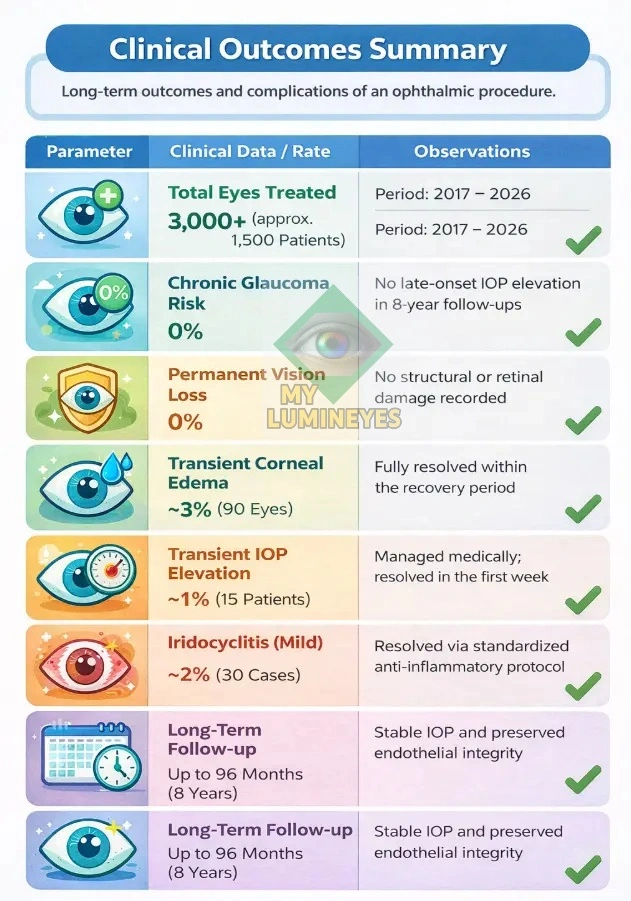
Figure description: Summary of the approximately 3,000-eye clinical dataset, including longitudinal follow-up, observed adverse events, IOP observations, and clinical outcome measures.
---
CORRESPONDENCE
Questions regarding this clinical dataset, methodology, or future research collaborations should be directed through the official clinical research channels.
For medical professionals interested in formal statistical methodology, prospective study design, or upcoming academic publications, please use the official clinical research contact channel.
---
SCIENTIFIC DISCLAIMER
This page summarizes retrospective clinical observations and is intended for scientific and professional discussion. It does not constitute a prospective clinical trial, independently validated safety study, or population-level risk estimate.
The reported observations should not be interpreted as a guarantee of safety, efficacy, permanence, or absence of complications for any individual patient.
Future prospective studies with independent validation, standardized endpoints, appropriate statistical methods, and longer-term follow-up are required to determine the reproducibility, generalizability, and biological mechanisms underlying the observed clinical outcomes.