Blepharoplasty (Eyelid Surgery): Upper & Lower Eyelid Rejuvenation
Blepharoplasty is not simply about removing excess skin. Modern eyelid rejuvenation begins by understanding the anatomy responsible for a heavy, tired, aged, or asymmetric appearance—and selecting the surgical approach that best fits the individual patient.
What Is Blepharoplasty?
Blepharoplasty, commonly known as eyelid surgery, is an oculoplastic procedure used to improve the appearance and, in selected patients, the function of the upper and lower eyelids.
Aging, genetics, gravity, and changes in the tissues surrounding the eyes can contribute to excess upper-eyelid skin, eyelid hooding, under-eye bags, tissue laxity, and a tired facial appearance. Depending on individual anatomy, surgery may involve the upper eyelids, lower eyelids, or both.
Blepharoplasty is an anatomical procedure—not simply a skin-removal procedure
Two patients may appear to have a similar eyelid concern while requiring very different treatment plans. Skin laxity, orbital fat, brow position, eyelid support, facial volume, and the relationship between the eyelid and cheek can all influence the appropriate approach.
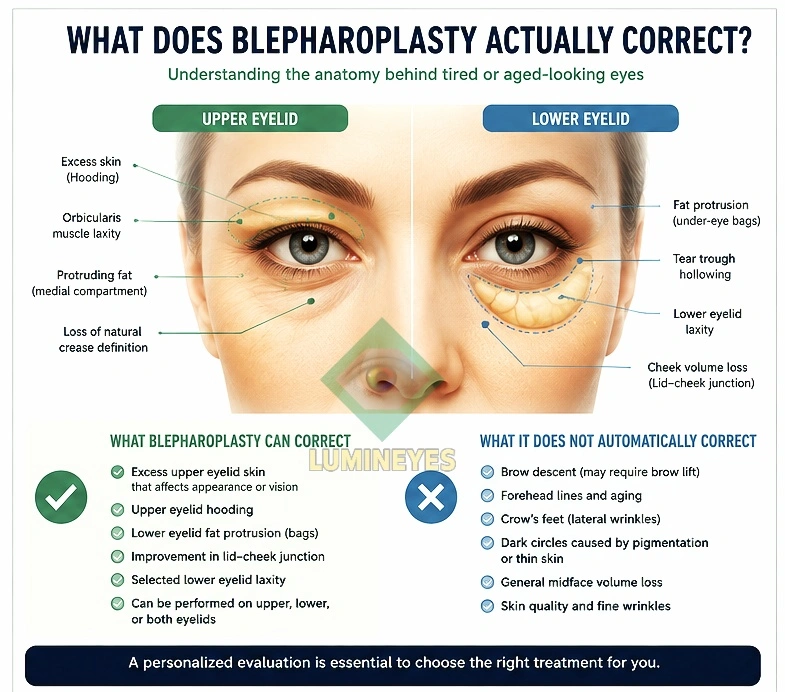
What Does Blepharoplasty Actually Correct?
A careful assessment begins by identifying which anatomical structures are contributing to the appearance of the eyelids. This helps distinguish problems that may respond to blepharoplasty from changes that may require another treatment strategy.
Upper Eyelid Concerns
- Excess or lax upper-eyelid skin
- Upper-eyelid hooding
- Selected orbital fat prominence
- Changes in the natural eyelid crease
- In selected cases, visual obstruction caused by excess tissue
Lower Eyelid Concerns
- Under-eye bags
- Selected orbital fat prominence
- Lower-eyelid skin laxity
- Changes in the eyelid–cheek transition
- Selected lower-eyelid contour abnormalities
What Blepharoplasty Does Not Automatically Correct
Not every feature around the eyes is caused by the eyelids themselves. Brow descent, forehead aging, midface changes, pigmentation, skin quality, and certain types of dark circles may require a different or additional treatment strategy.
Why Choose an Ophthalmic Surgeon for Blepharoplasty?
The eyelids are not isolated cosmetic structures. They are closely connected to ocular-surface health, eyelid closure, tear-film function, orbital anatomy, and visual function. An ophthalmic approach therefore considers not only how the eyelids look, but also how they function as part of the eye.
During blepharoplasty planning, factors such as eyelid position, closure, ocular-surface status, brow position, asymmetry, previous ocular procedures, and the patient's individual anatomy may influence the surgical approach and postoperative care.
Ocular Function
Eyelid closure, ocular-surface health, tear-film considerations, and eyelid position are relevant when planning surgery around the eye.
Anatomical Precision
The surgical plan can be developed by considering the eyelids together with the brow, orbit, ocular surface, and surrounding facial structures.
Appearance and Function Should Be Considered Together
The objective is not simply to create a tighter appearance. Appropriate rejuvenation should respect the anatomy and function of the eye while addressing the structures responsible for the patient's concern.
Who May Be a Good Candidate for Blepharoplasty?
Suitability for eyelid surgery depends on more than age or the amount of visible skin. A good candidate is generally someone whose concerns can be addressed appropriately with surgery and who understands the expected benefits, limitations, recovery, and potential risks.
Common Reasons for Consultation
- Drooping or heavy upper eyelids
- Excess upper-eyelid skin
- Persistent lower-eyelid bags
- Loose or wrinkled lower-eyelid skin
- A tired or aged appearance around the eyes
- Selected functional concerns caused by excess eyelid tissue
What Must Be Evaluated First
- Eyelid function and position
- Brow position
- Ocular surface and tear-film considerations
- Orbital fat distribution
- Facial symmetry
- Previous ocular or eyelid surgery
- Patient expectations
Upper vs. Lower Blepharoplasty
Upper and lower blepharoplasty are often discussed together, but they involve different anatomical considerations and may require different surgical approaches.
| Clinical consideration | Upper blepharoplasty | Lower blepharoplasty |
|---|---|---|
| Typical concern | Excess skin, hooding, and selected tissue changes | Under-eye bags, contour changes, and selected skin laxity |
| Main anatomy | Upper-eyelid skin, crease, brow relationship, and orbital tissues | Orbital fat, lower eyelid, eyelid support, and cheek relationship |
| Typical approaches | Incision within the natural upper-eyelid crease | Transconjunctival or subciliary approaches depending on anatomy |
| Main priority | Natural contour and preservation of eyelid function | Natural contour, volume balance, and lower-eyelid support |
Why Eyelid Aging Is More Complex Than Excess Skin
The appearance of the eyelids changes over time because several anatomical structures interact. Skin laxity is only one component of this process.
Skin
Thinning and laxity can produce folds and hooding, particularly in the upper eyelids.
Orbital Fat
Changes in the position or prominence of orbital fat may contribute to upper- or lower-eyelid fullness.
Brow Position
Brow descent can contribute to upper-eyelid hooding and may sometimes be mistaken for isolated excess eyelid skin.
Volume & Support
Age-related volume changes and differences in facial support can alter the relationship between the eyelid and surrounding tissues.
This is why a good blepharoplasty consultation is more than measuring how much skin can be removed.
How We Decide Which Blepharoplasty Technique Is Appropriate
Surgical planning should be based on the patient's anatomy, ocular health, expectations, and the specific structures responsible for the problem.
Assess
Examine the eyelids, brow, facial symmetry, ocular surface, and relevant ocular findings.
Identify
Determine whether skin, fat, support, volume, or another structure is contributing to the concern.
Select
Choose the appropriate approach for the identified anatomy rather than following a fixed cosmetic template.
Follow
Monitor healing, eyelid position, function, and the evolving result.
Upper Blepharoplasty
Upper blepharoplasty is commonly used when excess upper-eyelid skin or selected tissue changes create a heavy or hooded appearance. In appropriate patients, the incision is placed within the natural upper-eyelid crease so that the resulting scar can become difficult to detect after healing.
The upper eyelid should be assessed as part of the surrounding facial anatomy
Brow position, eyelid crease, skin quality, orbital tissues, and eyelid function can all influence the final result. Removing excessive tissue without considering these relationships may produce an unnecessarily hollow or unnatural appearance.
Lower Blepharoplasty
Lower blepharoplasty is anatomically demanding because the lower eyelid has a close relationship with orbital fat, eyelid support structures, and the cheek.
Depending on the patient's anatomy, treatment may involve a transconjunctival approach, a subciliary approach, selective fat management, skin treatment, or a combination of techniques.
Lower-Eyelid Principle
The objective is not simply to remove every visible fat pocket. In selected patients, modern lower blepharoplasty may involve conservative tissue management or fat repositioning to improve the transition between the lower eyelid and cheek while respecting natural volume and support.
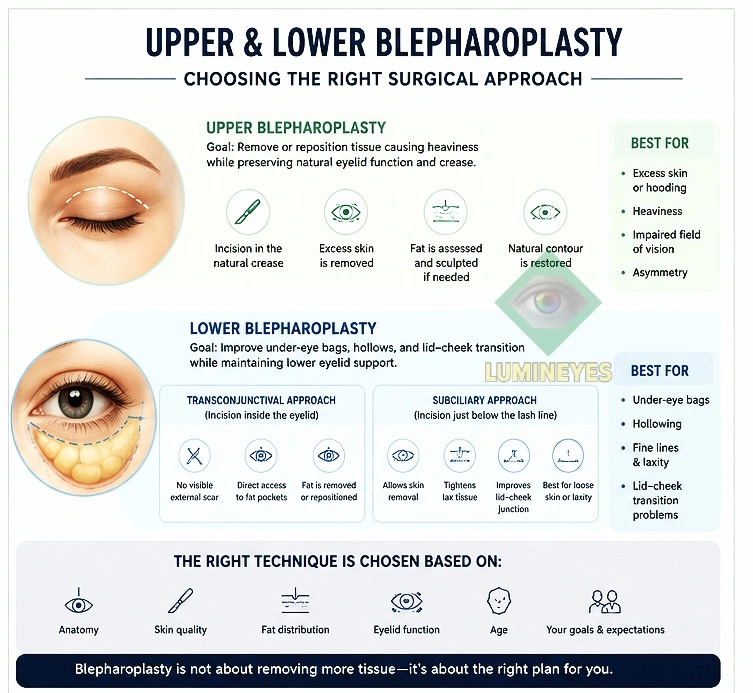
Upper & Lower Blepharoplasty: Choosing the Surgical Approach
The incision and technique are selected according to the patient's anatomy and treatment objectives rather than simply according to age or the amount of visible skin.
Upper Eyelid Approach
The incision is generally placed within the natural upper-eyelid crease. The amount of skin and other tissue addressed depends on the patient's anatomy and functional and aesthetic goals.
Transconjunctival Lower Approach
The incision is made on the inner surface of the lower eyelid and may be appropriate when lower-eyelid fat prominence is present without a significant need for external skin removal.
Subciliary Lower Approach
An incision is placed close to the lower eyelashes when external access is appropriate, particularly when skin laxity or other external lower-eyelid changes also need to be addressed.
Individualized Planning
The appropriate technique depends on eyelid position, skin laxity, orbital fat, support, facial proportions, previous surgery, and the patient's clinical findings.
When Blepharoplasty Alone May Not Be Enough
A natural-looking eyelid result requires an accurate diagnosis of the structures contributing to facial aging. Some concerns extend beyond the eyelids.
- Brow descent: may contribute to upper-eyelid hooding.
- Forehead aging: may require a different treatment strategy.
- Crow's feet: are wrinkles around the outer eye and are not simply excess eyelid skin.
- Midface changes: can influence the lower-eyelid and cheek relationship.
- Skin quality or pigmentation: may not be corrected by eyelid surgery.
Recognizing these limitations is part of responsible surgical planning and helps patients develop realistic expectations.
Blepharoplasty and Lumineyes™ in the Same Patient
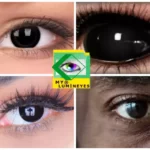
This is a real clinical case performed by Dr. Mustafa Mete. The patient underwent both blepharoplasty and Lumineyes™ laser eye color change as part of an individualized treatment plan.

The two procedures address different anatomical objectives. Blepharoplasty concerns the eyelids and surrounding periocular tissues, while Lumineyes™ is a separate ophthalmic procedure involving iris pigmentation.
This case is presented as a documented clinical example—not as evidence that the two procedures are appropriate for every patient. Whether different procedures can be safely included within the same treatment plan depends on individual ocular health, eyelid anatomy, timing, recovery, and direct clinical assessment.
Preoperative Assessment
Before surgery, the surgeon evaluates the eyelids and surrounding facial anatomy and looks for findings that may influence, modify, or prevent surgery.
Eyelid Assessment
- Skin laxity and excess
- Eyelid crease
- Upper- and lower-eyelid position
- Asymmetry
- Orbital fat prominence
- Brow position
Ocular & Functional Assessment
- Eyelid closure and function
- Ocular-surface considerations
- Tear-film or dry-eye symptoms when relevant
- Previous eye or eyelid surgery
- Relevant medical history
- Realistic expectations and treatment goals
What Happens During Blepharoplasty?
The exact procedure varies according to whether upper, lower, or combined surgery is performed and which anatomical structures require correction.
Depending on the case, surgery may be performed using local anesthesia, local anesthesia with sedation, or general anesthesia. The appropriate option is determined according to the procedure, patient factors, and the surgical team's assessment.
Blepharoplasty is commonly performed as an outpatient procedure, although individual circumstances may require a different postoperative observation plan.
Blepharoplasty Recovery
Swelling, bruising, tightness, and mild discomfort can occur during the early postoperative period. The degree and duration of these changes vary considerably between patients.
Early Recovery
Swelling, bruising, tightness, and mild discomfort may be most noticeable during the early postoperative period. Patients should follow their individualized postoperative instructions.
Initial Healing
Early healing continues and visible postoperative changes generally begin to settle. Follow-up and suture management, when applicable, are determined according to the procedure performed.
Progressive Recovery
Swelling and bruising usually continue to improve. Return to work and normal activities depends on the extent of surgery and the individual's recovery.
Tissue Settling
The eyelid contour continues to become more natural as swelling decreases and the tissues settle.
Final Maturation
Scar maturation, tissue flexibility, and the final appearance continue to evolve. The final result should be assessed after adequate healing rather than during the earliest postoperative period.
Recovery Is Individual
There is no single recovery timetable that applies equally to every patient. The extent of surgery, surgical approach, tissue characteristics, previous procedures, and individual healing can all influence recovery.
Blepharoplasty Results & Long-Term Aging
Blepharoplasty can provide long-lasting improvement, but surgery does not stop the natural aging process. Eyelid skin, facial volume, brow position, and surrounding tissues continue to change over time.
The long-term objective is therefore not to create an artificially tight appearance, but to achieve a balanced result that remains natural as the face continues to age.
Blepharoplasty Risks & Possible Complications
Although blepharoplasty is commonly performed, it remains genuine surgery and carries potential risks. The likelihood and severity of complications depend on the patient, anatomy, surgical technique, and other individual factors.
Common or Temporary Effects
- Swelling
- Bruising
- Tightness or discomfort
- Temporary irritation
- Temporary changes in appearance
- Temporary blurred vision in some patients
Potential Surgical Complications
- Bleeding or hematoma
- Infection
- Asymmetry
- Delayed or abnormal healing
- Lower-eyelid malposition
- Ectropion or eyelid retraction
- Difficulty closing the eyelids
- Need for revision surgery
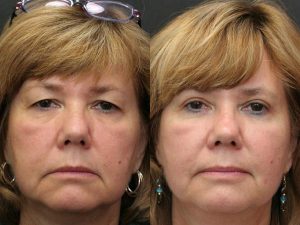
Blepharoplasty Before & After
Before-and-after photographs can demonstrate the types of changes that may be achieved, but they should be interpreted carefully. Lighting, camera angle, facial expression, healing stage, and individual anatomy can influence the appearance of photographs.
A photograph should therefore illustrate a clinical result—not serve as a guarantee of what another patient will experience.
Blepharoplasty in Turkey & Istanbul
Patients considering eyelid surgery in Turkey should evaluate the surgeon's qualifications, surgical setting, clinical assessment, follow-up arrangements, and the suitability of the proposed technique—not simply the advertised price.
For patients specifically researching treatment costs, see our dedicated Blepharoplasty Cost in Turkey guide.
Dr. Mustafa Mete's Surgical Philosophy
My approach to blepharoplasty begins with understanding the anatomy before deciding what, if anything, should be removed. The objective is to create appropriate rejuvenation while respecting the function, support, and natural proportions of the eyelids.
Anatomy Before Excision
The first question is which anatomical structures are actually responsible for the patient's concern—not simply how much tissue appears excessive.
Function Before Appearance
Eyelid closure, ocular-surface health, support, and normal function remain important considerations alongside aesthetic improvement.
Appropriate Tissue Management
Tissue may need to be removed, preserved, or selectively repositioned depending on the anatomy and the desired correction.
Long-Term Natural Balance
The goal is not an artificially tight early appearance, but a balanced result that respects how the eyelids and face continue to age.
Why MyLumineyes?
Ophthalmic Perspective
Eyelid surgery is considered in the context of the eyes, eyelids, ocular function, and surrounding facial anatomy—not as an isolated cosmetic skin procedure.
Individualized Planning
Surgical planning is based on the patient's anatomy, clinical findings, expectations, and the structures actually contributing to the concern.
Natural-Looking Goals
The objective is balanced rejuvenation while respecting normal eyelid contour, function, support, and facial harmony.
Long-Term Perspective
Healing, scar maturation, continued facial aging, and realistic expectations are considered when discussing long-term results.
Related MyLumineyes Clinical Resources
Blepharoplasty is a distinct clinical subject within MyLumineyes. For readers interested in other ophthalmic procedures, scientific documentation, or long-term clinical frameworks, the following resources provide separate areas of information.
Frequently Asked Questions About Blepharoplasty
What is blepharoplasty?
Blepharoplasty is eyelid surgery designed to improve the appearance and, in selected cases, the function of the upper or lower eyelids by addressing appropriate excess skin, fat, or other tissue changes.
Is upper or lower blepharoplasty better?
Neither is universally better. The appropriate operation depends on which eyelid structures are contributing to the patient's concern. Some patients need upper surgery, some lower surgery, and some may benefit from combined treatment.
Can upper and lower blepharoplasty be performed together?
Upper and lower blepharoplasty can be performed during the same surgical plan in appropriately selected patients. Suitability depends on the patient's health, anatomy, surgical objectives, and the surgeon's assessment.
Does blepharoplasty remove dark circles?
Not necessarily. Dark circles can have several causes, including pigmentation, vascular factors, shadowing, and volume changes. Blepharoplasty may improve some structural causes of under-eye shadowing but does not automatically eliminate every type of dark circle.
Does blepharoplasty remove crow's feet?
Blepharoplasty primarily addresses the eyelids. Crow's feet are wrinkles around the outer eye and may require a different treatment approach.
What is transconjunctival blepharoplasty?
Transconjunctival lower blepharoplasty uses an incision on the inner surface of the lower eyelid. It may be appropriate in selected patients, particularly when lower-eyelid fat prominence is present without a significant need for external skin removal.
What is subciliary blepharoplasty?
Subciliary lower blepharoplasty uses an incision close to the lower eyelashes to provide external access to the lower eyelid. It may be selected when skin laxity or other external lower-eyelid changes also need to be addressed.
How long does blepharoplasty recovery take?
Early swelling and bruising usually improve progressively, but the exact recovery period varies according to the extent of surgery and individual healing. Scar maturation and final tissue flexibility can continue to evolve for several months.
Are blepharoplasty results permanent?
Blepharoplasty can provide long-lasting improvement, but it does not stop natural aging. The eyelid skin and surrounding facial tissues continue to change over time.
What are the risks of blepharoplasty?
Potential risks include bleeding, infection, asymmetry, healing abnormalities, ocular-surface symptoms, difficulty closing the eyes, and lower-eyelid malposition such as ectropion or retraction. Individual risks should be discussed during consultation.
How much does blepharoplasty cost in Turkey?
Cost varies according to whether upper, lower, or combined surgery is performed, the complexity of the case, anesthesia, surgical setting, and postoperative care. See our Blepharoplasty Cost in Turkey guide for more information.
Considering Blepharoplasty?
The right question is not simply how much skin can be removed. It is whether the procedure is appropriate for your anatomy, which technique is justified, and what result can realistically be achieved while preserving normal eyelid function.
Request a Clinical Evaluation Explore Blepharoplasty Cost in Turkey