Before accepting a safety claim, ask one question: Which procedure was actually studied?
Laser eye color change is often discussed as though it represents a single, standardized medical procedure. In reality, procedures described under this broad category may differ in laser system, wavelength, treatment parameters, treatment pattern, staging strategy, patient selection, anatomical target, monitoring, and follow-up.
These differences matter when clinical complications are interpreted. Evidence generated from one procedure should be attributed first to the procedure in which it was actually observed. Generalization to another procedure requires meaningful clinical and procedural comparability.
A complication reported after one laser iris depigmentation procedure is evidence about that procedure. It should not automatically be presented as a demonstrated complication of another procedure merely because both use laser energy.
Learn more about the Lumineyes clinical approach: Laser Eye Color Change — The Lumineyes Approach →
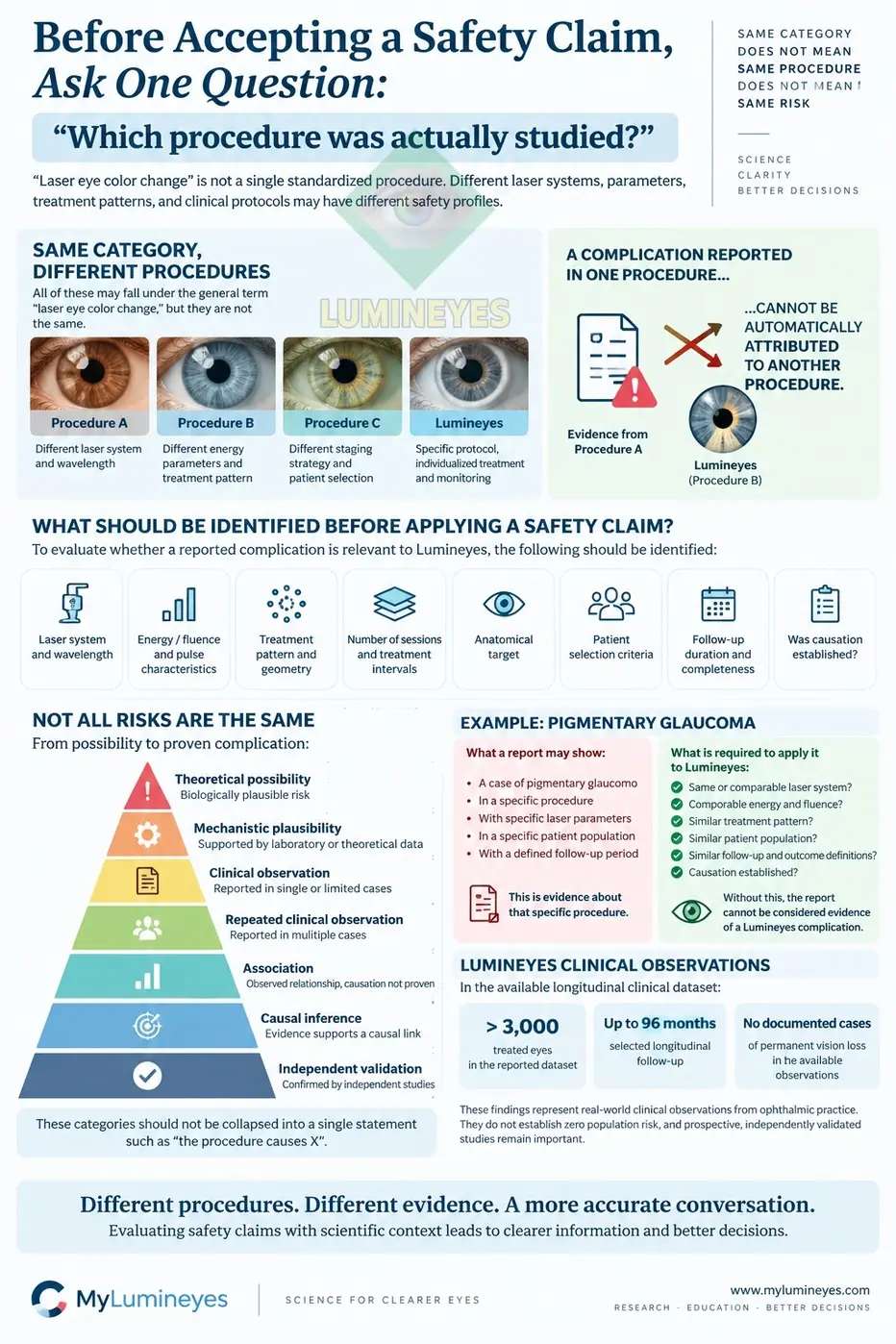
The phrase “laser eye color change” describes a broad procedural category. It does not, by itself, identify a specific laser platform, wavelength, energy level, pulse characteristic, treatment geometry, treatment schedule, or clinical monitoring protocol.
Two procedures may therefore share the same broad descriptive label while differing substantially in how laser energy is delivered, how iris pigment is affected, how treatment is staged, and how the patient is monitored.
For safety interpretation, the procedural label is therefore only the beginning of the analysis. For a broader discussion of laser–tissue interaction, wavelength, pulse characteristics, and ocular tissue response, see the Ophthalmic Lasers research overview.
A safety finding becomes meaningful only when the intervention that produced the finding can be identified with sufficient precision.
When a complication is reported, the relevant question is not simply whether the procedure involved a laser. The more important question is whether the procedure studied is sufficiently comparable to the procedure to which the finding is being applied. A related clinical perspective on the distinction between Lumineyes and the broader heterogeneous category of laser iris depigmentation is available in Laser Iris Depigmentation — Clinical Perspective.
| What should be identified? | Why it matters |
|---|---|
| Laser system and wavelength | Different laser systems and wavelengths may interact with ocular tissues differently. |
| Energy, fluence and pulse characteristics | Dose and exposure characteristics are relevant to biological response. |
| Treatment pattern and geometry | The spatial distribution of treatment can influence the tissue response and amount of pigment affected. |
| Number of sessions and treatment intervals | Cumulative exposure and biological recovery may differ between protocols. |
| Anatomical target | The tissue structures affected by a procedure determine the mechanisms that require monitoring. |
| Patient-selection criteria | Baseline ocular characteristics can influence both eligibility and observed outcomes. |
| Follow-up duration and completeness | Delayed events cannot be meaningfully assessed without adequate longitudinal observation. |
| Whether causation was established | An event occurring after treatment does not automatically establish that treatment caused the event. |
Medical risk communication becomes less precise when theoretical mechanisms, clinical observations, associations, and established causal relationships are described as though they were equivalent forms of evidence.
These categories should not be collapsed into a single statement such as “the procedure causes X.” For a broader framework on how clinical observations, limitations, patient selection, baseline assessment, and longitudinal evidence should be interpreted, see How Clinical Evidence Is Evaluated in Laser Eye Color Change.
Clinical vigilance and causal attribution are different things.
A plausible mechanism may justify monitoring for a potential complication. It does not, by itself, establish that the complication occurs at a clinically meaningful frequency after a particular procedure.
Pigment-related pressure elevation is an important ophthalmic consideration when evaluating procedures that interact with iris pigmentation. It is therefore appropriate to ask how pigment behavior, intraocular pressure, anterior-segment anatomy, and patient-specific risk factors are monitored.
However, if pigmentary glaucoma is reported after a particular procedure, the evidentiary question remains: which procedure produced the reported event?
This is evidence about the procedure in which the event was observed.
Without meaningful comparability, the finding should not automatically be presented as a demonstrated complication of another procedure.
A clinical event that occurs after a procedure has an important temporal relationship to that procedure. However, temporal sequence alone does not establish causation.
Interpretation may require consideration of baseline ocular status, alternative explanations, biological plausibility, temporal relationship, dose-response considerations, reproducibility, clinical pattern, and independent evidence.
After treatment does not automatically mean because of treatment.
For the specific clinical monitoring context of treatment-related intraocular pressure changes, see the Early IOP Monitoring Framework.
Long-term safety cannot be characterized adequately by short-term observations alone. Conversely, the existence of a long follow-up period does not automatically prove that a procedure has zero long-term risk.
Meaningful longitudinal interpretation also depends on how many patients were followed, how complete follow-up was, which outcomes were assessed, how outcomes were defined, and whether patients remained observable for the relevant period.
The appropriate conclusion is therefore not simply “long follow-up equals proven safety,” but rather that longer and more complete follow-up can provide stronger information about delayed clinical outcomes.
Lumineyes clinical observations should be interpreted as evidence arising from the Lumineyes clinical protocol, patient population, treatment approach, monitoring strategy, and available longitudinal follow-up.
They should not be presented as evidence that every laser eye color change procedure has the same safety profile. Conversely, complications reported after unrelated or materially different procedures should not automatically be presented as demonstrated Lumineyes complications. The broader biological distinction between heterogeneous laser iris depigmentation procedures is discussed in Biological Fate of Pigment in Cosmetic Iris Color Modification.
The available Lumineyes clinical dataset represents retrospective, real-world longitudinal clinical observation from ophthalmic practice.
In the available observations, no chronic or progressive intraocular pressure elevation has been documented.
Reported transient responses include approximately 3% transient corneal edema, 1% transient IOP elevation, and 2% mild iridocyclitis, described as resolving.
See the Lumineyes longitudinal clinical data report for the dataset and its methodological limitations.
Scientific credibility does not require claiming certainty where certainty does not exist. It requires clearly distinguishing what has been observed, what is plausible, what remains uncertain, and what requires further study. The underlying Lumineyes clinical framework is described separately in The Clinical Framework of Lumineyes.
A more precise safety discussion can follow five basic questions:
This sequence helps distinguish genuine safety information from conclusions created by combining findings from different procedures, different mechanisms, or different levels of evidence.
Patients considering laser eye color change deserve more than a list of alarming complications or a simple statement that a procedure is “safe.” They deserve to know where a safety claim comes from.
If a complication is cited, the patient should be able to determine whether it was observed after the exact procedure being considered, after a different laser technique, after a surgical alternative, or only as a theoretical possibility.
This distinction does not eliminate risk. It makes the discussion of risk more clinically meaningful.
Safety claims in laser eye color change should be interpreted at the level of the actual intervention studied. The broad phrase “laser eye color change” is not sufficient, by itself, to establish that two procedures have identical mechanisms, treatment parameters, biological responses, or complication profiles.
Reported complications remain important and should not be dismissed. However, their clinical meaning depends on the procedure in which they were observed, the quality of the evidence, the biological mechanism involved, the follow-up available, and the strength of the evidence supporting causation.
A more accurate discussion of safety begins not with the question “Is laser eye color change dangerous?” but with the question “Which procedure was actually studied, under which conditions, and what did the evidence actually show?”
No. Procedures described as laser eye color change may differ in laser system, wavelength, treatment parameters, treatment pattern, staging, patient selection, anatomical target, monitoring, and follow-up.
No. The relevance of a reported complication depends on the comparability of the procedures, including their laser characteristics, treatment strategy, patient population, anatomical target, monitoring, and follow-up.
No. A theoretical or mechanistic concern indicates biological plausibility. A demonstrated clinical complication requires clinical evidence showing that the event occurred and, where relevant, evidence supporting its relationship to the procedure.
No. Temporal sequence is important, but an event occurring after an intervention does not by itself establish that the intervention caused the event.
Some outcomes may develop or become apparent over longer periods. Adequate longitudinal follow-up therefore provides important information about delayed outcomes, although no observational dataset can establish zero lifetime risk by itself.
They should be interpreted as longitudinal real-world clinical observations from the Lumineyes clinical protocol and patient population. They provide procedure-specific information but should not be treated as proof of zero risk or as a substitute for independent prospective validation.
Lumineyes Longitudinal Clinical Data
Laser Eye Color Change Safety: Clinical Safety Guide
When to Stop Laser Eye Color Change
How Clinical Evidence Is Evaluated in Laser Eye Color Change
This article is provided for educational and scientific discussion. It does not constitute individual medical advice or guarantee a specific treatment outcome. Suitability for any ophthalmic procedure requires appropriate examination by a qualified ophthalmic professional.
 Lumineyes Assistant
×
Lumineyes Assistant
×