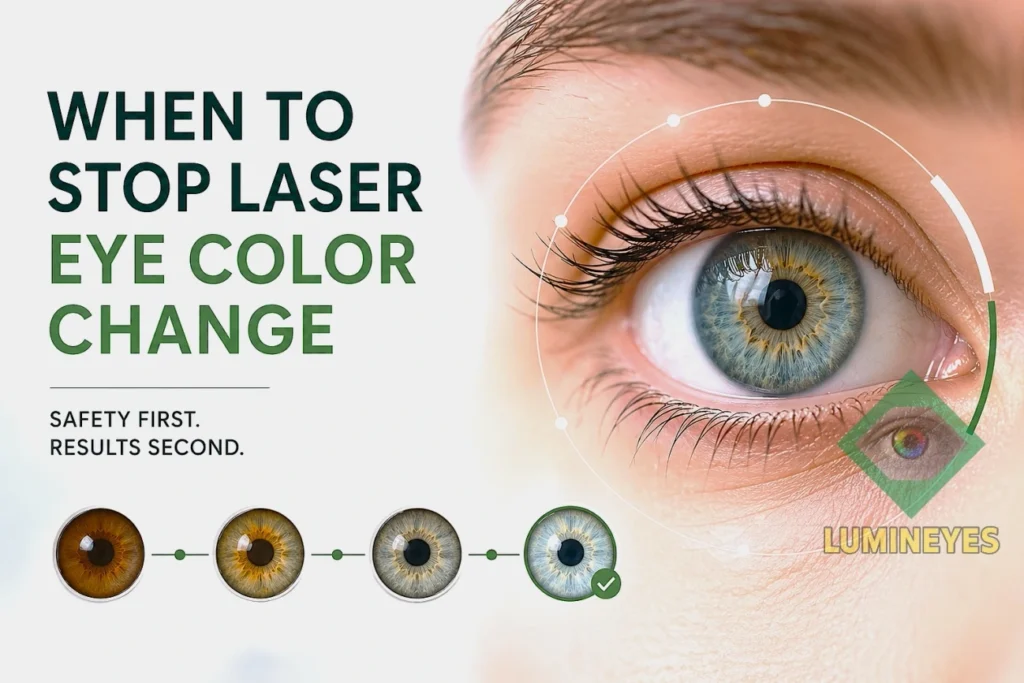
When Should Laser Eye Color Change Be Stopped?
Laser eye color change is not only about how many sessions can be performed. The more important medical question is when the treatment should stop.In a responsible protocol, the endpoint is not the lightest possible color. It is the safest visible change that respects the biological limits of the iris.
Many people searching for laser eye color change focus on the number of sessions, expected shade, or final appearance. These questions are understandable. However, in clinical practice, safety depends on a different question: how far should the process be allowed to go?
This page explains why stopping at the right point is one of the most important parts of laser iris depigmentation. It also explains why “more treatment” is not always better.
Laser eye color change should be stopped when further treatment no longer improves results or begins to increase biological risk.
Why More Sessions Are Not Always Better
Laser eye color change works through gradual pigment reduction. Because this change occurs in stages, patients may assume that continuing sessions will always produce a better or lighter result. That is not medically correct. Every iris has its own pigment density, tissue response, structural characteristics, and biological clearance pattern.
Some eyes respond clearly within fewer sessions. Others require a longer staged approach. Some eyes reach a point where further treatment may no longer be medically justified.
The goal is not to force the iris toward an artificial shade. The goal is to reach a stable, natural-looking, medically acceptable result without exceeding safe limits.
The Concept of Biological Limit
The biological limit refers to the point where additional treatment may no longer provide a meaningful benefit compared with the potential increase in tissue reaction, pigment release, inflammation, or pressure-related risk.
This limit is not the same for every patient. It depends on clinical evaluation, iris behavior during previous sessions, intraocular pressure response, anterior chamber reaction, healing pattern, and the realistic final color range.
Iris Response
The iris must be observed over time, not judged only by immediate color change.
Pressure Monitoring
Early IOP behavior is important when deciding whether to continue, pause, or stop.
Realistic Endpoint
The safest endpoint may not be the lightest shade a patient imagines.
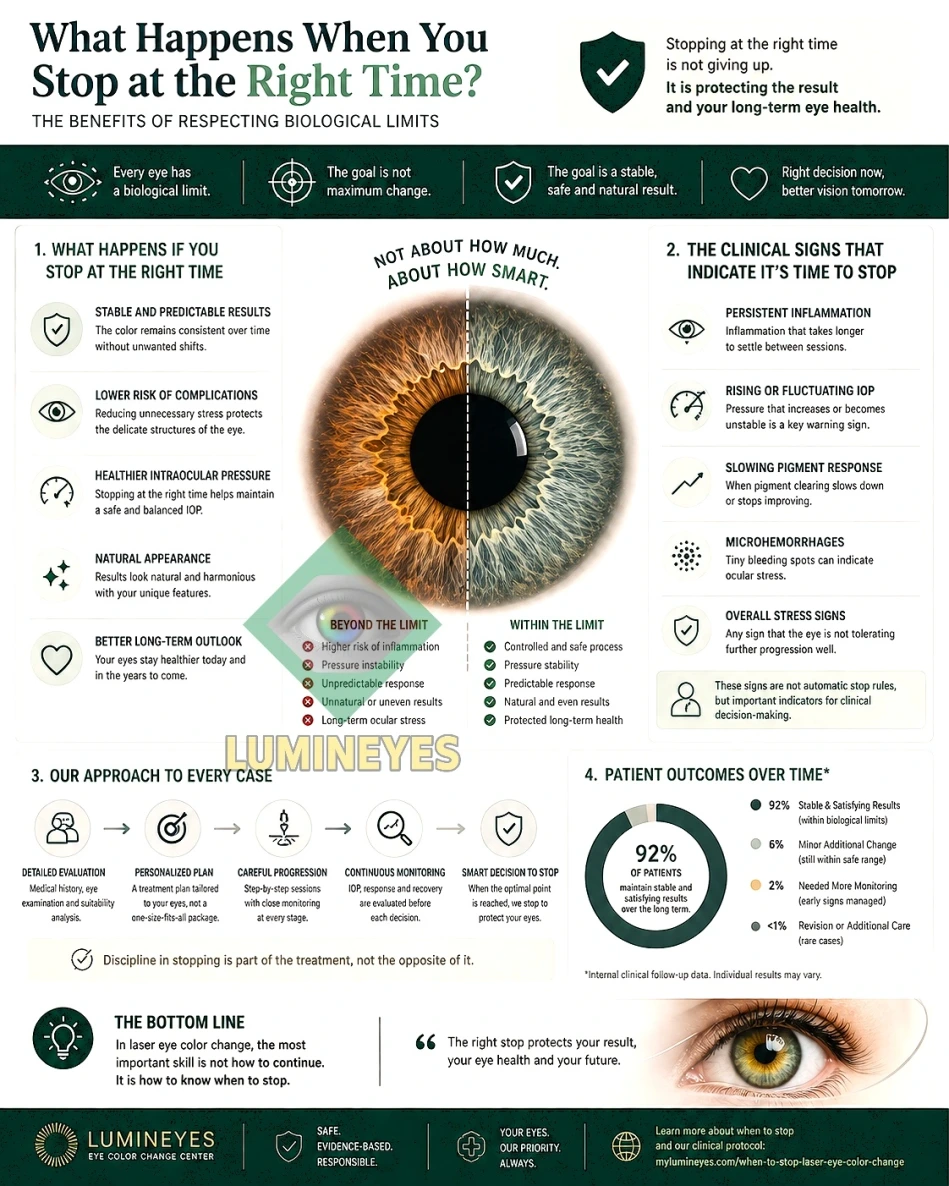
Signs That Treatment Should Be Paused or Stopped
A responsible protocol must include pause criteria and stop criteria. The decision should not be based on patient pressure, marketing promises, or a fixed package of sessions.
- Excessive early pigment reaction after previous sessions.
- Unfavorable intraocular pressure response requiring careful reassessment.
- Insufficient biological clearance between sessions.
- Signs of excessive inflammation or delayed recovery.
- Unrealistic final color expectations that cannot be safely achieved.
- Patient anxiety or dissatisfaction pattern suggesting poor suitability for elective treatment.
What Happens If Treatment Goes Too Far?
When treatment is pushed beyond safe biological limits, the problem is usually not the laser device alone. The problem is the decision-making around patient selection, session timing, energy planning, monitoring, and stopping.
Overtreatment may increase the risk of stronger inflammatory reaction, excessive pigment release, transient pressure elevation, prolonged discomfort, or unpredictable cosmetic expectations. This is why the safest protocols are staged, conservative, and medically monitored.
Why Some Clinics Avoid Talking About Stopping
Many commercial descriptions focus on before-and-after images, color promises, and fast transformation. But stopping criteria are harder to explain and less attractive for marketing.
For patients, however, this is exactly the part that matters most. A clinic that cannot explain when it would refuse, pause, or stop treatment is not giving the patient the full picture.
The MyLumineyes Approach
At MyLumineyes, laser eye color change is approached as a staged medical procedure, not as a simple cosmetic filter. The iris is evaluated before treatment, during the session plan, and after each stage of pigment response.
The decision to continue is based on clinical response, not on forcing a fixed number of sessions. In some cases, the safest decision is to pause. In other cases, the correct decision is to stop.
This is why patient selection is central to the process. You can also read:
- who may be a suitable candidate,
- who should not undergo laser eye color change,
- and the full discussion of costs and risks.
The MyLumineyes Clinical Protocol
Our approach is built on a disciplined, step-by-step clinical protocol to ensure that every patient reaches their goal safely:
Detailed Evaluation: We start with an intensive review of your medical history and a specialized eye suitability analysis.
Personalized Treatment Plan: Your iris is unique. We create a plan tailored specifically to your eye’s structural characteristics.
Careful Progression: We perform step-by-step sessions with close monitoring, avoiding the risks of aggressive “one-size-fits-all” treatments.
Continuous Monitoring: We constantly track your IOP (eye pressure), tissue response, and recovery rates during and between sessions.
Smart Decision to Stop: We identify the exact moment when the optimal result is reached to protect your long-term eye health.
Statistical Outcomes: Stability and Safety
Based on our internal clinical follow-up data, our commitment to biological limits results in high long-term success rates:
92% of Patients maintain stable and satisfying results within safe biological limits over the long term.
6% of Patients experience minor additional changes while remaining strictly within the safe range.
2% of Patients require extra monitoring due to early stress signs, ensuring all risks are managed proactively.
Final Answer: When Should It Stop?
Laser eye color change should stop when further treatment no longer improves the result in a medically meaningful way, or when the biological response of the eye suggests that continuing would increase unnecessary risk.
The safest endpoint of eye color change procedure is not always the lightest possible color. It is the point where visible improvement, tissue stability, pressure safety, and realistic expectation meet.
Not Sure If You Are a Suitable Candidate?
Before thinking about how light your eye color can become, first understand whether your eyes are suitable for a staged laser approach. Check Patient Eligibility