P-CLEAR: Pigment Release–Clearance Balance and Longitudinal Anterior-Segment Recovery
P-CLEAR is a proposed research framework for describing how the anterior-segment response evolves after treatment-related iris pigment liberation. Rather than assigning recovery from elapsed time alone, the framework examines the direction, persistence and concordance of serial biological findings.

One Research Question, Three Different Publication Roles
This page is intentionally not a web transcription of the formal manuscript. It is also distinct from the existing MyLumineyes educational resource on pigment-clearance physiology. Its role is to provide a site-native research synthesis of the kinetic hypothesis, the P-CLEAR vocabulary, its relationship to other MyLumineyes research frameworks, and the measurements required for future validation.
Formal mechanistic review containing the complete literature argument, conceptual equations, proposed P-CLEAR phenotypes, limitations and prospective validation strategy.
Public archival record for the scholarly work and its formal bibliographic identity.
View the Zenodo record →Original web structure focused on framework interpretation, terminology, longitudinal logic, research boundaries and integration with related MyLumineyes research.
The Exposure Is Brief; the Biological Response Is Not
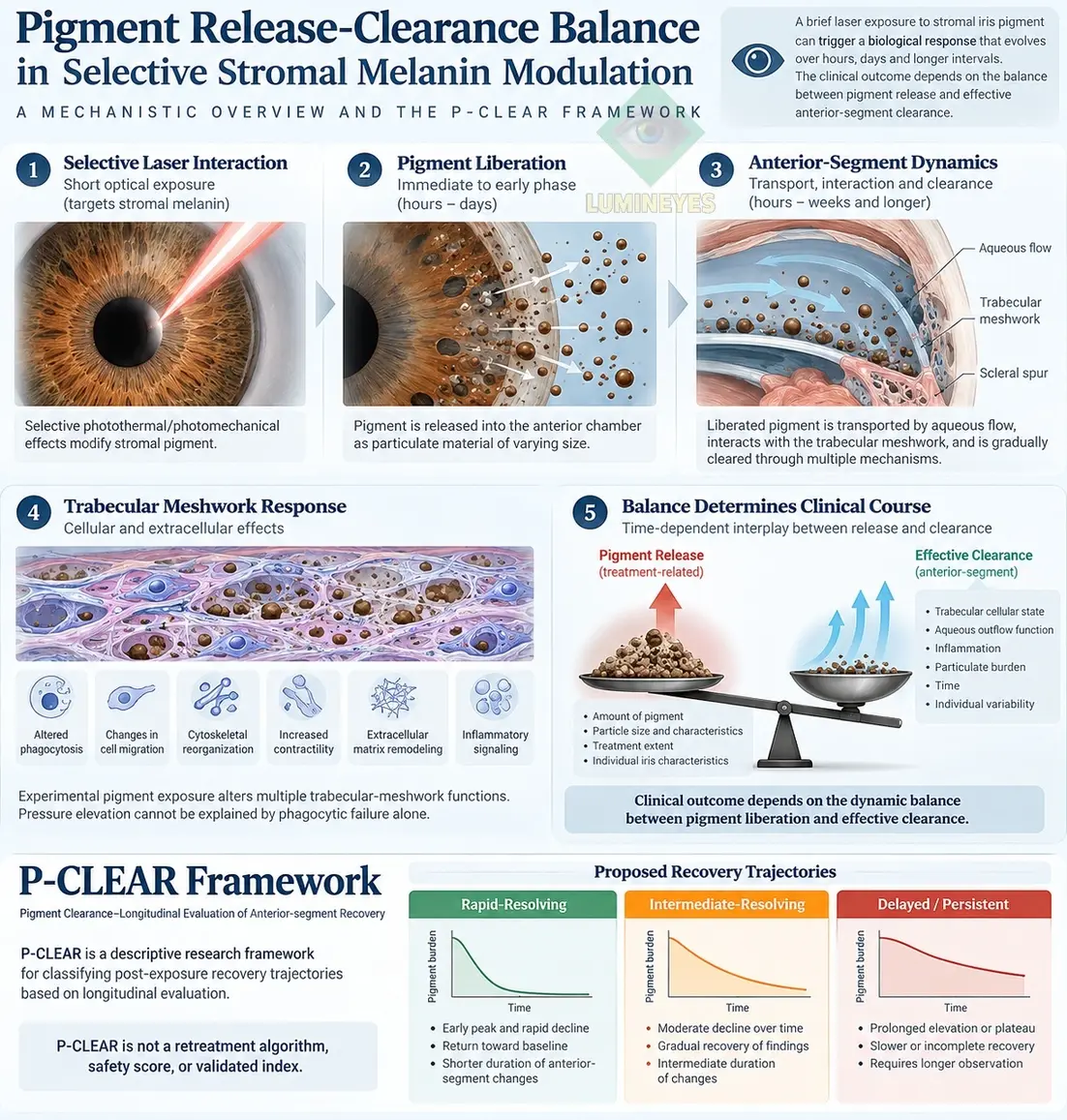
A short optical exposure can initiate a sequence that continues after the laser has stopped. Pigment-associated particulate material may enter the anterior chamber, interact with aqueous-flow pathways and trabecular tissues, coexist with inflammatory activity, and resolve at a rate that may differ between eyes and between treatment episodes.
The P-CLEAR model therefore separates three variables that are often collapsed into one idea: pigment liberation, anterior-segment burden, and effective clearance. The central research question is not simply whether pigment was released. It is whether the biological burden is moving toward resolution, remaining persistent, or accumulating over the observation interval.
From Pigment Release to Time-Dependent Burden
Let B(t) represent the biologically relevant pigment-associated particulate burden within the anterior-segment environment at time t. A conceptual mass-balance expression can then be written as:
This is a research construct rather than a validated clinical pharmacokinetic equation. Its value is conceptual: it separates the generation of particulate material from the biological processes that transport, process, redistribute, sequester or remove that burden.
Immediately after an exposure, liberation can transiently exceed simultaneous processing without implying that persistent accumulation will follow. The more informative quantity is the net balance across an interval:
Net Resolution
Effective processing exceeds new particulate input across the relevant observation period and burden moves toward the individual baseline state.
Persistence
Biological findings may remain detectable without convincing directional resolution, requiring continued longitudinal interpretation.
Net Accumulation
New burden exceeds effective clearance over a meaningful interval, allowing particulate or associated biological activity to persist or increase.
Liberation, Burden and Clearance Are Not Interchangeable
| Variable | Research meaning | Why the distinction matters |
|---|---|---|
| Pigment liberation | Treatment-related generation or mobilization of pigment-containing particulate material. | Describes the source event, not the duration of the subsequent biological response. |
| Anterior-segment burden B(t) | Biologically relevant particulate material present in the anterior segment at a particular time. | Makes pigment a time-dependent state variable rather than a binary present/absent finding. |
| Effective clearance Ceff(t) | Composite reduction of active burden through transport, cellular processing, redistribution, sequestration and outflow. | Avoids reducing recovery to a single cell type or a purely mechanical filtration model. |
| Recovery trajectory | The direction and tempo with which findings move toward, remain away from, or diverge from baseline. | Shifts interpretation from a calendar interval to serial biological change. |
Effective Clearance Is a State-Dependent System Property
A fixed-capacity drainage model is biologically incomplete. The trabecular meshwork is an active tissue, and experimental pigment exposure can alter cellular migration, phagocytic behavior, cytoskeletal organization and contractility. Early pressure change may also occur before measurable deterioration of phagocytic function.
P-CLEAR therefore treats effective clearance as a changing property of the anterior segment:
Current Burden
The amount and persistence of particulate material already present when the system is reassessed.
Particle Characteristics
Biologically relevant properties of treatment-related material that may influence transport and processing.
Trabecular State
The functional condition of cells and tissues participating in the conventional aqueous-outflow pathway.
Inflammatory State
Cells, flare and blood–aqueous-barrier disturbance may evolve on a different time course from visible pigment.
Outflow Function
Pressure behavior and angle/outflow findings provide information that cannot be inferred from visible particulate burden alone.
Time
Time is biologically useful only when linked to serial observations; elapsed days alone do not demonstrate recovery.
Why an Observation Interval Is Biologically Different From a Waiting Period
Dividing treatment into sessions has two conceptually separate effects. It distributes treatment-related pigment liberation through time, but equally importantly it creates a window in which the response to the preceding exposure can be observed before a new source term is introduced.
Pigment Liberation
A new exposure introduces additional biological burden into an anterior segment that may or may not have returned toward its prior baseline.
Effective Clearance
Recovery is assessed by the direction of serial pigment, inflammatory, pressure and outflow-related findings rather than by a predetermined number of elapsed days.
Three Proposed Directions of Longitudinal Recovery
P-CLEAR introduces an observational vocabulary for classifying the direction and tempo of serial anterior-segment findings. The phenotypes are proposed research classes; they are not derived from a validated patient-level clustering model.
Rapid-Resolving
A relatively prompt and internally consistent movement toward the eye's individual baseline.
Potential pattern: declining particulate activity, resolving inflammatory findings, stable pressure behavior and no progressive angle/outflow signal.
Intermediate-Resolving
Biological recovery continues, but the rate of resolution is slower or more prolonged.
Persistent findings remain directionally improving rather than demonstrating clear progression.
Delayed / Persistent / Discordant
Recovery is delayed, absent, progressive in one or more domains, or discordant across measurements.
One parameter may appear reassuring while pigment, inflammation, pressure, corneal or outflow-related findings remain abnormal.
P-CLEAR and L-SAFE Answer Different Questions
Both frameworks use longitudinal information, but they operate at different conceptual levels. Keeping them separate prevents a recovery phenotype from becoming an automatic treatment authorization.
| P-CLEAR | L-SAFE | |
|---|---|---|
| Primary question | How is treatment-related pigment burden and the associated anterior-segment response evolving through time? | Does the current integrated anterior-segment state contain a safety reason to withhold another staged exposure? |
| Unit of description | Recovery trajectory | Integrated pre-exposure safety state |
| Proposed classes | A · B · C | S0 · S1 · S2 · S3 |
| Main emphasis | Direction, tempo, persistence and concordance of recovery. | IOP, anterior chamber, cornea and angle/outflow interpreted together. |
| Automatic permission for exposure? | No | No. S0 only means that no L-SAFE contraindication has been identified within its defined domains. |
See the separate L-SAFE Research Hub for the pre-exposure safety-state framework.
What a Prospective P-CLEAR Study Would Need to Measure
The framework becomes scientifically useful only if its proposed trajectories can be linked to reproducible longitudinal measurements. A future study should therefore establish a standardized individual baseline and repeat comparable observations across the acute and recovery phases.
IOP
Serial Goldmann applanation tonometry interpreted relative to the eye's own baseline and medication context.
Anterior Chamber
Inflammatory cells and clinically distinguishable pigment or particulate material documented separately.
Flare
Objective laser flare photometry where available to characterize blood–aqueous-barrier disturbance longitudinally.
Angle / Outflow
Gonioscopic documentation of pigmentation and other outflow-relevant findings across time.
Cornea
Clarity, thickness and endothelial assessment when clinically and scientifically appropriate.
Imaging
Standardized anterior-segment photography and structural imaging for reproducible longitudinal comparison.
Exposure Variables
Standardized documentation of treatment architecture rather than a generic procedural label alone.
Baseline Referencing
Within-eye change, peak response, recovery slope, persistence and discordance analyzed relative to baseline.
What the Model Predicts
Recovery Will Be Heterogeneous
Broadly comparable exposures may still produce different longitudinal trajectories because effective clearance capacity is unlikely to be identical across eyes or constant through time.
Peak Pigment Alone Will Be Incomplete
A longitudinal combination of pigment persistence, IOP trajectory, inflammatory state and angle/outflow findings should contain more biological information than a single peak visible-pigment estimate.
Recovery May Be Non-Linear
Increasing biological burden may change the tissues responsible for processing and outflow, making recovery potentially non-proportional to the initial burden.
Direction May Outperform Elapsed Time
Serial movement toward or away from baseline should provide more meaningful information than the number of days since exposure alone.
Residual Activity May Matter Before Re-Exposure
Introducing another particulate source while the preceding biological response remains active may produce a different cumulative burden from an exposure delivered after documented recovery.
Objective Measures May Reveal Hidden Persistence
Quantitative pigment and flare measurements may identify ongoing biological activity that is difficult to characterize from a single cross-sectional clinical observation.
Selected Biological Anchors Behind the Hypothesis
P-CLEAR integrates several established areas of anterior-segment biology rather than assuming that all laser iris procedures are equivalent. The complete literature analysis and full reference list are preserved in the formal research record.
| Evidence domain | What it contributes to the P-CLEAR model |
|---|---|
|
Pigment dispersion and pigmentary glaucoma Niyadurupola & Broadway; Bustamante-Arias et al. | Establishes that dispersed melanin can interact with the trabecular outflow system and that pigment burden does not produce identical clinical consequences in every eye. |
|
Experimental pigment exposure Dang et al.; Wang et al. | Supports a biologically active trabecular response involving cytoskeletal, migratory, contractile and phagocytic changes rather than a purely passive obstruction model. |
|
Pressure before phagocytic decline Dang et al. | Demonstrates why early pressure elevation cannot be reduced to established phagocytic failure alone. |
|
SLT biology Alvarado et al.; Chen & Zeng | Shows that interaction with pigmented anterior-segment tissue can initiate cellular recruitment, signaling and outflow-related biological responses. |
|
Quantification of aqueous melanin Kuechle et al.; Mardin et al. | Demonstrates that aqueous melanin can be treated as a measurable variable rather than only a qualitative observation. |
| Heterogeneous iris-laser literature | Reinforces the need to record treatment architecture, session spacing, biological response and longitudinal measurements rather than treating a procedural name as a standardized exposure. |
For the complete cited literature, methodological discussion and limitation analysis, consult the public academic record linked above.
Pigment Release–Clearance Balance: Mechanistic Overview
What Remains to Be Demonstrated
P-CLEAR has not yet been derived from a patient-level longitudinal dataset. Total treatment-related pigment liberation and true biological clearance do not currently have validated clinical units after selective stromal melanin modulation, and the proposed A–C classes require empirical derivation.
A prospective study would first determine whether reproducible natural trajectory groups actually emerge. Candidate approaches include longitudinal mixed-effects modelling, clustering of normalized recovery curves and latent-class trajectory analysis. Subsequent work would need to examine interobserver agreement, repeatability, construct validity, association with independently defined safety outcomes and external validity across different iris phenotypes and exposure architectures.
Where P-CLEAR Fits Within the MyLumineyes Research Architecture
Citable Research Record
The formal scholarly work associated with this framework is archived as Zenodo record 23221292. Researchers citing the academic work should use the bibliographic metadata displayed in the Zenodo record rather than treating this explanatory owner page as a substitute for the archived manuscript.