How Does Color Vision Work?
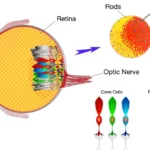
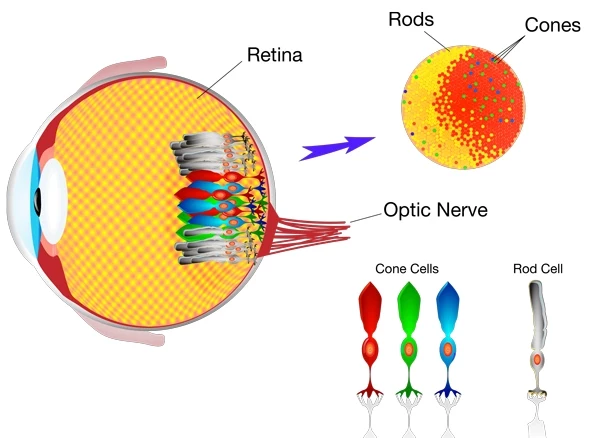
Human color vision is made possible by specialized light-sensitive cells in the retina called cones. These photoreceptor cells detect different wavelengths of visible light and send electrical signals through the optic nerve to the brain, where colors are interpreted.
Although we often think our eyes “see” colors, color perception is actually a complex process involving the retina, optic nerve, and visual cortex working together.
The Role of Rods and Cones
The retina contains two main types of photoreceptor cells:
- Rods – Responsible for vision in dim light and detecting movement, but they do not distinguish colors.
- Cones – Responsible for daylight vision and color perception.
The average human eye contains approximately 120 million rods and about 6 million cones.
How Do We See Different Colors?
Humans normally have three different types of cone cells, each most sensitive to a different portion of the visible light spectrum:
- Short wavelength (Blue)
- Medium wavelength (Green)
- Long wavelength (Red)
When light enters the eye, different wavelengths stimulate these cone cells in varying proportions. The brain combines these signals to create the perception of thousands of different colors.
Why Does a Lemon Look Yellow?
A lemon reflects wavelengths of light that stimulate both the red-sensitive and green-sensitive cone cells. The brain combines these signals and interprets them as yellow. Under very dim lighting, however, rod cells become dominant and color perception is greatly reduced.
Color Constancy
Our brain continuously adjusts for changes in lighting conditions. This phenomenon, known as color constancy, allows an object to appear to have the same color under sunlight, indoor lighting, or shade, even though the actual wavelengths reaching the eye may differ.
What Is Color Blindness?
Color blindness occurs when one or more cone photopigments are absent or function abnormally. The most common forms include:
- Protanopia – Reduced or absent red perception.
- Deuteranopia – Reduced or absent green perception.
- Tritanopia – Reduced or absent blue perception.
Most inherited color vision deficiencies affect red-green discrimination and are significantly more common in males.
Visible Light Spectrum
Visible light ranges from approximately 380 to 700 nanometers. Different wavelengths correspond to different perceived colors, while white light contains the full visible spectrum.
How the Brain Creates Color
Color is not produced by the eye alone. After photoreceptors detect light, electrical signals travel through the optic nerve to the visual cortex, where the brain combines the incoming information into the colors we perceive every day.
Why Understanding Color Vision Matters
Knowledge of normal color perception helps ophthalmologists diagnose retinal diseases, optic nerve disorders, inherited color vision deficiencies, and other conditions affecting visual function.
Understanding how healthy eyes perceive color also helps explain the biological principles behind iris pigmentation and cosmetic eye color modification.
Color Vision and Eye Color
Natural eye color depends on the amount and distribution of melanin within the iris rather than the way the retina perceives color. Modern ophthalmology distinguishes between iris pigmentation and retinal color perception because they involve completely different anatomical structures.
If you would like to learn how selective iris depigmentation differs from retinal color perception, explore our detailed guide on Laser Eye Color Change.