Grey Eyes
Rarity, Genetics, Silver Shades & Eye Color Change
Why do some eyes look silver, smoky or blue-grey? Explore the biology of this uncommon eye-color phenotype, the optics of the iris, and whether brown eyes may develop a grey appearance after selective laser depigmentation.
Quick Answer: What Are Grey Eyes?
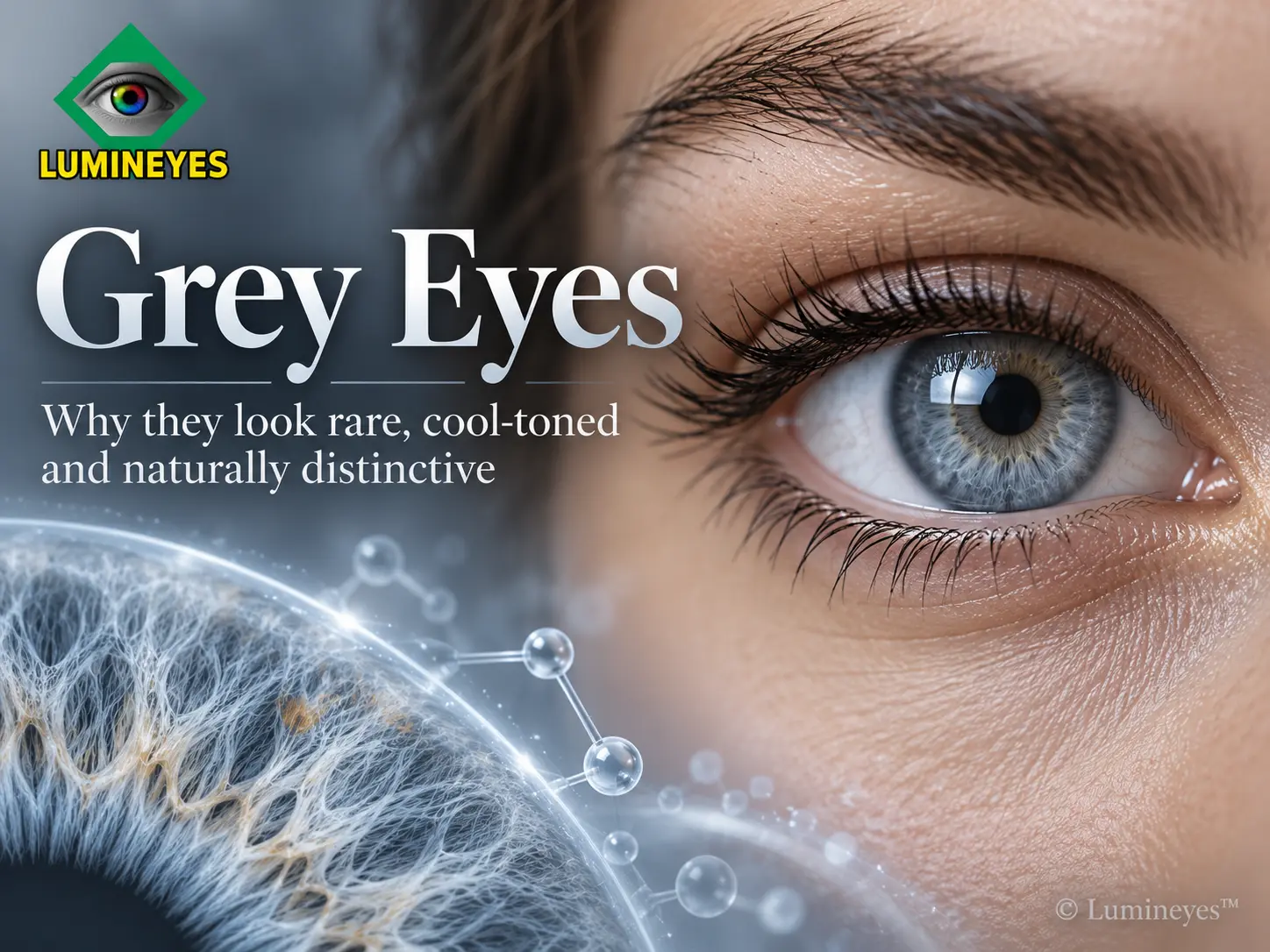
Grey eyes are a naturally occurring light-eye phenotype with a neutral, silver or smoky appearance. They generally have relatively little melanin in the visible anterior iris. Their colour arises from the combined effects of iris pigmentation, stromal architecture and the scattering and absorption of light—not from a distinct grey pigment. Grey eyes are considered uncommon, although precise worldwide prevalence is difficult to establish because surveys do not always separate grey from blue.
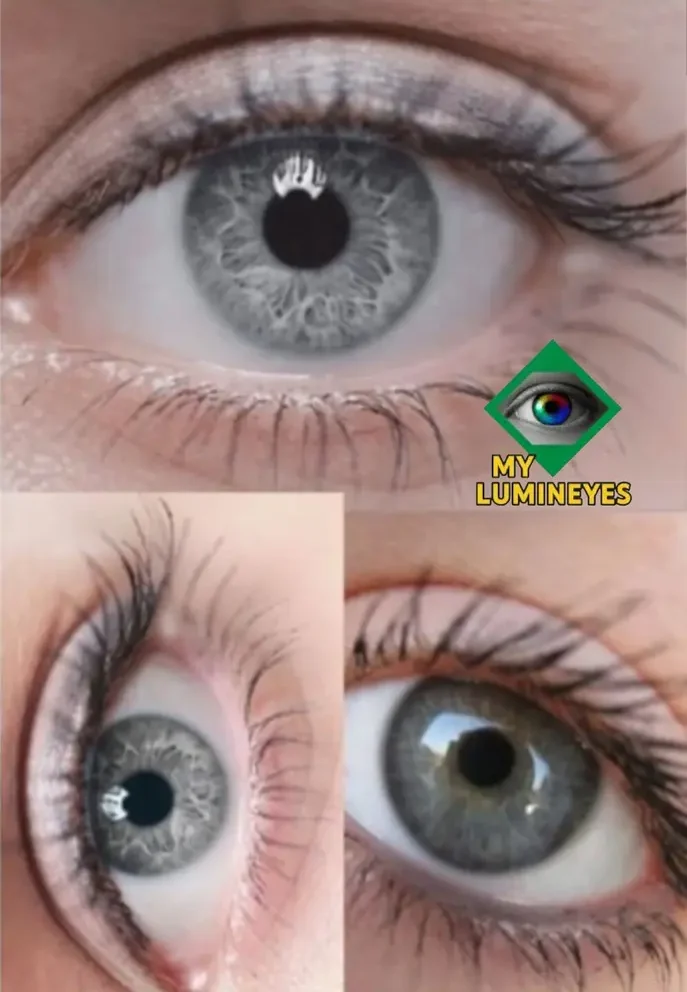
Grey eyes occupy a distinctive place on the natural eye-colour spectrum. Unlike bright blue irises, they may appear muted, metallic or almost colourless in soft daylight. Some have a darker limbal ring; others show fine yellow, green or blue details near the pupil. These variations reflect the complex relationship between iris melanin and the microscopic structure of the iris itself.
It is useful to distinguish a genuinely grey-looking iris from one that only appears grey in a filtered photograph. Human eye colour is a continuum rather than a collection of perfectly separated categories. For that reason, both the biology and the conditions under which the eye is viewed matter.
01 · Optical foundationWhat Makes Eyes Look Grey?
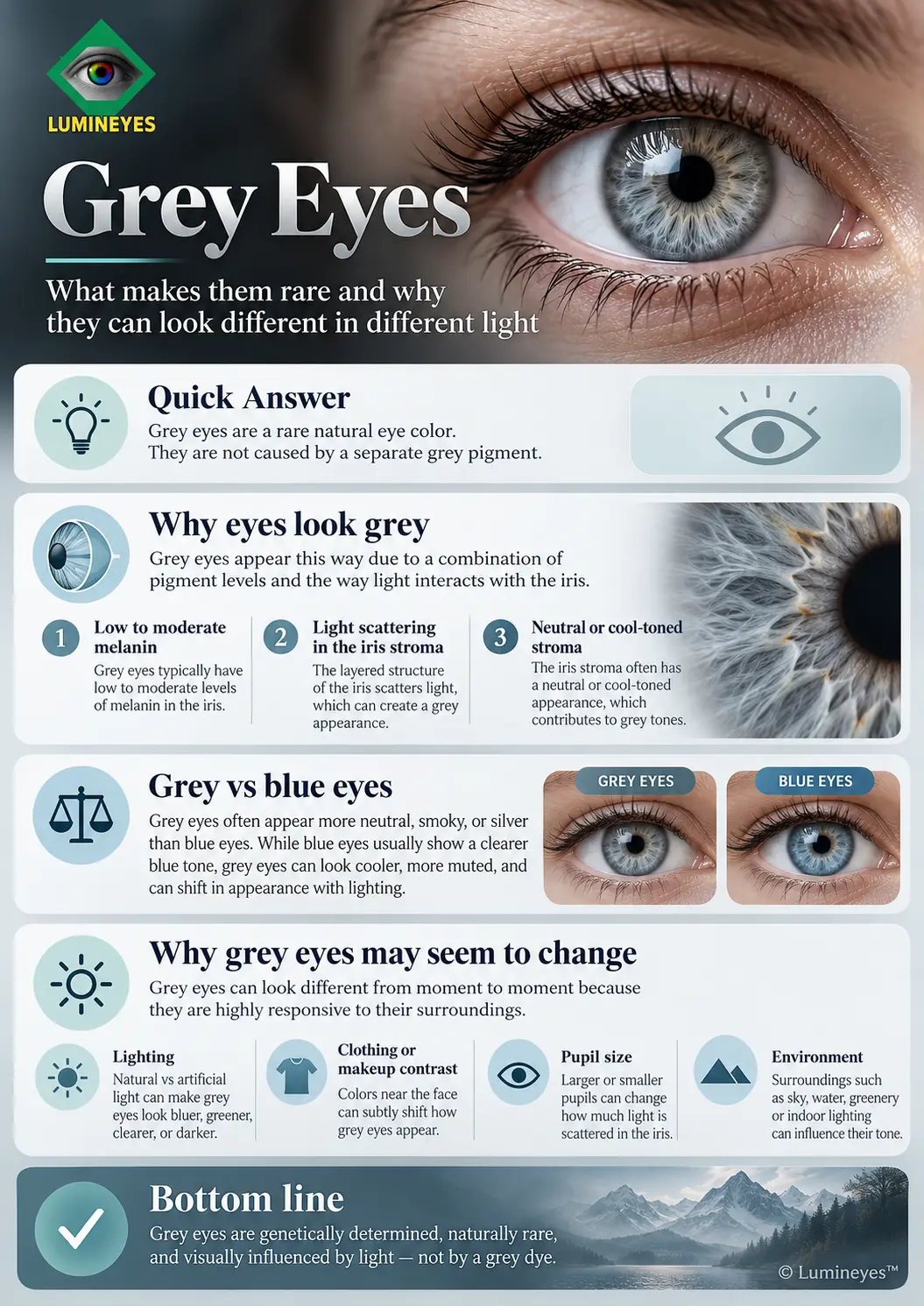
A healthy iris contains melanin-containing cells and an intricate framework of collagen, vessels and connective tissue. The apparent colour depends on how much incident light is absorbed by pigment and how the remaining light interacts with the anterior iris stroma. High concentrations of visible pigment tend to produce brown tones. When the anterior iris contains much less melanin, the underlying optical properties contribute more strongly to the colour we perceive.
Less anterior stromal pigment allows lighter appearances to become visible.
Collagen organization and tissue texture influence how incident light is scattered.
The resulting light can look silver or smoky rather than distinctly saturated blue.
There is no unique biological “grey dye” in the iris. Nor does every grey iris have an identical collagen pattern. The exact optical differences between grey and blue eyes are more complex than the simple claim that grey eyes always contain denser collagen or less pigment than blue eyes. The American Academy of Ophthalmology explains the central role of melanin and light scattering in structural eye colour.
02 · Population patternsHow Rare Are Grey Eyes?
Grey is an uncommon natural iris colour. It is reported more often in populations with a relatively high frequency of lighter eyes, including parts of Northern and Eastern Europe, but it can occur in people from other backgrounds as well.
An exact global percentage should be treated cautiously. Some studies and surveys classify grey independently; others combine it with blue or use broad categories that do not capture silver and mixed grey shades. As a result, the often-repeated claim that grey eyes have one precise worldwide prevalence figure is not well supported by consistent international measurement.
Important distinction: “Rare” describes how often a phenotype is observed; it does not make one eye biologically better or healthier than another. Explore our rarest eye-colours guide for a wider comparison.
03 · Natural variationThe Different Shades of Grey Eyes
Grey eyes are not one uniform shade. Depending on the iris pattern and illumination, they can be described as silver, slate, blue-grey or green-grey. The following colour samples are illustrative palette references, not clinical iris photographs or predictive treatment outcomes.
A single iris may contain more than one shade, particularly around the pupil, in iris crypts or near the outer border. That natural variability is why labels such as “ice grey” or “storm grey” are descriptive rather than strict medical categories.
04 · Recognizing colourGrey Eyes vs Blue, Green and Hazel Eyes
Grey eyes can resemble other light-coloured irises, especially when lighting changes. The most useful comparison is the dominant overall appearance under neutral, consistent light, not the brightest or darkest region in a single photograph.
| Eye colour | Typical overall appearance | How it differs from grey |
|---|---|---|
| Grey | Silver, smoky, slate or muted neutral | Grey is the dominant impression; blue or green may appear secondarily. |
| Blue | Clear cool blue or blue-white | More consistently recognisable blue saturation in ordinary daylight. |
| Green | Green, moss or olive | A stronger green component typically defines the dominant colour. |
| Hazel | Mixed brown, gold and green | Warmer and more heterogeneous pigment-related tones are prominent. |
When classification is uncertain, use the What Is My Eye Color? guide or the broader Eye Color Chart & Genetics reference to compare iris patterns rather than relying on a colour label alone.
05 · InheritanceWhat Causes Grey Eyes Genetically?
Natural iris colour is a polygenic trait: multiple genes influence melanin synthesis, transport and distribution. Two especially important genes are OCA2 and HERC2, alongside other pigmentation-related genes and regulatory variants. They contribute to a broad range of appearances rather than a simple one-gene rule for each shade.
Grey eyes share genetic pathways with other light-coloured irises, but there is no single established “grey-eye gene” that can reliably predict a precise silver or slate shade. Two family members may therefore have visibly different irises despite sharing many inherited pigmentation characteristics. The NIH MedlinePlus Genetics overview and the American Academy of Ophthalmology's eye-colour guide provide further context.
06 · Everyday appearanceWhy Do Grey Eyes Look Blue or Green in Different Light?
Grey eyes are particularly responsive to their visual environment because their perceived colour is subtle. A neutral-grey iris may seem more blue outdoors, more green beside certain fabrics or deeper slate under warm indoor lighting. In healthy adult eyes, these changes are usually changes in perception and illumination rather than rapid changes in melanin.
- Lighting: brightness, direction and colour temperature alter reflected light.
- Pupil size: dilation or constriction changes the visible geometry and contrast of the iris.
- Surroundings: clothing, makeup, hair colour and backgrounds affect colour perception.
- Photography: auto white balance, phone processing, flash and filters can strongly shift apparent colour.
For this reason, photographs taken under different conditions should not be treated as precise pigment measurements. See our article on why eye colour seems to change for a fuller explanation of everyday variation.
07 · Melanin-based changeCan Brown Eyes Turn Grey After Laser Eye Color Change?
In selected eyes, progressive reduction of anterior iris melanin may reveal a grey or blue-grey appearance. This is biologically plausible because the underlying iris structure and its light-scattering properties become more influential as visible pigment decreases. The process does not add grey dye; it changes the pigment contribution to the colour already generated by the eye's anatomy.
Within the Lumineyes™ laser eye color change approach, treatment is designed around selective pigment interaction and a staged, response-guided clinical plan. Baseline pigmentation and iris architecture matter: the appearance after lightening can be silver-grey, blue-grey, green-grey or another mixed light shade depending on the individual eye. A specific final colour cannot be selected or guaranteed in advance.
The existing pigment distribution, stromal pattern and ocular examination inform the initial assessment.
Anterior iris pigment is addressed through an individualized, staged treatment framework.
Clinical observations and gradual colour evolution guide subsequent decisions.
From brown to grey: a possibility, not a predetermined colour recipe
Some suitable brown or hazel irises may develop a grey-dominant appearance following pigment reduction. Others may retain warmer central zones or develop mixed blue, green and grey tones. A natural-looking outcome depends on the existing anatomy and individual response; responsible planning considers both the visual goal and the clinical findings.
The wider medical literature confirms that cosmetic iris laser approaches should be evaluated according to their specific technique and follow-up, rather than treated as interchangeable. A published European Journal of Ophthalmology case report illustrates the relevance of ocular assessment and pressure surveillance; it does not determine the outcomes of every laser protocol. For the approach, suitability criteria and treatment stages, see the main clinical guide and patient eligibility criteria.
08 · Practical guidanceHow to Enhance or Identify Grey Eyes Naturally
Without modifying iris pigment, people can highlight existing grey tones through clothing contrast, photographic conditions or appropriately prescribed cosmetic contact lenses. Digital previews are another way to explore how different shades might complement facial features without predicting biological outcomes.
Our Eye Color Simulator offers a visual approximation of colour choices. It is a design preview, not an instrument that measures iris melanin or predicts the final result of a medical procedure. For everyday wellbeing, good nutrition supports the eye's normal function, but foods do not change iris pigment. The separate eye health, vitamins and diet article explores this distinction.
If coloured contacts are used, they should be professionally fitted. The American Academy of Ophthalmology's advice on coloured contact lenses explains why correct fitting matters.
09 · Ophthalmic perspectiveDo Grey Eyes Affect Vision or Eye Health?
Grey eye colour is a normal human variation and does not, by itself, establish better or worse vision. Individuals with lighter iris pigmentation sometimes report greater sensitivity to bright light, but eye comfort and visual function depend on many factors beyond iris colour.
Natural colour typically becomes established during development. If an adult notices a new, persistent change—especially in one eye, or together with pain, redness or visual symptoms—an ophthalmic examination is appropriate. Such a change should not automatically be interpreted as a normal lighting effect.
10 · Questions answeredGrey Eyes: Frequently Asked Questions
Are grey eyes rare?
Yes. Grey is an uncommon natural colour, although international estimates vary because grey is sometimes grouped with blue.
Are grey eyes really blue eyes?
Grey and blue eyes share low-pigment optical features. Grey eyes, however, have a more neutral or smoky overall appearance, and the boundary between categories is not always sharp.
Is there a grey pigment in the iris?
No distinct grey dye is required. Melanin distribution, the structure of the iris and light interaction together produce a grey appearance.
What is the difference between silver and steel-grey eyes?
These are descriptive shade names. Silver usually refers to a paler, luminous grey; steel-grey generally suggests a deeper, cooler or more slate-like appearance.
Can grey eyes look green?
Yes. Some grey irises have subtle green or yellow-brown components that become more visible with changes in illumination or background contrast.
Can two brown-eyed parents have a grey-eyed child?
It is possible for children to inherit lighter eye colours than might be expected from their parents' appearance alone because iris colour is influenced by multiple genes.
Can food or supplements turn eyes grey?
No dietary method has been demonstrated to selectively remove normal anterior iris melanin and produce a permanent grey eye colour.
Can brown eyes become grey after laser treatment?
Some appropriately selected irises may develop a grey or blue-grey appearance as visible anterior pigment is reduced. Individual response and stromal characteristics influence the outcome; a specific grey shade cannot be guaranteed.
Does the Lumineyes simulator predict my exact future eye colour?
No. It is intended for visual exploration only. A medical assessment is required to discuss clinical suitability, and a particular final colour cannot be predicted with certainty.
Further readingExplore More Eye Color Science
Continue with related MyLumineyes articles covering melanin, genetics, natural shades and the distinction between optical appearance and medically supervised pigment modification.
Scientific References & Reading
1. American Academy of Ophthalmology. Eye Color: Unique as a Fingerprint. Updated 2026.
2. American Academy of Ophthalmology. Your Blue Eyes Aren't Really Blue. 2023.
3. MedlinePlus Genetics, U.S. National Library of Medicine. Is Eye Color Determined by Genetics?
4. Ong AY et al. Refractory iatrogenic pigmentary glaucoma secondary to cosmetic laser treatment: A case report. European Journal of Ophthalmology. 2023;33(2):NP1–NP4. doi:10.1177/11206721211050338.
© 2026 Lumineyes™ / MyLumineyes®. Original editorial and illustrated content. All rights reserved.