Dry Eye Syndrome: Causes, Symptoms, Diagnosis & Treatment
Dry eye syndrome is more than simply having “dry eyes.” It is a condition involving the tear film and ocular surface that can affect comfort, visual quality and the health of the front of the eye.
What is dry eye syndrome?
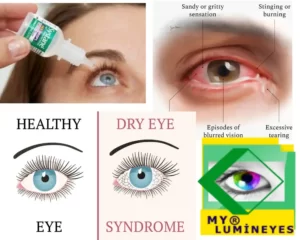
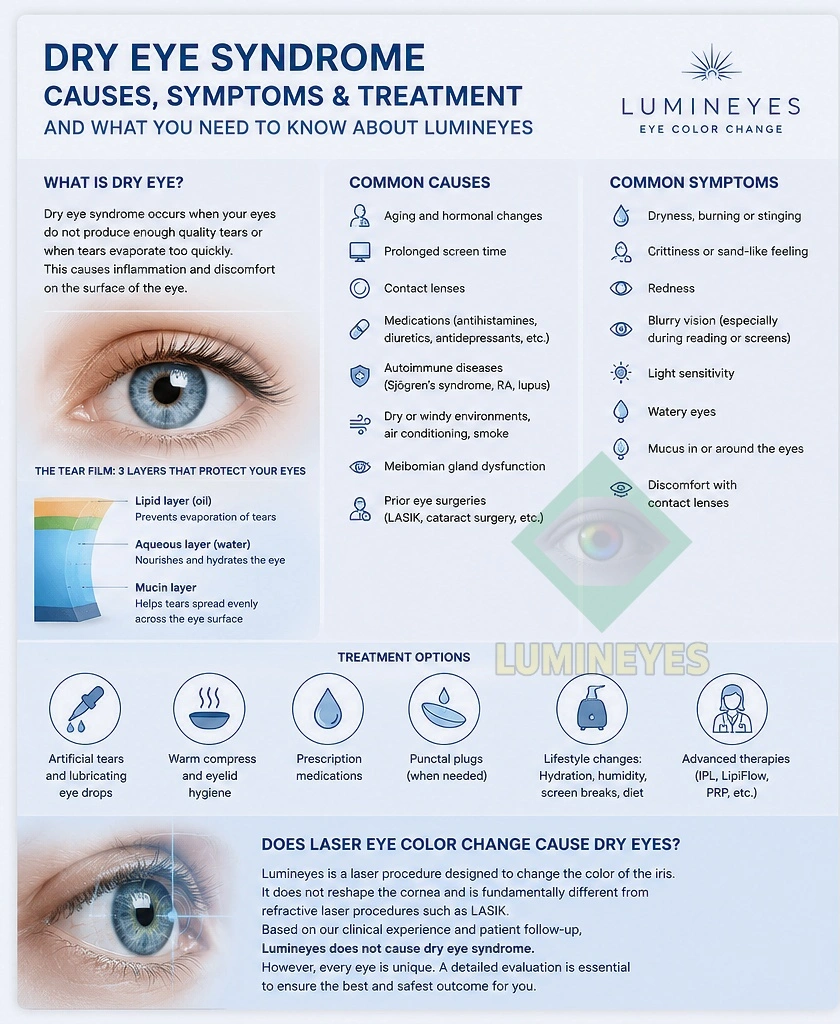
Dry eye disease occurs when the tear film that protects and lubricates the ocular surface loses its normal stability. This may happen because the eye does not produce enough tears, because tears evaporate too quickly, or because the composition and function of the tear film are disturbed.
The result may be burning, stinging, irritation, a gritty or foreign-body sensation, fluctuating vision, redness, light sensitivity or even excessive watering.
The term dry eye can therefore be misleading: an eye may water excessively while still having an unstable tear film.
Why the tear film matters
Every blink spreads a thin tear film across the cornea and conjunctiva. Its stability is essential not only for comfort, but also for a clear optical surface.
Oily layer
The outer lipid component helps reduce evaporation and contributes to tear-film stability. Meibomian glands are an important source of this layer.
Watery layer
The aqueous component provides hydration and contains substances important for maintaining the ocular surface.
Mucin layer
Mucin helps the aqueous component spread evenly across the ocular surface and supports a stable interface between tears and the eye.
Aqueous deficiency and excessive evaporation
Dry eye is not a single mechanism. More than one factor may contribute to symptoms in the same person.
| Pattern | What happens? | Common contributing factors |
|---|---|---|
| Aqueous-deficient dry eye | The eye does not produce enough of the aqueous component of the tear film. | Aging, hormonal changes, autoimmune disease and certain medications. |
| Evaporative dry eye | Tears evaporate too rapidly, even when tear production may be relatively adequate. | Meibomian gland dysfunction, reduced blinking, screen use, environmental dryness and contact lens wear. |
| Mixed mechanism | Both reduced tear production and excessive evaporation contribute. | Multiple ocular-surface, systemic, environmental or medication-related factors. |
What can cause dry eye?
Dry eye often has more than one cause. Identifying the contributing factors is important because treatment is more useful when it addresses the underlying mechanism.
How does dry eye feel?
Symptoms vary from person to person and may fluctuate throughout the day or according to environmental conditions.
Why screens can make dry eye worse
When concentrating on a screen, people often blink less frequently or incompletely. This increases the time between tear-film replenishment and can contribute to evaporation and ocular-surface discomfort.
Dry eye after laser procedures: why the distinction matters
“Laser eye surgery” is not one single type of procedure. Different ophthalmic lasers interact with different tissues and can produce fundamentally different biological effects.
Cornea, iris and laser-tissue interaction are not the same thing
Corneal refractive procedures such as LASIK are designed to reshape the cornea. Laser eye color change, by contrast, concerns the pigmentation of the iris. These procedures should therefore not be treated as interchangeable simply because both involve a laser.
Understanding the tissue target is especially important when discussing postoperative ocular-surface symptoms. A broader review of ophthalmic lasers and their interaction with ocular tissue explains how wavelength, tissue properties, energy delivery and the anatomical target influence biological response.
Why corneal assessment matters
The cornea is the transparent front surface of the eye and plays a central role in vision. The ocular surface and tear film interact continuously with the cornea, which is why persistent dry-eye symptoms should be evaluated in the context of the complete ocular surface.
Objective measurements are useful — but they need clinical context
Corneal endothelial assessment can provide quantitative information about endothelial cell density, cell size, variation and morphology. However, these measurements should be interpreted together with image quality, sampling methodology, ocular history and the broader ophthalmic examination.
For a deeper scientific discussion, see the Corneal Endothelial Assessment & Specular Microscopy review.
How is dry eye diagnosed?
Diagnosis is not based on symptoms alone. An ophthalmologist may combine the patient's history and ocular examination with tests that evaluate tear production and tear-film stability.
| Assessment | What it helps evaluate | Why it matters |
|---|---|---|
| Clinical history | Symptoms, medications, screen use, contact lenses and previous surgery | Helps identify potential contributing factors |
| Ocular-surface examination | Eyelids, conjunctiva, cornea and tear film | Identifies visible signs of ocular-surface dysfunction |
| Schirmer testing | Tear production | May help evaluate aqueous tear deficiency |
| Tear-film stability testing | How quickly the tear film breaks up | Helps assess tear-film instability |
How is dry eye treated?
Treatment depends on the cause, severity and type of dry eye. The aim is not simply to add moisture, but to improve the health and stability of the ocular surface.
Artificial tears
Lubricating eye drops may help relieve symptoms and improve ocular surface comfort.
Eyelid care
Warm compresses and appropriate eyelid hygiene may be useful, particularly when meibomian gland dysfunction is involved.
Prescription therapy
Depending on the clinical picture, an ophthalmologist may prescribe anti-inflammatory or tear-stimulating treatment.
Tear conservation
In selected patients, interventions that reduce tear drainage may help retain tears on the ocular surface.
Environmental changes
Humidity control, reducing direct airflow and limiting smoke exposure may reduce environmental triggers.
Advanced treatment
More persistent or severe disease may require additional therapies directed at inflammation, meibomian gland dysfunction or other underlying causes.
Dry eye: an ophthalmic perspective
The American Academy of Ophthalmology's patient information on dry eye provides additional information about causes, symptoms, diagnosis and treatment.
Frequently asked questions about dry eye
Yes. Irritation from an unstable tear film can trigger reflex tearing. Therefore, excessive watering does not necessarily mean that the ocular surface is adequately lubricated.
Prolonged screen use can reduce blink frequency and contribute to tear-film evaporation and ocular-surface discomfort.
No. Excessive tear evaporation, meibomian gland dysfunction, inflammation and other ocular-surface factors can contribute even when tear production is not severely reduced.
No. They are different types of ophthalmic laser procedures with different anatomical targets. LASIK is a corneal refractive procedure, whereas the Lumineyes approach is designed around iris pigmentation. The procedures should not be grouped together simply because both involve laser technology.
No. Laser technology itself does not define the postoperative effect. The tissue treated, mechanism of laser–tissue interaction, treatment parameters and clinical context all matter. Individual assessment is therefore more meaningful than simply classifying a procedure as “laser surgery.”
Selected medical and scientific resources
Every eye is different.
If you are considering laser eye color change, a comprehensive ophthalmic assessment is the appropriate starting point. Previous eye surgery, ocular-surface symptoms, iris pigmentation and other clinical findings may all be relevant to treatment planning.
Request a Clinical Evaluation