What Is My Eye Color? A Practical Guide to Understanding Your True Eye Color
Do you sometimes look in the mirror and wonder, “What is my real eye color?” Many people are unsure whether their eyes are green, hazel, amber or light brown, especially if their eye color seems to change with light, clothes or makeup. In reality, eye color is the result of a combination of iris anatomy, melanin density, light scattering and genetics.This page explains, in clear medical language, how you can evaluate your own eye color more accurately. For the scientific background, percentages and detailed genetics, you can refer to our Eye Color Chart & Genetics Guide, which is the main reference page for eye color science on this website.Why Many People Are Unsure About Their Eye Color
Most eyes are not a single, simple color. It is common to have a brown ring around the pupil with a green outer zone, or a grey background with golden spots. In addition, eye color can appear very different under indoor yellow light, strong phone flash, camera filters or colored contact lenses.Because of this, people often describe their eyes as “between” İki colors. Some call their eyes hazel, others say green-brown, honey, dark green, light brown or even “changeable.” The goal of this page is not to put you into a rigid box, but to help you understand which main group your eyes belong to and what that means medically.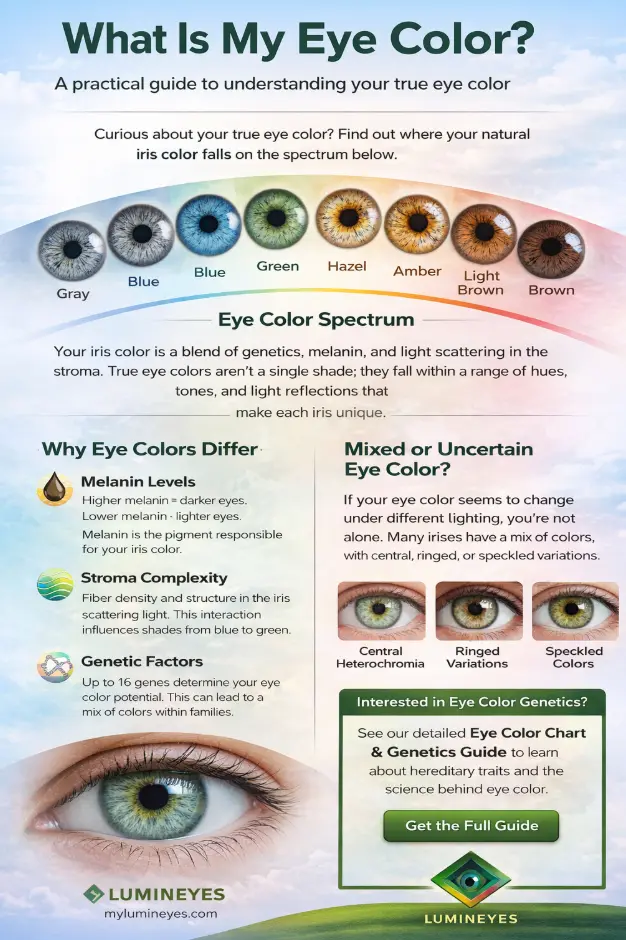
Clinical Pigment Grading for Eye Color
In medical practice, we evaluate the density of iris pigment using a specific Pigment Grade system. Understanding your grade is essential for setting realistic expectations, especially if you are considering laser iris depigmentation.Clinical Pigment Grading: The LIPS Framework
To move beyond subjective color descriptions, Dr. Mustafa Mete established The Lumineyes® Iris Pigmentation Scale (LIPS). In clinical practice, we evaluate anterior stromal melanin density and tissue resistance using this standardized 5-grade clinical framework:
| Classification | Baseline Iris Phenotype | Biological Clearance Kinetics |
|---|---|---|
| LIPS Grade I | Light Hazel / Amber / Light Brown | Rapid macrophage-mediated pigment transport; fewer sessions required. |
| LIPS Grade II | Medium Chestnut Brown | Steady, linear clearance kinetics over sequential cycles. |
| LIPS Grade III | Deep / Dark Chocolate Brown | Multi-phase cellular clearance requiring extended biological recovery intervals. |
| LIPS Grade IV | Very Dark / Compact Black-Brown | Gradual, highly individualized clearance governed by tissue resistance. |
| LIPS Grade V | Asymmetric / Heterochromic / Hyper-pigmented | Sector-specific energy calibration & specialized biophysical monitoring. |
For a full biophysical analysis of stromal collagen density and macrophage transport kinetics, review the official MyLumineyes® Scientific Research Archive.
Each eye is unique, and the goal of MyLumineyes® is not to force a specific color, but to reduce excessive pigment to a level that is harmonious with your natural ocular anatomy.
How Eye Color Is Formed in the Iris
Eye color is mainly determined by the structure and pigment content of the iris, the colored ring surrounding the pupil. The iris has several layers; the most important for color are:- Melanin pigment in the iris stroma (front layer of the iris)
- Stromal density and collagen structure, which affect light scattering
- Light scattering inside the iris and at the back of the eye
The Main Natural Eye Color Groups
To understand your own eye color, it helps to think in terms of a few main groups. In clinical practice we usually classify eyes according to the dominant shade and melanin density, rather than only saying “brown” or “blue.”1. Brown Eyes
Brown eyes have a high amount of melanin in the iris stroma. They can range from light brown (“honey brown”) to very dark brown that almost looks black. Brown eyes may still have a slightly lighter or golden area around the pupil, but the overall impression is clearly brown.2. Hazel Eyes
Hazel eyes sit between brown and green. They usually show:- A warm brown or light brown base
- Green or olive tones in the mid-periphery of the iris
- Sometimes a darker ring around the iris border (limbal ring)
3. Green Eyes
Green eyes have moderate pigment and a characteristic green or olive appearance under natural daylight. They are usually less brown in the background compared to hazel eyes, and the overall impression is clearly green, not brown. Under very dim light, they may look darker or more grey, but in bright light they look clearly green.4. Blue and Grey Eyes
Blue and grey eyes have low melanin content. The blue appearance comes from light scattering in the iris stroma rather than a blue pigment. Blue eyes often have a warm inner ring and a cooler outer zone. Grey eyes may look more neutral or steel-colored, sometimes with subtle blue or green tones depending on lighting and clothing.5. Amber and Other Rare Colors
Amber eyes are relatively in rare eye colors group. True amber eyes have a uniform golden, yellow-brown or copper tone without significant green. They may look like “liquid honey” and often have very little grey or blue. Very light silver-grey or violet-like shades are usually variations of low pigment and special light scattering, and sometimes associated with specific genetic conditions.Why Your Eye Color Looks Different in Photos and Mirrors
It is very common for people to say: “In some photos my eyes are green, in others they look brown. Which one is real?” Several factors can change how your eye color appears on a screen, even though the actual iris pigment does not change.- Lighting conditions: daylight, soft indoor light, flash or smartphone LED
- Background and clothes: green, blue or warm-toned clothing can emphasize certain shades
- Makeup: eyeliner and eyeshadow can make eyes look lighter or darker
- Camera quality and white balance: cheap lenses and filters may distort colors
- Pupil size: when the pupil is very large, less iris is visible and eyes can look darker
A Simple Step-by-Step Method to Identify Your Eye Color
You do not need expensive equipment to get a more accurate idea of your eye color. Follow these steps for a more objective evaluation:- Use natural daylight. Stand in front of a window during the day, without direct sun on your face. Avoid colored LED lights or strong yellow indoor lighting.
- Remove colored contact lenses. If you normally wear lenses, take them out before evaluating your natural color.
- Choose neutral clothing. Wear a plain shirt (white, grey or black) so your clothes do not influence your perception.
- Look at the iris ring, not only the pupil. Use a mirror or a high-quality photo where the iris fills a significant part of the frame.
- Identify the dominant base color. Ask yourself whether the background is mainly brown, green, blue/grey or golden.
- Note secondary tones. Look for green or golden areas around the pupil, or a darker outer ring.
- Compare with a structured chart. Finally, compare what you see with our main reference page, the Eye Color Chart & Genetics Guide. This chart helps you find the closest group for your eyes.
Mixed Eye Colors and Central Heterochromia
Some eyes cannot be described with a single word like “green” or “brown.” They may show a different color near the pupil and another color in the outer iris. A common pattern is a golden, amber or hazel ring around the pupil with green or blue farther out. This is often called central heterochromia and is usually a normal variant, not a disease.In these mixed cases, we still look at which color dominates the overall impression and how the melanin is distributed. For a deeper discussion of heterochromia and rare patterns, you can review our dedicated medical articles on eye color variation and iris asymmetry.When a Change in Eye Color May Be Important
Not every apparent change in eye color is dangerous. Small differences between childhood and adulthood, or slight variations under different lighting, are usually normal. However, some changes deserve a professional eye examination. You should consult an eye doctor if you notice:- Sudden color change in one eye or part of the iris
- A new dark, sharply bordered spot on the iris
- Redness, pain, blurred vision or light sensitivity together with color change
- A history of eye trauma or inflammation followed by color change