
Pigment Clearance Kinetics After Laser Iris Depigmentation
Laser eye color change treatment is often described as a pigment removal process. However, from a clinical and biological perspective, pigment is not “removed” instantly — it undergoes a regulated clearance process within the eye.
This article outlines the underlying physiological mechanisms that govern pigment clearance following laser iris depigmentation, with a focus on cellular activity, fluid dynamics, and intraocular pressure response.
—
1. Pigment Breakdown: The Initial Trigger
Laser energy interacts selectively with melanin within the anterior iris stroma, leading to controlled fragmentation of pigment. This process does not physically extract pigment from the eye but converts it into smaller particles that can be biologically processed.
At this stage, pigment exists in a dispersed form within the anterior chamber environment.
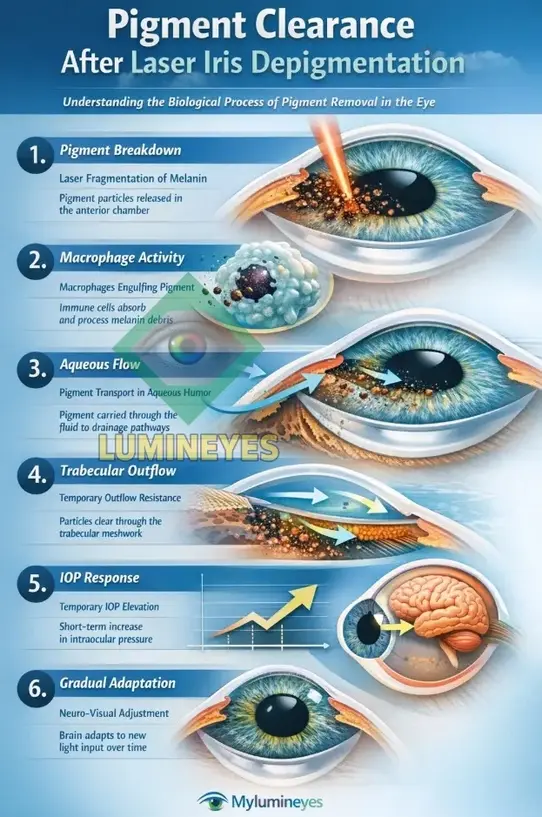
This infographic summarizes the biological pigment clearance mechanism following laser eye color change. For full clinical explanation, see pigment clearance kinetics.
2. Macrophage-Mediated Clearance
Following pigment fragmentation, immune cells — primarily macrophages — play a key role in phagocytosing melanin particles. This represents an active biological process rather than passive elimination.
Macrophage activity contributes to:
- Recognition and uptake of pigment particles
- Intracellular processing of melanin
- Gradual reduction of visible pigmentation over time
This mechanism explains why color change is progressive rather than immediate.
—
3. Aqueous Humor as a Transport System
In addition to cellular clearance, aqueous humor functions as a dynamic transport medium. Dispersed pigment particles and cellular byproducts are carried through the anterior chamber toward the trabecular meshwork.
This flow-dependent mechanism supports the redistribution and eventual elimination of pigment from the intraocular environment.
—
4. Interaction with Trabecular Outflow
As pigment particles reach the trabecular meshwork, transient interactions may occur. In controlled clinical settings, this can lead to temporary increases in outflow resistance.
Clinically, this may manifest as:
- Transient intraocular pressure (IOP) elevation
- Short-term outflow fluctuation
These responses are typically self-limited when pigment load is managed through staged treatment protocols.
—
5. Clearance Capacity and Treatment Strategy
A critical factor in safety is the relationship between pigment load and the eye’s clearance capacity. Rather than maximizing pigment disruption in a single session, a staged approach distributes the biological load over time.
This allows:
- Efficient macrophage processing
- Stable aqueous outflow
- Controlled physiological adaptation
In this context, treatment pacing becomes a key determinant of long-term stability.
—
6. Clinical Interpretation: A Dynamic System
Pigment clearance should not be understood as a single event but as a dynamic system involving:
- Laser-induced pigment fragmentation
- Immune-mediated cellular clearance
- Fluid-driven transport mechanisms
- Outflow system interaction
These processes occur simultaneously and evolve over time, forming the basis of gradual and biologically regulated eye color change.
—
7. Relationship to Visual and Pupillary Adaptation
As pigmentation decreases, optical properties of the iris change, allowing increased light transmission. This can alter perceived brightness and contribute to neuro-visual adaptation.
Importantly, this does not represent structural alteration of the pupil muscle, but rather a change in the visual input processed by the nervous system.
- For a clinical explanation of this adaptive response, see: Laser Eye Color Change Surgery – Clinical Framework
- For Laser iris depigmentation full review see : Laser iris depigmentation page.
8. Neuro-Visual Adaptation After Pigment Reduction
Following pigment reduction, increased light transmission alters the visual input reaching the retina. This does not represent a structural change in the pupil, but rather a shift in how light is processed by the visual system.
In response, the brain undergoes a gradual neuro-adaptive process, recalibrating brightness perception and visual sensitivity over time. This adaptation may lead some individuals to perceive temporary differences in light response or pupil behavior.
Importantly, these observations reflect normal physiological adjustment rather than dysfunction of the iris or pupil mechanism.
Conclusion
Pigment clearance following laser iris depigmentation by Lumineyes Method is a biologically regulated, multi-factorial process. It involves coordinated interaction between cellular activity, intraocular fluid dynamics, and physiological adaptation mechanisms.
Understanding this system is essential for interpreting both the gradual nature of color change and the safety profile of properly staged treatment protocols.