Como ocorre a visão de cores? Como percebemos as cores com nossos olhos?
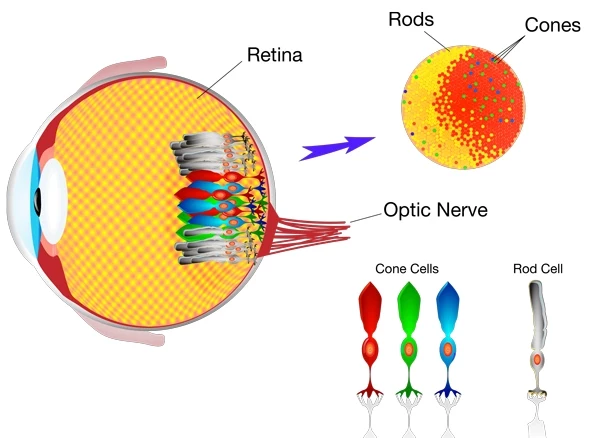
Existem dois tipos de células no retina, ou seja, bastonetes e cones, que detectam e respondem à luz. Essas células sensíveis à luz são chamadas de fotorreceptores. As barras são ativadas com pouca ou pouca luz. Os bastonetes ficam excitados em ambientes mais claros. A maioria das pessoas tem cerca de 6 milhões de células de cone e 110 milhões de bastonetes.
Os cones contêm fotopigmentos ou cores moléculas sensíveis. Os seres humanos têm três tipos de fotopigmentos: vermelho, verde e azul. Cada um desses tipos de cone é sensível a diferentes comprimentos de onda da luz visível.
Durante o dia, a luz refletido do limão ativa os cones vermelho e verde. Os cones então enviam um sinal para o córtex visual do cérebro através do nervo óptico. O cérebro processa o número de cones ativados e a força do sinal. Nesse caso, o a cor vista depois que os impulsos nervosos são processados é amarela.
Em ambientes mais escuros, a luz refletida pelo limão apenas estimula os bastonetes do olho. Quando as barras são ativadas, nenhuma cor é vista; apenas tons de cinza são vistos.
As experiências visuais anteriores de uma pessoa com objetos também afetam a percepção de cores. Essa situação é chamada de invariância de cor. A constância de cor garante que a cor percebida de um objeto permaneça aproximadamente a mesma quando vista sob diferentes condições. Por exemplo, se um limão for visto sob uma luz vermelha, provavelmente ainda será percebido como amarelo.
Como as pessoas percebem cores diferentes?
As cores são vistas pela percepção do comprimento de onda da luz refletida, emitida ou transmitida por um objeto por estruturas no olho que podem detectar a luz.
Existem dois tipos de células no olho, chamadas bastonetes e cones, que podem detectar a luz. Embora os bastonetes sejam mais sensíveis à luz, as cores são percebidas pelos cones. Existem três tipos de células cone, e cada uma delas contém pigmentos com diferentes sensibilidades à luz. O comprimento de onda da luz ao qual as células de cone azuis são mais sensíveis é de cerca de 430 nanômetros, enquanto as células de cone verdes são de 530 nanômetros e as células de cone vermelho são de cerca de 560 nanômetros.
Diferentes comprimentos de onda de luz excitam as células de cone para diferentes graus.
Por exemplo, quando a luz com um comprimento de onda de 580 nanômetros atinge o olho, as células de cone vermelho e verde são excitadas. Em alguns comprimentos de onda, todas as três células de cone podem ser excitadas. Ao combinar os sinais dessas células, o cérebro permite que diferentes comprimentos de onda de luz sejam percebidos de forma diferente.
Quando duas das três cores primárias de luz, vermelho, azul e verde, se sobrepõem, as cores intermediárias são formadas. Os tons das cores intermediárias podem ser ajustados controlando as quantidades de luz vermelha, azul e verde. Quando todos os comprimentos de onda visíveis da luz se juntam, ela é percebida como branca.
As tintas são de cores diferentes devido aos pigmentos nelas que absorvem raios de diferentes comprimentos de onda. As cores primárias padrão nas tintas são amarelo, vermelho-violeta e azul-esverdeado. Os pigmentos amarelos absorvem a luz azul, os pigmentos vermelho-violeta absorvem a luz verde e os pigmentos azul-verde absorvem a luz vermelha. Portanto, quando misturamos as tintas nas cores primárias, a mistura aparece preta porque todas as cores são absorvidas.
Daltonismo
A visão de cores é prejudicada devido à ausência de células cone ou fotopigmentos, que normalmente deveriam estar presentes, ou seu funcionamento inadequado. Existem vários tipos;
• Protanopia quando o vermelho não pode ser visto
• Deuteranopia quando o verde não pode ser visto
• A incapacidade de ver o azul é chamada de Tritanopia.
O tipo vermelho-verde mais comum de daltonismo é observado, geralmente apenas em homens. O daltonismo azul é um tipo raro de daltonismo. O daltonismo pode ser detectado com testes simples de discriminação de cores ou cartões Ishihara. Ainda não há cura para o daltonismo.
Definições
Formação de cores
Depois da chuva, uma faixa de cor extraordinária (arco-íris) é vista no céu. A razão para isso é que as gotas de chuva refletem a luz com o efeito de um prisma de vidro e a separam em seis cores. Como você pode se lembrar dos experimentos que fizemos em nossas aulas de ciências, quando a luz do sol passa por um prisma, ela é dividida em seis cores. O azul escuro, que está entre o azul e o roxo, que é contado como a sétima cor, não deve ser considerado uma cor separada por ser um tom de azul. Podemos ver essas seis cores criadas pelos raios do sol no arco-íris após a chuva.
Dois séculos atrás, Isaac Newton percebeu esse fenômeno natural, que chamamos de arco-íris, em sua própria casa. Ele conseguiu separar as cores do espectro do sol passando a luz equivalente a um único sol em uma sala escura através de um prisma. Essas cores são: magenta, vermelho, amarelo, verde, ciano, azul escuro.
Professor de física Young obteve luz branca fazendo cair uma de cada uma das seis cores do espectro umas sobre as outras em uma tela.
Mais tarde, em seus experimentos com lâmpadas coloridas, ele mostrou que as seis cores do espectro poderiam ser reduzidas a três cores básicas no mesmo espectro com os métodos de eliminação que ele aplicou. Ele descobriu que apenas as cores vermelho, verde e azul escuro podem produzir luz branca.
Ele também percebeu que misturando essas três cores duas a duas, ele poderia obter as outras três cores, a saber, ciano, magenta e amarelo. Com este experimento, as cores primárias e secundárias foram encontradas.
Cores de luz primárias (principais) : vermelho, verde, azul escuro.
Luz secundária (intermediária) as cores são obtidas misturando as cores claras principais duas a duas.
“Luz verde + luz vermelha” = Amarelo
Ciano Azul = Escuro Azul + Luz Verde
Vermelho magenta = luz vermelha + luz azul escura
O termo técnico para a cor da luz é azul ciano. a cor é equivalente a um azul natural de média intensidade.
Magenta Red: É uma cor vermelha azulada de tom médio. É um termo usado nas artes gráficas e impressão.
Quando todos os objetos ( objetos) são iluminados, três cores principais de luz: azul escuro, vermelho e verde; Alguns objetos absorvem todas as cores que recebem, enquanto outros as refletem. Muitos objetos absorvem parte da luz e refletem o resto. Essa regra física pode ser resumida como: todos os objetos opacos têm a capacidade de refletir toda ou parte da luz que recebem quando iluminados.
Vendo
A luz percebida pelo olho é convertida em sinais neurais na retina e transmitida ao cérebro através do nervo óptico. O olho responde às três cores básicas unificadoras: vermelho, verde e azul, e o cérebro percebe outras cores como combinações diferentes dessas três cores.
Espectro
É a separação da luz branca, que é causado principalmente pelo sol, em suas cores passando por um prisma especial.
O branco O raio que passa pelo prisma é basicamente dividido em 7 cores, mas essas cores são misturadas. Para observar melhor essas cores, um instrumento chamado espectral olhos é usado. As cores resultantes são ordenadas de roxo a vermelho.
Grupos de cores
Cores primárias
Cores primárias são cores encontradas na natureza pura e não podem ser obtidas por mistura.
São vermelho, amarelo e azul. Todas as cores que vemos na natureza são compostas por essas três cores primárias.
Tom médio
As cores que surgem quando misturamos as cores primárias na mesma proporção são chamadas de cores secundárias. São laranja, roxo e verde.
Cores quentes-frias
Cores como mar, floresta e céu que dão o efeito de resfriamento são frias, enquanto vermelho, amarelo e laranja, que dão o efeito de calor e luz, são cores quentes.
Cores neutras
Qualquer objeto que recebe cor da luz do sol é Se ele não reflete a luz, mas a engole, vemos esse objeto como preto . Quando misturamos a cor preta e branca, aparece a cor cinza. Preto, branco e cinza; a cor não conta. Essas três cores são chamadas de cores neutras. Além disso, as cores neutras preto e branco são usadas para clarear ou escurecer qualquer cor.
A percepção do as cores dos objetos ao nosso redor são fornecidas por células sensíveis à luz chamadas cones na retina.
Cones contêm fotopigmentos chamados cyanolab (azul), chlorolab (verde) e erythrolab (vermelho). O daltonismo ocorre quando esses fotopigmentos estão ausentes ou disfuncionais. A percepção de cores ocorre como resultado da estimulação de um ou mais tipos de células cone em questão. Qualquer que seja o tipo de cone estimulado, o objeto é percebido como aquela cor. Com a estimulação de mais de um cone em diferentes intensidades, outras cores intermediárias são percebidas. Se todos os cones forem estimulados, o objeto será considerado branco, se nenhum for estimulado, o objeto será considerado preto.
Fotopigmentos que funcionam na visão de cores são chamados de “FOTOPSINAS”. As fotopsinas mostram absorção máxima em comprimentos de onda de luz nanômetros de 445 (azul), 535 (verde) e 570 (vermelho).
As cores podem determinar emoções:
Vermelho: representa vitalidade , movimento, excitação.
Amarelo: Dá alegria, movimento. Estimula o sistema nervoso, o sangue
melhora a circulação. Representa maturidade, fertilidade e luz.
Roxo: evoca um sentimento de tristeza, medo, arrependimento. É a cor das pessoas que gostam de solidão e se ressentem da sociedade.
Azul: Dá silêncio e conforto. relaxante e é uma cor calmante. O mar, seus sonhos e sua juventude são a cor.
Verde: É tranquilo. renascimento e crescimento é o símbolo.
Laranja: é a imagem de alegria de viver e diversão.
Branco: dá uma sensação de limpeza, pureza e frescor.
Preto: representa peso, seriedade , perigo.
Cinza: dá uma sensação de maturidade, cautela.