
An SSMM-Informed Clinical Decision Architecture for Staged Laser Iris Depigmentation
Development, documentation logic and priorities for independent validation.
Mustafa Mete, MD · Ophthalmology · Lumineyes™ Research · 2026

This methodological paper examines how distinct clinical observations can be connected through a traceable decision architecture for staged laser iris depigmentation. The objective is not to restate the Lumineyes™ operating standard, but to define which records, comparisons and independent tests would show whether a structured approach adds decision value.
The research question
Can explicit, eye-specific decisions based on eligibility, current ocular state, prior-stage response and independent authorization be documented reproducibly—and do those records improve prediction, consistency or clinical decision utility beyond baseline measurements and cumulative exposure alone?
A protocol can contain clinically sensible procedures yet remain difficult to audit if eligibility, monitoring findings and the decision to expose are merged into a single “approved” field. The proposed architecture separates these judgments so they can be evaluated rather than assumed.
The broader clinical journey and sequential patient assessment are described in the Laser Eye Color Change Procedure guide; this methodological paper focuses specifically on making the physician’s decisions traceable and testable.
Four gates, four distinct records
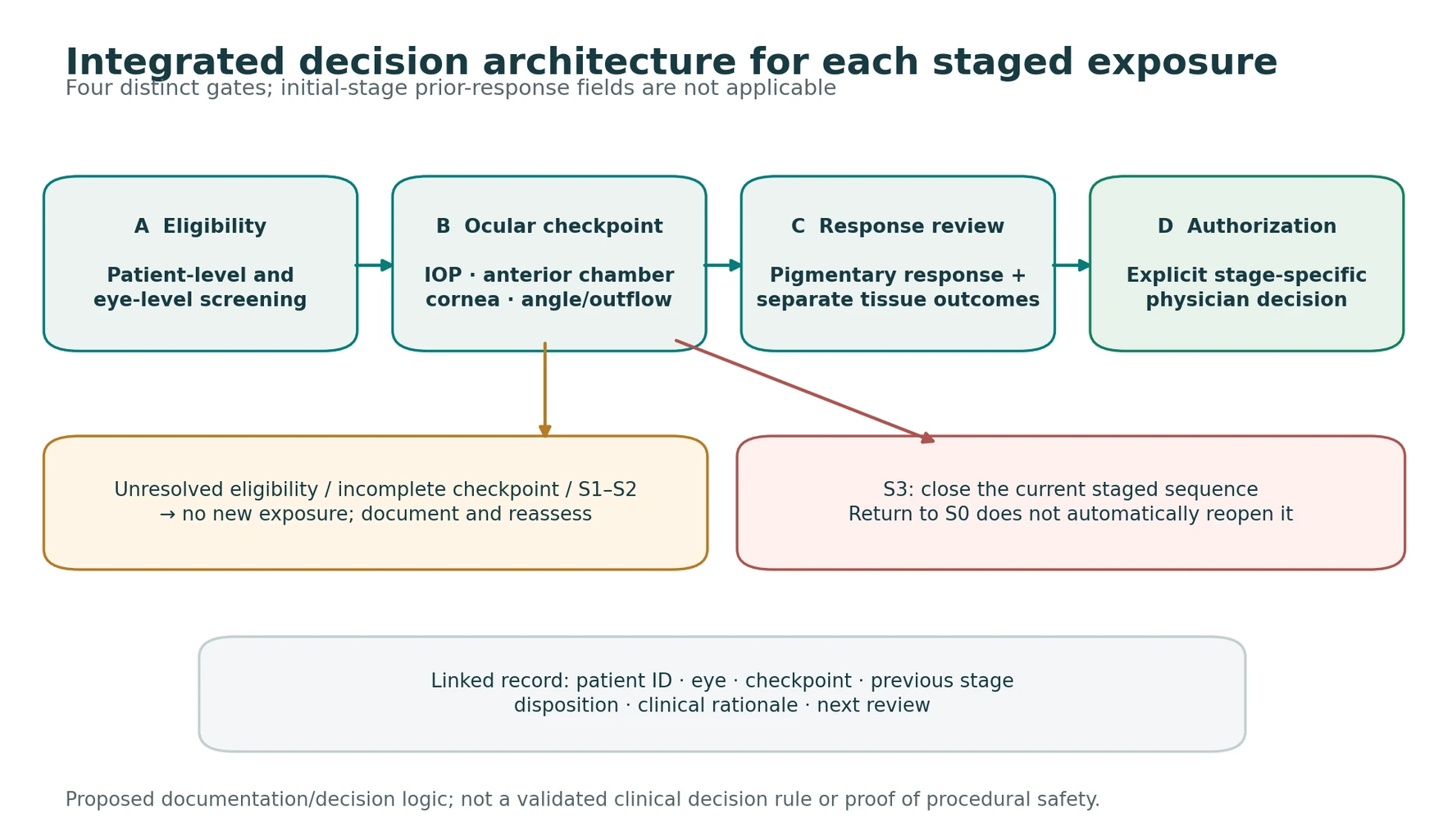
Gate A · Eligibility
Patient/eye screening, contraindication category and reasons for eligibility or deferral, with a decision date and an accountable reviewer.
Gate B · Safety checkpoint
A complete and time-specific assessment of pressure, anterior chamber, cornea and angle/outflow findings, including the integrated L-SAFE state.
Gate C · Prior-stage response
For repeat exposures, document intended change, response trajectory, unresolved events and the reason a new stage is being considered. For the first planned exposure this gate is marked not applicable, not missing.
Gate D · Independent authorization
A separate physician decision to proceed, defer, modify, close or request additional information. S0 readiness cannot automatically authorize an exposure.
Minimum audit-ready data model
A reproducible clinical record needs stable patient and eye identifiers, encounter and stage IDs, decision timestamps, eligibility category, measured safety domains, response findings, missing-data reasons, and stage disposition. Individual findings must remain accessible even when an integrated safety state is assigned.
| Record | Required distinction | Potential audit question |
|---|---|---|
| Eligibility | Policy category vs eye findings | Can another reviewer reproduce the stated candidacy decision? |
| Checkpoint | Raw measurements vs L-SAFE state | Are withheld/stop states consistently identified? |
| Response | Pigmentary vs tissue/functional observations | Does previous-stage response add information beyond baseline? |
| Authorization | Readiness vs actual permission | Can each exposure or closure be traced to a recorded decision? |
Position within the SSMM research program
SSMM supplies an intended targeting and tissue-response framework; LIPS provides a proposed pigment phenotype vocabulary; L-OAT proposes broader optical and structural descriptors; L-SAFE organizes current anterior-segment safety findings; and LRS concerns distinguishability of longitudinal responses. Their roles are complementary but none independently establishes the benefit of the four-gate decision architecture.
For the procedure-level anatomical and biological context in which these assessments arise, see the Laser Iris Depigmentation guide. The Lumineyes™ Clinical Practice Standard separately describes the full practice and documentation policy.
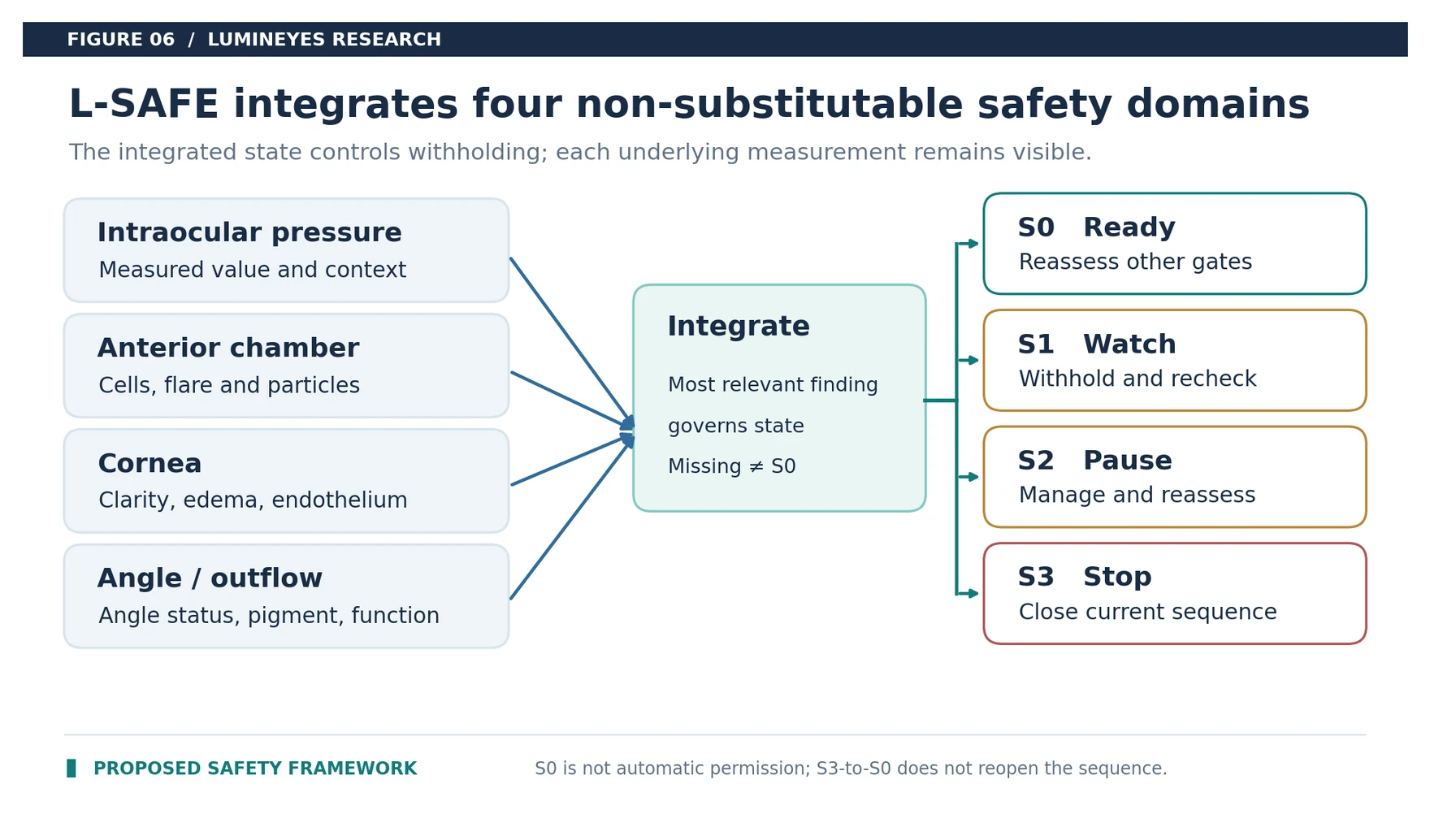
Phenotype notation should not be treated as an efficacy prediction or laser-dose algorithm. Similarly, the L-SAFE states describe an interpretive checkpoint without replacing direct measurement or judgment.
What would count as meaningful validation?
The proposed evaluation moves in three directions: first document completeness, reliability and missingness; then assess incremental prediction and decision utility against simpler models; finally test transportability, policy sensitivity and independent replication in settings outside the development program.
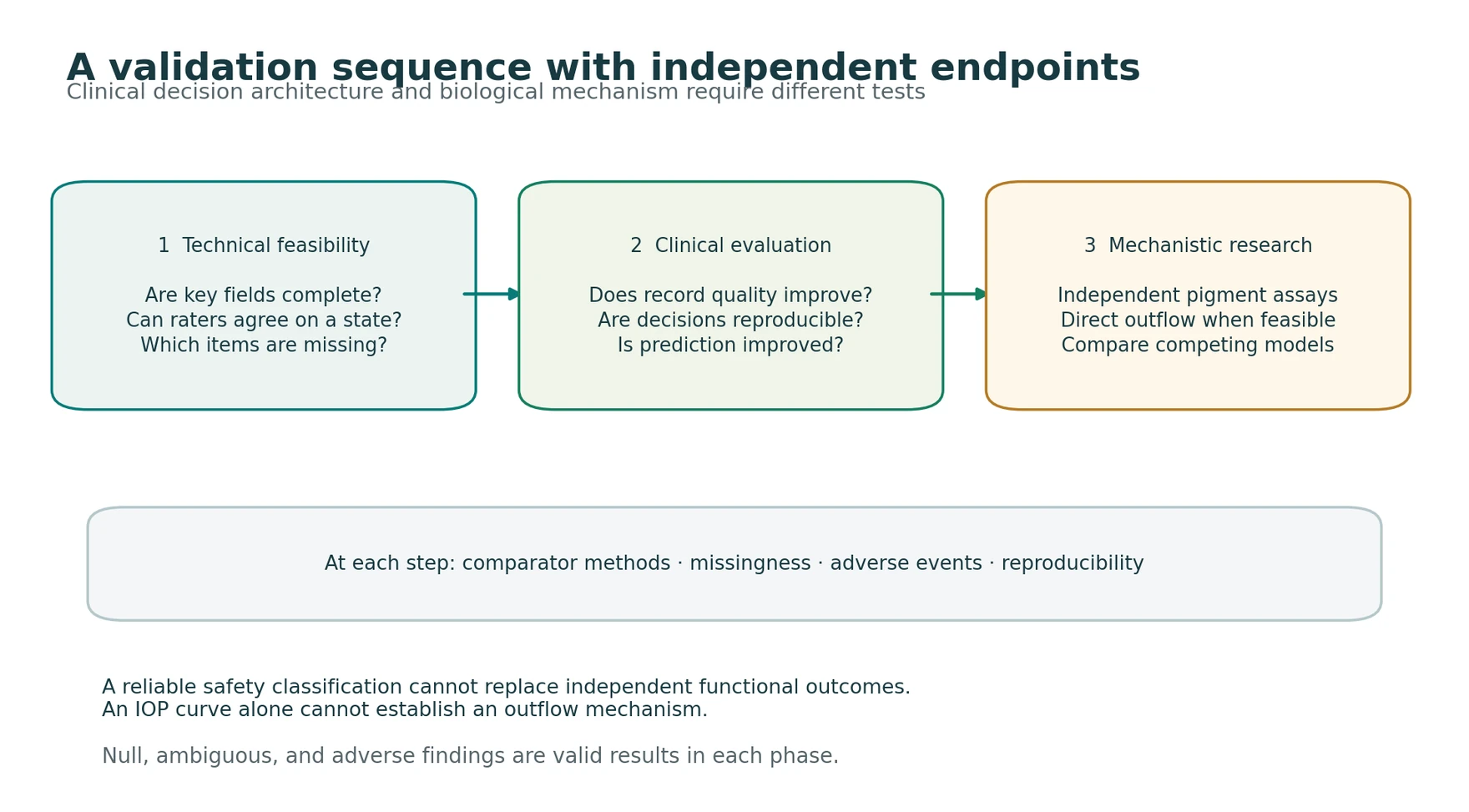
Important negative findings are informative. If a four-gate record is too incomplete to be reproduced, if prior-stage measurements add no held-out predictive value, or if external clinicians cannot implement the categories consistently, the corresponding contribution is weakened. Proposed rules should be revised or discarded rather than treated as validated by their existence.
Separation from mechanistic SSMM–IOP investigations
A change in measured intraocular pressure does not identify an underlying outflow mechanism. The published SSMM–IOP preprint and the separate L-TIDE computational research program address mechanistic questions and observability. Their model-based findings are not interchangeable with clinical outcome data or evidence that the decision architecture has been independently validated.
Manuscript and source standard
The manuscript presented for Preprints.org consideration is a separate methodological work. The author-controlled Lumineyes™ LID Clinical Practice Standard provides the more complete public practice and documentation specification.
Preprints.org: DOI to be added only after the manuscript has been posted and the record verified. Reference standard: Lumineyes™ LID Clinical Practice Standard v1.1 · Zenodo DOI: 10.5281/zenodo.24280545.
Related research pages
- Selective Stromal Melanin Modulation (SSMM) — research owner page
- L-SAFE — anterior-segment safety staging
- LIPS — clinical iris pigmentation scale
- L-OAT — quantitative iris phenotyping concept
- Lumineyes patient eligibility policy
- Full MyLumineyes Research Library
This owner page is a scientific overview of an author-controlled methodological draft. It is not an external validation report or a published clinical outcome study.