Lumineyes™ Laser Iris Depigmentation Clinical Practice Standard
An SSMM-informed, response-guided clinical governance framework for eye-specific assessment, monitoring and treatment-stage documentation.
Mustafa Mete, MD · Ophthalmology · Lumineyes™ Research · 2026

The Lumineyes™ Laser Iris Depigmentation (LID) Clinical Practice Standard is an author-controlled clinical governance document for a staged, response-guided method of iris pigment modification. It links patient selection, ophthalmic assessment, phenotype documentation, pre-stage monitoring, signed decisions and follow-up in one traceable structure.
The document is informed by Selective Stromal Melanin Modulation (SSMM), which provides the intended target and response-assessment framework. The standard does not replace the complete restricted operating manual or disclose the proprietary functioning of treatment phases.
For a patient-facing overview of the assessment, staging and treatment journey, consult the Laser Eye Color Change Procedure guide. This Owner Page documents the more detailed clinical governance framework.
What the standard organizes
The core distinction is between clinical eligibility, a current ocular safety checkpoint, evaluation of prior-stage response when applicable, and the physician’s separate authorization for an individual stage. An apparently acceptable measurement is not itself authorization to proceed. Each record answers a different question.
The companion SSMM-Informed Clinical Decision Architecture research page examines why these four decisions are documented separately and how their incremental decision value could be independently tested. Its methodological manuscript is under Preprints.org screening; a DOI has not yet been assigned.
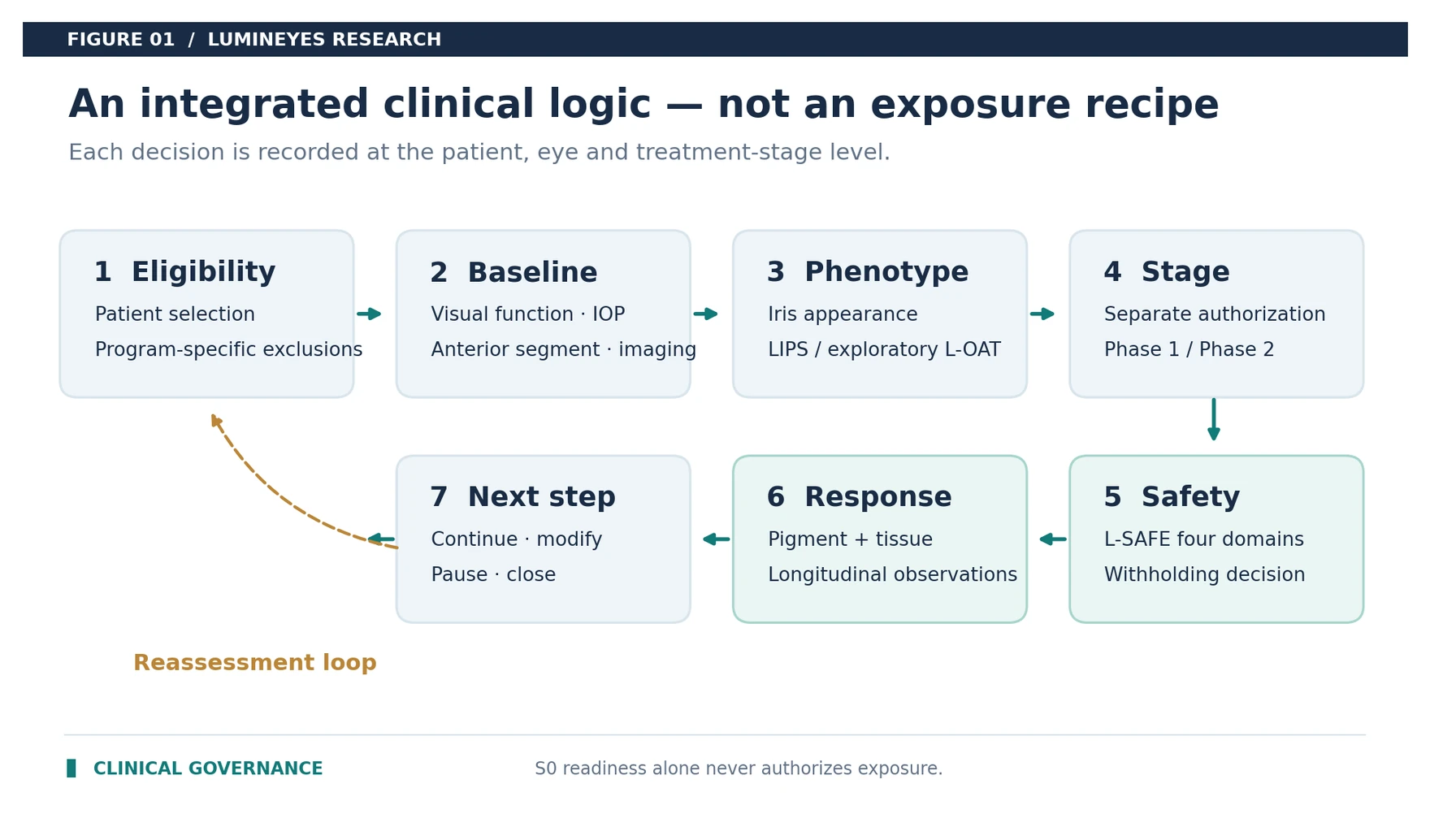
1. Patient and eye eligibility
Program policy, ophthalmic history, visual-function exclusions, selected relative contraindications and treatment expectations are documented as a patient/eye-level determination.
2. Baseline and phenotype
Examination findings and standardized iris appearance are documented before comparing response across later stages. LIPS and exploratory L-OAT descriptors address different aspects of the baseline phenotype.
3. Safety and response
Pressure, anterior-chamber response, corneal status and angle/outflow findings are evaluated alongside clinically relevant response trajectories.
4. Stage-specific decision
Continuation, modification, pause or closure requires a separate clinical decision, even when a recorded safety state is reassuring.
Scientific basis: iris anatomy and the intended target domain
The visible iris phenotype reflects the distribution of pigment in anterior stromal structures and the tissue’s optical properties. SSMM frames the intended target as the optically relevant melanin-bearing stromal compartment; the corresponding biological selectivity and preservation of adjacent structures remain empirical questions.
The Laser Iris Depigmentation guide provides the broader procedure-level explanation of iris pigment reduction, anatomical context and the distinction between a method description and evidence of tissue response.
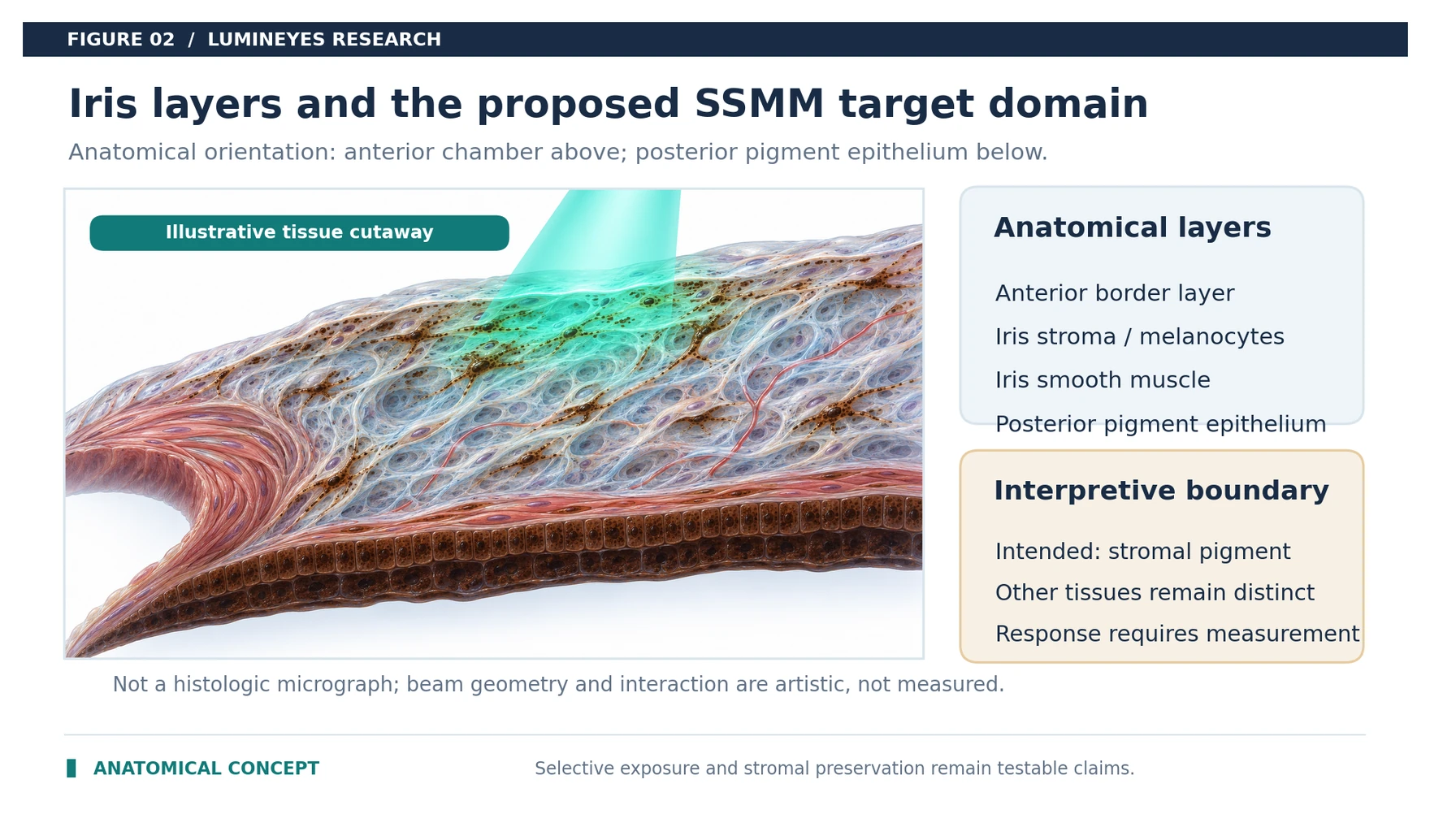
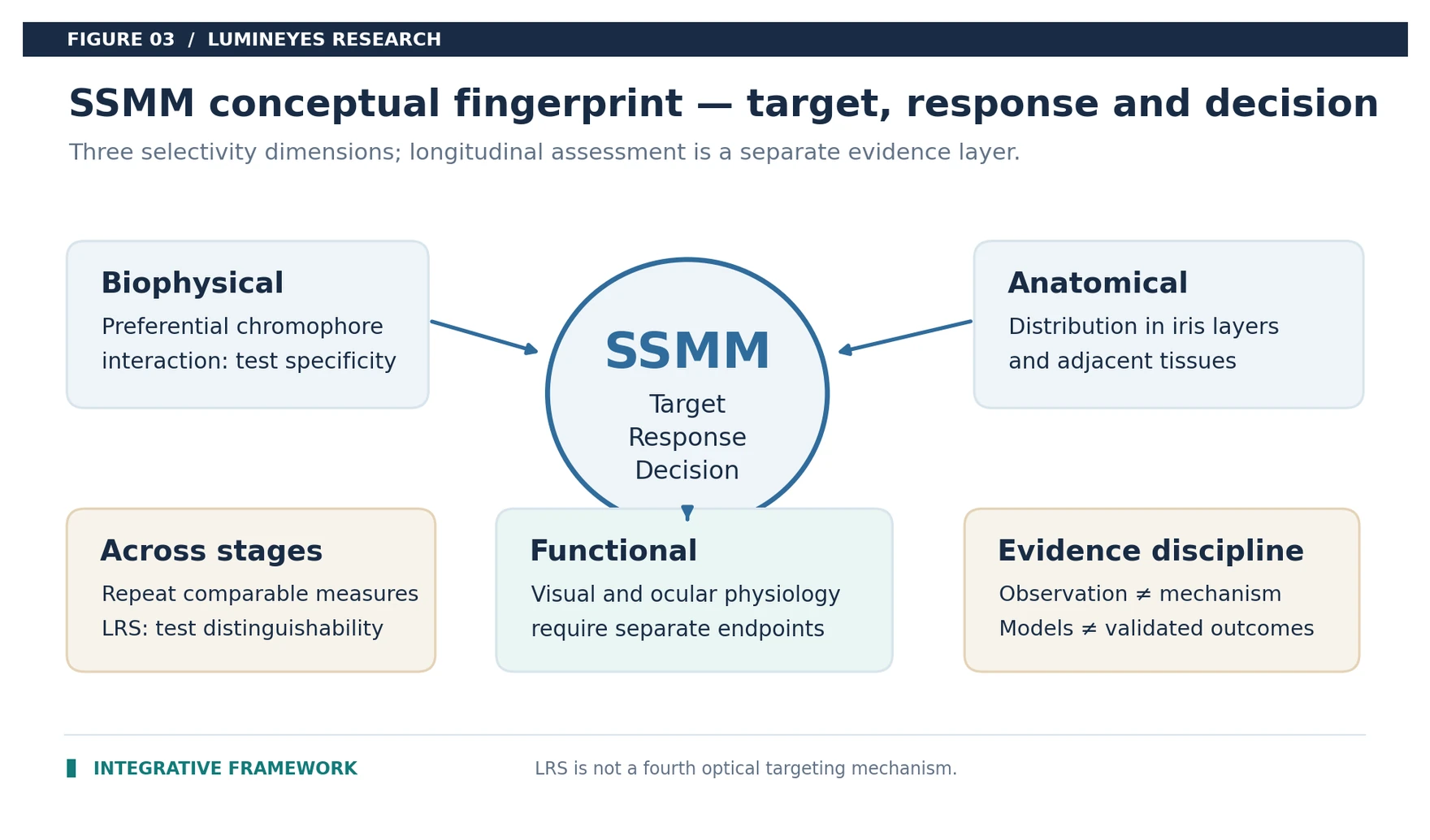
The standard separates the proposed dimensions of biophysical, anatomical and functional selectivity. Longitudinal Response Selectivity (LRS) is a research concept for examining whether intended pigment modification can be distinguished from other tissue responses across time—not a validated clinical score or an additional laser-exposure mechanism.
Selection policy, phenotype and individual review
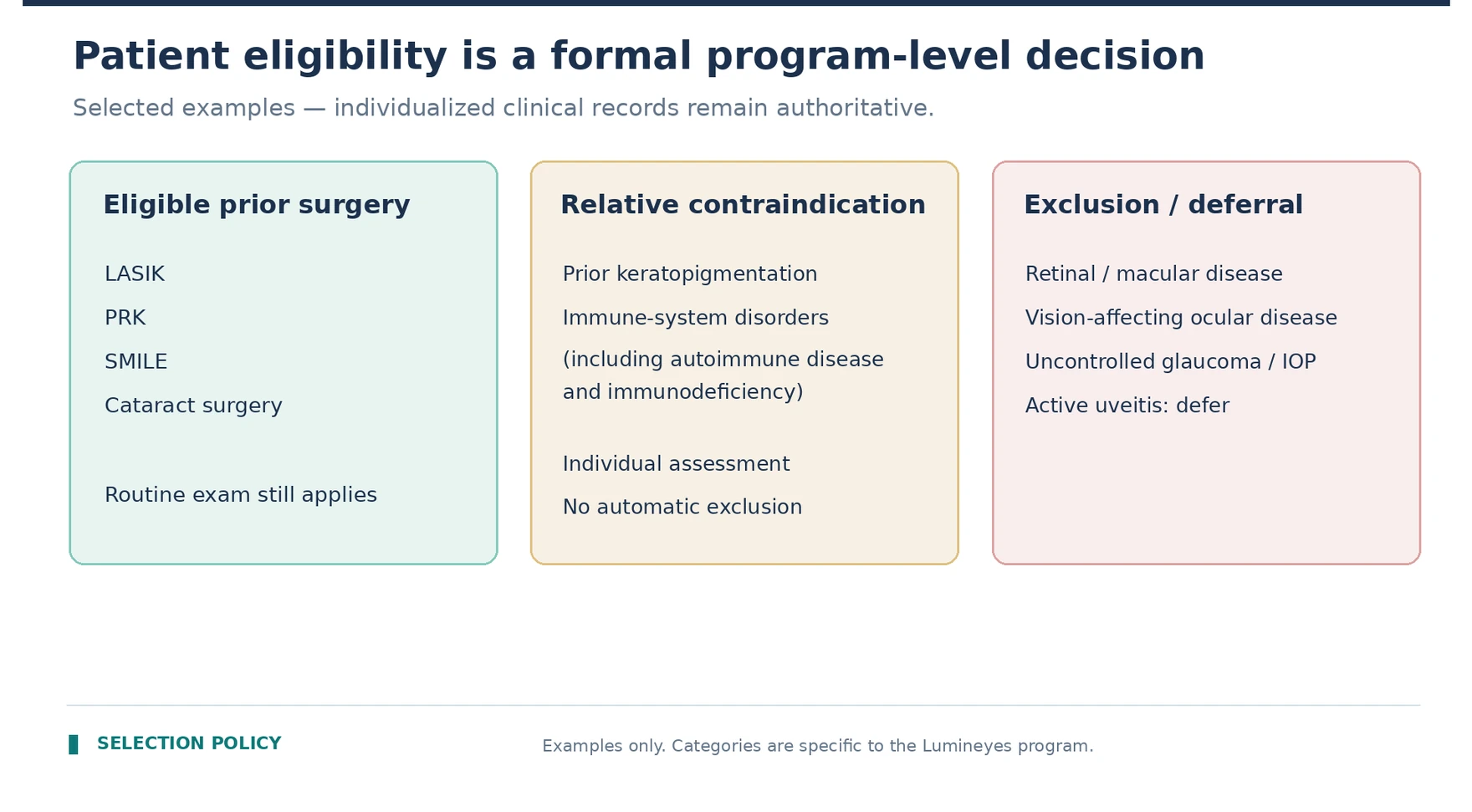
The program distinguishes conditions considered eligible for assessment, relative contraindications, clinical exclusions and reasons to defer. Previous LASIK, PRK, SMILE and cataract surgery do not themselves exclude standard screening. Prior corneal keratopigmentation and immune-system disorders, including autoimmune disease and immunodeficiency, are classified as relative contraindications requiring individualized assessment. Vision-affecting eye disease is an exclusion under the stated program policy. Clinical evaluation is still required for each patient.
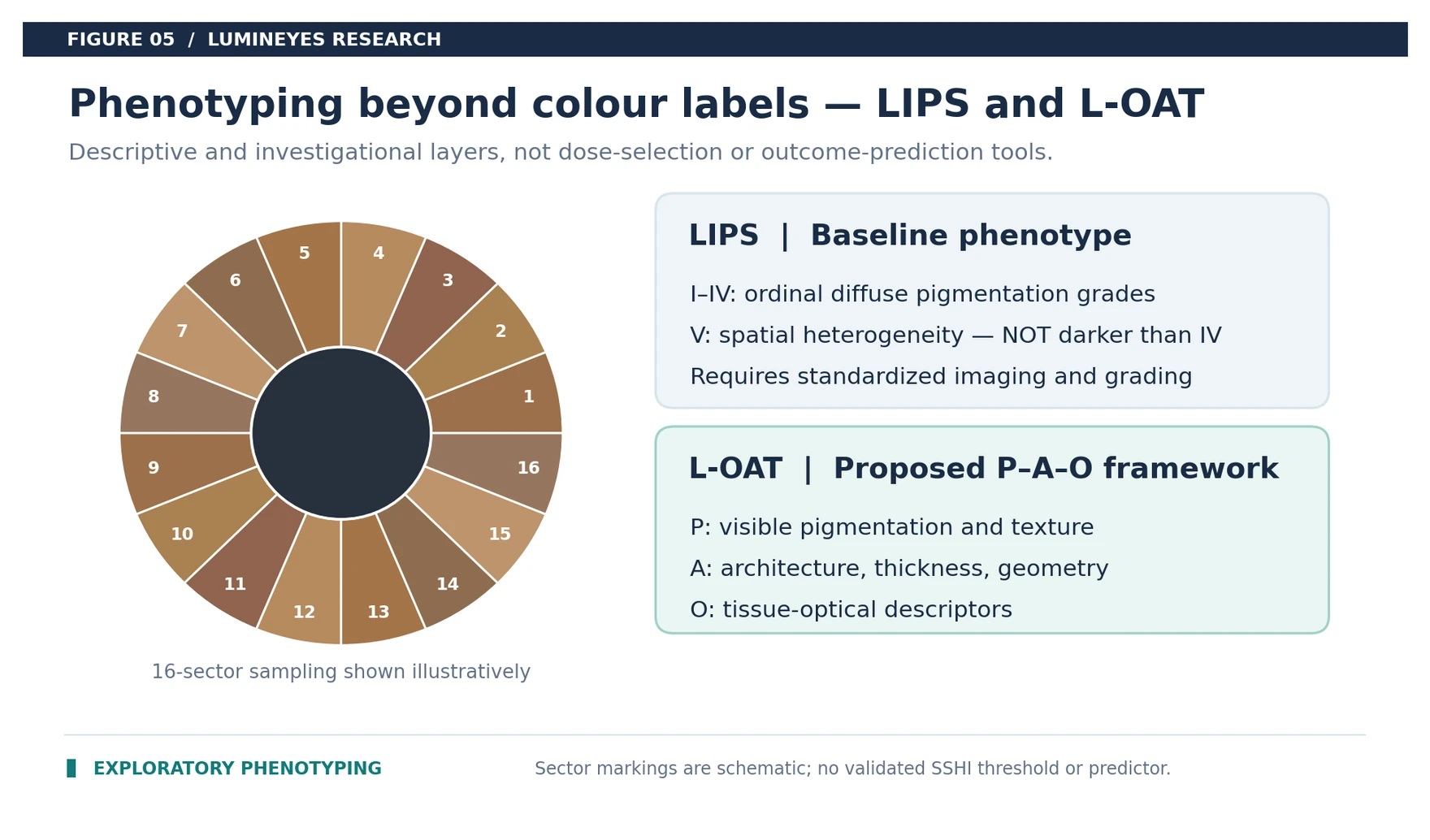
Visible pigment categories are descriptive, not substitutes for anatomy or safety assessment. LIPS grades I–IV describe diffuse appearance; grade V represents a spatially heterogeneous phenotype. Proposed L-OAT descriptors examine pigmentation, architecture and tissue-optical features without supplying independently validated treatment thresholds.
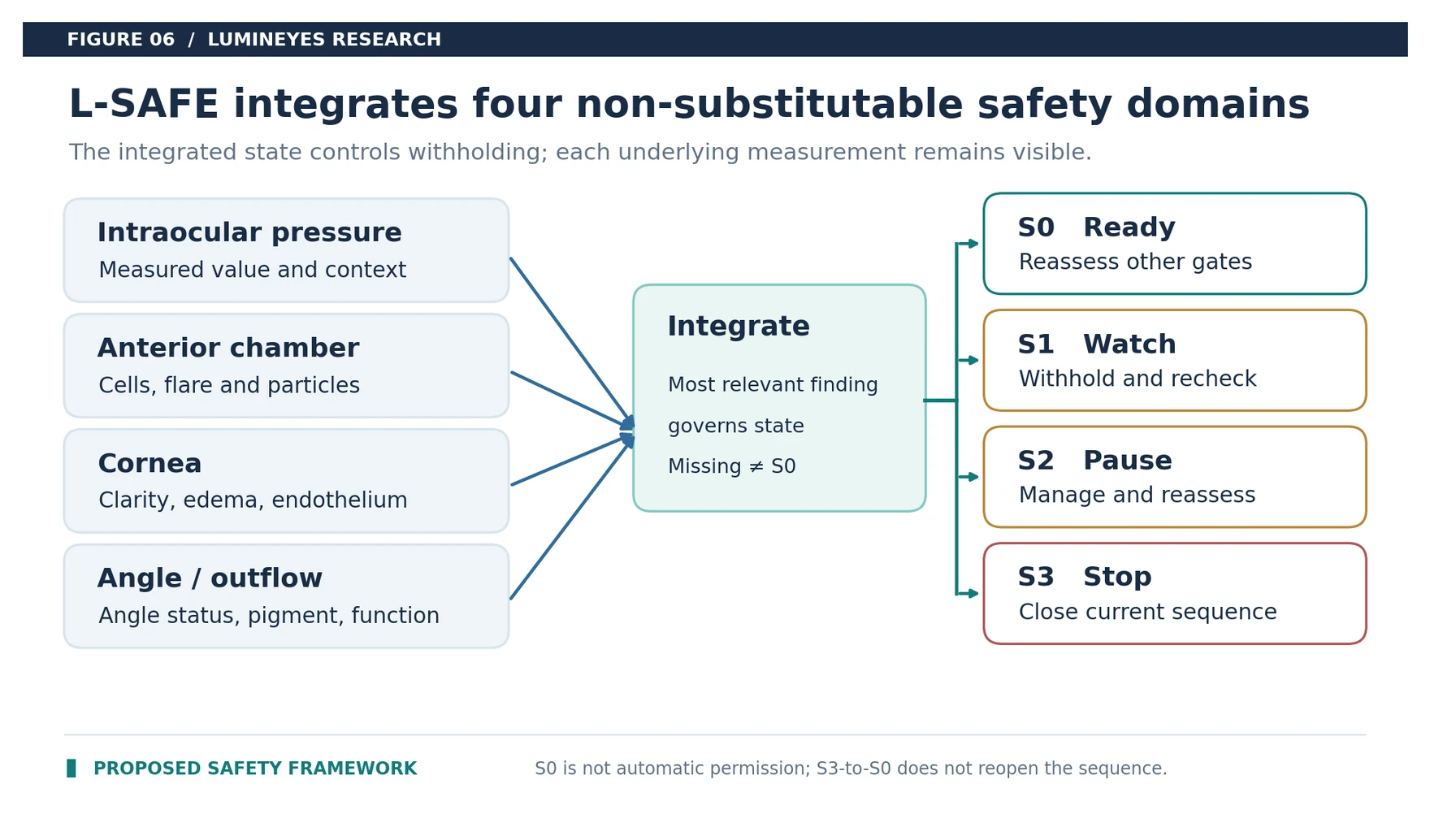
L-SAFE: four measured domains and distinct actions
The proposed L-SAFE framework brings together intraocular pressure, anterior chamber, cornea and angle/outflow findings. S0 indicates readiness for further clinical consideration but does not authorize exposure. S1 and S2 require withholding and reassessment; S3 closes the current treatment-stage sequence. A later S0 reading does not by itself reopen a previously closed sequence.
Longitudinal documentation and scientific questions
The standard calls for separate documentation of pigmentary appearance, sensory symptoms, anterior-segment response, corneal structural findings and ocular physiology. Changes in one domain do not imply a corresponding improvement in another. Repeated measurements with suitable timing and comparators are necessary to assess whether the domains can be meaningfully distinguished.
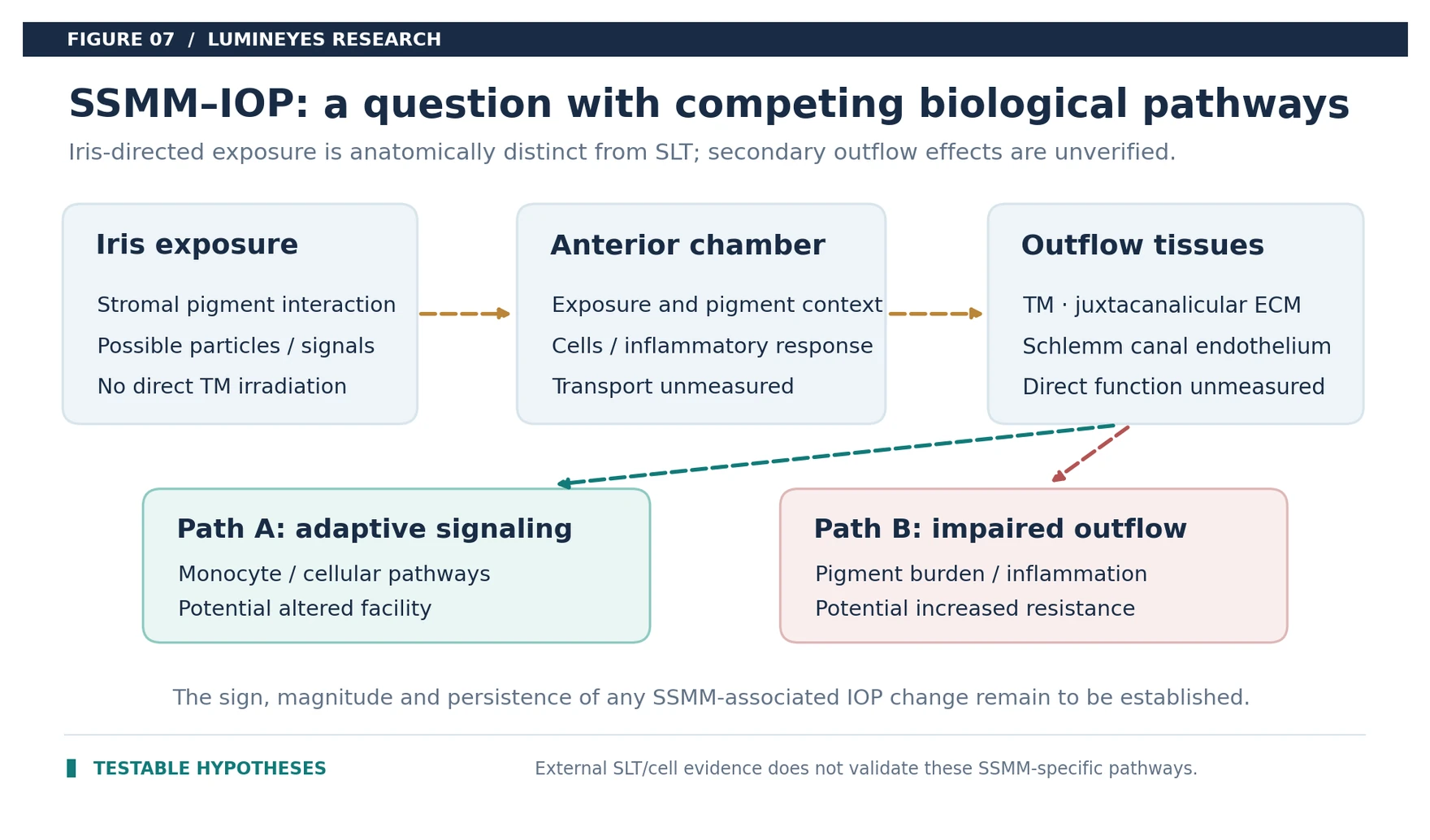
One research branch concerns intraocular pressure and aqueous outflow. Pigment-related burden and potentially adaptive biological signaling are competing pathways; neither a beneficial pressure response nor a harmful pathway can be generalized from the framework. A separately posted SSMM–IOP mechanistic preprint describes testable hypotheses rather than confirmed causal effects.
Read the complete 24-page standard
The complete public reference edition v1.1 is the current source document for this clinical framework. The web page is an explanatory research record and does not supersede the PDF. The public standard is separate from the restricted physician-training materials and controlled operating documents.
Open or download the full PDF · v1.1
Repository version of record: Zenodo DOI 10.5281/zenodo.24280545.
Repository record: Published Clinical Standard v1.1 on Zenodo · DOI: 10.5281/zenodo.24280545. Related methodological paper: An SSMM-Informed Clinical Decision Architecture for Staged Laser Iris Depigmentation (submitted to Preprints.org; under screening; DOI pending).
Related source records and research context
- Selective Stromal Melanin Modulation (SSMM) — research owner page
- L-SAFE — anterior-segment safety staging
- LIPS — clinical iris pigmentation scale
- L-OAT — quantitative iris phenotyping concept
- Lumineyes patient eligibility policy
- Full MyLumineyes Research Library
Scientific source context: Laser Iris Depigmentation for Eye-Color Change (preprint); Long-Term IOP Dynamics After SSMM (preprint). The cited preprints are not peer-reviewed journal publications.