
Early IOP Monitoring Protocol & Post-Laser Ocular Pressure Stability
Selective laser iris depigmentation involves controlled interaction with stromal pigment within the anterior segment. As with other pigment-altering ophthalmic laser procedures, transient intraocular pressure (IOP) changes may occur during the early postoperative period. Understanding these potential changes is an important component of clinical monitoring.
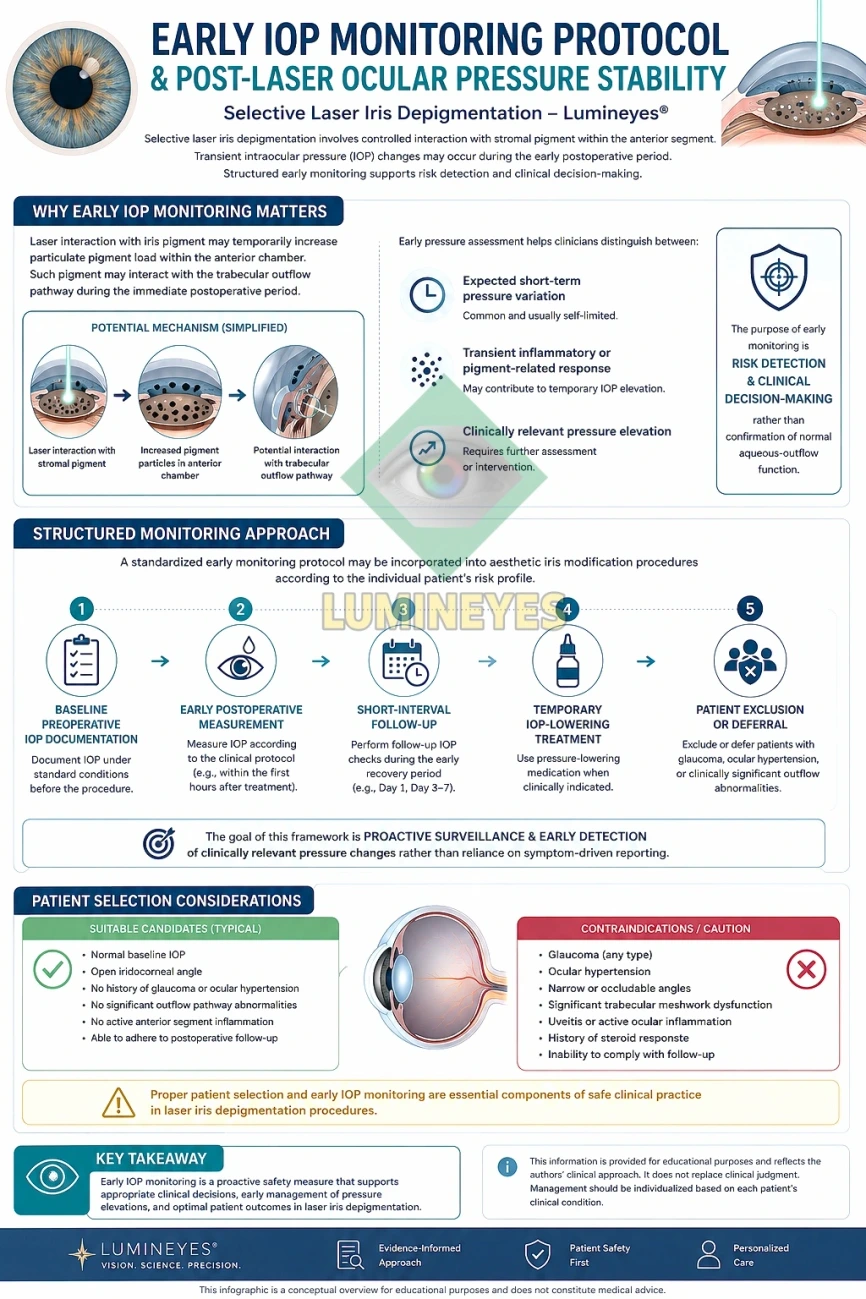
Why Early IOP Monitoring Matters
One aspect of the Lumineyes® laser eye color change procedure is that laser interaction with iris pigment may temporarily increase particulate pigment load within the anterior chamber. Such pigment may interact with the trabecular outflow pathway during the immediate postoperative period. This possibility provides a clinical rationale for structured IOP monitoring rather than relying solely on symptoms.
Early pressure assessment may help clinicians distinguish between:
- Expected short-term pressure variation
- Transient inflammatory or pigment-related response
- Clinically relevant pressure elevation requiring further assessment or intervention
The purpose of early monitoring is therefore risk detection and clinical decision-making, rather than confirmation of normal aqueous-outflow function.
Structured Monitoring Approach
A standardized early monitoring protocol may be incorporated into aesthetic iris modification procedures according to the individual patient’s risk profile. The framework may include:
- Baseline preoperative IOP documentation
- Early postoperative measurement according to the clinical protocol
- Short-interval follow-up during the early recovery period
- Temporary IOP-lowering treatment when clinically indicated
- Exclusion or deferral of patients with glaucoma, ocular hypertension, or clinically significant outflow abnormalities
The goal of this framework is proactive surveillance and early detection of clinically relevant pressure changes rather than reliance on symptom-driven reporting.
Patient Selection Considerations
Careful patient selection is an important component of procedural risk management. Individuals with glaucoma, ocular hypertension, or clinically significant structural abnormalities affecting aqueous outflow require particular consideration and may not be appropriate candidates for pigment-modifying laser procedures.
Postoperative compliance is also important because reliable follow-up permits early detection and management of potential pressure changes.
Clinical Perspective
Early IOP changes, when observed, may occur during the initial postoperative period. The appropriate clinical response depends on the magnitude and persistence of the pressure change, associated ocular findings, and the individual patient’s baseline risk profile.
This framework does not assume that stable IOP proves preservation of the trabecular meshwork or establishes overall ocular safety. Rather, serial IOP measurements provide one objective component of broader postoperative assessment.
Position Within Ongoing Clinical Evaluation
This document outlines an IOP-monitoring framework used within clinical observation. It does not represent a peer-reviewed statistical study and does not provide independent numerical outcome data.
Longitudinal clinical observation and appropriately designed prospective studies are required to further characterize the frequency, magnitude, duration, and clinical significance of IOP changes following laser iris depigmentation.
The MyLumineyes® Perspective on IOP Management
The authors’ clinical experience has led to an emphasis on early IOP assessment as part of the broader safety framework for staged laser iris depigmentation.
Within the Lumineyes® framework, IOP monitoring is considered a clinical decision parameter that may influence whether subsequent treatment is continued, deferred, modified, or discontinued.
The authors do not interpret IOP stability alone as evidence of complete preservation of aqueous-outflow structures, nor as proof of long-term procedural safety.
Medical Review & Fact-Checking
All medical content is reviewed by Dr. Mustafa Mete. Treatment suitability can only be determined following comprehensive ophthalmic examination and individualized clinical assessment.
The Lumineyes™ protocol is presented as the authors’ specific staged approach to laser iris depigmentation. The monitoring principles described on this page represent a clinical framework and should not be interpreted as independent evidence establishing universal safety or efficacy.