Laser Eye Color Change Cost & Risks: A Practical Guide
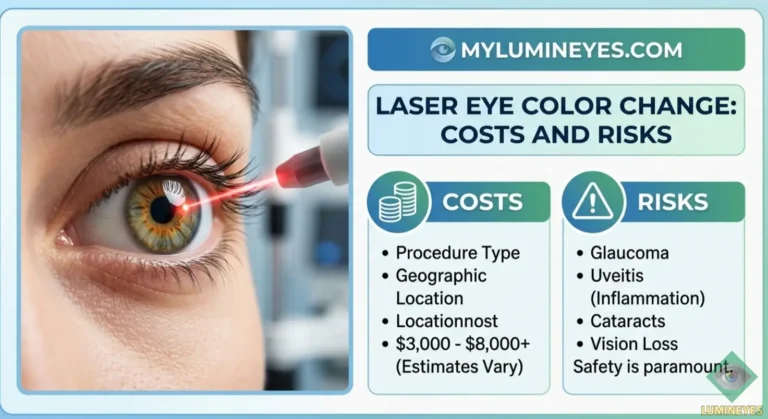
Laser iris depigmentation prices range from €850 to €5,950, according to pricing information supplied by MyLumineyes for this guide. The amount depends on the scope of the quoted treatment and included care. This indicative range is not a statistical market average or a guarantee that every complete treatment course falls within it. Confirm the number of eyes, treatment stages, examinations and follow-up included in an individual quotation.
This guide brings together laser eye color change costs and practical risk considerations: what a quotation covers, how the proposed protocol affects planning, and why clinical monitoring belongs in the budget. For the procedure itself, start with our laser eye color change procedure guide.
Laser Eye Color Change Prices: What Does the Quote Cover?
Before comparing numbers, establish what each price buys. The table below separates the main budget components; it is a quotation checklist rather than a clinic price list. The indicative €850–€5,950 range describes the pricing information supplied for this guide; it should be read alongside the scope of each offer.
| Cost Component | What to Confirm in Writing | Budget Check |
|---|---|---|
| Indicative laser iris depigmentation prices Pricing information supplied by MyLumineyes | Confirm the number of eyes, treatment stages and included assessment and follow-up. Additional care and travel may affect the final total; this is not a MyLumineyes package tariff. | €850–€5,950 |
| Pre-treatment assessment Consultation and indicated examinations | Which examinations are included, whether tests are charged separately and what the assessment fee covers if treatment is not recommended. | Included? |
| Initial laser treatment Per eye, per session or defined course | The exact procedure, one or both eyes, treatment stages covered and the limits of any course-based quotation. | Defined scope? |
| Follow-up and additional care Monitoring, medicines and reassessment | The follow-up period, included visits, medicine costs and whether further sessions or unscheduled care require a separate estimate. | Separate fees? |
| Travel and time away Non-clinical expenses | Accommodation, transport, time away from work and the financial effect of a longer stay or a return visit. | Add to budget |
Initial Treatment Fee vs. Total Treatment Cost
Planning budget = assessment + quoted treatment + separately billed follow-up and medicines + travel and accommodation. Add an allowance for possible extra visits where appropriate. This is a budgeting framework, not a prediction of the number of sessions or a guarantee of the final expense. Count included items only once.
What Affects Laser Iris Depigmentation Cost?
The advertised treatment price may be only one part of the financial commitment. Compare estimates using the same scope, currency and quotation date, and distinguish planned treatment from expenses that might arise later.
- Assessment and suitability: Ask whether an ophthalmic examination, eye pressure measurements and any indicated tests are included. A consultation does not guarantee eligibility for treatment.
- Method, eyes and treatment stages: Confirm that the quotation concerns laser iris depigmentation, whether it covers one or both eyes, and how additional sessions or changes to the plan would be charged.
- Monitoring and later care: Clarify the included follow-up period, medicines, reassessments and arrangements for urgent review or complications. Do not assume all future care is included.
- Travel and practical expenses: Budget separately for transport, accommodation, time away from work and possible return visits. The length of a first stay does not necessarily describe the full follow-up period.
Cost Per Session, Per Eye or Per Treatment Course
A per-session price describes one billing unit. A per-eye price needs to state whether assessment and monitoring are included. A course price needs to define its end point: a specified number of sessions, an initial treatment period or another clearly described scope. The word "complete" is not enough without those details.
For a meaningful comparison, ask each provider to describe the same proposed scope. If additional treatment cannot be estimated in advance, request the charging basis and the circumstances in which a new quotation would be issued. Multiplying a low session fee by an assumed number of sessions can produce a misleading total.
Laser Eye Color Change Cost in Turkey and Abroad
When comparing an estimate in Turkey with one in another country, compare the total journey as well as the clinical fee. Record the quotation currency, date, number of eyes, included care and expected visit schedule. Exchange-rate movements and currency-conversion charges can affect the amount paid; they do not explain differences in clinical scope.
For treatment away from home, clarify where later examinations will take place, who receives the clinical records and which costs remain your responsibility if an extra visit is needed. A shorter initial stay does not establish a lower total cost. Geographic location or a higher fee alone does not demonstrate better care.
How to Compare Two Treatment Estimates
- Match the procedure: Check that both estimates concern laser iris depigmentation rather than keratopigmentation or iris implantation.
- Match the billing unit: Compare the same number of eyes and clearly defined treatment stages.
- Separate included and excluded care: List examinations, medicines and follow-up beside each estimate, rather than comparing headline fees alone.
- Identify uncertain expenses: Record how further sessions, a revised plan, urgent examinations and return visits would be charged.
- Keep a dated written record: Confirm the currency, quotation validity and what happens financially if assessment finds treatment unsuitable or the plan changes.
Illustrative comparison: A quote that excludes assessment and later visits may have a lower headline fee than one that includes them. Compare the sum of the specified items before deciding which has the lower planned cost. Neither billing structure guarantees a particular eye color or eliminates medical risk.
Cost and Risk: What Should Be Evaluated Together?
A treatment quote and a clinical risk discussion answer different questions, but both should describe the same proposed care. Ask which assessments are performed before treatment, what is checked between stages and who provides follow-up. A lower headline price is not evidence of greater risk; a higher price is not proof of better outcomes.
For budgeting, the relevant uncertainties include changes to the treatment plan, additional examinations and possible later care. These are matters to clarify before treatment, not predictions that every patient will experience a complication. A quoted course should not be interpreted as a promise of a particular final shade or an obligation to complete further sessions regardless of clinical findings.
Lumineyes and Other Laser Iris Depigmentation Protocols
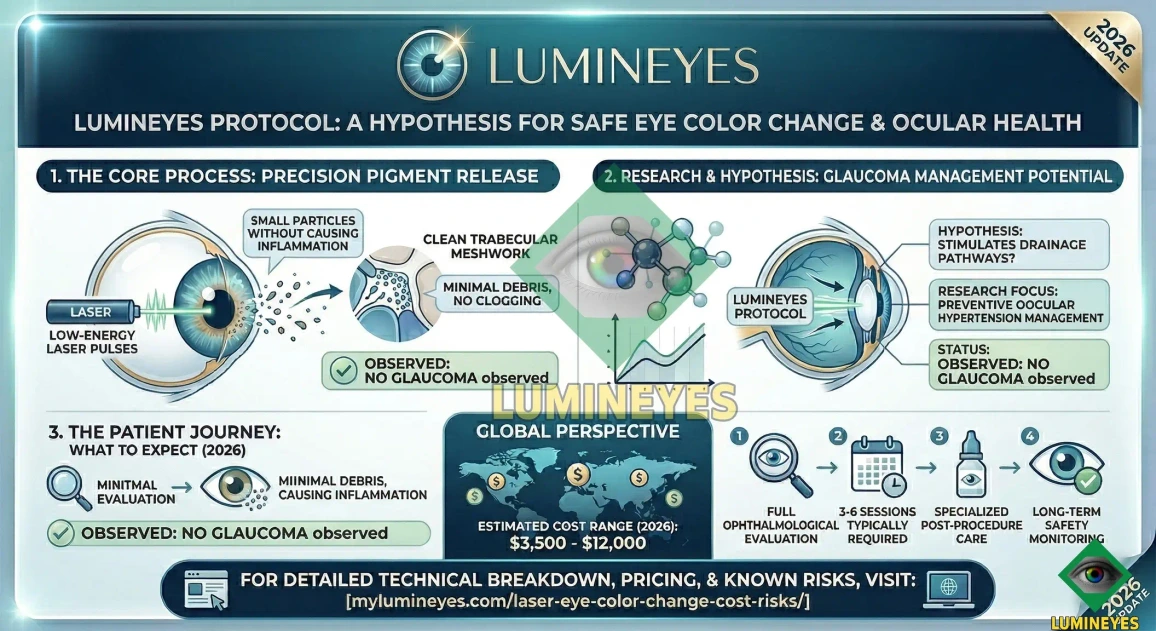
Laser iris depigmentation (LID) is a broad procedure category; Lumineyes is a named approach within it. The category does not identify a single device, treatment setting or follow-up schedule. The laser platform, delivery parameters, patient selection, session spacing and monitoring need to be considered before comparing outcomes or prices.
The Lumineyes procedure guide describes assessment-led planning and staged treatment. These descriptions identify the approach used by the practice; they do not by themselves establish a comparative complication rate. A complication reported after a different or incompletely documented LID procedure should not automatically be labelled a Lumineyes complication.
How Should Published Complication Reports Be Interpreted?
Individual case reports can identify possible harm, but they do not provide a treated-population denominator from which to calculate how often an event occurs. They also cannot establish a Lumineyes-specific rate unless the treatment is identified and sufficiently documented. This distinction supports proportionate discussion: reported events deserve clinical attention without being presented as the expected outcome of every laser protocol.
The P-CLEAR pigment release–clearance framework examines how treatment-related pigment release and biological clearance interact over time. It distinguishes pigment release from persistent pigment burden and emphasizes serial assessment of pigment, inflammation, intraocular pressure and outflow-related findings rather than elapsed time alone. P-CLEAR is a proposed research framework; it does not establish complication rates or comparative safety. Individual treatment decisions require ophthalmic assessment of the proposed protocol and the eye’s response between stages.
Why KTP, Iris Implant and Laser Quotes Are Different
Keratopigmentation (KTP) introduces pigment into the cornea; cosmetic iris implantation places an implant inside the eye; laser iris depigmentation acts on iris pigment. Their anatomical targets and care requirements differ. A price comparison should therefore identify the actual procedure rather than group every offer under "eye color change surgery."
These distinctions are covered in our eye color change surgery methods and clinical risks guide. The Cleveland Clinic overview provides additional clinical context. Risks associated with KTP or an iris implant should not be transferred to laser depigmentation simply because all three can alter eye appearance.
- Procedure and treatment stages: See the laser eye color change procedure guide.
- Detailed clinical safety and monitoring: See the Eye Color Change Safety guide.
Laser Eye Color Change Cost & Risk Questions
How much does laser iris depigmentation cost?
Pricing information supplied by MyLumineyes for this guide gives an indicative range of €850–€5,950. This is not a statistical market average or a guarantee of the complete treatment cost. Confirm the number of eyes, treatment stages, examinations and follow-up included in the quotation.
Does the quoted price cover both eyes and all sessions?
Only if the written quotation explicitly says so. Confirm whether the fee is per eye, per session or for a defined course, how many stages are covered and whether further treatment requires a separate quotation.
Does a complication reported after another LID procedure establish the risk of Lumineyes?
No. A report about another or incompletely documented laser iris depigmentation procedure does not establish a Lumineyes-specific complication rate. Interpreting relevance requires the protocol, treatment parameters, patient findings and follow-up. Case reports identify possible harm but cannot determine population incidence.
Does a higher treatment price mean lower risk?
Price alone cannot establish the risk or effectiveness of a treatment. Compare the proposed procedure, assessment, monitoring, follow-up arrangements and relevant clinical evidence alongside the fee. A more expensive course does not guarantee a particular color or eliminate medical risk.
Evidence note (16 October 2026): The indicative €850–€5,950 price range was supplied by MyLumineyes for this guide and has not been independently audited as a market-wide range. It is not a statistical average, a package offer or a ceiling on all future expenses. Clinical risk information is linked to its source. Individual suitability, treatment scope and total costs require assessment and a written quotation.