Off-Label Use in Laser Eye Color Change: Clinical Context and Safety Boundaries
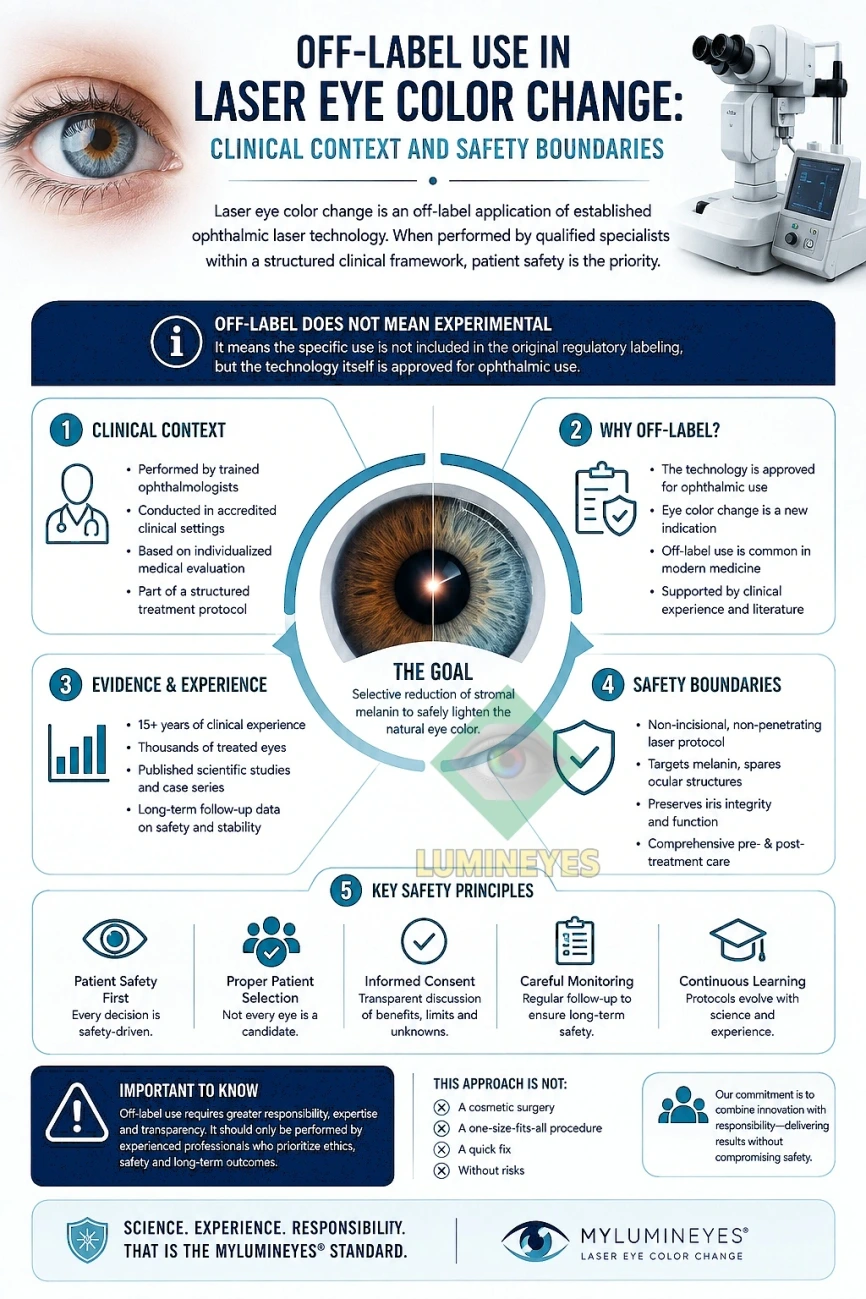
Laser eye color change using laser-based iris depigmentation represents an off-label clinical application of ophthalmic laser technology. In this context, off-label use means that an established medical device or technology is being used for a clinical purpose that falls outside the specific indication described in its regulatory labeling.
Off-label use is a recognized part of medical practice in many fields, including ophthalmology. However, the term describes the regulatory context of a particular use; it does not, by itself, establish that the specific application has been evaluated or approved for safety and effectiveness by a regulatory authority. Clinical judgment, patient selection, informed consent, available evidence, treatment methodology, and appropriate follow-up therefore remain essential.
Understanding Off-Label Application in Ophthalmic Lasers
In ophthalmology, a distinction should be made between the regulatory indication of a device and the clinical purpose for which a physician may use it. An ophthalmic laser may have an established regulatory indication while a particular application of that technology remains outside the labeled indication.
For laser-based iris depigmentation, the intended biological target is pigmentation within the iris stroma. The clinical application therefore depends not simply on the identity of the laser system, but on how the technology is selected, configured, and applied by the treating physician.
The use of iris depigmentation also requires consideration of treatment parameters, tissue response, pigment clearance, patient-specific anatomy, and postoperative monitoring.
Off-label status describes the regulatory context; it does not constitute evidence of clinical safety or effectiveness. Those questions must be evaluated separately through clinical evidence, patient selection, treatment methodology, documented outcomes, adverse-event monitoring, and longitudinal follow-up.
Off-Label Use Does Not Replace Clinical Responsibility
The fact that a medical device is established for ophthalmic use does not automatically establish the safety or effectiveness of every possible application of that device. The specific clinical indication, treatment objective, tissue target, treatment parameters, and patient population must be considered separately.
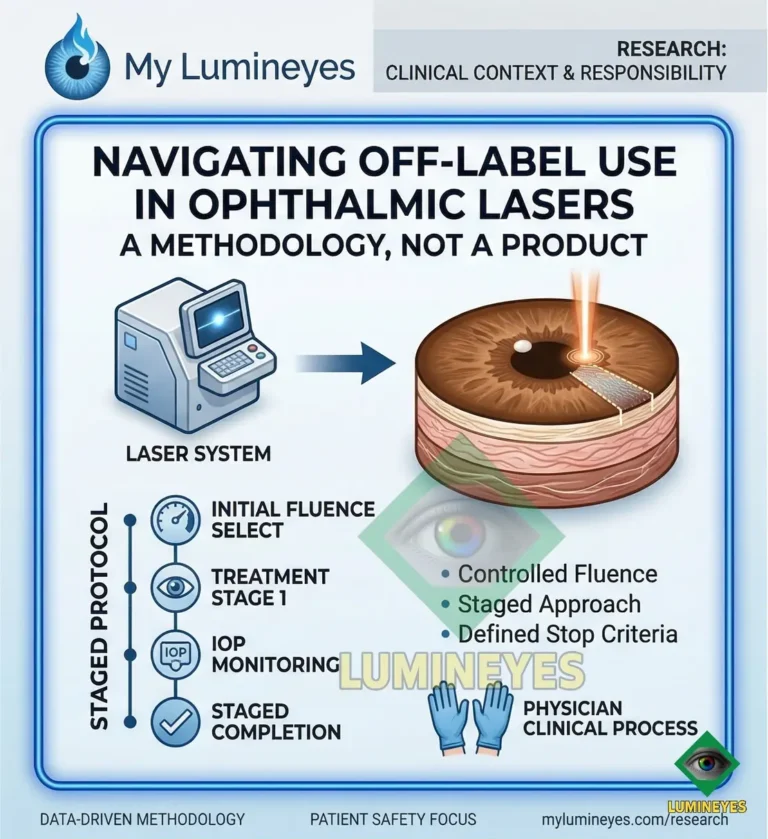
For this reason, an off-label ophthalmic procedure should be understood as a physician-dependent clinical process. The treating physician remains responsible for determining whether the procedure is appropriate for an individual patient, explaining the known and uncertain aspects of treatment, obtaining appropriate informed consent, and providing clinically appropriate follow-up.
Off-label does not mean that a procedure is necessarily experimental, prohibited, or unsafe. Conversely, off-label status should not be presented as proof that a specific procedure is safe or effective. The evidence supporting the particular clinical application must be evaluated independently.
Protocol-Dependent Safety
The clinical safety of laser iris depigmentation cannot reasonably be attributed to the laser hardware alone. It depends on the interaction between the device, treatment parameters, biological target, patient characteristics, treatment strategy, and postoperative monitoring.
Relevant clinical considerations may include:
- Fluence and Spot Size: Selection of laser parameters appropriate to the intended tissue target and treatment strategy, while limiting unnecessary energy exposure to surrounding structures.
- Pulse Characteristics: Appropriate consideration of pulse duration, radiant exposure, repetition, and other laser parameters relevant to the intended tissue interaction.
- Staged Treatment Planning: Where clinically appropriate, treatment may be planned in stages so that tissue response and pigment clearance can be assessed over time rather than assuming that the complete biological response occurs immediately.
- Intraocular Pressure Monitoring: Assessment of intraocular pressure when clinically indicated, particularly because liberated pigment may interact with aqueous outflow pathways.
- Individual Tissue Response: Treatment decisions should take account of patient-specific anatomy and the observed biological response rather than relying exclusively on predetermined numerical parameters.
- Longitudinal Follow-Up: Follow-up beyond the immediate postoperative period is important when evaluating the durability and safety of an off-label ophthalmic application.
Selective Photothermolysis and Tissue Targeting
The clinical concept underlying laser-based iris depigmentation involves controlled interaction between laser energy and pigmented tissue. The relevant treatment strategy therefore depends on factors such as wavelength, pulse characteristics, radiant exposure, spot size, tissue optical properties, and the desired biological response.
These parameters should not be interpreted as universally interchangeable or as establishing a single standardized protocol for every patient. Laser treatment is inherently dependent on the characteristics of the target tissue and the clinical judgment of the treating physician.
The available clinical evidence and longitudinal observations concerning the Lumineyes approach are presented separately in the Lumineyes clinical safety and research documentation.
What Should Be Evaluated in an Off-Label Ophthalmic Procedure?
Evaluating an off-label ophthalmic application requires more than confirming that the underlying device is an established medical technology. Several independent questions should be considered.
| Clinical consideration | Why it matters |
|---|---|
| Patient Selection | The patient's ocular history, examination findings, anatomy, and potential risk factors should be considered before treatment. |
| Treatment Methodology | The clinical protocol determines how the device is applied to the intended biological target. |
| Treatment Parameters | Laser parameters should be selected according to the intended tissue interaction and individual clinical circumstances. |
| Pigment Response and Clearance | The biological response may continue after treatment, making observation over time an important component of clinical assessment. |
| Intraocular Pressure | IOP monitoring may be clinically relevant because pigment release can interact with aqueous outflow pathways. |
| Long-Term Follow-Up | Longitudinal observation provides information that cannot be obtained from immediate postoperative findings alone. |
| Adverse-Event Monitoring | Potential complications and unexpected findings should be documented and evaluated rather than assuming that absence of an immediate problem establishes long-term safety. |
The Necessity of Clinical Judgment
An off-label ophthalmic application requires individualized clinical decision-making. The physician must determine whether the potential benefits of the procedure are appropriate for the individual patient and whether the known, potential, and uncertain risks have been adequately considered.
This includes appropriate ophthalmic assessment before treatment, informed consent, selection of suitable treatment parameters, recognition of contraindications or risk factors, and postoperative evaluation.
For laser iris depigmentation, the clinical process should also recognize that pigment clearance is a biological process that may continue over time. The visible result and the biological response should therefore not be evaluated solely on the basis of the immediate post-treatment appearance.
Longitudinal Clinical Follow-Up
Long-term follow-up is particularly important when evaluating an off-label application because immediate procedural tolerance does not answer every question concerning durability or delayed effects.
Depending on the clinical circumstances, ophthalmic follow-up may include assessment of visual function, intraocular pressure, anterior segment findings, inflammatory response, and other examinations considered appropriate by the treating physician.
Advanced imaging and objective testing may also be used when clinically indicated. Such examinations can contribute to longitudinal monitoring, but no single imaging modality should be presented as independently proving the absence of every possible long-term complication.
The principle is straightforward: longitudinal evidence should be accumulated through repeated clinical observation rather than inferred from a single postoperative examination.
Further discussion of biological clearance and long-term observation is available in the biological permanence and laser eye color change research documentation.
Clinical Evidence and the Limits of Off-Label Claims
The strength of an off-label clinical application should be assessed according to the quality and transparency of its evidence. Published literature, clinical datasets, follow-up duration, patient numbers, adverse-event reporting, study design, independent evaluation, and reproducibility all influence how confidently clinical conclusions can be drawn.
A case report, a small case series, a retrospective clinical dataset, and a prospective controlled study do not provide the same level of evidence. Similarly, accumulated clinical experience can provide valuable information while still having limitations that should be acknowledged.
For this reason, clinical experience should be presented together with its methodological limitations rather than being described as equivalent to prospective randomized evidence.
Clinical experience can contribute to the evaluation of an off-label procedure, but the duration, size, design, completeness, and independence of the available evidence should always be considered when interpreting safety and effectiveness claims.
Off-Label Use and Informed Consent
When an ophthalmic procedure is performed for an off-label indication, patients should understand the distinction between the regulatory indication of the underlying technology and the specific clinical purpose for which it is being considered.
Informed consent should address the intended cosmetic or clinical objective, the available evidence, known risks, potential risks, relevant alternatives, limitations of current knowledge, and the nature of postoperative follow-up.
The purpose of informed consent is not simply to document agreement to treatment. It is to ensure that the patient understands the relevant clinical context and can make an informed decision based on the available information.
Regulatory Context and Physician Responsibility
Regulatory approval or clearance generally relates to a device's specified intended use. The regulatory status of a device should therefore be distinguished from the clinical decision to use that technology for another purpose.
In the United States, the FDA regulates medical devices and evaluates them in relation to particular uses, while the practice of medicine itself remains within the professional and legal framework governing physicians. FDA materials also distinguish the regulatory status of a device from the clinical practice of medicine.
For this reason, the presence of an off-label indication should not be interpreted as a regulatory endorsement of that specific application. At the same time, the term "off-label" should not automatically be interpreted as meaning that a physician is using an unauthorized device.
For general regulatory information, see the U.S. Food and Drug Administration's overview of medical-device regulation .
Clinical Safety Boundaries
A responsible discussion of off-label ophthalmic treatment should acknowledge both what is known and what remains uncertain. No clinical procedure should be presented as risk-free, and no individual patient's outcome can be guaranteed solely on the basis of previously observed results.
For laser eye color change, clinically relevant safety considerations include appropriate patient selection, controlled treatment methodology, monitoring of intraocular pressure when indicated, assessment of ocular inflammation or other adverse findings, and appropriate long-term follow-up.
These principles also distinguish a physician-supervised clinical framework from cosmetic approaches in which pigment is permanently introduced into the cornea or an artificial implant is placed inside the eye.
A detailed comparison of available approaches to eye color change is provided in our clinical comparison of eye color change methods.
Why the Regulatory Context Should Be Explained Clearly
Patients considering an off-label ophthalmic procedure should not have to infer the regulatory status of a treatment from marketing language. Clear communication should identify what the underlying device is approved or cleared for, what the proposed clinical application is, what evidence is available for that application, and where limitations in the evidence remain.
This distinction allows patients and physicians to evaluate an off-label procedure on the basis of its actual clinical context rather than treating the regulatory label alone as either proof of safety or proof of danger.
Clinical Perspective
Laser eye color change represents a specialized application of ophthalmic laser technology. Because the cosmetic indication is distinct from the original regulatory indication of the underlying laser system, the procedure should be evaluated within an appropriate off-label clinical framework.
The central issue is therefore not simply whether a procedure is described as "off-label." The more important questions are: What is the biological target? What is the treatment methodology? What evidence supports the application? How are patients selected? What risks are monitored? And how long are patients followed?
These questions provide a more meaningful framework for evaluating the clinical safety and limitations of an off-label ophthalmic procedure.
Frequently Asked Questions
What does off-label use mean in laser eye color change?
Off-label use means that an established medical device or technology is being used for a clinical purpose outside the specific indication described in its regulatory labeling. The term describes the regulatory context of the use and does not, by itself, establish either safety or effectiveness for that specific application.
Does off-label mean that a procedure is experimental?
Not necessarily. Off-label use and experimental treatment are not synonymous. However, an off-label application should still be evaluated according to the quality and limitations of the available clinical evidence rather than assuming that the regulatory status of the underlying device establishes safety or effectiveness for the new application.
Does off-label use mean that the laser device is unapproved?
No. A device may be legally marketed for an established indication while a particular clinical application of that device is outside its labeled indication. The regulatory status of the device and the indication for which it is being used should therefore be considered separately.
Who is responsible for an off-label ophthalmic treatment?
The treating physician is responsible for the clinical decision to use a technology for an individual patient, including patient selection, clinical judgment, informed consent, treatment planning, and appropriate follow-up within the applicable professional and legal framework.
Does off-label use prove that laser eye color change is safe?
No. Off-label status is neither proof of safety nor proof of harm. Safety and effectiveness should be evaluated using the evidence available for the specific clinical application, including treatment methodology, documented outcomes, adverse-event monitoring, and longitudinal follow-up.
Why is long-term follow-up important?
Immediate postoperative findings cannot answer every question concerning durability or delayed effects. Longitudinal follow-up allows clinicians to monitor outcomes over time and to identify findings that may not be apparent during the early postoperative period.
Is laser eye color change the same as corneal tattooing?
No. They involve different anatomical targets. Laser iris depigmentation is intended to modify pigmentation within the iris, whereas keratopigmentation places pigment within the cornea to create a visible change in apparent eye color. The anatomical and optical implications are therefore different.
Where can I review the available clinical data?
The available Lumineyes clinical and research documentation is presented in the Lumineyes clinical safety and research documentation, including information concerning clinical experience, follow-up, reported outcomes, and limitations of the current evidence.
This page is provided for general educational and informational purposes and is not intended to constitute individualized medical advice, diagnosis, treatment recommendations, or a guarantee of outcome.
The term off-label describes the regulatory context of a particular clinical use. It should not be interpreted as a statement that a procedure is inherently safe, unsafe, experimental, approved, or prohibited. Regulatory requirements and professional standards may vary by jurisdiction.
Patients considering laser eye color change should undergo an appropriate ophthalmic evaluation and discuss the potential benefits, risks, alternatives, uncertainties, and expected follow-up with a qualified ophthalmologist before treatment.
Clinical information presented on this page should not be interpreted as establishing that every patient is an appropriate candidate or that a particular outcome can be guaranteed.