Medical Reference Page

Eye Color Change & Laser Ophthalmology Glossary

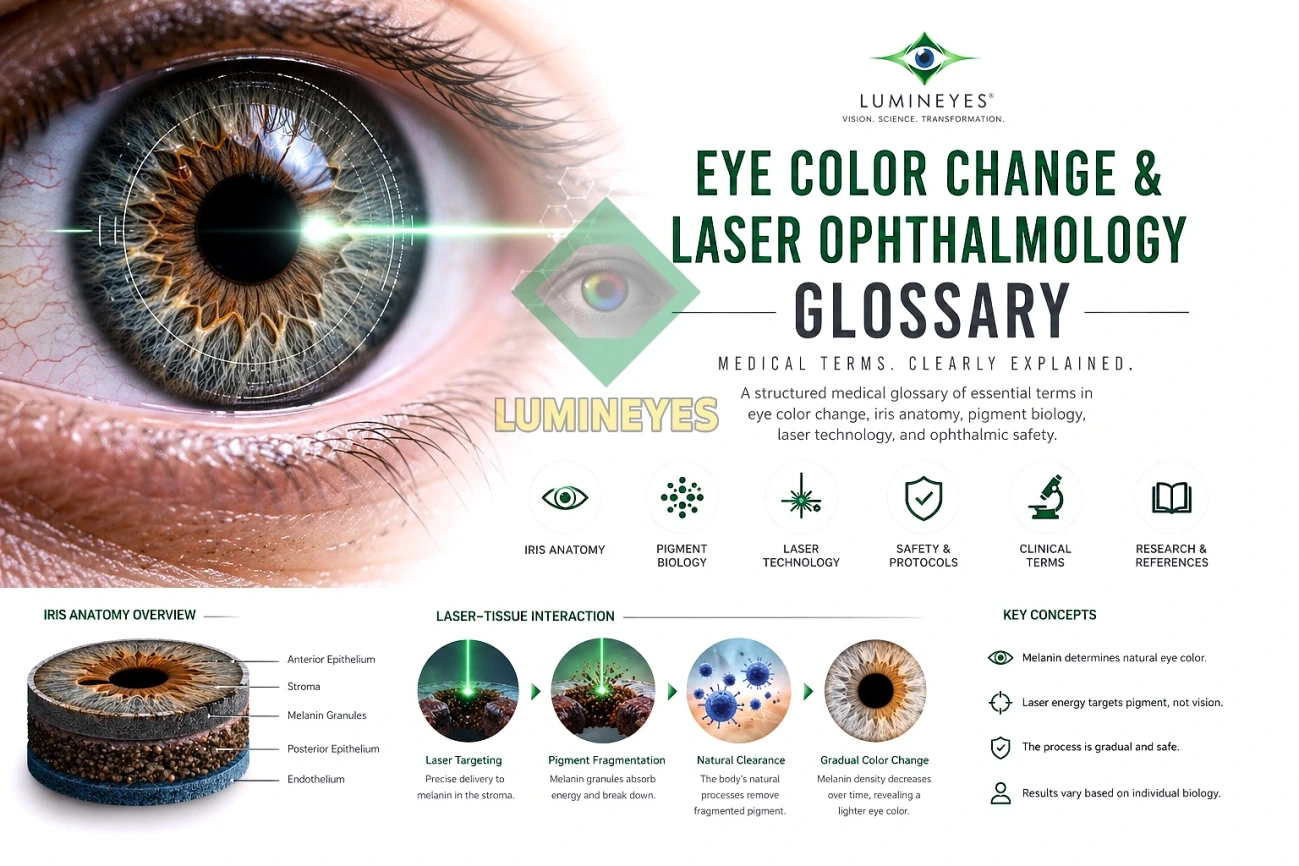
This glossary explains the core terms used in eye color change, iris anatomy, pigment biology, laser–tissue interaction, and ophthalmic safety monitoring. It is written as a structured educational reference for patients, researchers, and clinicians seeking clear, non-promotional medical language.

A B C D E F G I K L M O P R S T U V
No matching term was found. Try a broader word such as iris, melanin, pressure, or laser.
A

Anterior Chamber

The fluid-filled space between the cornea and the iris. It is clinically relevant because pigment movement and intraocular pressure dynamics are partly assessed through this compartment.

Anterior Segment

The front portion of the eye, including the cornea, iris, anterior chamber, and lens. It is the main region examined before and after laser-based eye color procedures.

Angle (Iridocorneal Angle)

The drainage region where aqueous humor exits the eye. Its anatomy is directly relevant to glaucoma risk and pressure monitoring in pigment-related procedures.

Aqueous Humor

The clear intraocular fluid that nourishes ocular tissues and helps maintain normal eye pressure. Its circulation is central to pressure balance and drainage function.

Atrophy

Loss or thinning of tissue. In iris discussions, this term may refer to structural weakening or damage and must be distinguished from controlled superficial pigment reduction.

B

Baseline Evaluation

The pre-procedure clinical assessment used to document the eye’s starting condition. It commonly includes slit-lamp examination, iris analysis, and pressure measurement.

Biocompatibility

The ability of a material or intervention to remain compatible with living tissue without causing unacceptable biological reactions. This is often discussed when comparing laser methods with implants or pigments.

Biological Clearance

The natural process through which fragmented pigment is gradually removed by ocular and immune mechanisms after selective laser interaction.

Brown Eye Color

A visible eye color largely determined by the density and distribution of melanin in the iris. Darker brown irides usually contain greater pigment load and may require more conservative staging.

C

Cellular Selectivity

A principle describing how laser energy may interact more strongly with a selected target such as pigment while minimizing effect on surrounding tissue.

Chromophore

A substance that absorbs light at specific wavelengths. Melanin is the principal chromophore involved in laser-based eye color modulation.

Clinical Follow-Up

The scheduled post-procedure monitoring period during which the eye is reassessed for pressure behavior, inflammation, pigment response, and overall structural stability.

Conservative Energy Planning

A safety-first treatment strategy in which laser settings and treatment burden are kept within cautious limits rather than pushing for rapid cosmetic change.

Cornea

The transparent front layer of the eye. Although it is not the target in iris depigmentation, it must remain healthy and unaffected throughout treatment and recovery.

Cumulative Effect

The gradual overall result produced over multiple sessions rather than a single aggressive intervention. This concept is central to staged pigment reduction.

D

Defined Pause Criteria

Pre-established clinical reasons to stop, delay, or extend the interval between sessions. These rules help prioritize safety over speed.

Depigmentation

Reduction of pigment within a tissue. In iris medicine, the term usually refers to controlled melanin reduction rather than the addition of cosmetic color.

Drainage Pathway

The anatomical route through which aqueous humor exits the eye. Efficient drainage is essential for maintaining normal intraocular pressure.

E

Eligibility Criteria

The medical and practical standards used to determine whether a patient is suitable for treatment. These may include iris structure, pigment density, ocular history, and compliance expectations. A more detailed clinical overview is available in our eye color change patient eligibility page.

Energy Density

The amount of laser energy delivered over a defined area. Careful control of energy density is essential to reduce unnecessary tissue stress.

Extracellular Melanin

Pigment located outside living cells or within superficial extracellular spaces. Some clinical models suggest that selective interaction with superficial extracellular pigment may help preserve deeper tissue.

Eye Color Change

A broad term referring to any method intended to alter visible iris appearance. Not all methods are medically equivalent, and their mechanisms and risks differ significantly. For a structured clinical overview, see Laser eye color change.

F

Fibrosis

Abnormal scar-like tissue response. In anterior segment medicine, the goal is always to avoid interventions that increase the risk of fibrosis or permanent structural change.

Fluence

A laser parameter describing energy delivered per unit area. It helps determine how strongly pigment absorbs the treatment energy.

Follow-Up Interval

The time between examinations or treatment sessions. Longer intervals may be necessary to evaluate pigment clearance and pressure stability properly.

G

Glaucoma

A group of eye diseases usually associated with optic nerve damage, often related to pressure or drainage dysfunction. It is one of the major safety concerns in pigment-related interventions.

Gonioscopy

A clinical examination used to inspect the drainage angle of the eye. It helps assess whether anatomy or pigment burden may influence pressure regulation.

Grade of Pigmentation

A descriptive way of classifying how much pigment is present in the iris. Heavily pigmented eyes usually require slower progression and more conservative planning.

Green Eye Color

A visible color pattern generally produced by lower melanin density combined with stromal light scattering. It is not simply a painted surface effect.

I

Immune Clearance

The contribution of the immune system to the removal of released pigment particles after treatment. This partly explains why visible color change may take time.

Implant

A foreign device inserted into the eye. In cosmetic eye color discussions, implants are fundamentally different from laser depigmentation and carry a different risk profile.

Inflammation

The biological response of tissue to stress or injury. Mild temporary inflammation may occur after eye procedures, but persistent or uncontrolled inflammation requires careful evaluation.

Informed Consent

The process through which a patient receives and understands the limitations, risks, uncertainties, and alternatives of a procedure before agreeing to treatment.

Intraocular Pressure (IOP)

The pressure inside the eye. It is one of the most important measurements in follow-up because pigment movement and drainage behavior can influence it.

Iris

The colored circular structure of the eye that regulates the amount of light entering through the pupil. Its pigment content determines much of visible eye color.

Iris Anatomy

The structural organization of the iris, including the anterior border layer, stroma, blood vessels, muscles, and posterior pigment epithelium. Understanding this anatomy is essential in any color-change discussion.

Iris Crypts

Natural openings or depressions in the anterior iris surface. They are part of normal iris topography and do not by themselves indicate pathology.

Iris Depigmentation

A term used for controlled reduction of iris pigment. It generally refers to a biological pigment-removal process rather than an additive cosmetic technique. For the core concept, see laser iris depigmentation.

Iris Pigment Epithelium

The dark posterior layer of the iris that should remain untouched in superficial treatment concepts. Protecting deeper layers is a major safety principle.

Iris Stroma

The connective tissue framework of the iris containing vessels, structural fibers, and pigment distribution. Preserving stromal integrity is central to safety-oriented treatment philosophy.

K

Keratopigmentation

A corneal color-altering method in which pigment is placed within the cornea rather than the iris. It belongs to a different clinical category and should not be confused with iris depigmentation.

L

Laser–Tissue Interaction

The way laser energy is absorbed, scattered, or converted into biological effect within ocular tissue. Safe treatment depends on predictable and controlled interaction.

Light Scattering

The optical phenomenon in which light disperses through tissue. In lighter irides, stromal scattering contributes significantly to visible color appearance.

Long-Term Stability

The sustained preservation of structural health and pressure balance over time after treatment. In medical frameworks, long-term stability matters more than rapid cosmetic change. Related discussion can also be found on our permanent eye color change page.

M

Macrophage Clearance

A biological process in which macrophages help remove released pigment debris after laser interaction. This contributes to the gradual character of visible shade transition.

Medical Monitoring

The structured follow-up process used to assess healing, pressure behavior, pigment response, and early warning signs after treatment.

Melanin

The pigment primarily responsible for brown eye color. Variations in melanin amount, depth, and distribution strongly influence visible iris appearance.

Melanin Density

The relative concentration of pigment within the iris. Higher density usually means darker eyes and may require more sessions and slower progression.

Microparticles

Tiny released pigment fragments that may appear during biological clearance. Their safe handling by the drainage system and immune response is part of follow-up evaluation.

Mid-Dilated Pupil

A pupil size larger than normal but not fully dilated. Unusual pupil behavior after a procedure should always be assessed with proper clinical context.

O

Ocular Hypertension

Higher-than-normal intraocular pressure without definite glaucomatous damage. It is important because pigment-related procedures may temporarily affect pressure dynamics.

Ocular Surface

The exposed front surface of the eye, including the cornea and conjunctiva. It is examined during recovery to confirm overall comfort and tissue health.

Off-Label Use

The use of an approved device or treatment approach in a manner different from its original labeled indication. Off-label use is not automatically improper, but it requires strong clinical judgment and informed consent.

Optic Nerve

The structure that transmits visual signals from the eye to the brain. It becomes especially relevant when pressure-related safety is discussed.

P

Patient Selection

The process of deciding who should or should not undergo a procedure. In elective eye color treatment, selection standards are a major part of risk control.

Pigment Dispersion

The release and movement of pigment particles within the anterior segment. Depending on amount and timing, it may influence pressure and follow-up strategy.

Pigment Load

The total burden of pigment present in the iris or released during treatment. Greater pigment load usually requires more conservative staging and closer monitoring.

Pigment Reduction

The gradual decrease in visible or measurable melanin within the iris after treatment. This process is typically progressive rather than instant.

Pigment Release Kinetics

The timing and pattern by which pigment is disrupted and then cleared after laser exposure. Understanding this helps explain why results vary in speed. A deeper review is available in pigment release kinetics.

Plateau

A point at which further sessions are unlikely to produce meaningful benefit or where safety considerations favor stopping. A defined plateau helps prevent overtreatment.

Predictability

The degree to which treatment response can be estimated in advance. In eye color medicine, predictability depends on pigment density, anatomy, and patient-specific biological variation.

Pressure Spike

A temporary rise in intraocular pressure. Early pressure spikes are clinically important because they may require treatment or closer observation.

Pupil

The central opening in the iris that allows light to enter the eye. Its size changes through muscular control in response to light and physiological stimuli.

Pupillary Function

The ability of the pupil to constrict and dilate normally. Preserving normal pupillary behavior is an important safety objective.

Pulse Duration

The length of time a laser pulse lasts. Pulse duration influences how energy is delivered and how tissue responds to exposure.

R

Real-World Clinical Data

Outcome information collected from routine practice rather than strictly controlled experimental settings. Such data can be valuable, but interpretation requires proper context and limitations. Additional academic material is available in our research section.

Response Variability

The fact that different eyes may respond differently even under similar treatment conditions. Biological variability is one reason final shade cannot be guaranteed with absolute precision.

Risk Mitigation

The use of treatment planning, patient selection, monitoring, and stopping rules to reduce avoidable complications. A more detailed discussion is available on our laser eye color change cost and risks page.

S

Safety Framework

A structured clinical system defining who may be treated, how treatment is staged, what parameters are used, and when treatment should stop or pause. Our broader eye color change safety page explains this framework in more detail.

Selective Absorption

The preferential uptake of light energy by a specific target such as melanin. This principle forms one of the foundations of modern laser medicine.

Selective Laser

A laser approach designed to interact with a chosen target while minimizing effect on adjacent tissue. True selectivity depends on wavelength, fluence, pulse characteristics, and tissue biology.

Session Staging

The division of treatment into multiple carefully spaced sessions. Staging reduces biological burden and allows observation between interventions.

Shade Transition

The gradual visible change in iris appearance as pigment decreases and optical characteristics shift. The speed and extent of this transition vary among individuals.

Short-Term Reaction

An early temporary response after treatment, such as transient light sensitivity, mild inflammation, or a pressure fluctuation. These must be distinguished from late complications.

Slit-Lamp Examination

A standard ophthalmic examination performed with a microscope and focused light. It is essential for evaluating the cornea, anterior chamber, iris surface, and recovery pattern.

Staged Treatment

A conservative approach in which treatment burden is distributed across time rather than delivered aggressively in a single step. This helps improve control and safety.

Stroma Preservation

The goal of maintaining the structural integrity of the iris connective tissue while limiting treatment effect to pigment-related targets.

Superficial Targeting

A treatment philosophy that aims to interact with more superficial pigment-related structures while avoiding deeper tissue disruption.

T

Tissue Integrity

The preservation of normal structure and function in ocular tissue. In elective procedures, maintaining tissue integrity is more important than pursuing fast cosmetic outcomes.

Trabecular Meshwork

A key drainage structure of the eye located in the angle. Pigment burden in this area may influence aqueous outflow and intraocular pressure behavior.

Transient Photophobia

Temporary light sensitivity that may occur after anterior segment procedures. Persistent or severe symptoms require proper ophthalmic evaluation.

Treatment Burden

The total biological and procedural stress imposed by treatment. Lower burden per session is often preferred in safety-oriented frameworks.

U

Uvea

The vascular middle layer of the eye that includes the iris, ciliary body, and choroid. The iris is the anterior visible part of this system.

Uveitis

Inflammation involving part of the uveal tract. Any history or sign of inflammatory eye disease is highly relevant in patient assessment.

V

Visual Axis

The central optical path through which incoming light reaches the retina. Preserving clarity along this axis is essential in any ocular procedure.

Visible Outcome

The externally observed shade result after treatment. A visible outcome may lag behind the biological process and should not be judged only in the first days.

Editorial note: This glossary is intended for educational reference. It does not replace individualized ophthalmic evaluation, eligibility screening, informed consent, or direct medical decision-making.
error: WARNING: PATENTED TECHNOLOGY & COPYRIGHT