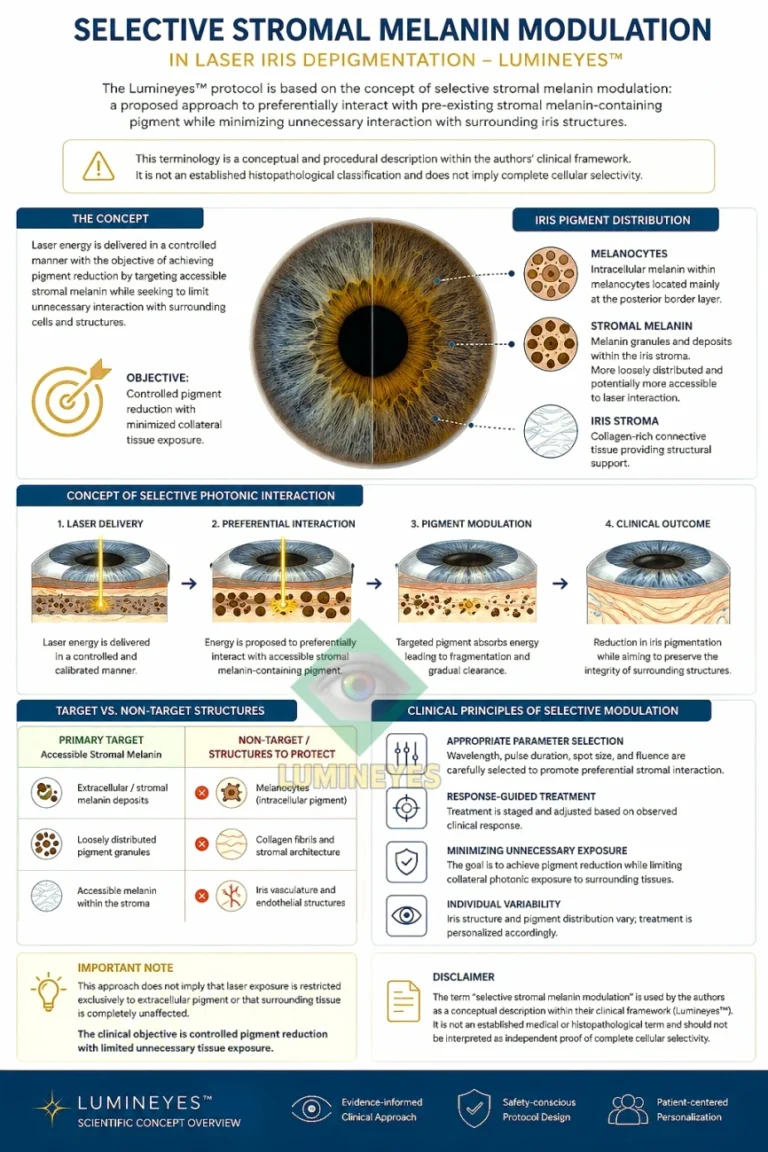
Selective Stromal Melanin Modulation in Laser Iris Depigmentation
Laser iris depigmentation involves interaction between laser energy and melanin-containing structures within the iris. A central clinical consideration is whether pigment reduction can be achieved while minimizing unnecessary interaction with surrounding cellular and stromal structures.
The authors use the term “selective stromal melanin modulation” to describe the proposed treatment concept underlying the Lumineyes™ protocol. The term refers to the intended preferential interaction with pre-existing stromal melanin while minimizing unnecessary interaction with surrounding iris structures.
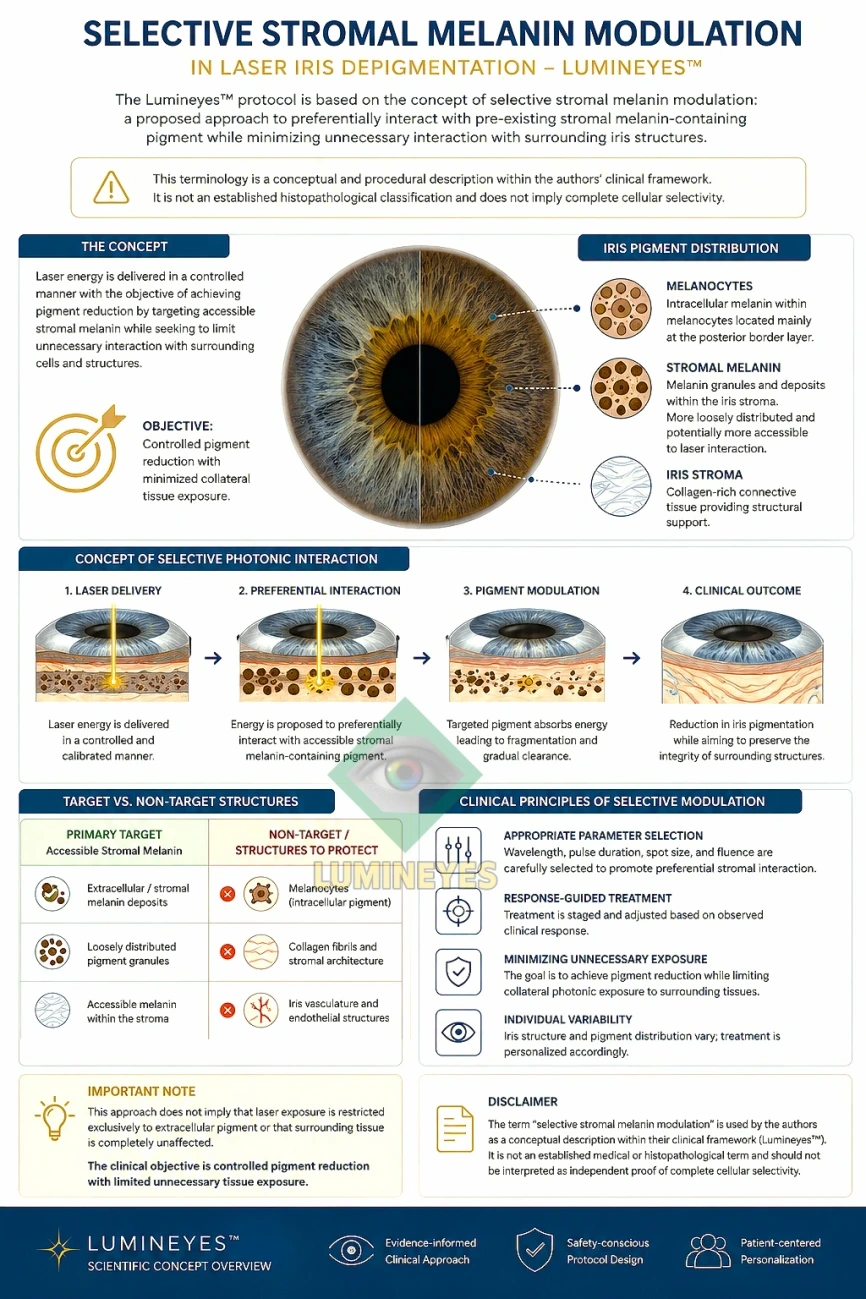
Concept of Selective Photonic Interaction
The principle underlying selective laser iris depigmentation – Lumineyes™ is based on controlled photonic interaction with melanin-containing structures. However, melanin within the iris may exist in different cellular and stromal distributions, and these compartments may not respond identically to laser exposure.
A distinction may therefore be made between intracellular pigment contained within melanocytes and extracellular or more loosely distributed stromal pigment deposits. Within the authors’ clinical observations, appropriately calibrated treatment parameters are proposed to preferentially interact with accessible stromal melanin-containing pigment while seeking to minimize unintended interaction with surrounding cellular and structural components.
This proposed interaction should not be understood as implying that laser exposure is restricted exclusively to extracellular pigment or that surrounding tissue is completely unaffected. Rather, the clinical objective is to achieve controlled pigment reduction while limiting unnecessary tissue exposure.
Extracellular and Stromal Melanin as a Treatment Target
Clinical observations and the proposed biological model suggest that a portion of visible iris pigmentation may be distributed within the anterior stromal layers as extracellular or loosely organized pigment deposits. These pigment distributions may exhibit optical characteristics that allow interaction with appropriately selected laser parameters.
How readily this pigment responds to treatment depends in part on pigment resistance and stromal adherence — the biological degree to which individual iris melanin remains associated with stromal collagen and connective tissue.
Within the Lumineyes framework, treatment is therefore directed toward controlled reduction of pre-existing stromal melanin, rather than intentional ablation of iris tissue. The intended response is progressive pigment fragmentation and subsequent biological clearance, with treatment decisions guided by the observed clinical response.
The authors emphasize that this represents a proposed clinical model, rather than a universally established mechanism applicable to all laser iris depigmentation procedures.
Preservation of Iris Stroma & Ocular Homeostasis
The iris stroma is a highly organized, vascularized connective tissue whose structural integrity is clinically important. Unnecessary disruption of this architecture may contribute to inflammation, altered light scattering, or other anterior-segment complications.
Accordingly, the intended treatment objective is to reduce stromal melanin while minimizing unintended structural alteration of the surrounding iris tissue.
Monitoring ocular homeostasis is an important component of the clinical safety framework. Rather than assuming complete structural preservation from the treatment mechanism alone, the Lumineyes approach emphasizes response-guided staged treatment, clinical reassessment, and continuous monitoring for treatment-related responses.
The avoidance of unnecessary intracellular or structural disruption is therefore considered a treatment objective, rather than a claim that such interaction can be completely excluded.
Conclusion & Clinical Implications
The concept of selective stromal melanin modulation provides a framework for considering laser iris depigmentation as a controlled pigment-reduction process rather than intentional ablation of iris tissue.
Within the Lumineyes™ protocol, the clinical objective is to balance pigment reduction with controlled tissue interaction, staged treatment, and longitudinal clinical monitoring.
Selective interaction with stromal melanin is therefore regarded as a proposed treatment principle within the authors’ clinical framework. Its biological mechanisms, comparative tissue effects, and long-term implications require further independent investigation and prospective evaluation.
For a detailed technical review on selective laser interaction with iris pigmentation, see the following clinical publication.
Selective Stromal Modulation – Research FAQ
Is selective stromal melanin modulation a universally proven histopathological fact?
No. It is a proposed clinical and procedural model specific to the authors' clinical framework that describes intended preferential interaction with visible stromal melanin, rather than an independently proven histopathological classification.
How does stromal adherence affect pigment modulation?
Individual iris pigment differs in how strongly it adheres to stromal collagen fibers. Pigment resistance and adherence influence how readily melanin responds to calibrated laser interaction and cellular clearance.
What determines whether subsequent treatment sessions proceed?
The treating physician evaluates the clinical appearance of pigment clearance and anterior segment response between stages before deciding to continue, adjust, pause, or conclude treatment.
Medical Review & Fact-Checking
All medical content is reviewed by Dr. Mustafa Mete. Treatment suitability can only be determined following comprehensive ophthalmic examination and individualized clinical assessment.
The Lumineyes™ protocol is presented here as the authors’ specific staged approach to laser iris depigmentation. The clinical observations and proposed mechanistic concepts described on this page should not be interpreted as independent evidence or as proof of universal safety or efficacy.