
Amber Eyes: The Genetics, Biochemistry, and Rarity of Honey-Colored Irises
Amber eyes represent one of the rarest phenotypic expressions in human ocular genetics. Unlike the optical illusion of blue eyes or the multi-tonal zones of hazel, true amber irises derive their striking golden-copper hue from a dense, monochromatic deposition of lipochrome pigment within the stroma.

Human eye color is a sophisticated interplay between molecular pigmentation and optical physics. While the global population is overwhelmingly dominated by dark brown irises, amber eyes remain a fascinating genetic outlier, presenting in less than 5% of the worldwide demographic. Characterized by a warm, solid, golden-yellow or copper hue, they are frequently described as "wolf eyes" or honey-colored.
To understand amber eyes clinically, we must move beyond cosmetic descriptions and examine the anterior border layer of the iris, evaluating how specific melanin polymers interact with incoming light photons.

The Biochemistry of Amber: Eumelanin vs. Pheomelanin
The spectrum of human eye color is governed primarily by specialized cells called melanocytes, which produce pigment granules within the iris stroma. However, not all melanin is identical. The biological differentiation of amber eyes relies on the precise ratio of two distinct pigment subtypes:
- Eumelanin: The dense, dark brown to black pigment polymer responsible for standard brown eyes. It effectively absorbs light, preventing any reflection or structural scattering.
- Pheomelanin (Lipochrome): A lighter, red-to-yellow pigment polymer containing sulfur. It is the exact same biological pigment responsible for red hair.
In blue or green eyes, pigment is sparse, and the color is generated structurally via Rayleigh scattering (the same physical phenomenon that makes the sky appear blue). Amber eyes are entirely different. They possess an exceptionally high concentration of pheomelanin (lipochrome) with very little eumelanin. The result is a solid, luminescent golden hue that does not rely on optical scattering, but rather on the true physical color of the pigment itself.
Clinical Distinction: Amber Eyes vs. Hazel Eyes
One of the most common diagnostic confusions in ocular pigmentation is misidentifying a hazel eye as amber, or vice versa. Under slit-lamp biomicroscopy, an ophthalmologist can easily distinguish the two based on pigment topography.
| Clinical Parameter | True Amber Eyes | Hazel Eyes |
|---|---|---|
| Pigment Distribution | Uniform & Monochromatic: A solid, continuous golden/copper sheet extending from the pupil to the limbus. | Segmental & Heterogeneous: Distinct concentric zones, typically a brown/gold ring around the pupil surrounded by a green periphery. |
| Optical Mechanism | True pigment color (Pheomelanin/Lipochrome absorption). No structural scattering involved. | A complex mixture of melanin absorption (inner ring) and Rayleigh scattering (outer green ring). |
| Lighting Reaction | Maintains a solid golden/copper hue in all lighting, though intensity may shift. | "Color-shifting" effect. May appear more brown or more green depending on the ambient light source. |
The Genetic Framework of Amber Pigmentation
Historically, eye color was taught as a simple Mendelian dominant-recessive trait (brown dominates blue). Modern ocular genetics proves this model obsolete. Eye color is a highly polygenic trait involving up to 16 different chromosomal loci.
The golden hue of amber eyes is heavily influenced by the OCA2 and HERC2 genes located on Chromosome 15. The HERC2 gene acts as a regulatory switch for the OCA2 promoter. In amber eyes, these genes command the melanocytes to synthesize and package substantial amounts of lipochrome rather than shutting down pigment production entirely (which would result in blue eyes) or maxing out eumelanin production (which would yield dark brown).
For a comprehensive breakdown of how these specific alleles orchestrate melanin synthesis, consult the official MedlinePlus Genetics database.
How Rare Are Amber Eyes Globally?
Amber eyes are statistically classified as an ocular rarity. While exact demographic data fluctuates, clinical consensus places true amber eyes at roughly 5% of the global population. They are most frequently observed in populations of Spanish, South American, South African, and some Asian descents.
If you wish to compare the statistical frequency and geographic distribution of amber irises against green, gray, and central heterochromia, you can review our clinical demographic analysis of the rarest eye colors in the world.
⚠ Medical Warning: Pathological "Golden" Rings (Wilson's Disease)
A true amber eye is a uniform, genetic trait. However, if a patient with naturally blue or light brown eyes suddenly develops a distinct golden, copper, or rusty-brown ring at the outer edge of the cornea, it is a medical emergency. This is known as a Kayser-Fleischer ring. It is not an eye color change; it is the toxic deposition of copper within Descemet's membrane of the cornea, indicating Wilson's Disease—a fatal genetic disorder causing acute liver failure and neurological damage if left untreated. Any sudden pigmentary change in the eye requires immediate ophthalmic evaluation.
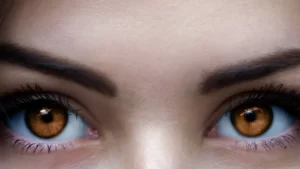
Slit-lamp view: The dense lipochrome stroma of an amber eye.
Can Laser Depigmentation Reveal Amber or Honey Tones?
As the inventor of the MyLumineyes® technology, I am frequently asked by patients with dark brown eyes if a laser can "create" amber eyes. The clinical answer lies in the natural topography of the patient's iris.
In many brown eyes, the dense dark eumelanin is strictly localized to the anterior border layer. Beneath this dark shield lies the stroma. If a patient genetically possesses lipochrome within their deep stroma, strategically stripping away the superficial black/brown eumelanin using precise, low-fluence laser energy can unveil a spectacular, natural honey or amber hue before reaching the blue or gray baseline.
This process is entirely dependent on selective photodisruption and macrophage clearance. Dangerous cosmetic implants or unverified color-changing eye drops cannot replicate this natural biology and pose massive risks to intraocular pressure. To understand how we safely map and selectively reveal underlying stromal pigments, explore our definitive guide on Laser Eye Color Change.
Frequently Asked Questions: Amber Eyes
Are amber eyes and hazel eyes the same thing?
No. Hazel eyes possess multiple colors (typically a brown center radiating into a green outer ring) and utilize both pigment absorption and light scattering. Amber eyes are a solid, uniform, monochromatic golden/yellow tone originating purely from a pigment called lipochrome.
Can eye drops change my brown eyes to amber?
Absolutely not. There are no FDA-approved, scientifically valid eye drops capable of safely dissolving stromal melanin to change eye color. Drops marketed online as "color changers" are predatory scams and carry severe risks of corneal toxicity and uveitis.
Are amber eyes considered "wolf eyes"?
Yes, colloquially. The distinct golden-yellow coloration of amber eyes is highly prevalent in wolves, domestic dogs, cats, and owls. In humans, it is a rare but entirely natural genetic phenotypic expression.
Can the MyLumineyes laser turn my eyes amber?
If your underlying iris stroma genetically contains lipochrome (pheomelanin), selectively removing the overlying dark eumelanin via the MyLumineyes protocol can reveal a striking, natural amber or honey tone. This is determined during your pre-operative anatomical mapping.
Medical Disclaimer: This comprehensive guide to ocular pigmentation is authored by Dr. Mustafa Mete for educational purposes. Any sudden, unilateral changes in your natural eye color should be evaluated immediately by a board-certified ophthalmologist to rule out pigmentary glaucoma, intraocular melanoma, or systemic metabolic disorders.