Lumineyes Anterior-Segment Safety Staging (L-SAFE): A Proposed Framework for Pre-Exposure Assessment in Laser Iris Pigment Reduction
The original source PDF is authoritative for tables, figures, and layout. This HTML is a reading edition of the same document, not an independently validated clinical algorithm.
Abstract
Purpose. Repeated laser exposure for iris pigmentation reduction raises a distinct safety question: whether the ocular response to a preceding exposure provides a reason to withhold the next staged exposure. This report proposes the Lumineyes Anterior-Segment Safety Staging (L-SAFE) framework to structure that assessment and its documentation.
Framework. L-SAFE is an author-proposed conceptual framework informed by selected literature and general clinical experience, without patient-level data analysis. Four mandatory domains are assessed at each checkpoint: intraocular pressure, anterior-chamber response, corneal status, and angle/outflow status. Findings are integrated into S0 (READY), S1 (WATCH), S2 (PAUSE), or S3 (STOP). Resolving, stable, and progressive trajectory modifiers apply only to S1 and S2.
Exposure control. Only S0 indicates absence of an L-SAFE safety contraindication to consideration of the next staged exposure. S1 and S2 require withholding exposure and reassessment; S3 terminates the current staged exposure sequence. Recovery is documented by integrated return to S0. A preceding S2 response remains relevant to subsequent exposure planning. Return to S0 after S3 documents ocular recovery but does not establish eligibility for renewed treatment.
Conclusion. L-SAFE proposes a shared vocabulary and a structure for future evaluation. It is not a validated clinical decision rule or evidence that the procedure is safe. Reproducibility, state boundaries, feasibility, and clinical utility require independent evaluation.
Keywords. Laser iris depigmentation; anterior segment; safety assessment; intraocular pressure; clinical framework; research methodology.
Introduction
Laser iris pigmentation reduction has been described in a clinical series reporting favorable outcomes, while separate case reports document serious complications [1-4]. Reported events include refractory pigmentary glaucoma and, in one report, paracentral acute middle maculopathy [2,3]. A subsequent report described marked pressure elevation and a temporally associated episode of herpetic keratitis with corneal scarring; temporal association alone does not establish the cause of the keratitis [4]. These different study designs cannot be combined into a reliable complication rate or used to establish safety across devices and exposure protocols.
When exposures are staged, initial treatment eligibility and the response to a preceding exposure are different questions. A record of pressure alone does not describe the anterior-chamber response, corneal condition, or angle findings. A compact structure that preserves those observations while stating the reason for withholding further exposure may support more interpretable records. Whether such a structure improves decisions or outcomes must be tested.
The Standardization of Uveitis Nomenclature (SUN) initiative illustrates the value of explicitly defined ophthalmic terminology [5,6]. Its formal development and validation work cannot be transferred to a new classification by analogy. L-SAFE is an author-proposed framework that integrates four established examination domains into a pre-exposure safety state. The proposal concerns documentation and exposure withholding; it does not establish the acceptability, efficacy, or overall safety of cosmetic laser iris pigmentation reduction.
Framework Development and Evidentiary Basis
L-SAFE was developed through clinical experience with staged procedures and longitudinal patient follow-up, together with clinical reasoning informed by selected published literature. No patient records or patient-level dataset were systematically reviewed or analysed to derive or evaluate the framework for this report. No cohort results, complication frequencies, treatment-response estimates, or empirical performance measures are presented.
The literature was used as a targeted, non-systematic evidentiary basis. Sources address reported complications after laser iris treatment [1-4], inflammation terminology [5,6], glaucoma assessment and pigment dispersion [7-9], and endothelial measurement [10]. They support the relevance of the examination domains. The S0-S3 definitions, trajectory restrictions, and exposure-control consequences are proposed design choices; the cited literature does not validate these rules. This report does not present a formal consensus exercise or a systematic review.
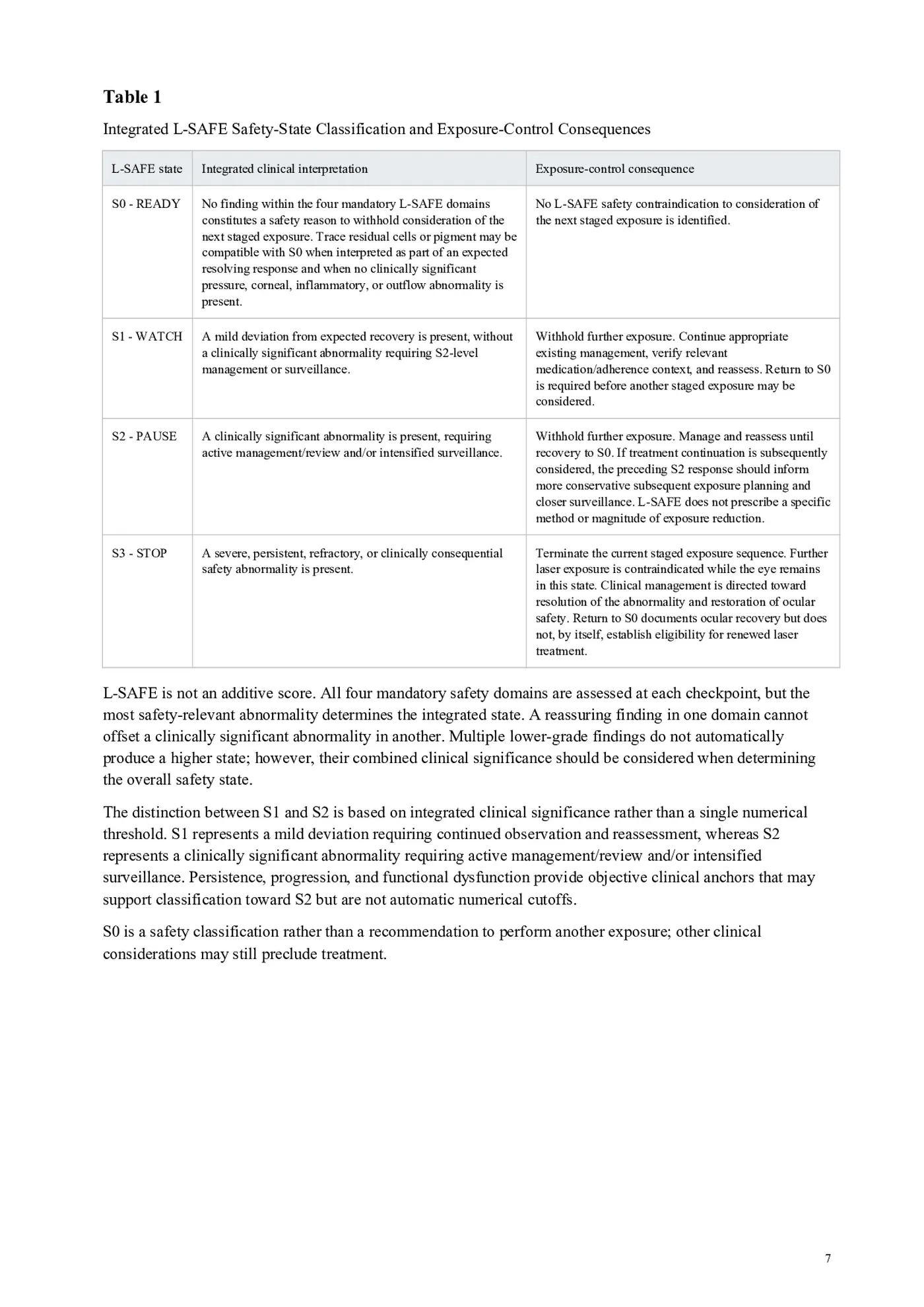
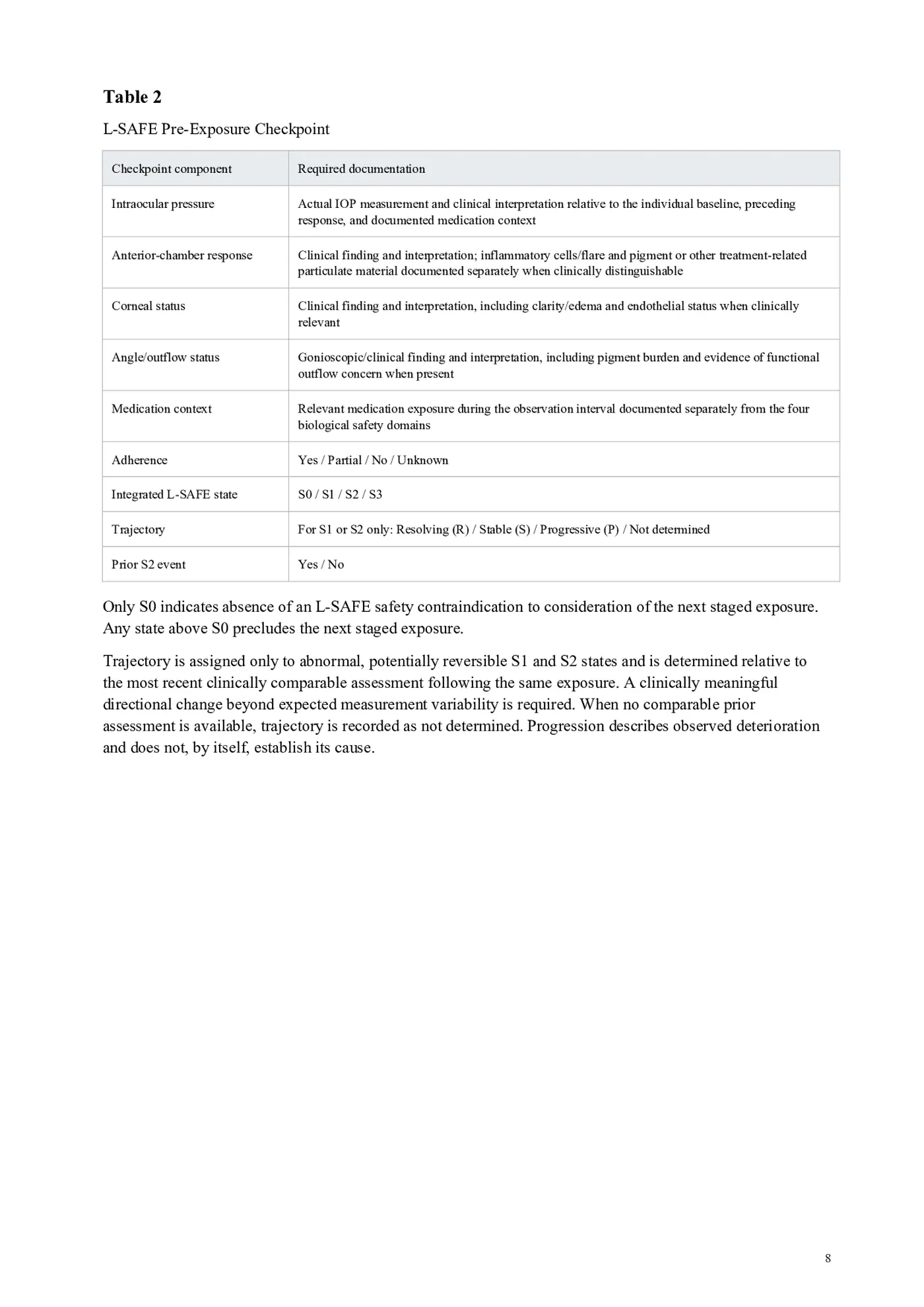
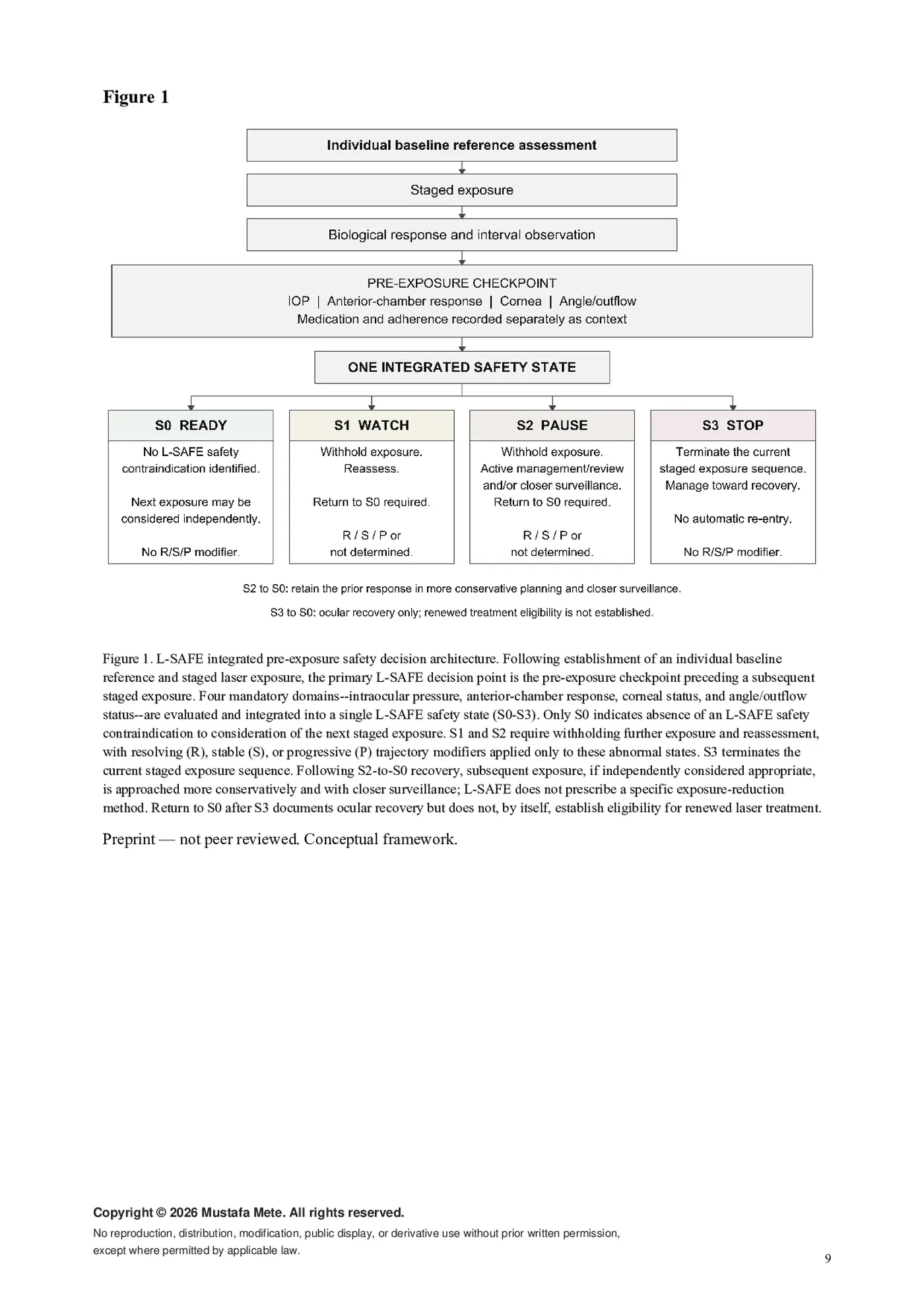
The framework separates three elements: the observations recorded in each domain, the clinical interpretation integrating those observations, and the consequence for the next staged exposure. Table 1 defines the states and consequences; Table 2 specifies checkpoint documentation; Figure 1 shows their relationship. The aim is to make the proposal inspectable and testable before any claim of clinical utility.
Purpose and Scope
L-SAFE asks whether the current integrated anterior-segment response supplies a safety reason to withhold the next staged exposure. The unit of assessment is an individual eye at a documented checkpoint. Each eye is assessed separately, with findings interpreted against its own baseline and subsequent course. Initial candidacy, informed consent, regulatory compliance, device selection, and the overall decision to offer treatment remain outside the framework.
The four domains are mandatory for an integrated checkpoint assessment. They do not constitute a complete ophthalmic safety examination. Visual symptoms, visual acuity, optic nerve findings, retinal pathology, or other clinical concerns may independently preclude further treatment, including when the four-domain classification is S0. Assessment of an acute concern must not be deferred until a scheduled checkpoint.
L-SAFE specifies no universal numerical intraocular-pressure (IOP) or endothelial-cell-density (ECD) cutoffs, fixed waiting intervals, drug protocol, or laser dosing rule. This does not remove the need to measure, investigate, or manage clinically significant abnormalities. The timing and content of clinical care remain determined by the findings and applicable clinical standards.
The Lumineyes Iris Pigmentation Scale (LIPS), if used, provides optional descriptive baseline information to document the initial iris phenotype. It is neither a prerequisite for L-SAFE nor a predictor of pigment release, dose tolerance, treatment interval, or subsequent safety state within this proposal.
Four Mandatory Domains
Intraocular pressure. Record the actual measurement and interpret it alongside the individual baseline, preceding response, measurement conditions, and medication context. Glaucoma guidance and pressure-measurement literature support contextual interpretation rather than treating one number as a complete assessment [7,9]. A pressure measured during treatment should not be described as untreated recovery. L-SAFE does not require medication withdrawal to establish a state and does not translate an absolute value or a change from baseline into an automatic stage.
Anterior-chamber response. Document inflammatory cells and flare separately from pigment or other particulate material when clinically distinguishable. SUN terminology can describe inflammation [5]; its grades do not automatically determine L-SAFE state. If the nature of visible particles is uncertain, that uncertainty should be recorded. The proposal does not assume that every visible particle is an inflammatory cell or that residual particles are invariably benign.
Corneal status. Assess clarity, edema, and other clinically relevant corneal findings, including endothelial status where indicated. When ECD is measured serially, interpretation should account for image quality, sampling, analysis method, and comparability of examinations [10]. Corneal status remains mandatory even when a particular ancillary measurement is not indicated or available. Absence of an ECD measurement is not evidence that endothelial status is normal, and an apparent percentage change alone does not establish a L-SAFE state.
Angle and outflow status. Record gonioscopic and clinical findings, including pigment burden and concern about outflow dysfunction. Pigment dispersion literature provides a rationale for attending to the outflow pathway [8,9], without establishing a laser-specific staging threshold. Pigmentation and functional impairment are distinct observations. A reassuring IOP measurement does not replace angle assessment, particularly when medication or the preceding course affects its interpretation.
Integrated Safety States
L-SAFE is not an additive score. The most safety-relevant abnormality governs the integrated interpretation; a reassuring domain cannot cancel a clinically significant abnormality elsewhere. Several mild findings do not automatically add up to S2, although their combined significance can justify a more concerning integrated state. The underlying findings and the reason for classification should remain visible in the record.
S0 (READY) indicates that no finding within the four mandatory domains constitutes a L-SAFE safety reason to withhold consideration of the next staged exposure. READY is a restricted state label, not a recommendation to perform treatment. Table 1 permits trace residual cells or pigment only when clinically interpreted as an expected resolving response without a significant pressure, corneal, inflammatory, or outflow abnormality. That boundary is a proposed feature requiring evaluation, not a validated tolerance threshold.
S1 (WATCH) describes a mild deviation from expected recovery without an abnormality requiring S2-level management or surveillance. S2 (PAUSE) denotes a clinically significant abnormality requiring active management or review and/or intensified surveillance. Both require withholding the next exposure. Their distinction rests on documented clinical significance rather than a universal numerical boundary. Variation in what clinicians consider expected recovery is an acknowledged source of uncertainty.
S3 (STOP) describes a severe, persistent, refractory, or clinically consequential abnormality and terminates the current staged exposure sequence. Persistence is interpreted with severity, function, and response to management; mere continuation of a mild finding across visits is not an automatic S3 criterion. Irreversibility is not required. Recovery from an abnormal safety state must not be equated with reversal of any established tissue damage.
Trajectory and Recovery
Resolving (R), stable (S), and progressive (P) modifiers apply only to S1 and S2. They describe observed change relative to the most recent clinically comparable assessment after the same exposure. Resolving and progressive require a clinically meaningful directional change beyond expected measurement variability.
Stable describes absence of meaningful directional change when comparison is possible; an isolated assessment cannot establish stability. If comparison is unavailable or an integrated direction cannot be supported, record trajectory as not determined and retain the domain-level explanation.
Improvement does not itself authorize another exposure: S1-R remains S1 and S2-R remains S2 unless a new integrated assessment supports a different state. A trajectory modifier describes the course, not its cause or guaranteed reversibility. No R/S/P modifier is attached to S0 or S3.
Recovery within the framework is the integrated return to S0, with no separate recovery decision layer.
Following S2-to-S0 recovery, the prior S2 event remains clinically relevant. If continuation is independently considered appropriate, the proposal calls for more conservative exposure planning and closer surveillance without prescribing a method or magnitude of exposure reduction. Following S3-to-S0 recovery, the current sequence remains terminated; the recovery entry does not establish eligibility for renewed laser treatment. The preceding S3 event must remain explicit in the longitudinal record.
Checkpoint Documentation
Table 2 records the four biological domains and keeps medication exposure and adherence as contextual fields. Document eye laterality, the checkpoint date, its relationship to the preceding exposure, the baseline used for comparison, and the reasoning behind state assignment in the accompanying clinical record. A prior S2 event and any prior sequence termination remain relevant even after the current findings improve.
An unassessed mandatory domain must not be presumed normal or silently coded as S0. Where information is insufficient, document the incomplete assessment and its reason; it cannot establish S0 readiness. Incomplete documentation is not an additional biological state and should not be converted automatically into S1, S2, or S3. Lack of documentation must likewise remain distinguishable from a documented absence of abnormality in retrospective research.
Discussion
The proposed contribution is a link between integrated examination findings and explicit exposure-control consequences. A vocabulary may make it easier to distinguish mild deviation from clinically significant abnormality, current improvement from recovery, and recovery from eligibility for renewed treatment. Those potential advantages remain hypotheses. Naming a framework does not establish consensus or show that its use reduces harm.
A particular tradeoff is the absence of universal IOP or ECD boundaries. Context-sensitive interpretation avoids presenting an unvalidated numerical rule as authoritative, but it can reduce agreement between observers. The framework therefore retains measurements and clinical reasoning rather than substituting a state label for source observations. The S1-S2 boundary and the allowance for trace residual findings in S0 are priorities for evaluation and may require revision.
The four-domain scope also creates a risk of false reassurance. Reported retinal and optic nerve consequences after laser iris treatment illustrate why an anterior-segment state cannot certify whole-eye safety [2,3].
Similarly, an improved value under medication does not demonstrate that the eye would remain stable without that medication. Historical adverse responses, treatment context, and concerns beyond the framework must remain available to the clinician.
The name Lumineyes identifies the proposed framework; it supplies no comparative evidence for a named provider, device, or technique. Findings from the cited laser reports should not be transferred to an unspecified platform as incidence estimates, nor should the framework be used to claim a superior safety profile. The proposed terminology should be assessed independently of commercial associations.
Evaluation Priorities
Initial evaluation should examine whether clinicians can apply the definitions consistently using complete examination records or explicitly fictional vignettes. Independent raters should assess the same material, with the information available to each rater specified. Exact state agreement, disagreements across the S0 versus above-S0 boundary, and uncertainty around agreement estimates are relevant endpoints. Reliability studies should follow appropriate reporting guidance such as GRRAS [11]. Agreement on fictional examples would demonstrate only interpretability under those conditions, not clinical safety.
Subsequent observational evaluation should retain all four domains, medication context, exposure timing, and missingness. It should examine feasibility, state transitions, and associations with independently assessed clinical outcomes, while accounting for repeated visits and paired eyes. Because management and surveillance help distinguish states, using management escalation alone as a validation outcome would be circular.
Classification should, where feasible, be assessed without knowledge of subsequent outcomes.
Retrospective application can examine whether existing records support classification; it cannot imply that historical treatment decisions were guided by a framework introduced later. Missing domains must be reported, and any comparison should acknowledge selection and documentation bias. Prospective evaluation requires an appropriate protocol and ethical oversight. It should not expose an eye to further laser solely to test whether withholding was necessary.
Limitations
L-SAFE is an unvalidated conceptual proposal informed by a selected, non-systematic literature base and general clinical experience. No patient-level derivation, interobserver study, external validation, or formal consensus process is reported. The four-domain selection and state boundaries may be incomplete or insufficiently reproducible. Terms such as clinically significant, expected recovery, and persistent require contextual judgment and may be interpreted differently across observers and settings.
The framework does not estimate complication incidence, predict an individual outcome, establish a safe exposure schedule, or demonstrate clinical benefit. A return to S0 does not establish restoration of pretreatment tissue reserve or absence of future risk. Generalization across laser platforms or to cosmetic iris implants, keratopigmentation, or other interventions has not been established. Clinical recommendations beyond the proposed withholding architecture require their own evidence.
Conclusion
L-SAFE proposes four mandatory domains integrated into S0-S3, with R/S/P modifiers restricted to S1 and S2. Any state above S0 precludes the next staged exposure within the proposed architecture. S0 records recovery-readiness within that limited scope; it does not establish general treatment suitability. The framework provides definitions that can be examined and revised through independent evaluation before claims of reproducibility, clinical utility, or safety benefit are made.
Ethics and Data Availability
This report presents a conceptual framework informed by published literature and general clinical experience.
No patient-level data were collected or systematically analysed for this report, and no individual patient cases or identifiable patient information are presented. No patient-level research dataset was generated. The state definitions and documentation structure are provided in Tables 1 and 2.
Funding
No funding was received for the preparation of this manuscript.
Competing Interests
Mustafa Mete is the developer of the Lumineyes method and the owner of Mylumineyes and has a commercial interest in the method.
Author Contributions
Mustafa Mete contributed to conceptualization, framework development, and manuscript preparation.
References
- Grimaldos Ruiz P. Photoablative cosmetic iridoplasty: effective, safe, and predictable-eye color change in 1176 eyes. Int Ophthalmol. 2021;41(4):1381-1393. doi:10.1007/s10792-021-01693-5.
- Ong AY, Ching-A-Sue G, Krilis M, Guirao-Navarro MC, Hornby S, Jutley G. Refractory iatrogenic pigmentary glaucoma secondary to cosmetic laser treatment: a case report. Eur J Ophthalmol. 2023;33(2):NP1-NP4. doi:10.1177/11206721211050338.
- Liu J, Korban S, Moster MR, Rheaume MA, Wang Q. Bilateral severe iatrogenic pigmentary glaucoma following laser treatment for cosmetic iris color change. Am J Ophthalmol Case Rep. 2023;32:101927. doi:10.1016/j.ajoc.2023.101927.
- Jaber W, Nemet M, Waisbourd M. Laser iris depigmentation resulting in markedly elevated intraocular pressure and herpes simplex keratitis with corneal scarring: case report. Case Rep Ophthalmol. 2026;17(1):312-317. doi:10.1159/000551226.
- Jabs DA, Nussenblatt RB, Rosenbaum JT; Standardization of Uveitis Nomenclature (SUN) Working Group. Standardization of uveitis nomenclature for reporting clinical data. Results of the First International Workshop. Am J Ophthalmol. 2005;140(3):509-516. doi:10.1016/j.ajo.2005.03.057.
- Jabs DA, McCluskey P, Palestine AG, Thorne JE; Standardization of Uveitis Nomenclature (SUN) Working Group. The standardisation of uveitis nomenclature (SUN) project. Clin Exp Ophthalmol. 2022;50(9):991-1000. doi:10.1111/ceo.14175.
- Pazos M, Traverso CE, Viswanathan A; European Glaucoma Society. European Glaucoma Society -Terminology and guidelines for glaucoma, 6th Edition. Br J Ophthalmol. 2025;109(Suppl 1):1-212. doi:10.1136/bjophthalmol-2025-egsguidelines.
- Niyadurupola N, Broadway DC. Pigment dispersion syndrome and pigmentary glaucoma-a major review. Clin Exp Ophthalmol. 2008;36(9):868-882. doi:10.1111/j.1442-9071.2009.01920.x.
- Weinreb RN, Brandt JD, Garway-Heath D, Medeiros FA, editors. Intraocular Pressure. World Glaucoma Association Consensus Series 4. Kugler Publications; 2007.
- McCarey BE, Edelhauser HF, Lynn MJ. Review of corneal endothelial specular microscopy for FDA clinical trials of refractive procedures, surgical devices, and new intraocular drugs and solutions. Cornea. 2008;27(1):1-16. doi:10.1097/ICO.0b013e31815892da.
- Kottner J, Audige L, Brorson S, Donner A, Gajewski BJ, Hrobjartsson A, et al. Guidelines for Reporting Reliability and Agreement Studies (GRRAS) were proposed. J Clin Epidemiol. 2011;64(1):96-106. doi:10.1016/j.jclinepi.2010.03.002.
Table 1
Integrated L-SAFE Safety-State Classification and Exposure-Control Consequences L-SAFE state Integrated clinical interpretation Exposure-control consequence S0 - READY No finding within the four mandatory L-SAFE domains No L-SAFE safety contraindication to consideration of constitutes a safety reason to withhold consideration of the the next staged exposure is identified. next staged exposure. Trace residual cells or pigment may be compatible with S0 when interpreted as part of an expected resolving response and when no clinically significant pressure, corneal, inflammatory, or outflow abnormality is present.
S1 - WATCH A mild deviation from expected recovery is present, without Withhold further exposure. Continue appropriate a clinically significant abnormality requiring S2-level existing management, verify relevant management or surveillance. medication/adherence context, and reassess. Return to S0 is required before another staged exposure may be considered.
S2 - PAUSE A clinically significant abnormality is present, requiring Withhold further exposure. Manage and reassess until active management/review and/or intensified surveillance. recovery to S0. If treatment continuation is subsequently considered, the preceding S2 response should inform more conservative subsequent exposure planning and closer surveillance. L-SAFE does not prescribe a specific method or magnitude of exposure reduction.
S3 - STOP A severe, persistent, refractory, or clinically consequential Terminate the current staged exposure sequence. Further safety abnormality is present. laser exposure is contraindicated while the eye remains in this state. Clinical management is directed toward resolution of the abnormality and restoration of ocular safety. Return to S0 documents ocular recovery but does not, by itself, establish eligibility for renewed laser treatment.
L-SAFE is not an additive score. All four mandatory safety domains are assessed at each checkpoint, but the most safety-relevant abnormality determines the integrated state. A reassuring finding in one domain cannot offset a clinically significant abnormality in another. Multiple lower-grade findings do not automatically produce a higher state; however, their combined clinical significance should be considered when determining the overall safety state.
The distinction between S1 and S2 is based on integrated clinical significance rather than a single numerical threshold. S1 represents a mild deviation requiring continued observation and reassessment, whereas S2 represents a clinically significant abnormality requiring active management/review and/or intensified surveillance. Persistence, progression, and functional dysfunction provide objective clinical anchors that may support classification toward S2 but are not automatic numerical cutoffs.
S0 is a safety classification rather than a recommendation to perform another exposure; other clinical considerations may still preclude treatment.
Table 2
L-SAFE Pre-Exposure Checkpoint
Checkpoint component Required documentation Intraocular pressure Actual IOP measurement and clinical interpretation relative to the individual baseline, preceding response, and documented medication context Anterior-chamber response Clinical finding and interpretation; inflammatory cells/flare and pigment or other treatment-related particulate material documented separately when clinically distinguishable Corneal status Clinical finding and interpretation, including clarity/edema and endothelial status when clinically relevant Angle/outflow status Gonioscopic/clinical finding and interpretation, including pigment burden and evidence of functional outflow concern when present Medication context Relevant medication exposure during the observation interval documented separately from the four biological safety domains Adherence Yes / Partial / No / Unknown Integrated L-SAFE state S0 / S1 / S2 / S3 Trajectory For S1 or S2 only: Resolving (R) / Stable (S) / Progressive (P) / Not determined Prior S2 event Yes / No Only S0 indicates absence of an L-SAFE safety contraindication to consideration of the next staged exposure.
Any state above S0 precludes the next staged exposure.
Trajectory is assigned only to abnormal, potentially reversible S1 and S2 states and is determined relative to the most recent clinically comparable assessment following the same exposure. A clinically meaningful directional change beyond expected measurement variability is required. When no comparable prior assessment is available, trajectory is recorded as not determined. Progression describes observed deterioration and does not, by itself, establish its cause.
Figure 1
Figure 1. L-SAFE integrated pre-exposure safety decision architecture. Following establishment of an individual baseline reference and staged laser exposure, the primary L-SAFE decision point is the pre-exposure checkpoint preceding a subsequent staged exposure. Four mandatory domains--intraocular pressure, anterior-chamber response, corneal status, and angle/outflow status--are evaluated and integrated into a single L-SAFE safety state (S0-S3). Only S0 indicates absence of an L-SAFE safety contraindication to consideration of the next staged exposure. S1 and S2 require withholding further exposure and reassessment, with resolving (R), stable (S), or progressive (P) trajectory modifiers applied only to these abnormal states. S3 terminates the current staged exposure sequence. Following S2-to-S0 recovery, subsequent exposure, if independently considered appropriate, is approached more conservatively and with closer surveillance; L-SAFE does not prescribe a specific exposure-reduction method. Return to S0 after S3 documents ocular recovery but does not, by itself, establish eligibility for renewed laser treatment.
Preprint — not peer reviewed. Conceptual framework.
Copyright © 2026 Mustafa Mete. All rights reserved.
No reproduction, distribution, modification, public display, or derivative use without prior written permission, except where permitted by applicable law.
Original figures and tables from the preprint
Each image is a facsimile of the indicated page in the original 2026 Zenodo PDF, not a newly generated scientific figure. The original PDF is authoritative.