Abstract
Selective Laser Iris Depigmentation represents a controlled anterior segment laser approach aimed at reducing stromal melanin density in selected cases. This clinical perspective describes procedural rationale, patient selection criteria, safety monitoring principles, and observed short-term structural responses. Outcomes may vary depending on baseline iris anatomy, pigment distribution, treatment response, and individual healing dynamics. The documentation reflects structured clinical observations and does not constitute a substitute for formal peer-reviewed prospective analysis.
Selective Laser Iris Depigmentation vs. Other Depigmentation Approaches
Although the term “depigmentation” may be used broadly, the Lumineyes approach is described here as a specific staged laser iris depigmentation protocol with an emphasis on controlled reduction of pre-existing stromal pigmentation. Rather than treating pigment removal as an immediate color-conversion endpoint, the approach emphasizes treatment response, reassessment, and progressive decision-making.
The authors use the term “selective stromal melanin modulation” to describe the proposed treatment concept underlying the Lumineyes protocol. This terminology refers to the intended biological and procedural framework of the approach and should not be interpreted as an established histopathological classification or as independent proof of complete cellular selectivity.
The paradigm of selective laser iris depigmentation relies on preferential interaction with melanin-containing structures while seeking to minimize unintended interaction with surrounding anterior-segment tissues. The Lumineyes protocol uses calibrated laser parameters intended to preferentially interact with melanin-containing structures and to reduce pre-existing stromal pigmentation while minimizing unintended interaction with adjacent stromal and muscular tissues.
The proposed concept is therefore not based on an assumption that laser interaction is confined exclusively to melanocytes or that surrounding tissue remains completely unaffected. Rather, the clinical objective is to achieve a controlled pigment-reduction response while limiting unnecessary tissue exposure. The authors consider this principle an important distinction between the Lumineyes approach and laser procedures in which pigment reduction is pursued without the same staged, response-guided framework.
Following laser interaction, liberated pigment may enter the anterior chamber and undergo cellular processing and clearance. Because excessive or persistent pigment within the anterior segment may be associated with impaired aqueous outflow and intraocular-pressure elevation, staged treatment and early intraocular pressure (IOP) monitoring are important components of the clinical framework. Serial tonometric assessments provide an objective clinical parameter for detecting pressure changes during the post-treatment period and may support decisions to continue, defer, modify, or discontinue further treatment when the pressure response is clinically concerning.
Keywords:
Iris depigmentation; Selective laser iris depigmentation; Anterior segment laser surgery; Stromal melanin reduction; Cosmetic ophthalmic laser procedures; Selective stromal melanin modulation.
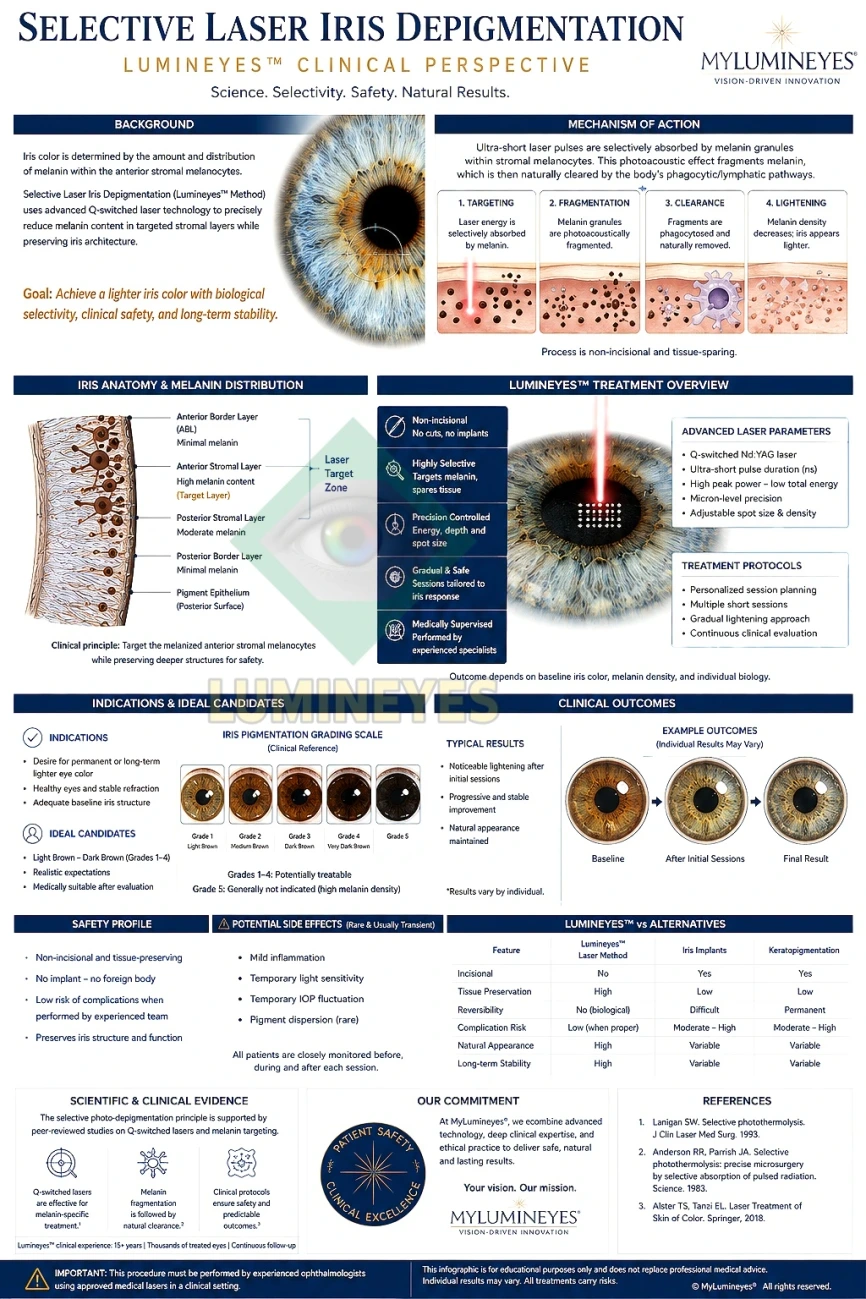
Selective Laser Iris Depigmentation: a clinical overview of melanin targeting, treatment principles, iris anatomy, safety considerations, and expected outcomes using the Lumineyes™ method.
Clinical Scope
This document outlines:
- The biological basis of selective pigment interaction
- The concept of selective stromal melanin modulation
- Response-guided staged treatment
- Early intraocular pressure monitoring logic
- Transient response patterns observed in short-term follow-up
- Exclusion principles applied to minimize risk
- Limitations inherent to non-incisional pigment modulation
- The distinction between the Lumineyes protocol and other laser iris depigmentation techniques
The Lumineyes™ approach is discussed within defined safety boundaries and does not represent a universal solution applicable to all patients. In this document, the term “Lumineyes” refers specifically to the authors’ staged laser iris depigmentation protocol and should not be taken to represent all laser iris depigmentation techniques, protocols, treatment parameters, or clinical practices.
For a broader surgeon-led clinical perspective on laser eye color change, read the full publication on Issuu.
Clinical Terminology and Proposed Treatment Concept
The authors use the term selective stromal melanin modulation to describe the proposed biological and procedural concept underlying the Lumineyes protocol. The term is intended to distinguish the protocol from the broader and heterogeneous category of laser iris depigmentation procedures and does not imply that all laser iris depigmentation techniques share the same treatment parameters or biological effects.
Within this framework, treatment is considered a response-guided staged process rather than a single laser exposure intended to produce an immediate predetermined color endpoint. The clinical response following each treatment stage is reassessed before further treatment is considered.
The observed pigment response may include pigment liberation, cellular processing, and progressive reduction in visible pigment burden. These observations form part of the authors’ clinical framework but should not be interpreted as establishing a universally predictable biological pathway or outcome for every patient.
Limitations & Medical Context
All documentation presented here reflects a retrospective clinical observation model and does not replace individualized ophthalmic assessment. Long-term outcomes require structured prospective evaluation.
The authors’ preference for a staged, response-guided, tissue-conservative approach represents a clinical perspective based on longitudinal experience and should not be interpreted as an established comparative safety conclusion. Formal comparison with other cosmetic eye-color-change procedures requires appropriately designed, independently evaluated longitudinal studies.
This page is intended for educational and academic clarity. It is not a substitute for clinical examination, diagnosis, or medical decision-making.
Suggested Academic Citation
APA:
Mete, M. (2026). Selective laser iris depigmentation—Lumineyes clinical perspective. MyLumineyes Clinical Research & Scientific Documentation.
AMA:
Mete M. Selective laser iris depigmentation—Lumineyes clinical perspective. MyLumineyes Clinical Research & Scientific Documentation. 2026.
Download Full Clinical Review (PDF)
Long-term expectations and stability factors are discussed under Permanent Eye Color Change.