Keratopigmentation Eye Color Change – Risks, Results & Safer Alternatives

Keratopigmentation eye color change has been aggressively marketed in recent years as a “simple” way to get blue or green eyes. However, this technique was not originally designed for cosmetic use in healthy eyes. It began as a medical procedure to mask opaque or damaged corneas in blind eyes. As an ophthalmologist who has seen patients seeking help after unsatisfactory keratopigmentation, I consider it essential to explain what this procedure really does – and why non-surgical laser methods such as MyLumineyes® are usually safer and more natural-looking alternatives.

Over the years, I have examined many patients who arrived with high expectations after seeing attractive photos or aggressive marketing claims about keratopigmentation. In reality, the outcome often looks very different from what they were promised. When you sit in front of a patient who is unhappy with the appearance of their eyes or struggling with visual disturbances after such a procedure, the importance of caution becomes very clear. This is why I always evaluate keratopigmentation from both a functional and aesthetic standpoint — not just as a “color change technique.”

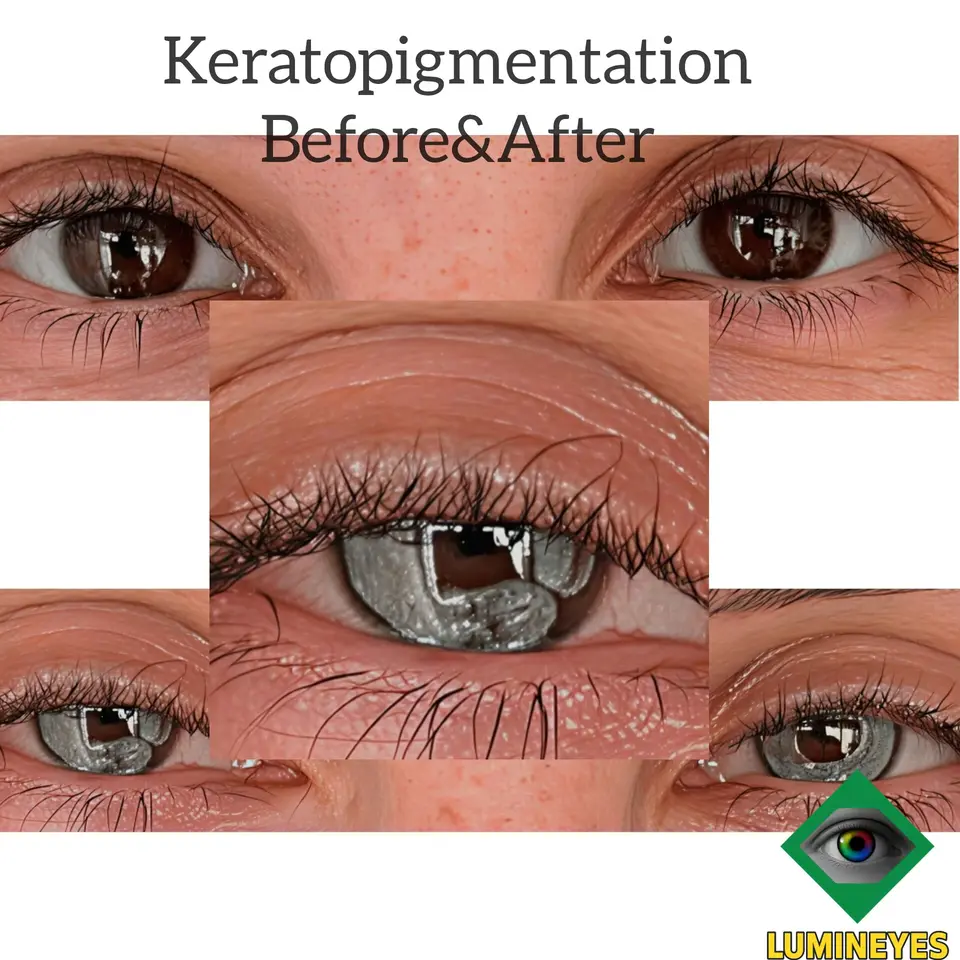
keratopigmentation eye color change

What Is Keratopigmentation eye color change surgery?

Keratopigmentation is essentially a form of corneal tattooing. Instead of changing the natural iris pigment, it places an artificial color layer inside the cornea, in front of the iris. The goal is to make the eye appear a different color when light passes through this tinted zone.

Originally, keratopigmentation was used for:

  • Masking a white or opaque cornea in a blind or severely damaged eye
  • Improving cosmetic appearance after trauma or major corneal scarring
  • Reducing glare or photophobia in some specific medical situations

Using the same technique in a healthy, seeing eye only for cosmetic color change is a much more controversial and riskier application.


How Is Keratopigmentation Performed?

In a typical cosmetic keratopigmentation procedure:

  • A femtosecond laser or manual micro-surgical technique is used to create a circular tunnel or pocket inside the corneal stroma.
  • Colored pigment is injected into this tunnel in a pattern that roughly imitates the iris.
  • The pigment remains inside the cornea permanently and acts like a tattoo or inlay, changing how the eye looks from the outside.

This has two important consequences:

  • It does not change your natural iris pigment or melanin. The iris remains the same color beneath the corneal pigment.
  • The procedure permanently alters the structure of the cornea, which is your most important optical surface.

Even small irregularities in the pigment layer or corneal shape can lead to visual disturbances and an artificial appearance.


Why Keratopigmentation Often Looks Unnatural

A natural iris has a complex, three-dimensional texture with radial lines, crypts, and subtle color variations. Keratopigmentation attempts to simulate this with a flat, artificially colored ring inside the cornea.

For this reason, cosmetic keratopigmentation may:

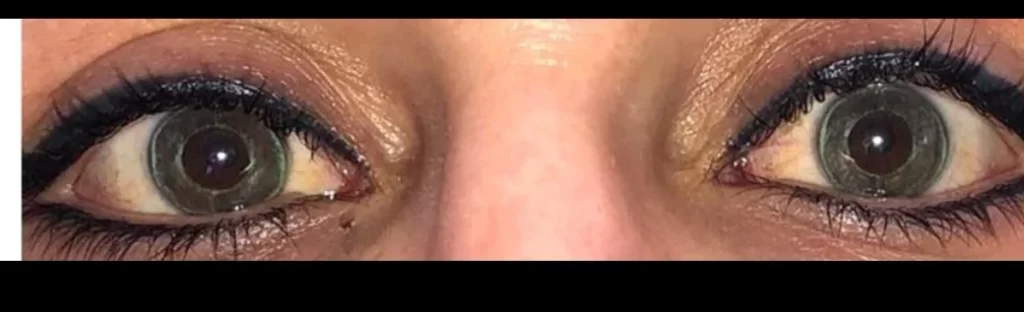
  • Mask the underlying iris pattern and create a flat, contact lens–like look
  • Appear very different under various lighting conditions and angles
  • Show visible transitions between pigmented and non-pigmented areas
  • Look obviously artificial at close distance, especially in photographs


In clinical practice, you immediately notice the difference between a natural iris and a keratopigmented cornea. When examined under the slit lamp, the pigment layer creates a uniform color plate, while the natural iris has micro-textures, crypts, fibers, and depth variations. Patients rarely think about these microscopic details, but the human eye is incredibly sensitive to small differences — this is why even a perfectly centered pigment ring can still appear unnatural to the observer.

In my practice, patients who regret keratopigmentation often describe their eyes as “not really mine anymore” or complain that the color looks unnatural and too homogeneous.


Short-Term and Long-Term Risks of Keratopigmentation

Any procedure on the cornea carries risk, and cosmetic keratopigmentation is no exception. Because it changes a critical optical surface, the potential impact on visual quality must be taken seriously.

Short-term risks

  • Pain, foreign body sensation, and light sensitivity after surgery
  • Corneal inflammation or infection
  • Irregular healing of the corneal tunnel or pocket
  • Temporary blurred or fluctuating vision

Long-term risks

  • Permanent reduction in visual quality (contrast, clarity)
  • Glare, halos, and starbursts, especially while driving at night
  • Irregular astigmatism due to changes in corneal shape
  • Pigment migration, fading, or patchy, uneven color over time
  • Difficulty or impossibility of complete reversal if you are unhappy

One thing I personally observe in many keratopigmentation revision cases is that the complaints rarely start immediately. Some patients return months or even years later, reporting that the pigment no longer looks the same, or that nighttime lights appear scattered or hazy. These real-world experiences have shaped my medical opinion: even when the cornea heals normally, the long-term visual experience can still be unpredictable.

In some cases, even if the pigment is partially removed, the structural and optical changes to the cornea may remain. This is why keratopigmentation should never be presented as a “simple” cosmetic procedure.


Can Keratopigmentation Be Reversed or Corrected?

Reversing keratopigmentation is complicated and often incomplete. Pigment can sometimes be reduced or modified, but restoring the cornea to its original state is rarely possible. Additional corneal surgery can further affect visual quality.

I have seen patients who underwent cosmetic keratopigmentation elsewhere and later came to me asking for more natural-looking eyes. They frequently report:

  • Dissatisfaction with the artificial color or pattern
  • Visual disturbances such as glare and halos
  • Anxiety about having permanent pigment inside the cornea

Perhaps the most emotionally difficult situations are the patients who come to me saying, “I just want my old eyes back.” Restoring a natural appearance after pigment-based surgery is extremely challenging, and I always wish these patients had been given clearer information before undergoing the procedure.

In selected cases, laser techniques such as MyLumineyes® can sometimes help improve overall appearance or reduce contrast between the artificial ring and the natural iris. However, this is always evaluated individually, and there is no guarantee of a complete cosmetic or visual “repair”.


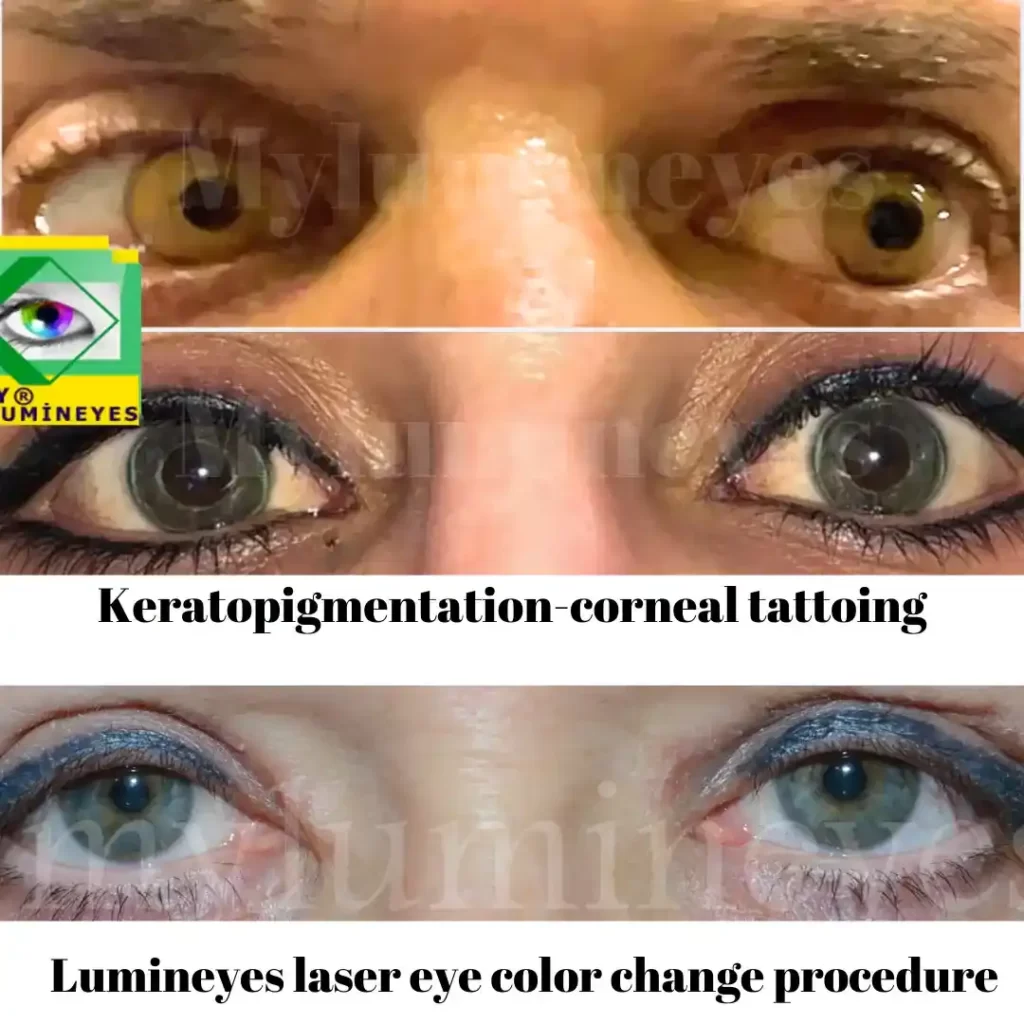
Keratopigmentation vs Lumineyes Laser Eye Color Change

For patients who simply want lighter, more attractive eye color, keratopigmentation is usually not the best starting point. The Lumineyes laser method takes a completely different, non-surgical approach that works with your own iris instead of covering it with pigment.

From a surgeon’s perspective, the key difference is this: keratopigmentation tries to create the illusion of a new iris, while the laser works with your own biology. In medicine, working with natural tissue almost always produces more stable and predictable results than trying to replace or mimic it artificially.

FeatureKeratopigmentationLumineyes Laser (MyLumineyes®)
Type of procedureSurgical corneal tattooNon-surgical laser depigmentation of the iris
What changes?Artificial pigment is placed inside the corneaExcess melanin is reduced in your natural iris
Look and textureCan appear flat, lens-like, or artificial up closePreserves the natural iris pattern and depth
Impact on corneaPermanent structural alteration of the corneaNo corneal incision; the cornea remains intact
ReversibilityLimited, complex, often incompleteColor change is gradual and planned; natural tissues remain
Primary risksVisual quality loss, glare, irregular astigmatism, infectionNon-surgical risks managed with controlled protocols and follow-up

Because of these differences, I generally do not recommend keratopigmentation as a cosmetic option for healthy eyes. A non-surgical, physiologic method that works on the iris itself is usually safer and more consistent with long-term eye health.


Who Should Avoid Keratopigmentation for Cosmetic Eye Color Change?

In my opinion, most people who have healthy eyes and normal vision, but simply want a different eye color, should avoid keratopigmentation. You should be especially cautious if:

  • You expect a perfectly natural, multi-toned iris appearance
  • You are sensitive to fine visual details or night driving quality
  • You are uncomfortable with permanent surgical changes to the cornea
  • You want the option to reconsider your decision in the future

If a patient tells me they want a perfectly natural, multi-toned, dynamic eye color, I immediately explain that keratopigmentation cannot achieve this. The natural iris behaves differently in light, angle, and emotion; pigment inside the cornea cannot replicate this dynamic range. This is one of the main reasons I rarely recommend keratopigmentation for cosmetic purposes.

Keratopigmentation may still have a role in carefully selected therapeutic cases (for example, to mask disfiguring scars in a blind eye), but this is very different from performing the procedure on a healthy eye purely for cosmetic reasons.

keratopigmentation and laser eye color change (Lumineyes procedure) comparison


Before You Consider Surgery: Evaluate Your Appearance Safely

If you are only at the stage of imagining how lighter eyes might look, there is no reason to rush into any surgical procedure. A safer first step is to work with high-quality close-up photographs and a professional medical opinion.

Before making any permanent decision, I always ask my patients to document their eyes properly. A good close-up photo often reveals details people have never noticed about their own iris. This is exactly why we created the Lumineyes app — not as a toy or filter tool, but as a way for you to see your eyes more clearly before considering any medical option.

  • See your natural iris in high resolution
  • Observe how lighting and angle change the perceived color
  • Prepare photographic material for a proper assessment

You can download the app here:


Lumineyes app on Google Play


Learn More and Explore Safer Alternatives

If you are considering changing your eye color, I strongly recommend that you first understand all available methods and their risk profiles. You can read more here:

For independent information on corneal and ocular health, you can also consult:


American Academy of Ophthalmology – Eye Health

Your eyes are not just part of your appearance; they are vital sensory organs. Any decision to change their color must be made with a clear understanding of the techniques involved, their real risks, and the safer alternatives available.

FAQ – Keratopigmentation Eye Color Change

Keratopigmentation can be useful in selected therapeutic cases, such as iris defects, but using it purely for cosmetic eye color change in healthy eyes is controversial. The procedure permanently alters the cornea, and risks include reduced visual quality, glare, haze, and irregular astigmatism. For most cosmetic patients, the potential risk is not justified by the outcome.

Results vary but NO. Some patients may initially like the effect, but many later find that the color appears flat or artificial, especially in bright light or at close range. A tattooed cornea cannot reproduce the depth, translucency, and structural detail of a natural iris.

Keratopigmentation places dye (a kind of tattoo) inside the cornea, not the iris. This means the eye color you see is on the surface of the eye, not coming from natural iris structures. The iris muscles and melanin remain unchanged underneath. And the shape of the colored area is irregular.

Complete reversal is very difficult and often impossible. Removing pigment from the cornea may require multiple surgeries, and even then, the cornea’s clarity and optics may not return completely to normal. A perfect “back to original state” result cannot be guaranteed.

Some clinics offer every available cosmetic method, including higher-risk procedures. As an ophthalmologist, the priority is long-term ocular health. For cosmetic eye color change, corneal tattooing is often not the safest choice. Non-incisional, iris-based laser approaches are generally medically safer and preserve natural eye anatomy.

Keratopigmentation adds artificial pigment to the cornea, creating an overlay color. Laser eye color change reduces melanin inside the iris itself, without adding foreign material. This makes laser an anatomically more natural and less invasive option when performed under medical supervision.

Facebook
Twitter
LinkedIn
WhatsApp