Quantitative Iris Phenotype–Response Coupling During Selective Stromal Melanin Modulation
A prospective research framework asking whether measurable characteristics of the untreated iris contain information about the trajectory of subsequent longitudinal response.
Quick Answer
Quantitative Iris Phenotype–Response Coupling is a proposed framework for investigating whether measurable pretreatment iris characteristics are associated with the way an iris subsequently changes over time during response-guided selective stromal melanin modulation.
The framework deliberately moves away from the question “What exact color will this eye become?” and instead asks whether baseline phenotype, cumulative exposure, and elapsed time can be studied in relation to measurable longitudinal response behavior.
The concept is investigational. It is not a validated treatment algorithm, patient-specific prediction system, stopping rule, or final-eye-color model.
From Static Color to Longitudinal Tissue Behavior
Conventional descriptions such as brown, hazel, green, grey, or blue compress a biologically and optically heterogeneous tissue phenotype into a small number of visual categories. Quantitative photography, colorimetry, and anterior-segment imaging permit a different research approach: the untreated iris can be described through measurable visible, structural, and spatial variables rather than by color label alone.
The present framework extends that question longitudinally. Instead of treating post-exposure appearance as one fixed endpoint, it asks whether pretreatment phenotype is associated with differences in the rate, spatial distribution, and temporal evolution of subsequent measurable change.
The Conceptual Architecture
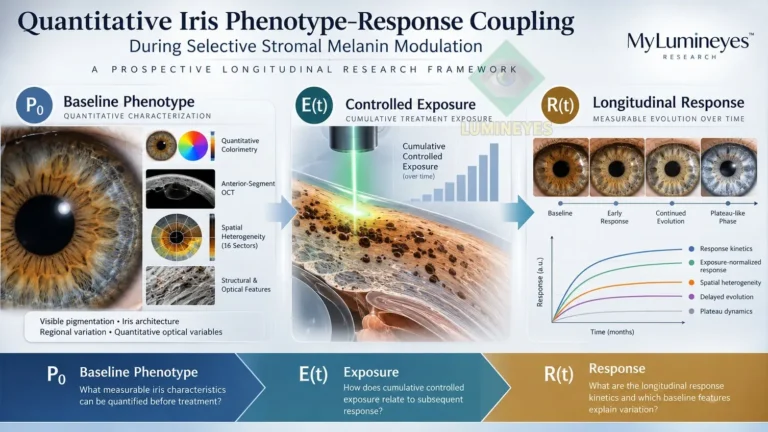
This expression is a research architecture rather than a validated biological equation. Baseline phenotype is not assumed to determine outcome. The empirical question is whether baseline characteristics explain a reproducible proportion of observed longitudinal variation after exposure and time are taken into account.
What Would Be Measured?
Candidate baseline characterization includes standardized visible-light photography, continuous colorimetric variables, clinical pigmentation descriptors, structural AS-OCT measurements, and technically qualified OCT-derived optical features.
Longitudinal investigation would then examine several complementary response domains:
- early quantitative response characteristics;
- response considered relative to cumulative exposure;
- sectoral and regional response heterogeneity;
- continued post-exposure evolution;
- plateau-like longitudinal behavior; and
- inter-individual and inter-eye variation across serial measurements.
Why This Is Not a Final-Eye-Color Prediction Model
Previous patent literature has described approaches intended to predict or simulate postoperative perceived iris color using anatomical, photographic, phenotypic, or other patient-specific information.
The present framework addresses a different scientific endpoint. It does not ask what named cosmetic color an eye will ultimately obtain. Instead, it asks whether a quantitatively characterized baseline iris is associated with the trajectory of measurable response after controlled exposure and over time.
A longitudinal response can therefore be scientifically characterized even when a predetermined final perceived color cannot be specified reliably.
Relationship to Existing MyLumineyes Research
The framework belongs to the same research program as L-OAT, Temporal Response Architecture, and L-SAFE, but these concepts address analytically different questions and should not be interpreted as mutual validation.
Evidence and Validation Status
This work is a hypothesis-generating prospective research framework. No prospective patient-level validation dataset is analyzed in Version 1.2.
Future empirical testing would require standardized longitudinal imaging, explicit exposure documentation, repeated measurements, participant-level statistical handling, and independent validation before any predictive interpretation could be considered established.
The framework does not establish treatment efficacy, treatment safety, eligibility, patient-specific prognosis, optimal exposure, retreatment timing, a stopping rule, or a predictable cosmetic result.
Figure 1 · Phenotype–Exposure–Response Architecture

Figure 1. Conceptual architecture of quantitative iris phenotype–response coupling during selective stromal melanin modulation. The framework separates baseline quantitative iris phenotype, controlled cumulative exposure, and longitudinal measurable response. All photographic, OCT-like, graphical, and response-curve elements are schematic and do not represent patient imaging or observed clinical outcome data.
Intellectual and Methodological Boundary
Lumineyes™ is discussed here as a response-guided staged research framework based on selective stromal melanin modulation. Findings from heterogeneous laser iris depigmentation techniques should not automatically be generalized across procedural architectures without evidence of technical and clinical equivalence.
Cite the Citable Research Record
View Zenodo Preprint ↗
This MyLumineyes Research page is an author-maintained web research record. The Zenodo publication is the citable Version 1.2 manuscript. This page is an original web synthesis rather than a duplicate reproduction of the preprint.